

Contingency recruitment is defined as a pay-on-placement hiring model where employers pay a recruitment fee only when a candidate is successfully hired. The fee is not charged upfront. Instead, it is triggered by a successful placement, making it a performance-based arrangement. Fees typically range from 15% to 25% of the candidate’s first-year base salary for mid-level roles, rising above 30% for specialised positions. That percentage structure is the defining feature of contingency recruitment and the primary reason many Australian and New Zealand businesses are now weighing it against flat-fee alternatives. Understanding how the model works, where it fits, and where it falls short gives HR professionals and business owners a clear basis for smarter hiring decisions.
What is contingency recruitment and how does it work?
Contingency recruitment operates on a simple principle: no placement, no fee. A hiring manager shares a job brief with one or more recruitment agencies, and those agencies independently source, screen, and submit candidates. The first agency to place a successful candidate earns the fee. This structure creates direct competition between agencies, which drives recruiters to submit candidates within days of receiving a brief.

The non-exclusive nature of the model is what separates it from retained search. Employers can engage multiple agencies simultaneously, each working independently toward the same role. That flexibility is appealing, particularly for businesses filling mid-level or high-volume positions where speed matters and candidate pools are accessible.
The typical process follows this sequence:
- Job brief — The employer provides a detailed role description, salary range, and key requirements to one or more agencies.
- Candidate sourcing — Recruiters search their databases, advertise the role, and approach passive candidates through LinkedIn and professional networks.
- Screening and shortlisting — Agencies conduct initial interviews and reference checks before submitting a shortlist to the employer.
- Employer interviews — The hiring manager interviews shortlisted candidates and selects a preferred applicant.
- Offer and placement — Once the candidate accepts an offer and starts, the agency invoices the agreed fee.
- Guarantee period — Most contracts include an 8–12 week period during which the agency replaces the candidate or refunds part of the fee if the hire departs.
Pro Tip: Always confirm the guarantee period and refund conditions in writing before signing any contingency recruitment agreement. Terms vary widely between agencies, and a poorly worded clause can leave you with no recourse if a new hire leaves within the first month.
What are the advantages and disadvantages of contingency recruitment?
Contingency recruitment carries genuine advantages for employers, but it also introduces risks that are easy to underestimate.
Benefits worth knowing
- No upfront cost. Employers pay nothing unless a hire is made. This removes financial risk from the search process and suits businesses with tight cash flow.
- Speed of delivery. Recruiters submit initial candidates within days of receiving a brief, making the model well suited to urgent or time-sensitive roles.
- Access to multiple talent pools. Engaging several agencies simultaneously broadens the candidate reach without additional cost to the employer.
- Flexibility. Employers can run their own internal search in parallel, with no obligation to hire through the agency if a direct candidate emerges.
Risks to weigh carefully
- Speed over fit. Contingency recruiters are incentivised to fill roles quickly, which can result in “good enough” candidates being submitted rather than the best available match.
- Diluted recruiter focus. Because agencies are not guaranteed payment, they may deprioritise a difficult brief in favour of easier placements elsewhere.
- Candidate duplication. Recruiters in contingency models often submit the same candidates to multiple employers, which can affect your employer brand and create confusion in the market.
- Fee disputes. When multiple agencies are engaged, candidate ownership disputes arise frequently without clear internal tracking processes.
- Cost unpredictability. A 20% fee on a $90,000 salary is $18,000. That figure is difficult to budget for in advance, particularly for small businesses hiring across multiple roles.
Flat-fee recruitment models address several of these disadvantages directly by fixing the cost regardless of salary level.
Pro Tip: Negotiate guarantee and refund terms before you brief any agency. An 8-week replacement guarantee is standard, but some agencies offer 12 weeks. The difference matters significantly if a hire resigns in week nine.
How does contingency recruitment compare to other models?
Three main recruitment fee structures exist in the Australian and New Zealand market: contingency, retained, and flat-fee. Each suits a different hiring context.
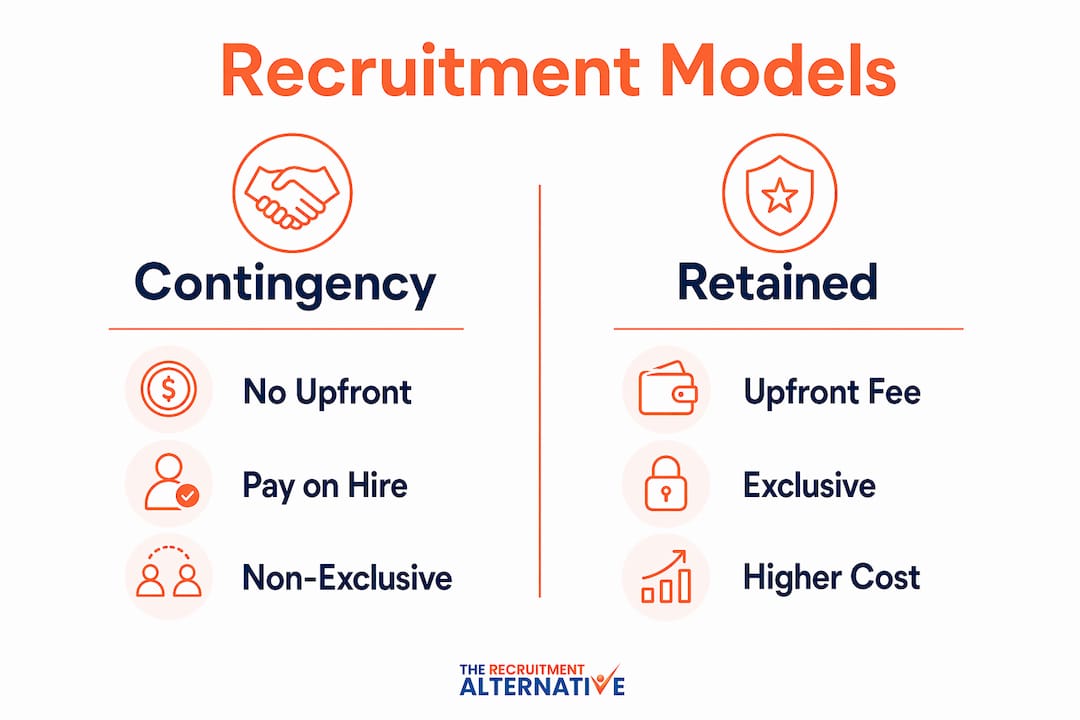
Retained recruitment requires an upfront payment, typically split across three stages: engagement, shortlist delivery, and placement. The agency works exclusively on the role and commits significant research time to the search. This model suits senior executive appointments where the candidate pool is narrow and discretion is critical.
Contingency recruitment sits in the middle ground. It works best for mid-level and professional roles where candidates are accessible and speed is a priority. The trade-off is that recruiter focus is conditional on success, which affects the depth of search.
Flat-fee recruitment charges a fixed price regardless of the candidate’s salary. This model delivers full budget transparency and aligns recruiter incentives with quality rather than speed. Flat-fee models can reduce hiring costs by up to 82% compared to percentage-based agencies. That saving is material for any business hiring more than two or three people per year.
| Model | Fee structure | Payment timing | Best suited for | Exclusivity |
|---|---|---|---|---|
| Contingency | 15%–25% of base salary | On successful placement | Mid-level, professional roles | Non-exclusive |
| Retained | Staged percentage fees | Upfront and on milestones | Senior executive roles | Exclusive |
| Flat-fee | Fixed dollar amount | On engagement or placement | SME hiring, volume roles | Varies |
Many businesses now prefer flat-fee recruitment because it removes the salary-linked cost variable entirely. For a business hiring a $120,000 manager, the difference between a 20% contingency fee ($24,000) and a flat fee can be substantial.
Pro Tip: For permanent recruitment of roles below general manager level, flat-fee models almost always deliver better value than percentage-based contingency fees. Reserve contingency arrangements for roles where speed is the overriding priority.
How to get the best results from contingency recruitment
Employers who manage contingency recruitment well treat it as a structured process, not a passive one. The following practices reduce risk and improve outcomes.
- Write a detailed job brief. Vague briefs produce vague candidates. Include the reporting structure, key performance indicators, must-have skills, and salary range. Recruiters perform better with clear parameters.
- Limit agency numbers. Engaging more than three agencies on the same role rarely improves outcomes. It increases the risk of candidate duplication and fee disputes without meaningfully broadening the talent pool.
- Track every candidate submission. Record the agency name, candidate name, and submission date for every CV received. Candidate ownership disputes are common when multiple agencies are engaged, and a clear log is your best protection.
- Give timely feedback. Recruiters deprioritise clients who take weeks to respond. Fast, specific feedback keeps agencies engaged and improves the quality of subsequent submissions.
- Negotiate guarantee terms upfront. Guarantee and rebate periods vary substantially between agencies. A minimum of eight weeks is reasonable; twelve weeks is better for roles with longer onboarding periods.
- Measure recruiter performance. Track time-to-shortlist, interview-to-offer ratios, and placement retention rates across agencies. This data tells you which agencies to prioritise on future briefs.
For SME recruitment, the administrative overhead of managing multiple contingency agencies can outweigh the perceived benefit of competition. A single, well-briefed agency on a flat-fee arrangement often delivers faster and more consistent results.
Pro Tip: Ask each agency to confirm in writing that they will not submit a candidate to your competitors while that candidate is under active consideration with you. This protects your hiring process and your employer brand.
Key takeaways
Contingency recruitment is a pay-on-placement model best suited to mid-level roles where speed matters, but the percentage-based fee structure makes flat-fee alternatives a stronger choice for most Australian and New Zealand businesses hiring permanent staff.
| Point | Details |
|---|---|
| Fee structure | Contingency fees range from 15%–25% of base salary, paid only on successful placement. |
| Speed advantage | Recruiters submit candidates within days, making the model useful for urgent mid-level roles. |
| Key risk | Speed incentives can produce rushed hires; candidate duplication across agencies is common. |
| Flat-fee comparison | Flat-fee models can reduce hiring costs by up to 82% compared to percentage-based fees. |
| Contract protection | Always negotiate guarantee periods of at least 8–12 weeks before briefing any agency. |
The model works, but not always the way employers expect
I have spoken with hundreds of business owners across Australia and New Zealand who assumed contingency recruitment was the default, the safe choice, the thing you do when you need someone quickly. Most of them had never stopped to calculate what that 20% fee actually cost them over a year of hiring.
The model is not broken. For the right role, at the right time, contingency recruitment delivers. A business that needs a sales manager in three weeks, in a market with plenty of candidates, will likely get a solid result. The problem is that employers often apply it to roles where it is the wrong tool entirely. A senior finance director search run on a contingency basis, across three competing agencies, is a recipe for a shallow candidate pool and a recruiter who moves on to easier briefs the moment the search gets difficult.
What I find most telling is the candidate experience side of this equation. Candidates submitted by multiple agencies to the same employer quickly realise what is happening. It signals a disorganised hiring process, and the best candidates, the ones with options, tend to disengage. That is a cost that never appears on an invoice but absolutely affects the quality of your hire.
The shift toward flat-fee and fixed-price recruitment in Australia reflects something real: employers want predictability, and they want recruiters whose incentives align with finding the right person, not just the fastest person. Contingency recruitment has a place, but it should be a deliberate choice, not a default.
— Josh Townsend
How The Recruitment Alternative approaches permanent hiring
The Recruitment Alternative offers employers across Australia and New Zealand a genuine alternative to percentage-based contingency fees. The agency operates on a flat-fee recruitment model that fixes the cost of hiring regardless of the candidate’s salary, delivering full budget transparency from the start.
Whether you are a small business filling your first professional role or a growing company hiring across multiple departments, The Recruitment Alternative covers sales, management, administration, finance, engineering, healthcare, technology, and executive positions. The small business recruitment service is built specifically for organisations that need quality candidates without the unpredictable cost of salary-linked fees. Contact The Recruitment Alternative to discuss your next hire and find out exactly what it will cost before the search begins.
FAQ
What is contingency recruitment in simple terms?
Contingency recruitment is a hiring arrangement where employers pay a recruitment agency only when a candidate is successfully placed in a role. No placement means no fee.
What percentage do contingency recruiters charge?
Contingency recruitment fees typically range from 15% to 25% of the candidate’s first-year base salary, with specialised or senior roles attracting fees above 30%.
What is the difference between contingency and retained recruitment?
Contingency recruitment is non-exclusive and paid only on placement, while retained recruitment requires upfront payment and gives the agency exclusive rights to the search, making it better suited to senior executive roles.
How does flat-fee recruitment differ from contingency recruitment?
Flat-fee recruitment charges a fixed dollar amount regardless of the candidate’s salary, whereas contingency recruitment charges a percentage of salary. Flat-fee models deliver greater cost predictability and can significantly reduce hiring costs for businesses filling mid-level roles.
What guarantee period should I expect from a contingency recruiter?
Most contingency recruitment contracts include a guarantee period of 8–12 weeks, during which the agency will replace the candidate or refund part of the fee if the hire departs. Always negotiate these terms before signing.

