

Start by writing the GM mandate, not the job ad. Nail down which P&L the role owns, what decisions are theirs alone, and what “success” looks like at 12 months, then choose your sourcing route. If you want a cost-predictable external option, a fixed-fee recruiter like The Recruitment Alternative can run the search while you keep control of the brief.
TL;DR:
- A clear, detailed mandate outlining P&L ownership, decision rights, and expected outcomes within the first year is essential for a successful GM hire.
- Sourcing options should be matched to urgency, budget, confidentiality needs, and candidate pool strength, with fixed-fee recruiters offering a cost-predictable middle ground.
- Building a weighted scorecard based on the mandate and conducting structured, multi-round interviews with real working exercises significantly reduce the risk of mis-hiring.
- Negotiations must align closely with the mandate, emphasizing first-year outcome KPIs and clarifying authority and reporting lines before onboarding.
- Using fixed-fee recruitment firms enables faster, cost-controlled searches, especially for SMEs, by maintaining clear, structured processes without fee inflation incentives.
Table of Contents
- What does the general manager hiring process actually involve?
- Define the role and mandate so the hire has clarity
- Sourcing options: search internally, advertise, or go external
- How should you assess and interview general manager candidates?
- Offer, negotiation and the first 90 days
- Why fixed-fee recruitment changes the maths on GM hires
- Ready to start your general manager search?
- Sources
What does the general manager hiring process actually involve?
General manager hiring runs through eight stages, and skipping any of them is where most mis-hires begin. Here’s the sequence, with rough timing and ownership:
- Define the mandate (Week 1) — owned by the CEO or business owner. Sets P&L scope, decision rights, first-year outcomes.
- Build the scorecard (Week 1 to 2) — HR or hiring manager, with CEO sign-off.
- Source the shortlist (Week 2 to 5) — internal HR, or an external recruiter if the market is thin.
- Run structured interviews (Week 4 to 7) — hiring manager plus at least one senior stakeholder.
- Working assessment (Week 6 to 8) — a real problem, not a hypothetical.
- Reference checks (Week 7 to 8) — HR or the recruiter.
- Offer and negotiation (Week 8 to 9) — CEO or owner directly.
- Onboarding (Week 9 onward) — shared between CEO and HR.
Most GM searches take 8 to 10 weeks from a finished mandate to a signed offer. The bottleneck is almost always step one. Employers who rush the mandate end up re-interviewing the same shortlist twice because nobody agreed what “good” looked like.
Define the role and mandate so the hire has clarity
A general manager recruitment process without a written mandate is a coin toss. The document needs to say which P&L the GM owns, who they report to, and exactly which decisions sit with them versus the owner. According to Norman Consultants, genuine P&L ownership and breadth across commercial and operational leadership is the defining feature of the role, and it has to be spelled out before you start sourcing.
Pin down which archetype you actually need:
- Steady operator — protects margin and consistency in a stable business.
- Grower — drives revenue and market share in an expansion phase.
- Fixer — turns around a struggling site, division, or P&L.
Each profile demands different first-year outcomes. Norman Consultants also notes GM scope varies enormously, from single-site operator to multi-market leadership, so the assessment has to match the actual operating span, not a generic template.
Pro Tip: Write the mandate as if you’re briefing a recruiter, even if you’re not using one. Forcing yourself to state decision rights and KPIs in plain language exposes gaps a job description never will.
Sourcing options: search internally, advertise, or go external
Once the mandate exists, the sourcing decision comes down to speed, reach, and budget. There are three realistic paths for a general manager job posting and search.
- In-house sourcing and advertising works when your employer brand is strong locally and the role isn’t highly specialised. It’s slow for niche GM briefs because you’re relying on active job-seekers only.
- Retained executive search reaches passive candidates who aren’t looking, which matters for hard-to-fill or confidential GM roles. According to Robert Travis, retained search typically costs a substantial percentage of first-year cash compensation, reflecting the market mapping and dedicated hours involved.
- Contingent or fixed-fee recruitment sits between the two. Robert Travis puts standard contingent fees at 15 to 25% of salary, still calculated as a percentage. Fixed-fee models charge a flat amount regardless of the final salary negotiated, which removes the incentive misalignment that comes with percentage-based fees.
Decide using four questions: How urgent is the start date? What’s the budget ceiling? Does the search need to stay confidential from current staff or competitors? And does the role require genuine market mapping, or is there already a strong local candidate pool? For SMEs and mid-size employers without an internal recruitment function, a fixed-fee recruiter is often the pragmatic middle path. It gives you dedicated search effort without the retained percentage, and budget certainty from the outset. Recruiting executive staff through an external partner also frees the CEO from running first-round screens.
How should you assess and interview general manager candidates?
A weighted scorecard is the single biggest lever against a bad hire. Build it directly from the mandate: if the first-year outcome is 15% revenue growth, score commercial acumen and growth-plan articulation heavily; if it’s a turnaround, weight cost discipline and change management instead. Treeline frames this as building the search around a concise mandate covering span of control, outcomes, and constraints before you even start comparing candidates, and the same logic applies to scoring them.
The recommended interview sequence, per JRG Partners, runs four rounds:
- Initial screen — confirm scope fit, salary expectations, availability.
- Structured competency interview — same questions, same order, for every candidate, scored independently by each interviewer.
- CEO or senior stakeholder session — tests strategic alignment and cultural fit at the level the GM will actually operate.
- Working exercise or 90-day plan — the candidate presents how they’d approach a real (lightly sanitised) problem from your business.
That last step matters more than most employers realise. Working assessments built around your actual operational or commercial problems reveal how a candidate thinks about your specific challenges, something abstract case studies simply can’t test.
Reference checks close the loop. Ask former managers and direct reports about decision-making under pressure and how the candidate handled a genuine setback, not just achievements. Red flags include vague answers about P&L results, an inability to name specific decisions they made without sign-off, and references who seem coached rather than candid.
Most senior mis-hires trace back to one gap: no consistent scorecard and no working exercise to test claims against real performance, according to JRG Partners.
Offer, negotiation and the first 90 days
Structure the offer around the mandate, not a generic salary benchmark. Base salary should reflect market rate for the scope you defined, with short-term incentives tied directly to the first-year outcomes in the scorecard.
- Set incentive KPIs that mirror the mandate exactly, not a watered-down version of it.
- Negotiate notice period and start date early. Senior GMs often carry 4 to 12 week notice obligations.
- Confirm references and any outstanding checks before the written offer goes out, not after.
- Prepare the organisation before day one: clarify authority and reporting lines internally so the GM isn’t fighting for decision rights in week two.
Onboarding should map cleanly to 30, 60 and 90 days: orientation and stakeholder meetings in the first month, early wins and process reviews by day 60, and a formal progress check against the mandate’s outcomes by day 90.
Why fixed-fee recruitment changes the maths on GM hires
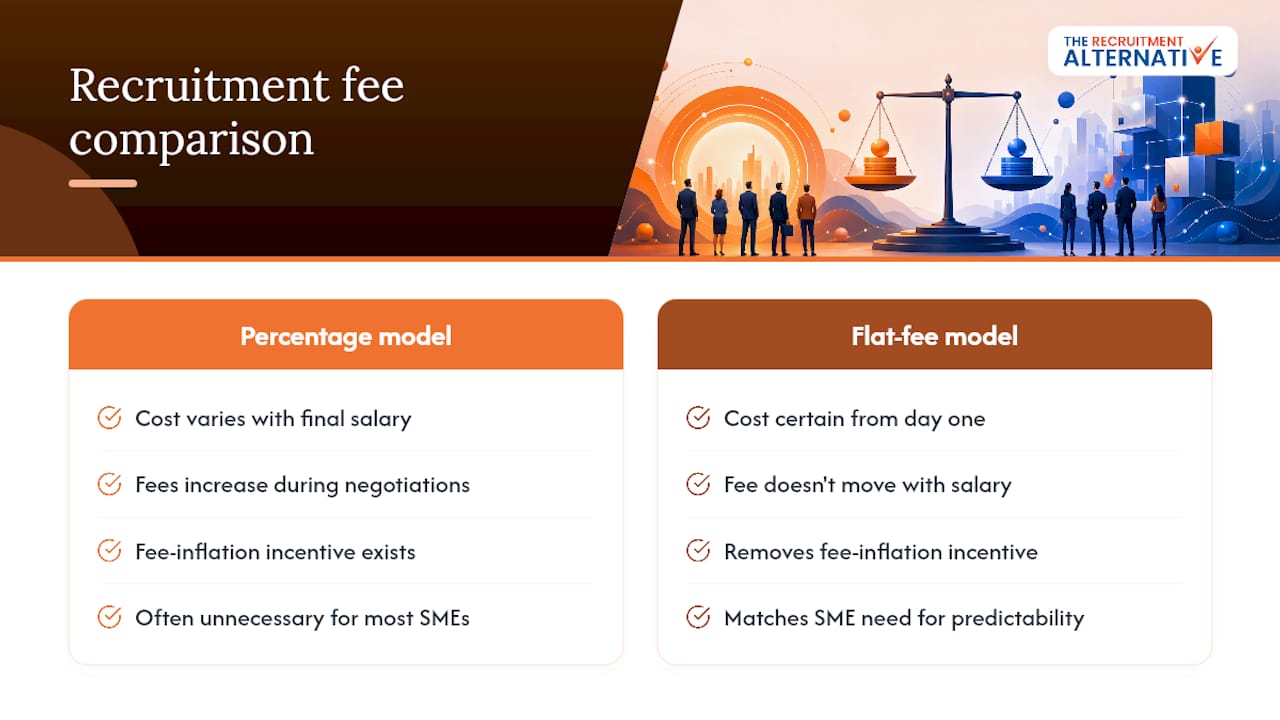
Running GM searches without expensive retained fees is entirely possible when the mandate is tight and the sourcing route matches the brief. That’s the premise The Recruitment Alternative was built on: most SMEs don’t need a percentage-based retained engagement to access a genuine shortlist, they need a structured process at a predictable price.
Employers working with us go through the same discipline this article describes: a written mandate, a scorecard tied to first-year outcomes, and structured interviews before any offer goes out. The difference is cost certainty from day one, because our flat-fee structure doesn’t move when the final salary negotiation does. That single change removes the fee-inflation incentive that sits inside every percentage-based model.
— Josh Townsend
Ready to start your general manager search?
If you’ve drafted the mandate and want a structured, cost-predictable route to a shortlist, engaging a fixed-fee recruiter is the fastest way to skip the trial-and-error of a first-time internal search.
Here’s what to expect: you brief The Recruitment Alternative on the mandate, P&L scope, and first-year outcomes; we confirm the fee tier upfront based on the role’s salary band; and sourcing begins against that brief rather than a generic job description. Having your mandate, scorecard, and decision-rights document ready before that first conversation shortens the whole timeline, because we’re not spending week one extracting information you could have written down already. Candidate replacement insurance covers the first few months, so a mismatch doesn’t mean starting the search costs from scratch. If you’re ready to move, get in touch to engage and we’ll walk through pricing tiers and expected timing for your specific role.
Sources
For deeper tactics and downloadable templates, see the management recruitment strategies guide. For KPI benchmarks worth mirroring in your mandate, review how to succeed as a General Manager.
- How to Hire a General Manager | Norman Consultants
- How to hire a General Manager | Exec Search | Robert Travis
- 25 Interview Questions to Ask When Hiring a General Manager (With What Great Answers Sound Like) – JRG Partners LLC
- Which Executive Search Recruiter Can Help Me Hire a General Manager? – Treeline, Inc. Sales Recruiting


