

Under the National Employment Standards, employers must give a minimum notice period when ending someone’s employment, with longer periods required for employees with more years of service, and additional notice if the employee is older and has sufficient service. There’s no equivalent federal rule for employees who resign. Your notice period as an employee comes from your contract, award or enterprise agreement, and if none of those spell it out, “reasonable notice” applies. Employers can pay out the notice period instead of requiring the person to work it, provided the payment matches what they’d have earned.
TL;DR:
- Employers must provide written notice that meets or exceeds the minimum periods based on the employee’s length of service, plus an extra week for workers over 45 with at least two years of continuous employment.
- Payment in lieu of notice must match the employee’s full ordinary pay, including allowances and loadings, not just the base salary, to avoid underpayment claims.
- Employees are generally bound by their contract or award for resignation notice, with “reasonable notice” applying only if no specific terms exist, and failure to give proper notice can lead to pay deductions.
- During the notice period, employees continue accruing leave and public holiday entitlements, and employers can opt to pay out the notice in full instead of requiring work.
- Casuals, fixed-term contract employees, and those dismissed for misconduct have different or limited notice obligations, and proper documentation of notice procedures helps prevent disputes.
Table of Contents
- Minimum notice periods under the National Employment Standards
- What employers must do when they terminate: s117, written notice and payment in lieu
- Resigning as an employee: where your notice obligation comes from
- Working the notice period versus payment in lieu
- Special cases: casuals, fixed-term contracts, redundancy and misconduct
- How to give notice: a practical checklist
- Employer drafting guidance from The Recruitment Alternative
- What employers and employees should take from this
- Replacing staff quickly when a notice period is running out
- Sources
Minimum notice periods under the National Employment Standards
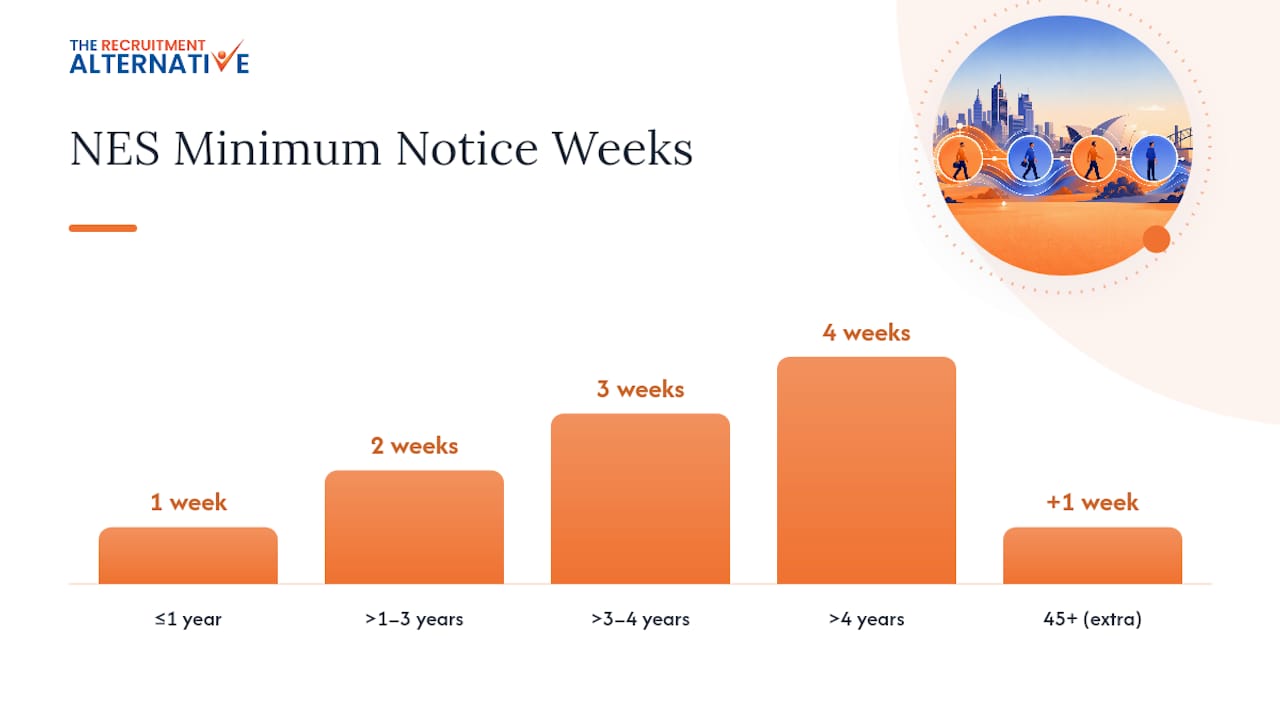
The Fair Work Act sets out fixed notice periods employers must give when they end someone’s employment, and these figures are the legal floor, not a suggestion.
| Length of continuous service | Minimum notice period |
|---|---|
| 1 year or less | 1 week |
| More than 1 year, up to 3 years | 2 weeks |
| More than 3 years | 3 weeks |
| More than 4 years | 4 weeks |
Anyone 45 or older with at least two years of continuous service gets an extra week on top of whichever figure applies, a detail plenty of employers overlook when they calculate final pay. These minimums come straight from Fair Work Act 2009: notice of termination, and the Fair Work Commission’s NES fact sheet confirms the same table.
Modern awards, enterprise agreements or individual contracts can require longer notice than the NES table, but they can never require less. Continuous service generally excludes casual employment, so an employer who treats a long-term casual’s tenure as qualifying service for notice purposes is miscalculating it, a mistake that Fair Work’s own guidance flags as common.
What employers must do when they terminate: s117, written notice and payment in lieu
Section 117 of the Fair Work Act requires employers to give written notice stating the day employment ends, and that notice must meet or exceed the NES minimum for the employee’s length of service. Employers aren’t locked into making someone work out the period. They can pay it out instead, in full or in part.
Payment in lieu of notice must equal the full rate of pay the employee would have earned had they worked the notice period, including relevant allowances and loadings, not just base salary. The AIHR’s guide to payment in lieu is clear on this: shortcutting the calculation to base rate alone leaves the payment short and exposes the employer to a claim.
Before finalising a termination, employers should:
- Issue written notice specifying the exact last day of employment.
- Calculate payment in lieu using full ordinary pay, plus any applicable allowances or loadings.
- Record the termination reason, notice date and payroll entries for future reference.
- Retain documentation in case the calculation is later challenged.
Pro Tip: Keep a simple spreadsheet logging start dates, birthdates and award classifications for every employee. It turns a notice calculation that could take an hour of digging into a two-minute lookup.
Resigning as an employee: where your notice obligation comes from
There’s no clause in the Fair Work Act that tells employees how much notice to give when they resign. That surprises a lot of people who assume a blanket “two weeks” rule exists nationally. It doesn’t.
Your actual obligation sits in one of three places:
- Your employment contract, which often specifies a fixed notice period (commonly one to four weeks depending on seniority).
- The modern award covering your role, if it addresses resignation notice.
- An enterprise agreement, where one applies to your workplace.
If none of those documents mention it, the fallback is “reasonable notice”, a common law concept that varies with your seniority, how replaceable your role is, and how long you’ve worked there. Legal commentary from LexisNexis notes many awards mirror the employer’s notice periods when they specify anything at all. If you walk out without giving the notice your contract requires, your employer may be entitled to withhold amounts from your final pay, but only where the award, agreement or contract explicitly permits that deduction under section 324 of the Fair Work Act.
Working the notice period versus payment in lieu
Once notice is given, either by the employer or the employee, the employer generally decides whether the person works through it or gets paid out instead. The Fair Work Ombudsman’s resignation guidance confirms notice starts the day after it’s given and runs to the agreed final day.
During a working notice period, employees keep accruing annual leave and personal leave as usual, and public holidays that fall within it are paid as normal. Some practical points to keep in mind:
- Employees can request to take accrued annual leave during notice, though employers aren’t obliged to approve it.
- Payment in lieu must still reflect what the person would have earned, leave accrual included where relevant.
- “Garden leave” (being paid to stay away from work during notice) is sometimes used for senior roles with sensitive client relationships or confidential information.
Pro Tip: If you’re worried about a departing employee accessing sensitive systems, garden leave is usually cheaper and lower-risk than trying to manage an awkward final fortnight in the office.
Special cases: casuals, fixed-term contracts, redundancy and misconduct
Not every ending of employment follows the standard notice table, and knowing which exception applies saves a lot of confusion.
- Casual employees generally aren’t required to give or receive statutory notice, though letting your employer know your last shift is common courtesy.
- Fixed-term contracts typically end automatically on the agreed date, with no notice obligation unless the contract itself says otherwise.
- Redundancy still uses the same NES notice table, but adds redundancy pay on top, calculated separately based on service length.
- Serious misconduct (theft, violence, gross insubordination) can justify dismissal without notice, but employers should tread carefully. Skipping a fair process to end someone on the spot is a common trigger for unfair dismissal claims, a risk covered in more depth in this guide to high-risk terminations.
How to give notice: a practical checklist
Written notice protects both sides, and it doesn’t need to be complicated.
- State the date clearly. Note when notice is given and the intended final working day.
- Say whether you’ll work the notice or request payout. This avoids a payroll scramble later.
- Keep a copy. Both employer and employee should retain the written notice.
- Arrange handover and return of property. Laptops, keys, access cards, and any outstanding work should be documented.
A short resignation might read: “I am resigning from my position, effective [date]. My last working day will be [date], in line with my contract’s notice requirement.” An employer’s written notice can be just as plain: “Your employment will end on [date], in accordance with section 117 of the Fair Work Act. You will be paid in lieu of notice / required to work your notice period until that date.” For more on handling the resignation conversation professionally, see this guide on resigning without burning bridges.
Employer drafting guidance from The Recruitment Alternative
Vague notice clauses cause most of the disputes we see. A contract that spells out exact terms saves both sides a headache when someone eventually leaves. Strong clauses should cover:
- A clear minimum notice period, matched to or exceeding NES minimums.
- Explicit payment-in-lieu terms, including how allowances are calculated.
- A separate, shorter notice period during probation.
- Whether garden leave applies and under what conditions.
- Handover expectations, including documentation and return of company property.
Getting this right at the drafting stage, not after someone resigns, protects continuity. Our guide on creating an employment contract in Australia walks through the clauses worth building in from day one. Clear notice terms also mean less scrambling when a vacancy opens, because you already know your timeline for finding a replacement.
What employers and employees should take from this
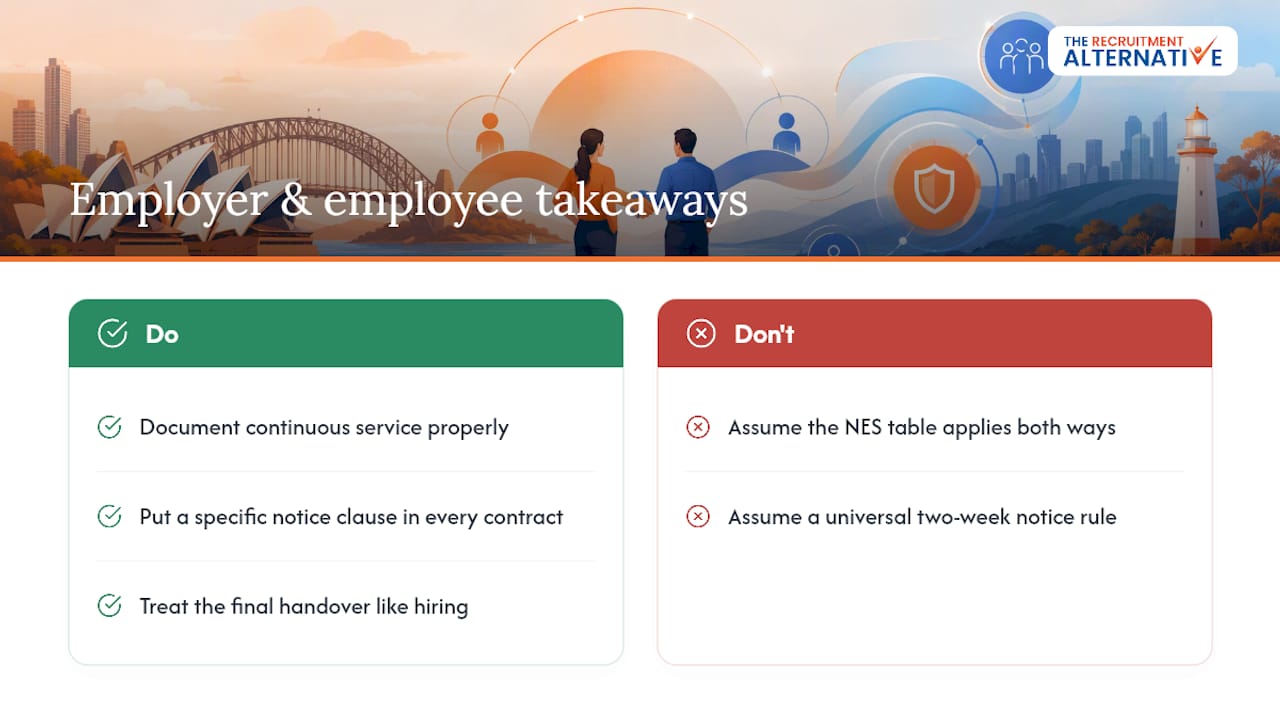
Most disputes over notice come down to one thing: nobody read the contract carefully before someone resigned or got terminated. Employers assume the NES table applies both ways, and it doesn’t. Employees assume there’s a universal two-week rule, and there isn’t.
The fix isn’t complicated. Document continuous service properly, put a specific notice clause in every contract, and treat the final handover as seriously as the hiring process was. Businesses that plan their staff retention properly rarely get caught out by a sudden resignation, because they’ve already thought through what happens next.
— Josh Townsend
Replacing staff quickly when a notice period is running out
A resignation notice period is a countdown clock, and most businesses don’t have a bench of ready candidates waiting. The Recruitment Alternative is the alternative to a traditional percentage-fee agency for employers facing this exact squeeze: instead of paying a recruiter a slice of the new hire’s salary, you pay one transparent flat fee, regardless of how senior the role is.

That fixed-price structure matters most when you’re under time pressure. You know the cost of replacing someone before you start the search, which makes budgeting for a departure far less stressful than an open-ended commission arrangement. We recruit across sales, admin, finance, engineering, healthcare, trades and technology, and our candidate replacement insurance covers you if a new hire doesn’t work out in the first few months. Have a look at our flat-fee recruitment service or check the simple fee structure and get a quote before your current employee’s notice period runs out.
Sources
For the legal text itself, the Fair Work Act notice provisions and the Fair Work Commission’s NES fact sheet are the primary references. The Fair Work Ombudsman’s resignation page covers practical scenarios in plain language. For calculation help, see this guide to calculating notice periods. If you’re in dispute, contact your union or Legal Aid in your state for advice specific to your situation.
- Library
- Resignation — Fair Work Ombudsman
- Notice of termination and redundancy pay — Fair Work Commission
- Payment in lieu of notice — AIHR


