

Confidentiality is essential in many executive searches because a single leak can destabilise an incumbent, spook investors, alert competitors, or cause a high-calibre candidate to withdraw before the process even begins. According to industry research, approximately 35–40% of retained VP+ searches involve some degree of confidentiality, rising to around 60–70% at CEO and board level. For Australian HR teams, the obligations extend beyond discretion: the Privacy Act 1988 and the Australian Privacy Principles (APPs) set binding rules on how candidate data is collected, stored, and disclosed.
Three controls should be in place before any confidential search begins:
- Assign a codename to the role so internal documents never name the position directly.
- Apply tiered data access so only those with a genuine need-to-know see each layer of detail.
- Execute a mutual NDA with your recruiter before any company identity or candidate details are exchanged.
Key takeaways
Confidentiality in executive search is a structured discipline that protects incumbents, candidates, and commercial outcomes, and it is legally required under the Privacy Act 1988 for any Australian organisation handling candidate personal information.
| Point | Details |
|---|---|
| Confidential searches are common | Confidentiality is involved in many VP+ retained searches and more frequently at CEO level. |
| Three core controls | Assign a codename, apply tiered data access, and execute an NDA before any identity is disclosed. |
| Australian legal baseline | The Privacy Act 1988, Australian Privacy Principles, and the Notifiable Data Breaches scheme all apply to candidate data. |
| Breach response is time-critical | Contain, document, assess NDB obligations, and notify affected candidates promptly. |
| The Recruitment Alternative | Offers fixed-fee executive search across Australia with structured confidentiality controls and candidate replacement insurance. |
Table of Contents
- What does confidentiality in executive search actually cover?
- Why confidentiality matters in executive-level hires
- Australian legal and compliance considerations you must follow
- Operational checklist: how to preserve confidentiality through a search
- If confidentiality is breached: immediate steps for HR
- When should you run a confidential search versus an open one?
- What should you expect from a recruiter on confidentiality?
- Three scenarios that show confidential searches in practice
- Why confidentiality deserves more rigour than most searches get
- The Recruitment Alternative supports confidential executive searches
- Sources
What does confidentiality in executive search actually cover?
The term “confidential search” describes a spectrum, not a single method. Understanding the models helps you choose the right one and set realistic expectations with your board, hiring panel, and candidates.
Three common models:
- Silent search: The employer’s identity is never disclosed, even to shortlisted candidates, until an offer is imminent. Used most often for incumbent replacement or pre-announcement restructuring.
- Confidential search: The employer’s identity is released selectively, typically after a candidate signs an NDA. The role may be described in general terms during early screening.
- Anonymous or blind profile: A position description that omits the company name, specific location, and any detail that would allow triangulation. Widely used in sourcing to test market interest before committing to disclosure.
Information tiers and who typically sees each:
- Tier 1 (public-facing): Role function, seniority level, industry, and general location. Visible to all sourced candidates.
- Tier 2 (post-expression of interest): Compensation range, reporting structure, and high-level strategic context. Shared after initial screening.
- Tier 3 (post-NDA): Employer identity, specific financials, deal context, and board composition. Released only to candidates who have signed a confidentiality agreement.
Fully anonymous searches restrict identity to Tier 3 throughout. Limited identity release searches move to Tier 3 earlier, once mutual interest is confirmed. Internal-only searches, where the process is invisible to the broader market, sit at the most restrictive end of the spectrum.
Why confidentiality matters in executive-level hires
The business consequences of a leak depend on context, but they are rarely minor. Confidentiality creates the trusting environment that encourages people to share sensitive information; when that trust breaks down, candidates disengage and deals unravel.
Consider the scenarios HR teams face most often:
- Incumbent replacement: If the sitting executive learns they are being replaced before a successor is secured, the organisation risks an early resignation, disrupted operations, and a damaged relationship with the outgoing leader.
- M&A or PE-backed transactions: Premature disclosure of a leadership search can signal deal activity to the market, affecting valuations or alerting counterparties.
- Competitive sensitivity: In concentrated industries, contacting candidates at rival firms without a blind profile can reveal strategic intent before a product launch or market entry.
- Public company share price: A leaked CEO search can trigger speculation, analyst commentary, and share price volatility before the board is ready to communicate.
From the candidate’s side, senior executives considering a move rarely want their current employer to know they are in the market. Breaches undermine trust and reduce willingness to engage, which directly shrinks your accessible talent pool. An executive who hears that a search firm disclosed another candidate’s interest will not take your call.
Pro Tip: When briefing a recruiter, ask them to name the last three confidential searches they ran and what controls they used. Vague answers are a red flag.
Australian legal and compliance considerations you must follow
Australian HR teams operate under a specific regulatory framework that shapes how candidate data is handled throughout a search.
- Privacy Act 1988 and the Australian Privacy Principles: The APPs require that personal information is collected only for a stated purpose, stored securely, and not disclosed to third parties without consent. Candidate CVs, compensation details, and reference notes all constitute personal information under the Act.
- Candidate consent: Obtain written consent before collecting or sharing a candidate’s details. A consent form should specify what data is collected, who will see it, and how it will be stored and destroyed.
- Notifiable Data Breaches (NDB) scheme: Under the NDB scheme, organisations covered by the Privacy Act must notify the Office of the Australian Information Commissioner (OAIC) and affected individuals when a data breach is likely to cause serious harm. A confidentiality leak that exposes a candidate’s identity or compensation details may trigger this obligation.
- Minimum necessary data principle: Collect only the information needed for the search. Avoid storing speculative notes, personal health information, or financial details beyond what the role assessment requires.
- Documented NDAs: NDAs must be executed before identity disclosure, not after. Keep signed copies in a secure, access-controlled system.
- Legal advice trigger: If the search involves a listed company, a regulated industry, or a cross-border candidate, seek legal advice before the process begins.
Professional guidance confirms that confidentiality is not absolute: disclosure may be justified where there is an overriding legal requirement or public interest, and those decisions must be made case by case. The OAIC’s guidance on the APPs is the primary reference point for Australian employers navigating these exceptions.
Compliance note: The NDB scheme applies to organisations with an annual turnover above $3 million, as well as certain health service providers and other entities regardless of turnover. Check your coverage with legal counsel before assuming the scheme does not apply.
Operational checklist: how to preserve confidentiality through a search
Good confidentiality practice is built in layers. Operational controls recommended by practitioners include codename assignment, tiered information access, NDAs before identity disclosure, and blind company profiles for sourcing. The checklist below translates those controls into steps.
Pre-engagement:
- Assign a codename to the role before any internal briefing documents are circulated.
- Execute a mutual NDA with the recruiter covering both the employer’s identity and candidate details.
- Define information tiers in writing and confirm who internally has access to each tier.
- Brief only those board members or executives with a direct need to know.
Sourcing and screening:
- Use a blind company profile that omits name, specific location, and any triangulating detail.
- Prioritise referral-based sourcing over broad market advertising to limit exposure.
- Conduct initial screening against the blind profile; do not name the employer at this stage.
Disclosure:
- Disclose the employer’s identity by phone or video, never by email, and only after the candidate has signed an NDA.
- Use a neutral meeting location for in-person interviews where possible.
Data security:
- Store all candidate files in an encrypted, access-controlled system. Technology and evolving communication channels increase the risk of unintentional breaches, so administrative, training, physical, and technical safeguards are all necessary.
- Maintain access logs and set a data retention and destruction timeline at the outset.
Pro Tip: A confidential search typically carries a premium fee because the additional operational rigour reduces leak risk. Budget for it from the start rather than negotiating it out.
If confidentiality is breached: immediate steps for HR
Speed and structure matter when a leak occurs. The following sequence keeps you compliant and limits damage.
- Contain immediately. Identify the source of the leak, restrict further access to the affected data, and notify your internal legal or privacy officer within hours, not days.
- Preserve evidence. Document what was disclosed, to whom, and through which channel. Do not delete communications.
- Assess NDB obligations. Determine whether the breach is likely to cause serious harm to any individual. If yes, notify the OAIC and affected candidates promptly. Ethical duties require balancing confidentiality against legal obligations, and the NDB scheme makes that balance legally enforceable in Australia.
- Notify affected candidates. Contact them directly, explain what occurred, and outline the steps taken to address it.
- Remediate controls. Revise the information tier structure, update access permissions, and retrain anyone involved in the breach.
- Disciplinary review. If the breach involved an internal employee or recruiter, follow your organisation’s disciplinary process.
“The most common breaches in confidential searches do not come from malicious actors. They come from overly specific blind profiles or from contacting too many insiders in a small market, which allows peers to triangulate the employer’s identity.” ExecSignals, Confidential Executive Search Guide
When should you run a confidential search versus an open one?
Not every senior hire needs full confidentiality. Choosing the wrong model wastes time and narrows your candidate pool unnecessarily.
Use a confidential search when:
- You are replacing an incumbent who has not yet been told.
- The hire is linked to an unannounced M&A, restructure, or strategic pivot.
- The role is in a concentrated industry where sourcing from competitors would signal intent.
- The position is at CEO, CFO, or board level where market speculation is a real risk.
- The candidate pool is small and any outreach would be visible to peers.
| Factor | Confidential search | Open search |
|---|---|---|
| Candidate pool | Smaller, targeted | Broader, faster to fill |
| Timeline | Longer (NDA steps add time) | Shorter |
| Cost | Higher (operational premium) | Standard fee |
| Market exposure | Minimal | Full |
| Best fit | Incumbent replacement, M&A, board-level | New roles, growth hires, no incumbent risk |
For recruitment transparency to work alongside confidentiality, the two approaches need clear criteria. A new role with no incumbent risk and no strategic sensitivity rarely justifies the extra cost and timeline of a confidential process.
What should you expect from a recruiter on confidentiality?
A recruiter’s confidentiality competence is not a given. These are the questions worth asking before you engage.
Ask directly:
- What NDAs do you use, and at what point in the process are they executed?
- How do you structure information tiers, and who on your team has access to each?
- What encrypted systems do you use to store candidate files?
- How do you disclose the employer’s identity to candidates?
- Can you provide references from past confidential searches at a comparable level?
What good looks like:
- A documented confidentiality policy they can share before engagement.
- Identity disclosed by phone or video, never by email.
- Tiered access logs and a named data custodian.
- NDA executed before any Tier 3 information is shared.
Red flags to watch for:
- Blind profiles that include enough detail to identify the employer through triangulation.
- No NDA process before identity disclosure.
- Contacting large numbers of candidates in a tight market without a sourcing strategy.
- Inability to name the systems used for secure data storage.
Choosing a recruiter you can trust on confidentiality means verifying their process, not just their reputation. Ask for documentation, not assurances.
Three scenarios that show confidential searches in practice
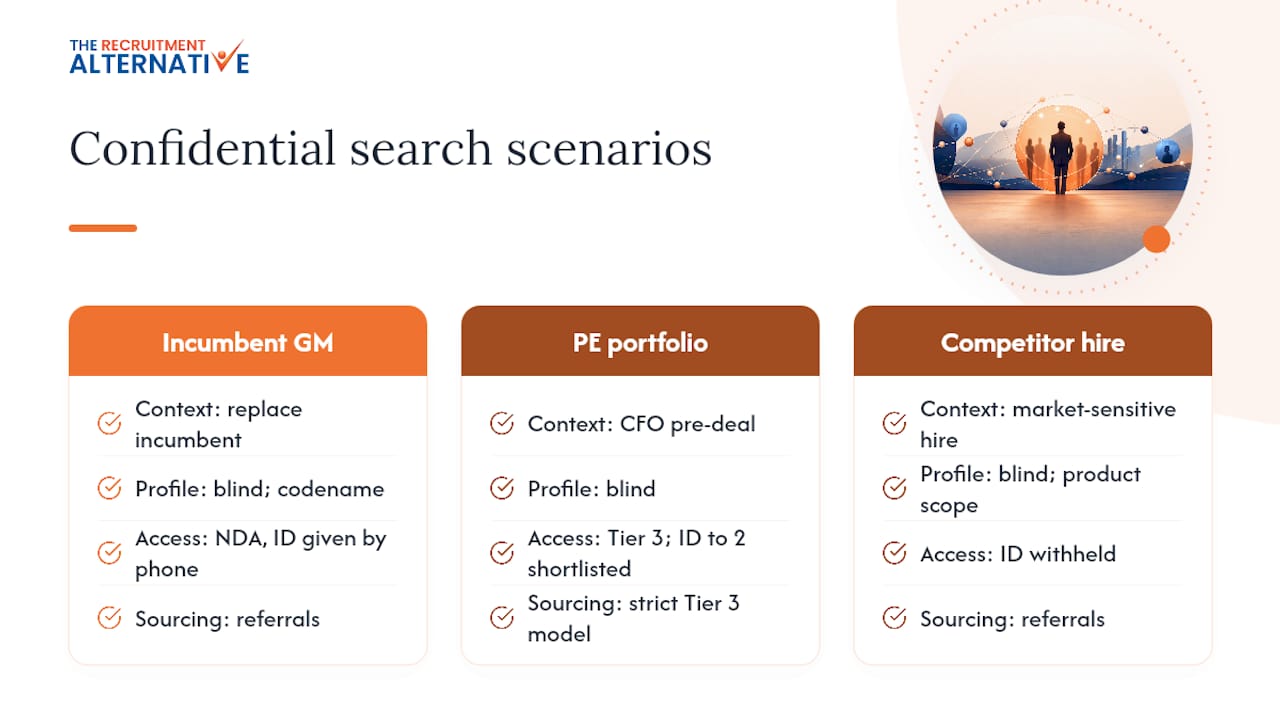
Scenario 1: Replacing an incumbent GM
A national logistics company needed to replace its General Manager, who was underperforming but unaware of the board’s decision. The recruiter assigned a codename, used a blind profile describing the sector and scope without naming the business, and sourced through referrals. Candidates signed an NDA before the company was named by phone. The incumbent remained in role until a successor accepted an offer, and the transition was managed without disruption.
Scenario 2: PE-backed portfolio company pre-deal
A private equity firm needed a new CFO for a portfolio business before a planned exit. Disclosing the search publicly would have signalled deal activity to the market. The recruiter operated under a strict Tier 3 access model, with identity released only to two shortlisted candidates post-NDA. The appointment was made and announced simultaneously with the transaction.
Scenario 3: Market-sensitive hire from a competitor
A fintech business needed a Head of Product with specific experience held by only a handful of people at rival firms. A blind profile describing the product scope and team size, combined with referral-based sourcing, produced a shortlist of three without alerting the competitor. The successful candidate moved without their employer knowing a search had been conducted.
Why confidentiality deserves more rigour than most searches get
Most organisations treat confidentiality as a courtesy rather than a competency. That is a mistake. The role of confidentiality in executive search is not just about discretion; it is about protecting commercial outcomes, candidate trust, and legal compliance simultaneously.
The searches that go wrong are rarely the ones where someone deliberately leaked information. They fail because the blind profile was too specific, the recruiter contacted too many people in a small market, or the NDA was executed after the identity was already shared verbally. Process gaps, not bad intentions, are the primary cause.
HR teams that treat confidentiality as a structured discipline, with documented tiers, encrypted systems, and a clear NDA sequence, consistently produce better outcomes: more senior candidates engage, incumbents are protected, and the organisation retains control of its own narrative.
The Recruitment Alternative supports confidential executive searches
For HR teams and hiring managers who need a confidential executive search partner, The Recruitment Alternative offers a fixed-fee model that covers the full process without the percentage-of-salary cost that traditional retained search firms charge. That means you get the operational rigour of a structured confidential process, including tiered information access, NDA management, and secure candidate handling, at a predictable cost.
The agency recruits executive staff across Australia and includes candidate replacement insurance if a placement does not work out within the first two to three months. Whether you are replacing an incumbent, managing a pre-announcement hire, or sourcing from a competitor’s talent pool, the team can review your brief, recommend a codename structure, and outline the right confidentiality controls for your situation. To discuss a confidential brief, visit The Recruitment Alternative and get in touch directly.
Sources
- Confidential Executive Search Guide | ExecSignals
- Confidentiality | UW Department of Bioethics & Humanities
- Tri-Council Policy Statement: Ethical Conduct for Research Involving Humans – TCPS 2 (Chapter 5)
Recommended
- Why recruitment transparency matters for Australian employers – The Recruitment Alternative
- What is executive recruitment: a guide for employers – The Recruitment Alternative
- Affordable Recruitment for CEO’s and General Management
- Keep it simple when you resign (and don’t burn your bridges)… – The Recruitment Alternative

