

Write the opening line to tell candidates what the role offers them, not what your company has achieved since 1998. Two quick wins fix most weak ads immediately: make the title match what people actually search for, and state a salary range or pay indicator. Templates and worked examples follow below, so you can copy the structure and adjust it to your role.
TL;DR:
- Use the exact industry term and a clear benefit in the job title to improve searchability and attract the right candidates.
- Keep responsibilities to five or fewer bullets, clearly separate required and desirable skills, and focus only on essentials.
- Always include a salary range or clear pay indicator, and specify application instructions with a deadline and contact details.
- Post on channels aligned with the candidate persona, prioritizing niche or industry-specific platforms for technical roles.
- A well-crafted ad results in fewer but more qualified applications, improving recruitment efficiency and reducing screening time.
Table of Contents
- How do you research a role before you write the job ad?
- What’s the difference between a job description and a job ad?
- How do you structure a job ad that converts?
- Where should you post a job ad for the best results?
- What does a ready-to-copy job ad template look like?
- What should you check before you publish the ad?
- Why good ad copy matters more than most employers think
- When it’s time to bring in a fixed-fee recruitment partner
- Where to find the templates and guidance behind this article
- Sources
How do you research a role before you write the job ad?
Start by auditing the internal job description with fresh eyes. Most were written for payroll or performance reviews, not for a stranger deciding whether to click “apply”. Strip out internal jargon, org-chart references, and duties that exist only on paper.
- Check what candidates actually search for by scanning current job board listings for similar roles in your industry.
- Note the salary range other employers are quoting for comparable positions, so your offer is competitive rather than guessed at.
- Write a one-paragraph candidate persona: their current frustrations, what they’re likely earning now, and what would make them stop scrolling.
- Run the ad wording past Business Victoria’s guidance on structuring role overviews, duties, and application steps.
This step takes a short amount of time and saves you from posting an ad that reads like it was written for the person leaving the role, not the person you want to replace them.
What’s the difference between a job description and a job ad?
A job description is an internal document. It lists every duty, reporting line, and compliance requirement your HR file needs. A job advertisement is marketing copy aimed at a stranger who has ten seconds to decide whether you’re worth their time. Confusing the two is the single most common reason ads underperform.
To convert one into the other:
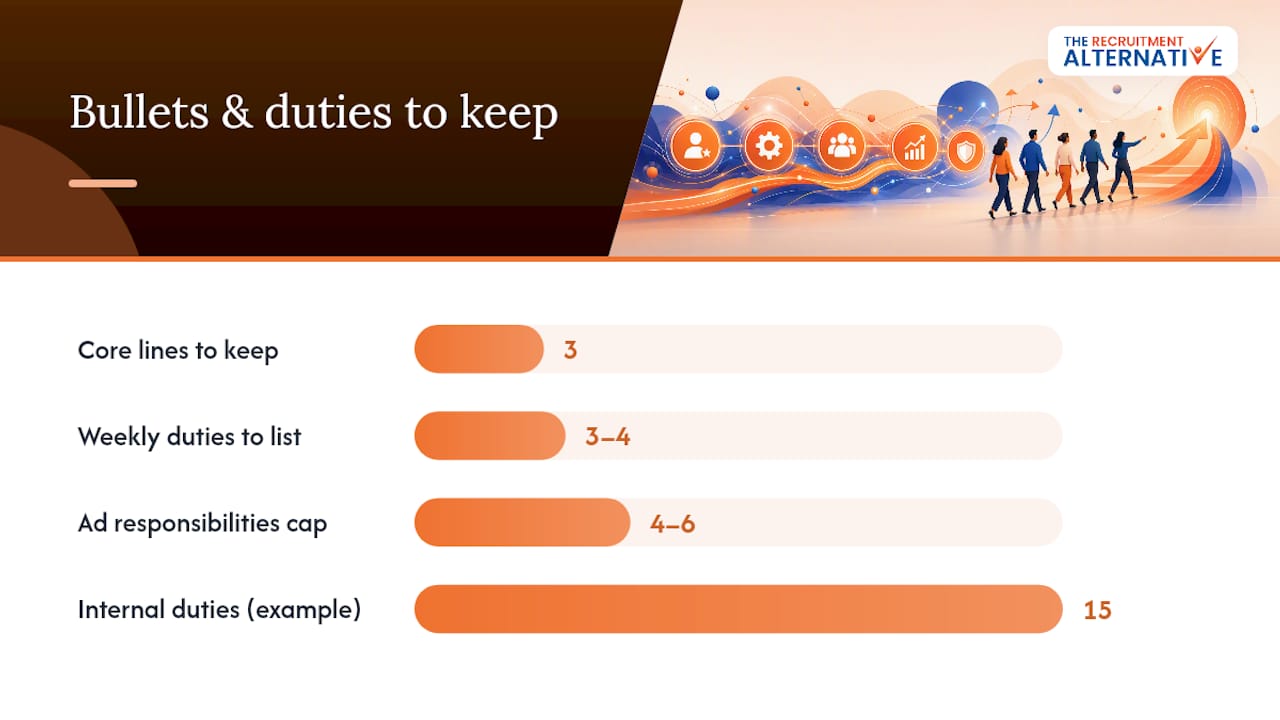
- Keep three types of lines from the original document: the core purpose of the role, the three or four duties that define a typical week, and the qualifications that genuinely determine whether someone can do the job.
- Sort requirements into two honest buckets. Only list something as “required” if a candidate without it literally cannot perform the role. List all other qualifications as “nice to have”.
- Cap responsibilities at four to six bullets. If your internal document lists fifteen duties, that’s a job description problem, not an excuse to write fifteen bullets in the ad.
This distinction matters because long or unclear requirement lists deter applicants and disproportionately discourage women from applying for the role, even when they’re qualified. Every extra “must have” line you don’t actually need is a filter removing people you might have hired.
How do you structure a job ad that converts?
Every part of the ad has a job to do. Skip one and the whole thing weakens.
Title. Use the standard industry term candidates would type into a search bar, plus one clarifying detail: “Senior Bookkeeper, Remote”, not “Numbers Wizard Wanted”. Clever titles don’t get found.
Opening hook. Lead with what the role offers, not your company history. A workable formula: role + one standout benefit + location or format. “Join a growing engineering firm as a Project Coordinator, with genuine flexibility to work three days from home.” Practitioner guidance from Jobs Go Public backs this up: concise, candidate-focused openings with a clear call to action consistently lift apply rates.
Structure. Apply the rule of five: five bullets maximum for responsibilities, five for skills. Beyond that, readers skim and miss the point. ANU’s guidance on effective job advertisements recommends the AIDA principle here, attention, interest, desire, action, as a simple check on ad flow.
Salary. Include a range or a clear indicator (“$70,000 to $80,000 plus super”). Candidates routinely skip ads with no pay information, assuming the worst.
Inclusion. Trim requirements to what’s essential and avoid gendered or exclusionary phrasing.
Apply steps. State exactly what to send, where to send it, the closing date, and a rough timeline for response.
- Title: searchable, specific, honest
- Hook: benefit first, company second
- Bullets: five and five, no more
- Salary: always visible
- Apply: name the file type, link, and deadline
Pro Tip: Write your “how to apply” section as if the candidate has never used your website before. “Apply via the link below” fails when the link is broken or buried behind three clicks.
Where should you post a job ad for the best results?
Match the channel to your candidate persona rather than defaulting to the biggest board. General job boards work well for high-volume roles like administration or customer service. Niche boards and industry associations perform better for trades, healthcare, or technical roles where candidates search specific communities. LinkedIn suits professional and management roles; broader social platforms work for younger or casual workforces.
- Pay to promote only when a role has sat unfilled for more than two weeks on organic reach alone.
- Ask current staff for referrals first. It’s usually your cheapest and highest-quality source.
- Tag postings with location and role keywords so job boards and applicant tracking systems can surface them correctly.
What does a ready-to-copy job ad template look like?
Short example (entry-level, under 250 words)
Warehouse Assistant, Full-Time, Western Sydney
Join a busy logistics team where no two days look the same. You’ll pick and pack orders, keep the warehouse floor safe and tidy, and work alongside a crew that actually likes coming to work.
What you’ll do: Pick/pack orders, operate a forklift (training provided if unlicensed), maintain stock accuracy, support delivery loading.
What you need: Physical fitness for standing/lifting shifts, reliable transport, a positive attitude.
Pay: $55,000 to $58,000 plus super.
Apply: Send your resume to [email] by Friday. We’ll call shortlisted candidates within a week.
Medium example (mid-level professional role) follows the same skeleton but adds a “why this role” line addressing career growth, and expands the skills section to distinguish must-haves from nice-to-haves.
Copyable field template:
| Field | What goes here |
|---|---|
| Title | Standard term + qualifier |
| Summary | One line, benefit-first |
| About the role | Two to three sentences |
| Responsibilities | four to six bullets |
| Skills (must/nice) | Split clearly |
| Benefits | Salary, flexibility, perks |
| Apply steps | Method, deadline, timeline |
Strip internal acronyms and system names before pasting into any ATS or job board form.
What should you check before you publish the ad?
Run this list before the ad goes live:
- Title is searchable and specific
- Opening line leads with a candidate benefit
- Salary range or indicator is visible
- Requirements are split into must-have and nice-to-have
- Apply steps name the method, deadline, and timeline
- Copy reads cleanly on a mobile screen
- Language has been checked against inclusive hiring guidance
The most common mistakes: listing ten “essential” requirements when three would do, opening with company history instead of the role’s benefit, omitting salary entirely, and vague apply instructions like “send your details”. Track apply rate and time-to-shortlist over two to three weeks, then test one variable at a time, usually the title or the opening line first.
Why good ad copy matters more than most employers think
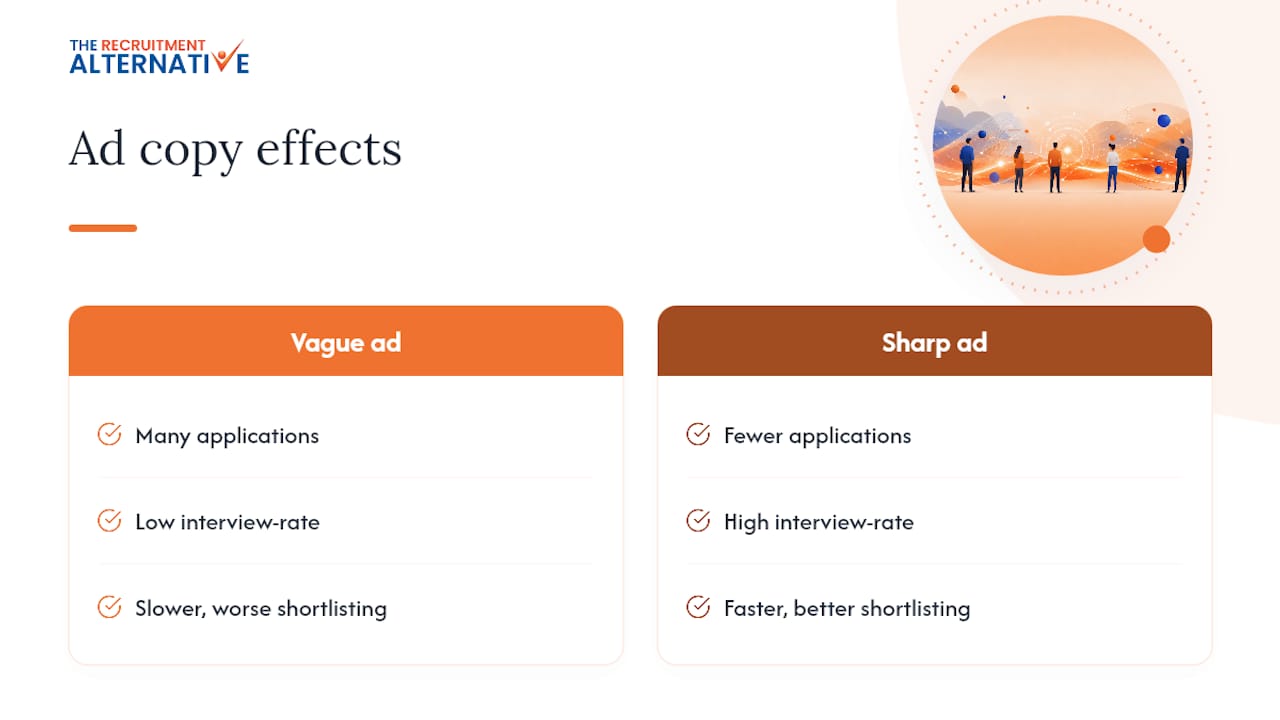
Employers who tighten their ad copy almost always report the same shift: fewer applications overall, but a much higher proportion worth interviewing. That’s the trade-off nobody warns you about. A vague ad with fifteen requirements attracts volume; a sharp, honest ad attracts fit.
Where this gets interesting is the overlap with managed recruitment. Good ad copy doesn’t replace a recruitment partner, it makes one more effective. A flat-fee agency working from a well-written brief moves faster and shortlists better candidates than one working from a bloated internal job description. The ad you write yourself and the recruitment process you run in parallel aren’t competing approaches. They’re the same job, done from two angles.
— Josh Townsend
When it’s time to bring in a fixed-fee recruitment partner
Writing a sharp job ad gets you better applicants. It doesn’t solve the hours you’ll spend screening resumes, chasing candidates for interviews, or negotiating an offer when your shortlist has already gone quiet. That’s where The Recruitment Alternative fits, a flat-fee recruitment service instead of the traditional commission model that charges a percentage of the new hire’s salary.
Businesses across a wide range of industries use recruitment agencies when they want the outcome of a strong job ad without doing the sourcing and screening themselves.
- Transparent pricing instead of a percentage-of-salary fee
- Coverage across a range of roles and industries
- Support if a placement does not work out within a few months
If you’ve written the ad and want someone to run the process from there, check the simple flat-fee structure and get a quote for your next hire.
Where to find the templates and guidance behind this article
- Victoria government job advertisement template
- Business Victoria’s job ad writing guidance
- ANU’s effective job advertisement guide
Sources
- Job advertisement template (Victoria government)
- Writing an effective job advertisement (ANU services)
- Write job descriptions and ads (Business Victoria)

