

Verify current, unconditional AHPRA registration before any registered nurse starts, then choose your route: run the compliance checklist in-house, or engage a fixed-fee recruiter like The Recruitment Alternative to source and verify candidates for you. Either way, registration checks don’t end at the offer. Ongoing monitoring throughout employment is mandatory, not optional.
TL;DR:
- Verify AHPRA registration immediately before the start date and build a two-week buffer to handle last-minute changes or restrictions.
- Conduct registration checks and criminal history, right-to-work, and immunisation verifications in parallel to avoid delays during onboarding.
- Use scenario-based assessments and shadow shifts to evaluate clinical competence and cultural fit simultaneously during interviews.
- Focus on ongoing registration monitoring throughout employment, with automated alerts and documentation to ensure compliance with changing conditions.
- Outsourcing recruitment and verification to fixed-fee specialists can save time, reduce risk, and ensure compliance when hiring registered nurses.
Table of Contents
- What does registered nurse hiring actually require?
- How do you verify AHPRA registration and NMBA standards?
- What background checks does a registered nurse hire need?
- How should you interview and assess registered nurse candidates?
- How do you onboard and monitor a nurse’s registration after hiring?
- What employment laws and WHS obligations apply to nurse hiring?
- How do you write a job description that attracts qualified nurses?
- How do you assess clinical skill and cultural fit together?
- How do you retain registered nurses once you’ve hired them?
- Publisher perspective: why employers choose a flat-fee recruiter for RN hires
- How The Recruitment Alternative supports registered nurse hiring
- Sources
What does registered nurse hiring actually require?
Hiring a registered nurse is not the same process as hiring for most other permanent roles. The role sits inside a national regulatory framework, and employers carry real legal exposure if they skip steps. Here’s the practical order of operations that avoids the two most common failures: hiring someone whose registration has a condition attached, and missing a start date because verification happened too late.
- Define the role and its registration requirements. Decide whether the position needs general registration, a specific endorsement (such as scheduled medicines), or a particular scope of practice.
- Choose your sourcing route. Advertise directly, use your networks, or engage a recruiter who already screens for nursing job opportunities and understands clinical role requirements.
- Draft a conditional offer. Make the offer explicitly conditional on verified AHPRA registration, satisfactory reference checks, and a clear right to work.
- Run pre-offer checks. Confirm right to work, search the AHPRA public register, and check any required licences or endorsements match the role.
- Run final pre-start checks. Recheck AHPRA registration close to the start date, confirm immunisation records, complete NDIS or Working With Children Check screening where relevant, and finish referee checks.
The gap between steps 3 and 5 is where most delays happen. A candidate’s registration status can change between the offer and the start date, and immunisation or screening paperwork often takes longer than employers expect.
Pro Tip: Build a two-week buffer between your final AHPRA recheck and the intended start date. If a condition or restriction appears on the register at the last minute, you need time to respond without blowing up your roster.
How do you verify AHPRA registration and NMBA standards?
Search the practitioner’s name on the AHPRA public register before their start date. The register shows whether registration is current, and it flags any active conditions or practice restrictions attached to that individual. This single check is the most important compliance step in registered nurse hiring, and it’s free and takes minutes.
Registration status alone doesn’t tell you everything an employer needs to know. The Nursing and Midwifery Board of Australia sets registration standards that cover several areas worth confirming directly with the candidate:
- Criminal history disclosure obligations
- English language skills (relevant for overseas-trained applicants)
- Continuing professional development as required by the registration standards
- Recency of practice as defined in the registration requirements
- Professional indemnity insurance arrangements
- Any endorsements relevant to the role, such as scheduled medicines
Internationally qualified registered nurses (IQRNs) follow one of three defined pathways, known as Stream A, B or C, depending on their qualifications and prior assessment. Timelines vary significantly between streams, and some involve additional steps such as an OSCE or MCQ assessment. The NMBA is explicit that employers should not rely on provisional assumptions about when an IQRN candidate will be fully registered. Confirm the actual stream and expected timeframe before you commit to a start date, particularly if you’re replacing a departing staff member with a hard deadline.
Registration isn’t a set-and-forget check. AHPRA is direct on this point: conditions or restrictions can be imposed at any time between renewal periods, which means the check you ran at offer stage may already be out of date by the start date.
What background checks does a registered nurse hire need?
AHPRA verification is the anchor check, but it’s not the only one. Best-practice screening for clinical roles pairs registration verification with several complementary checks that confirm the person is safe to work in your setting, not just legally allowed to.
At minimum, run these for every registered nurse hire:
- AHPRA registration status and conditions
- National criminal history check
- Right to work verification, including visa conditions where relevant
- Immunisation status, particularly for roles involving direct patient contact
Beyond that baseline, some roles need extra layers. If the position involves working with children, add a Working With Children Check. If it touches disability services, NDIS worker screening is mandatory. Aged care roles carry their own additional screening obligations depending on the setting and state.
Documentation matters as much as the checks themselves. Keep signed copies of consent forms, screening results, and registration confirmations in the employee’s personnel file, and note the date each check was performed. This record becomes essential if a dispute or incident arises later, and it’s the paper trail that shows your organisation exercised proper due diligence.
Pro Tip: Run the criminal history check and right-to-work verification in parallel with your AHPRA search, not after it. Sequencing checks one after another is the single biggest cause of avoidable delays between offer and start date.
A simple internal tracker, even a shared spreadsheet listing check type, date completed and expiry, prevents screening gaps from slipping through when you’re juggling multiple hires at once.
How should you interview and assess registered nurse candidates?
Structured interviews for registered nurses need to test more than general people skills. Five areas deserve deliberate focus during any clinical hiring process, and scoring each one separately makes your final decision far easier to defend if it’s ever questioned.
- Clinical competence. Ask candidates to walk through how they’d manage a specific scenario relevant to your setting, such as a deteriorating patient or a medication discrepancy, and listen for structured reasoning rather than a rehearsed answer.
- Recency of practice. Confirm what clinical work the candidate has done in the last 12 months and in what setting, since this ties directly back to the NMBA’s recency of practice standard.
- Scope alignment. Check the candidate’s endorsements and prior scope match what your role actually requires, not just what their CV claims.
- Communication under pressure. Ask how they’ve handled a difficult conversation with a patient, family member, or colleague, and probe for specifics rather than accepting a generic answer.
- Cultural safety. Ask how they’ve adapted care or communication for patients from different cultural backgrounds, and note whether their answer reflects genuine practice rather than a rehearsed line.
Reference checks for clinical roles should go further than confirming dates of employment. Ask former supervisors directly about clinical judgement, reliability under pressure, and whether they’d rehire the candidate into a similar role. Documented reference checks that record specific answers, not just a tick box, give you a defensible paper trail if a hiring decision is ever challenged.
Treat certain findings as hard stops. An unexplained gap in clinical practice, a reference who declines to confirm clinical competence, or any undisclosed condition on the AHPRA register are all reasons to pause and extend verification, or withdraw the offer entirely, before the person sets foot on your roster.
How do you onboard and monitor a nurse’s registration after hiring?
Day one should include a final AHPRA status confirmation, not just a induction pack and a tour of the ward. Collect immunisation evidence and professional indemnity insurance confirmation as part of that first-day paperwork, and file it alongside the checks completed before the offer.
Registration monitoring has to continue for the life of the employment relationship. AHPRA’s own guidance frames this clearly: monitor throughout employment, because a condition or restriction can appear on the register at any point between renewal cycles, not just when a nurse’s registration is due for renewal.
- Set an annual recheck at minimum, timed to registration renewal
- Consider automated alerts through your HRIS if your organisation manages a large clinical workforce
- Keep dated evidence of every check in the personnel file, not just the most recent one
If a condition or restriction does appear after hire, treat it as an immediate risk assessment trigger. Review what the condition actually restricts, adjust the nurse’s scope of duties if needed, and loop in HR or legal advice before making any decision about continued employment. The NMBA won’t intervene in employment outcomes. That due diligence obligation sits squarely with you as the employer.
Pro Tip: Link your AHPRA recheck dates to your rostering system’s renewal reminders. A missed recheck is far more likely when it lives only in someone’s memory or a calendar nobody checks.
What employment laws and WHS obligations apply to nurse hiring?
Registered nurse hiring sits inside two overlapping legal frameworks: general employment law and workplace health and safety regulation. Both are layered on top of the registration requirements already covered. Getting the employment contract wrong is just as costly as getting the clinical screening wrong.
Award coverage matters from the outset. Most registered nurse roles fall under a relevant nursing award or an enterprise agreement, which sets minimum pay rates, penalty rates for shift work, and classification levels tied to experience and qualification. Misclassifying a nurse’s pay level, even unintentionally, creates back-pay liability that can surface years later during an audit.
Workplace health and safety obligations for nursing roles go beyond the general duty of care every employer owes. Manual handling risks, exposure to infectious disease, and fatigue from shift rotation all require specific risk assessments and controls under work health and safety legislation. If your organisation runs rotating rosters, your WHS policy needs to address fatigue management directly, not as an afterthought bolted onto a generic policy document.
Anti-discrimination obligations apply with particular weight to internationally qualified candidates. Decisions about registration timelines or visa status must be handled consistently and transparently, and any hesitation to hire based on someone’s country of training, rather than their actual verified competence, risks a direct discrimination complaint. Document your reasoning for every hiring decision involving an IQRN candidate, and base it strictly on verified registration status and role fit.
How do you write a job description that attracts qualified nurses?
A vague job ad is the fastest way to attract the wrong applicants and waste weeks screening unsuitable candidates. Registered nurses reading job ads are scanning for specifics, and generic language signals a poorly organised employer.
State the exact registration requirement up front: general registration, a required endorsement, or a specific scope of practice. Vague phrasing like “nursing qualification required” filters out serious candidates who assume you haven’t thought through the role.
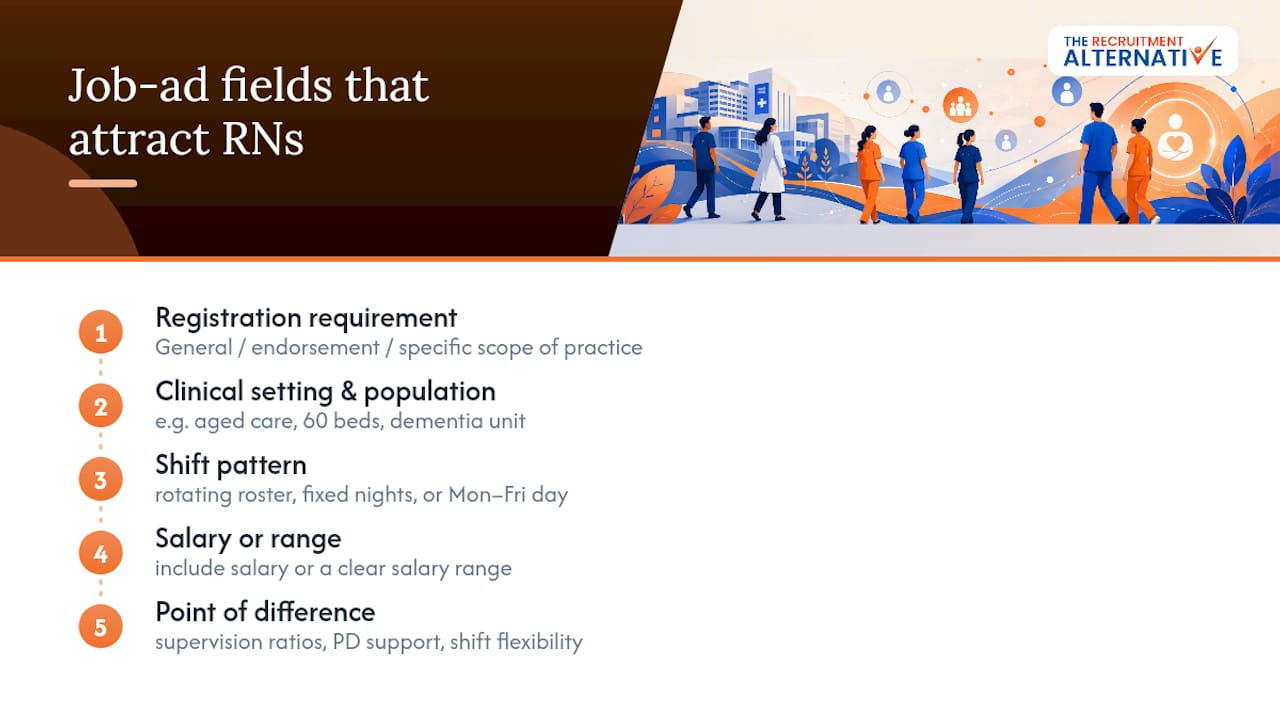
Be specific about the clinical setting and patient population. “Aged care facility, 60 beds, high-acuity dementia unit” tells a candidate far more than “healthcare facility, patient care role”, and it lets the right candidates self-select in while discouraging a flood of irrelevant applications.
List the actual shift pattern, not a euphemism. Rotating roster, fixed nights, or Monday to Friday day shift each attract completely different candidate pools, and burying this detail until the interview wastes everyone’s time.
Include salary or salary range where you can. Nurses comparing multiple RN job openings will prioritise ads that hide pay entirely, particularly when award rates are publicly known anyway. Transparency here shortens your time to fill rather than lengthening it.
Name your point of difference honestly. Supervision ratios, professional development support, or genuine flexibility around shift swaps matter more to experienced nurses than generic phrases about “a great team culture” that could describe any employer.
How do you assess clinical skill and cultural fit together?
Clinical competence and cultural fit are not separate boxes to tick. They interact constantly in ward-level decision-making, and treating them as two unrelated interview sections misses how nurses actually work.
Scenario-based assessment remains the strongest tool available to employers without a formal clinical assessor on staff. Present a realistic situation specific to your setting, ask the candidate to talk through their reasoning step by step, and pay attention to how they prioritise competing demands, not just whether they reach the “correct” answer.
Shadow shifts or working interviews, where practical, reveal far more than any interview question can. Watching how a candidate interacts with existing staff and patients over a few hours exposes communication style and team fit in a way no scripted answer replicates.

Cultural fit assessment should focus on how a candidate handles differences in practice norms, communication styles, and patient expectations, rather than testing for a personality that simply mirrors your existing team. A nurse who challenges an unsafe practice diplomatically is a better cultural fit than one who agrees with everything to avoid conflict, even if the second candidate feels more comfortable in the interview room.
Involve a senior clinical staff member in the final interview stage wherever possible. HR and hiring managers can assess communication and professionalism effectively, but a peer clinician will spot inconsistencies in clinical reasoning that a non-clinical interviewer might miss entirely.
How do you retain registered nurses once you’ve hired them?
Nurse turnover is expensive well beyond the direct cost of rehiring. Every departure means lost institutional knowledge, disrupted rosters, and pressure on remaining staff that can trigger further resignations if left unaddressed.
Competitive base pay matters, but it’s rarely the deciding factor once a nurse has accepted a role. Predictable rostering, genuine input into shift patterns, and manageable patient ratios influence retention far more heavily than a small pay differential between employers.
Professional development support is a retention lever many employers underuse. Funding continuing professional development hours, supporting further study, or creating a clear path toward a clinical specialty or leadership role gives nurses a reason to build a career with you rather than treating the position as a stepping stone.
Recognition and voice matter more than most employers assume. Nurses who feel their clinical judgement is respected by management, and who have a real avenue to raise concerns about staffing or safety, are considerably less likely to start looking elsewhere. A retention conversation held six months into employment, well before any resignation is on the table, catches problems while they’re still fixable.
Onboarding quality in the first month sets the tone for the entire tenure. A nurse who feels unsupported or under-oriented in week one is statistically far more likely to disengage early, regardless of how competitive the original offer looked on paper.
Publisher perspective: why employers choose a flat-fee recruiter for RN hires
Most employers underestimate how much time registration verification, screening, and reference checks actually consume until they’ve done it once for a clinical role. Outsourcing that sourcing and compliance work to a specialist doesn’t just save hours. It transfers the risk of a missed check to someone whose job is catching it. The Recruitment Alternative built its flat-fee model around addressing time and compliance challenges with transparent fixed pricing and replacement assurance if a placement doesn’t work out early. If your team is stretched thin on a clinical hire, that’s worth a conversation before you start the process alone.
— Josh Townsend
How The Recruitment Alternative supports registered nurse hiring
The Recruitment Alternative offers a fixed-price recruitment service for registered nurse hiring, with one transparent fee per placement instead of a percentage of annual pay.

Our permanent recruitment service supports registered nurse hiring with sourcing and screening tailored to role requirements, registration and background verification including AHPRA checks, and onboarding support to facilitate a smooth start.
If you’re weighing up the cost and time of an in-house search against outsourcing it, view our simple flat-fee structure or engage our team to start sourcing your next registered nurse hire today.

