

A skills gap analysis compares the skills your business needs against the skills your people actually have, so you can decide whether to train, redeploy or hire. It gives you a documented, prioritised list of shortfalls and the actions needed to close them.
- What it delivers: a ranked list of specific skill shortages, not a vague sense that “something’s missing”
- How it’s built: through a five-step process covering planning, identification, measurement, analysis, and action
Many businesses with unaddressed skills gaps report higher workloads for existing staff, and a significant proportion face increased operating costs, according to the Chisholm Institute. That’s the cost of skipping the analysis, not doing it.
Key Takeaways
The most reliable way to close a workforce skills gap is to score it for size, criticality and urgency, then match the fix, training, redeployment or hiring, to that score rather than defaulting to one response.
| Point | Details |
|---|---|
| Definition matters | A skills gap is a capability shortfall in an existing role, distinct from a market-wide shortage or a skills mismatch. |
| Follow the five steps | Plan, identify, measure, analyse and act gives a repeatable, defensible process rather than a one-off guess. |
| Triangulate your measurement | Combine self-assessment, manager input and objective tests to avoid the bias that skews single-source ratings. |
| Score before you act | Rank gaps by size, criticality and urgency so training budgets go to the gaps that matter most. |
| Hire for critical, urgent gaps | The Recruitment Alternative’s fixed-fee model gives a known cost for closing gaps too large or urgent to train away. |
Table of Contents
- What is a skills gap, and why does it matter to your business?
- When should you run a skills gap analysis?
- How do you conduct a skills gap analysis in five steps?
- How do you measure skills reliably without bias creeping in?
- How do you prioritise which skills gaps to fix first?
- How do you build an action plan that actually closes the gap?
- When does hiring make more sense than training?
- How The Recruitment Alternative helps when the gap can only be closed by hiring
- Sources
What is a skills gap, and why does it matter to your business?
A skills gap is the difference between the skills a role or team needs and what the person currently doing it can demonstrate. It’s a narrower concept than a skills shortage, where the talent simply doesn’t exist in the labour market, and different again from a skills mismatch, where someone has the wrong skills for their current role rather than a deficient set.
Technical gaps show up in obvious places: a finance team without anyone confident in a new reporting system, or a trades crew lacking a required certification. Soft-skill gaps are subtler but often costlier. Leadership, teamworking and problem solving are among the most common gap areas businesses report.
The OECD’s review of workforce skills found technical skills, problem solving and teamworking to be the most frequent shortfalls, and that gaps tend to raise workloads, push up costs and slow technology adoption. A gap might affect only a handful of employees, but the operational drag is disproportionate.
- Slower rollout of new systems or processes because too few people can operate them competently
- Reduced output as unaffected staff absorb the extra workload
- Higher recruitment and training spend addressing the same shortfall repeatedly
When should you run a skills gap analysis?
Run one whenever the business is about to ask people to work differently. Common triggers include a technology change, a strategic planning cycle, rapid growth, or a resourcing crunch where projects are stalling because nobody has the right capability.
- New strategy or transformation project – map required skills before the project starts, not after it stalls.
- Annual or biannual planning cycle – build the analysis into budget and workforce planning so it’s never a one-off exercise.
- Rapid headcount growth – check that scaling isn’t outpacing capability.
- Persistent delivery problems – if the same type of task keeps slipping, a gap is often the root cause.
Ownership usually sits with HR, but the sponsor should be the manager whose team or project depends on the outcome. If you’re unsure whether now is the time, ask one question: is a lack of a specific skill currently costing you time, money or client trust? If yes, don’t wait for the next cycle.
How do you conduct a skills gap analysis in five steps?
Every credible skills gap assessment follows the same underlying structure. The Chisholm Institute documents it as five steps: define scope and goals, identify required skills, measure current skills, analyse the data, and act. Here’s how each looks in practice.
1. Define scope and business goals
Decide what you’re assessing before you assess it. Is this a whole-of-business review, a single department, or one role? Set a timeframe (this quarter, this financial year) and name the business outcome you’re protecting, whether that’s a system rollout, a service expansion or reduced turnover.
2. Identify required and future skills
Build a competency list for each role, covering both what’s needed today and what the role will need in twelve to twenty-four months. Job descriptions are a starting point, but they’re often outdated. Talk to team leaders about what “good” actually looks like day to day.
3. Measure current skills
This is where most analyses fall over, because measuring skill is harder than listing it. Use a mix of:
- Self-assessments against the competency list
- Manager assessments and, for senior roles, 360-degree feedback
- Objective tests or simulations for technical or safety-critical skills
- HRIS data, performance reviews and project outcomes as supporting evidence
Psychometric testing can add an objective layer here, particularly for roles where self-reported confidence tends to run ahead of actual capability.
4. Analyse the data
Plot the results into a skills matrix or heat map, with roles or teams down one axis and required competencies across the other. Colour-code each cell by proficiency level. MindTools recommends scoring each identified gap for size (how far below target), criticality (how much the business depends on it) and urgency (how soon it will bite).
5. Act
Turn scored gaps into a blended plan. Training suits gaps that are widespread but not urgent. Redeployment suits gaps where the skill exists elsewhere in the business. Hiring suits gaps that are critical, urgent and not realistically closeable through development in the available timeframe. Assign an owner and a metric to every action, not just a training date
Pro Tip: Don’t build your competency list from job titles alone. Sit in on the actual work for an hour, whether that’s a sales call, a production run or a finance close, and you’ll usually spot a skill nobody wrote down.
How do you measure skills reliably without bias creeping in?
Self-assessment alone is unreliable. People tend to overrate skills they’re comfortable with and underrate ones they’ve never been tested on, which is why the most defensible skills gap assessment triangulates at least two data sources before drawing a conclusion.
- Self-assessment gives you a fast, low-cost baseline, but treat it as a starting hypothesis, not a finding.
- Manager assessment adds context the individual can’t see themselves, particularly around consistency under pressure.
- 360-degree feedback works well for leadership and collaboration skills where peers see more than a manager does.
- Objective tests and simulations are worth the extra setup time for technical, safety-critical or compliance-linked skills, where a wrong self-rating carries real risk.
Practical guides on running the assessment stress that knowing you have a gap is different from knowing exactly which skill is missing, and the wrong assessment method will blur that distinction. HRIS platforms and dedicated skills-mapping tools can speed up data collection, but the common pitfall is treating software output as truth without a human sanity check. A tool will happily produce a heat map from bad inputs.
How do you prioritise which skills gaps to fix first?
Not every gap deserves the same urgency, and treating them equally is how training budgets get spread too thin to fix anything properly. MindTools frames prioritisation around three axes, and a simple scoring rubric against each, makes the ranking defensible rather than a gut call.
- Size – how far is current capability from the target level? Score 1 (minor) to 5 (severe).
- Criticality – how much does the business depend on this skill to function or grow? Score 1 to 5.
- Urgency – how soon will the absence of this skill cause a visible problem? Score 1 to 5.
Add the three scores per gap and rank them. A gap scoring 12 to 15 goes straight into the action pipeline; something under 6 can sit on a watch list. In practice, a critical, urgent, large gap in a technical certification usually points to hiring, because training can’t compress a multi-year skill in time. A large but non-urgent gap in a common soft skill, like presentation confidence, is a textbook case for group training. A moderate gap held by one otherwise strong performer often solves itself through redeployment rather than either.
How do you build an action plan that actually closes the gap?
Once gaps are ranked, the plan needs to match the fix to the gap type rather than defaulting to training because it’s the easiest option to approve. Most enterprises still lean on training as the primary response, and it remains the right call for widespread, non-urgent gaps.
- Design training and reskilling around the actual task, not a generic course; short, applied modules beat a day-long workshop for most technical gaps.
- Use redeployment when the skill already exists elsewhere in the business. A soft-skills gap on one team is sometimes a strength on another.
- Scope recruitment specifically for gaps that are critical and urgent. Around half of businesses turn to hiring when a skill is needed quickly, because reskilling simply can’t move fast enough.
- Link every closed gap back to a performance metric or succession plan, so the analysis feeds workforce planning rather than sitting in a drawer until next year.
A talent pipeline built off the back of this analysis reduces how often you’re forced into emergency hiring for the same recurring gap.
When does hiring make more sense than training?
Hiring is the right call when a gap is too large, too urgent, or too specialised to close through development in the time you’ve got. A fixed-fee recruitment model suits this scenario particularly well, because the cost of bringing in the missing skill is known upfront rather than scaling with the salary the way commission-based agency fees typically do.
- Expect a defined process: role scoping, candidate sourcing, shortlisting and placement, rather than an open-ended search.
- Hiring for attitude and transferable skills works well when the exact technical background is scarce but the underlying capability (problem solving, communication, adaptability) is present and trainable.
- A SWOT-style planning template is a useful companion during the scope-setting step, helping you separate genuine capability gaps from resourcing or process issues before you commit to a hire.
Pro Tip: If a role has been vacant and “covered” by the team for more than a quarter, that’s rarely a resourcing gap. It’s usually a skills gap wearing a headcount disguise.
How The Recruitment Alternative helps when the gap can only be closed by hiring
Training closes most gaps, but not the ones that are large, urgent and specialised all at once. That’s when a fixed-fee recruitment partner earns its keep: The Recruitment Alternative charges a transparent, tiered flat fee based on the role’s salary, not a percentage that climbs with it, so the cost of filling a critical gap is known before you commit.
The Recruitment Alternative recruits across sales, administration, finance, engineering, healthcare, technology, trades and executive roles for businesses of all sizes, and includes candidate replacement insurance if a placement doesn’t work out in the first two to three months. That takes the risk out of using hiring as your fastest lever when the analysis flags a genuinely urgent gap. If your skills gap analysis has already pointed to a hire you can’t train your way around, check the flat-fee structure and get a quote for the role you need filled.
Treating skills gap analysis as a strategic habit, not a project
Most businesses treat a skills gap analysis as a one-off fire drill after something’s gone wrong. That’s the biggest mistake in this whole process. The businesses getting real value from it run the analysis on a cycle, tied to strategic planning, so gaps are visible before they become urgent rather than after.
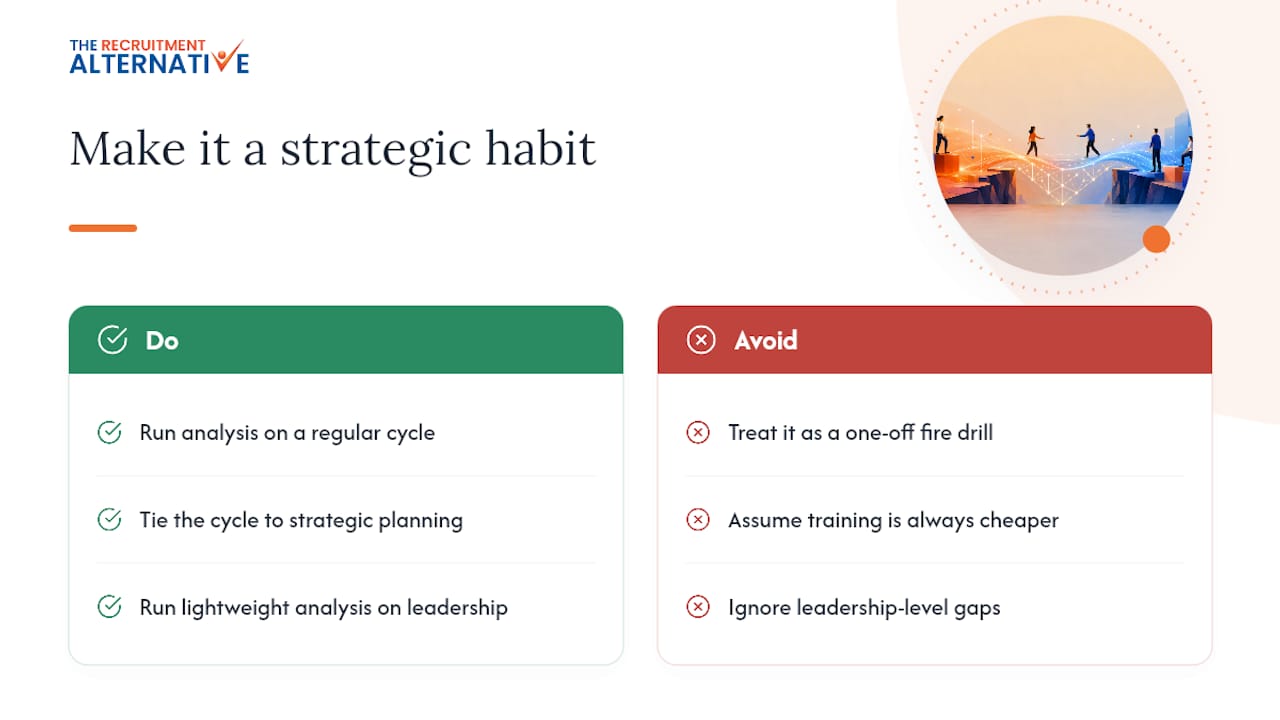
The second mistake is assuming training is always cheaper than hiring. It isn’t, once you factor in the time a large or urgent gap sits open, quietly costing productivity while a course gets scheduled.
Pro Tip: Run a lightweight version of this analysis on your leadership team first. Gaps at that level tend to cascade, and they’re the ones most often missed because nobody wants to say it out loud.
— Josh Townsend
Sources
For deeper reading, the OECD’s research on workforce skill gaps covers prevalence and business impact in detail, while MindTools’ skills gap analysis guide offers a practical matrix template. Capsim’s how-to guide is worth bookmarking for measurement methodology.
- How to analyse and document skills gaps — Chisholm Institute
- Understanding skill gaps in firms — OECD
- Skills gap analysis: build the capabilities your organization needs — MindTools
- How to Perform a Skills Gap Analysis — Capsim
Recommended
- Hire across multiple industries: a skills-first guide for employers – The Recruitment Alternative
- Build a talent pipeline this week, not next quarter – The Recruitment Alternative
- Hire for attitude not skillset – Part One. The Recruitment Alternative
- 4 things to get across in an interview – The Recruitment Alternative

