

The fastest, most cost-predictable way to hire a permanent sales representative is through a structured fixed-fee recruiter that includes a candidate replacement guarantee. Skip the percentage-of-salary model, and skip agencies that hand you a stack of CVs with no scoring behind them.
Your next move is simple: write a one-page brief covering the role, targets, and territory, then ask any recruiter you’re considering for two things before you sign anything.
- Their shortlisting rubric (how they score and rank candidates)
- Their guarantee terms in writing (replacement window, what triggers it, what’s excluded)
Every legal box still needs checking regardless of who does the sourcing. That means following the Business for right-to-work and compliant offers, meeting Fair Work’s pay and record obligations, and confirming your recruiter, like The Recruitment Alternative, works to a documented, bias-checked selection process.
Key Takeaways
Fixed-fee recruitment with a documented scorecard and a written replacement guarantee is the most reliable way to hire a permanent sales representative without inheriting compliance risk or unpredictable cost.
| Point | Details |
|---|---|
| Brief the role first | Write the role description and selection criteria before advertising or engaging a recruiter. |
| Verify, don’t just interview | Ask how attainment claims and referee checks are confirmed, not just how the interview went. |
| Compliance stays with you | Employers remain responsible for anti-discrimination process even when using an external recruiter. |
| Get the guarantee in writing | Confirm the exact replacement window and what triggers it before signing any agreement. |
| Choose a structured flat-fee partner | The Recruitment Alternative offers flat-fee pricing tiered by salary, structured shortlists with evidence, and a replacement guarantee for permanent sales representative hires. |
Table of Contents
- Why fixed-fee recruitment suits sales representative hiring
- Hiring checklist and legal must-dos for compliance
- How to choose the right recruitment partner for sales roles
- Designing selection and interviews that predict sales performance
- Handover and onboarding after you select a candidate
- How long does fixed-fee sales rep recruitment take?
- What does fixed-fee recruitment actually cost?
- Questions to ask before engaging a recruitment agency
- Red flags when choosing a recruitment partner
- What actually determines a good sales hire
- Get a fixed-fee sales representative hire started
- Essential regulatory and guidance links for hiring and payroll
- Sources
Why fixed-fee recruitment suits sales representative hiring
Percentage-based agency fees scale with salary, which means the cost of hiring a $90,000 sales rep can jump significantly the moment a candidate negotiates a higher package. A fixed-fee model removes that variable entirely. You know the number before the search starts, regardless of who you eventually hire.
This model works best in specific conditions: a clearly defined role (territory, product, targets already mapped), predictable hiring volume (one or two reps rather than a rolling pipeline of twenty), and a budget that needs to be locked in before finance signs off.
A capable fixed-fee provider should deliver more than a CV pile. Expect:
- A properly scoped role brief, not a generic job ad rewritten
- Structured screening against sales-specific criteria, not just a phone chat
- A replacement guarantee if the hire doesn’t work out in the first few months
Pro Tip: Ask any recruiter to show you a sample scorecard before you engage them. If they can’t produce one, they’re likely still working off gut feel, not process.
The simple flat-fee structure approach ties price to salary tier rather than a percentage, which keeps the number predictable across sales roles of different seniority.
Hiring checklist and legal must-dos for compliance
Recruiting a permanent sales representative comes with legal obligations that don’t disappear just because you’ve outsourced the search. Work through these in order:
- Write the role description and selection criteria first. Define the territory, targets, reporting line, and must-have experience before you advertise, so shortlisting has something objective to measure against.
- Advertise and shortlist against those criteria. Consistency here is what protects you from a discrimination complaint later.
- Check right to work, licences and qualifications. Some sales roles (finance, insurance, pharmaceuticals) carry licensing requirements that must be verified before an offer goes out, per the Business.
- Apply anti-discrimination process even when a recruiter is doing the legwork. The Australian Human Rights Commission is explicit that employers stay responsible for ensuring any agent they engage follows fair process.
- Get payroll basics right from day one. Pay slips must be issued within one working day of pay, and you need accurate records of pay, leave and hours on file, according to Fair Work.
- Report through Single Touch Payroll on or before pay day. The ATO’s STP rules leave no grace period for late reporting.
- Issue a compliant offer and a proper employment contract, checked against award coverage where it applies.
Missing pay slip timing isn’t a minor slip. A pay slip issued even one day late breaches Fair Work’s requirement, and it’s the kind of gap a Fair Work audit picks up immediately.
How to choose the right recruitment partner for sales roles
Not every recruiter that says “fixed fee” runs a disciplined process behind it. Before you sign an engagement, ask for proof, not promises.
- Request examples of the role-definition work they do upfront, and ask to see a blank candidate scorecard.
- Ask directly how they train assessors on anti-discrimination obligations. If they can’t answer specifically, that’s a gap you’ll inherit.
- Get the shortlist format, timeline, and everything the fee covers in writing, along with the exact replacement or guarantee window.
- Confirm what handover support looks like: does the offer letter and contract get drafted for you, and do they provide payroll or STP notes for the new hire?
Pro Tip: A recruiter who can’t explain how they verify a candidate’s sales attainment claims is asking you to trust a resume, not evidence. Push on this before you engage.
The potential pitfalls in personnel recruitment worth watching for often trace back to skipped structure at this exact stage, not bad luck with candidates.
Designing selection and interviews that predict sales performance
A sales representative’s charm in an interview tells you almost nothing about whether they’ll hit target in month four. Good selection design separates the two.
- Build one standardised scorecard and use the same interview questions for every candidate. This is the single biggest lever against bias, and it’s backed by structured recruitment guidance from the AHRC, which recommends documented criteria applied consistently.
- Weight measurable signals over stories. Attainment history against target, average deal size, territory complexity, and sales-cycle discipline tell you more than a confident pitch.
- Add a practical task or role-play scored against a fixed rubric. A five-minute cold-call simulation or a mock discovery call, scored the same way for everyone, reveals actual selling behaviour rather than rehearsed answers.
- Require verification evidence from whoever runs your shortlist. Annotated interview notes, referee summaries, and attainment verification let your hiring panel spend their time assessing culture fit, not re-discovering basics the recruiter should have already checked.
Sales candidates are notoriously good at self-presentation, which is exactly why the verification step matters more here than in most other roles. Ask how attainment figures were checked, not just what the candidate claimed.
Handover and onboarding after you select a candidate
Selection is only half the job. What happens in the week after you say yes determines whether the hire actually starts strong.
A solid recruiter handover should include an offer letter and contract template already aligned to the relevant award or agreement, alongside a documentation pack covering referee checks, identity and licence verification, the candidate’s scorecard, and reference notes.
You’ll also want payroll and STP handover details sorted before day one: pay frequency, a pay date that lines up with your STP reporting cycle, and superannuation information ready to load. Agree on first-week check-ins and a 90-day review point, and confirm whether probation support is included in the engagement.
How long does fixed-fee sales rep recruitment take?
Most fixed-fee placements for a permanent sales representative move through role scoping, advertising, shortlisting, interviews, and offer within a few weeks, though the exact timeline depends heavily on how niche the role is.
A generalist B2B sales role with a broad candidate pool typically shortlists faster than a technical or licensed sales position, where the qualified candidate pool is smaller. Territory-specific roles, or ones requiring existing industry relationships, tend to add time to sourcing rather than to the assessment stage itself.
The stages that eat the most time usually aren’t the ones employers expect. Advertising and initial sourcing move quickly when the brief is clear. What slows things down is a vague role definition at the start, indecision during shortlist review, or reference and licence checks that get left until the final week instead of running in parallel with interviews.
You can compress the timeline meaningfully by having your role brief, selection criteria, and interview panel availability locked in before you engage a remote recruitment and staffing service, rather than working these out mid-search. A recruiter who’s already run structured sales searches will also have a warmer sense of where candidates with the right attainment history are currently sitting, which shortens the sourcing phase.
If a recruiter promises a shortlist within days regardless of role complexity, ask what shortcuts they’re taking on verification to hit that number.
What does fixed-fee recruitment actually cost?
The core promise of fixed-fee recruitment is that the number you’re quoted at the start is the number you pay, tied to a salary tier rather than a percentage of the final package. That’s the headline appeal, but “fixed fee” isn’t automatically “all-inclusive,” so it pays to ask what sits outside the quoted figure.
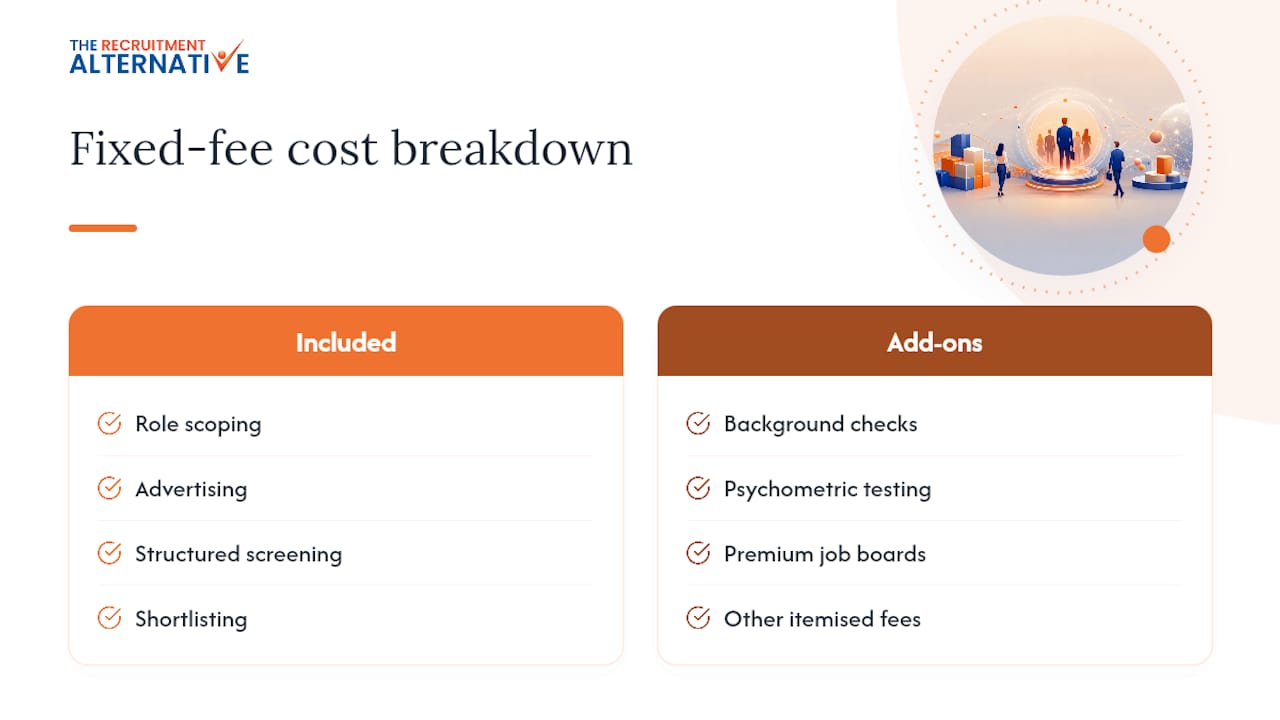
A properly transparent fixed-fee engagement should state upfront what’s included: role scoping, advertising, structured screening, shortlisting, interview coordination, and the replacement guarantee window. Where providers differ is in the extras: some quote separately for background checks, psychometric testing, or advertising spend on premium job boards. None of that is necessarily unreasonable, but it should be itemised before you sign, not discovered on an invoice.
The other cost variable worth watching is what happens if the hire doesn’t work out. A genuine guarantee should specify a defined window (commonly a matter of months) during which a replacement search is covered without a second fee. If that window is vague, or the guarantee has so many exclusions it’s unlikely to ever apply, you’re not getting the protection the “fixed fee” framing implies.
Ask for the full fee breakdown in writing before committing, including anything billed separately from the headline number. A provider confident in their process will hand this over without hesitation.
Questions to ask before engaging a recruitment agency
Before you commit budget to any provider, run through a short set of questions that expose how they actually operate, not just how they market themselves.
- How many sales representative placements have you made in the last twelve months, and in which industries?
- Can you show me a sample scorecard and shortlist format from a comparable role?
- What exactly triggers your replacement guarantee, and what’s the time window?
- What’s included in the fixed fee, and what would be billed as an extra?
- How do you verify a candidate’s sales attainment and reference history?
- What handover documents do you provide (offer letter, contract, payroll notes)?
A provider with genuine experience in recruiting top staff for SMEs will answer these specifically, with real examples, rather than in general marketing language. Vague answers to direct process questions are themselves useful information: they tell you the recruiter hasn’t formalised what they do.
Red flags when choosing a recruitment partner
Some warning signs show up before you’ve even engaged a recruiter, if you know where to look.
Watch for a recruiter who can’t produce a sample scorecard or explain their screening criteria beyond “we interview them and send you the good ones.” That’s not a process, it’s a filter with no documentation behind it. Similarly, treat vague guarantee language as a real problem: if a provider can’t tell you the exact replacement window and what triggers it, assume it won’t help you when a hire falls through.
Pressure to sign quickly, before you’ve seen their brief template or asked about anti-discrimination training for their assessors, is another signal worth pausing on. So is a fee structure that seems fixed at the quote stage but grows once background checks, advertising, or “priority sourcing” get added as separate line items.
Finally, be wary of any recruiter who treats compliance as your problem alone. Outsourcing the search doesn’t outsource your legal responsibility, and a provider who can’t speak confidently about how they meet anti-discrimination obligations is leaving that risk sitting with you.
What actually determines a good sales hire
Most advice on hiring sales representatives focuses on the interview: how to spot confidence, how to test for “hunger,” how to read body language. That’s the wrong place to look for signal.

The research on structured hiring is consistent on one point: documented criteria, applied the same way to every candidate, beat gut-feel interviewing almost every time. For sales roles specifically, that means the real differentiator isn’t the interview performance, it’s whether anyone actually checked the attainment numbers a candidate quoted. Persuasive people are, unsurprisingly, good at sounding persuasive in interviews. That’s the exact skill you’re trying to hire for, which makes it a poor filter on its own.
Where I’d push back on conventional hiring advice is the assumption that a longer interview process produces a better hire. It usually just produces a slower one, with the same blind spots repeated across more meetings. What moves the needle is verification work done before the interview stage, not more rounds of it.
If you take one thing from this guide, prioritise the scorecard and the verification evidence over the vibe in the room. The rest of the process should exist to confirm fit, not discover basics that should already be settled.
— Josh Townsend
Get a fixed-fee sales representative hire started
The Recruitment Alternative runs a flat-fee model built for exactly the scenario this guide covers: a defined sales role, a budget that needs to be locked in early, and a hiring process you can trust without paying a percentage of salary for the privilege. Coverage spans sales alongside administration, finance, engineering, healthcare, technology, and executive roles, with pricing tiered by salary rather than open-ended.
What you receive is a proper role briefing, a structured shortlist with scoring evidence behind each candidate (not a folder of unfiltered resumes), a defined replacement window if the hire doesn’t work out in the first few months, and support through the offer and onboarding stage.
Every point raised in this guide, the scorecard, the verification evidence, the guarantee terms in writing, is exactly what a dependable, affordable flat-fee engagement should include from the outset. If you’re ready to brief a sales representative role, request a quote and get the shortlisting rubric in front of you before you commit to anything.
Essential regulatory and guidance links for hiring and payroll
Consult these directly if you’re unsure on a specific compliance point:
- Business
- Hiring employees – Fair Work Ombudsman
- Rules of reporting through STP | Australian Taxation Office
- Step-by-step guide to preventing discrimination in recruitment | AHRC
Sources
- Business
- Paying wages – Fair Work Ombudsman
- Rules of reporting through STP | Australian Taxation Office
- Step‑by‑step guide to preventing discrimination in recruitment | AHRC


