

An employment contract is a legally binding written agreement that sets out the terms and conditions of work between an employer and an employee. To create employment contract Australia businesses must comply with the Fair Work Act 2009, the National Employment Standards (NES), and any applicable Modern Awards or Enterprise Agreements. A compliant contract covers employment type, remuneration, hours, leave entitlements, superannuation, confidentiality, intellectual property, and termination provisions. Getting these elements right from the start protects your business and sets clear expectations for every new hire.
What are the legal requirements for employment contracts in Australia?
Every employment contract in Australia operates within a three-layer legal framework. The Fair Work Act 2009 sits at the top, followed by the NES, then any relevant Modern Award or Enterprise Agreement. Contracts cannot undercut these minimum standards. Any clause that attempts to do so is void to that extent, and the statutory entitlement replaces it automatically.

The NES sets the baseline conditions that apply to all national system employees. These include a maximum of 38 ordinary hours per week, four weeks of paid annual leave, and ten days of paid personal and carer’s leave per year. Modern Awards and Enterprise Agreements may impose additional pay rates, penalty rates, and allowances on top of these minimums.
A compliant employment agreement must include the following elements:
- Parties to the contract: Full legal names of the employer and employee
- Start date: The commencement date of employment
- Employment type: Whether the role is full-time, part-time, or casual
- Remuneration: Base salary or hourly rate, plus superannuation at 11.5% as of 2026
- Hours of work: Ordinary hours and any overtime arrangements
- Leave entitlements: Annual leave, personal leave, and any other applicable leave
- Probation period: Duration and conditions, consistent with Award minimums
- Notice of termination: Periods that comply with the NES and any applicable Award
- Confidentiality clause: Protection of sensitive business information
- Intellectual property clause: Ownership of work created during employment
Superannuation at 11.5% is a statutory obligation, not a negotiable benefit. Omitting it from the contract does not remove the obligation. It simply creates ambiguity that can lead to disputes.
What practical steps should employers follow to draft a tailored employment contract?
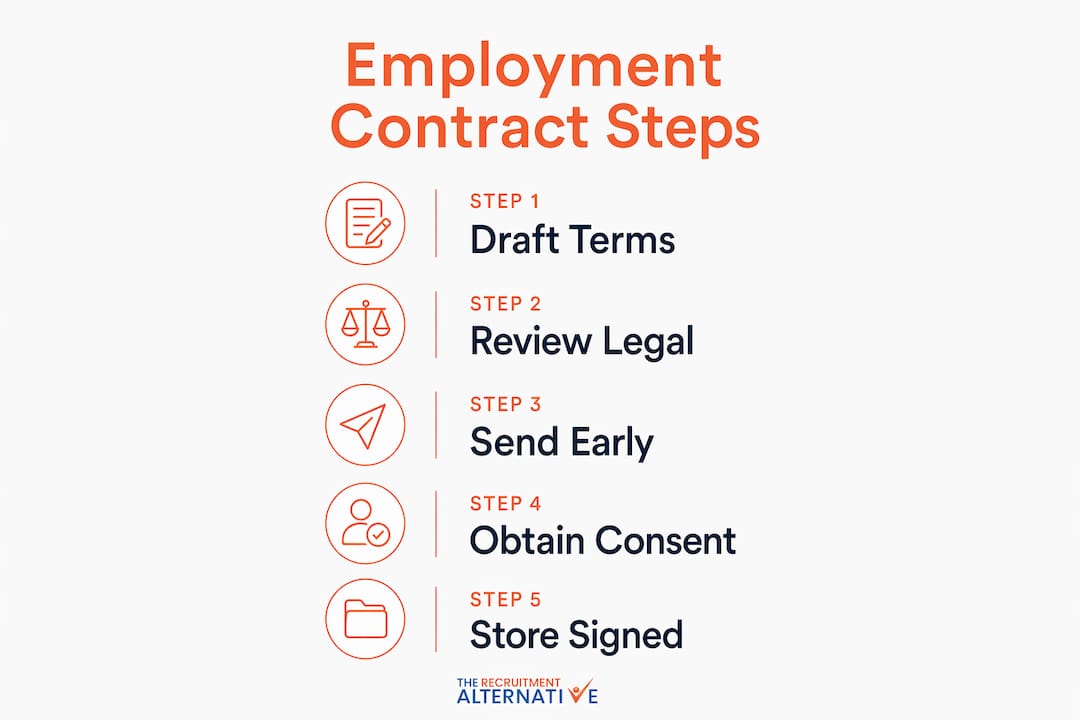
A structured drafting process prevents the most common compliance failures. Written contracts are best practice because oral agreements, while technically enforceable, carry significant risk. Follow these steps to produce a contract that is both legally sound and tailored to your business.
-
Identify the applicable Modern Award. Use the Fair Work Ombudsman’s Award Finder tool to confirm which Award covers the role. Some senior or professional roles may be Award-free, but you must verify this before proceeding.
-
Confirm the employment type and classification. Determine whether the role is full-time, part-time, or casual. Confirm the correct classification level under the relevant Award, as this determines minimum pay rates.
-
List the agreed terms. Document the base salary or hourly rate, ordinary hours, probation period, and any additional benefits. Cross-check each term against the Award and NES to confirm compliance.
-
Incorporate NES entitlements. Include leave entitlements, maximum weekly hours, and notice periods as required by the NES. Do not attempt to exclude or reduce these entitlements.
-
Add role-specific clauses. Include confidentiality, intellectual property, and any restraint of trade provisions relevant to the position. Senior or specialised roles often require bespoke IP clauses due to complex proprietary information.
-
Seek professional legal review. Have a qualified employment lawyer review the contract before it is issued. This step is particularly important for senior roles, roles with access to sensitive data, or roles involving significant IP creation.
-
Obtain signed acceptance before work commences. A structured signing process before the start date is critical to enforce contract terms and reduce disputes. Never allow an employee to begin work without a signed agreement in place.
Pro Tip: Send the contract at least five business days before the start date. This gives the employee time to seek independent advice and removes any argument that they signed under pressure.
Understanding the Australian job market also helps you set competitive terms that attract quality candidates while remaining compliant.
How can Australian employers avoid common mistakes when creating employment contracts?
The most costly employment contract errors are also the most preventable. Most arise from using generic documents without proper customisation or from misunderstanding how Australian employment law operates.
-
Assuming the contract overrides the NES or Awards. It does not. Non-compliant clauses are void and replaced by the relevant statutory entitlement. The contract cannot reduce minimum conditions, only improve on them.
-
Using a generic template without customisation. A Word template without adaptation creates enforceability risks. Templates are a starting point, not a finished product. Every contract must reflect the specific role, Award, and business context.
-
Misclassifying the employment type. Misclassifying a casual employee as part-time, or vice versa, triggers Award and tax compliance breaches. The classification must match the actual working arrangement.
-
Vague probation and termination provisions. Probation periods must be clearly defined. Termination notice periods must meet or exceed the NES minimums. Ambiguous wording creates disputes and potential unfair dismissal claims.
-
Omitting confidentiality and IP clauses. Businesses that skip these clauses have no contractual protection if an employee takes proprietary information or client lists on departure. Clear IP and confidentiality clauses provide a defensible record in disputes.
-
Failing to align contract terms with payroll. The pay rate in the contract must match what payroll actually processes. Discrepancies between the two create underpayment liability and erode employee trust.
-
Not obtaining a signed agreement before the start date. An unsigned contract is very difficult to enforce. Implement a consistent process that requires a signed copy before the employee’s first day.
Pro Tip: Keep a signed copy of every contract in a secure HR system. If a dispute arises years later, the signed document is your primary evidence.
Good contracts also support staff retention by setting clear expectations from day one, which reduces misunderstandings that lead to early departures.
Which tools and resources help Australian businesses create compliant contracts?
Several resources are available to Australian employers, each suited to different levels of complexity and risk.
The Fair Work Ombudsman website provides free contract templates and guidance notes. These are appropriate for straightforward roles in well-defined Award categories. The business.gov.au portal also offers plain-language guidance on employment obligations for small business owners.
Editable Word templates are widely used by small businesses as a starting point. They are practical and cost-effective, but they require customisation for every role and legal review before use. A template that worked for a customer service role will not automatically suit a software developer with IP creation responsibilities.
For complex or senior roles, professional legal review is the correct approach. Employment lawyers can draft bespoke clauses for confidentiality, restraint of trade, and IP ownership. The cost of a legal review is minor compared to the cost of a dispute arising from a poorly drafted clause.
Recruitment and HR agencies can also support the contract drafting process. Agencies with deep knowledge of Australian employment law help employers align contract terms with Award requirements and current legislative standards. The Recruitment Alternative works with businesses across Australia to support compliant hiring practices, including guidance on employment documentation as part of the broader recruitment process.
Whichever resource you use, build a process to review and update contracts when legislation changes. The superannuation rate, for example, has increased progressively and will continue to do so. Contracts that reference a fixed rate rather than “the applicable statutory rate” quickly become outdated.
Key takeaways
A compliant Australian employment contract requires alignment with the Fair Work Act 2009, the NES, and any applicable Modern Award, with all core terms documented and signed before work commences.
| Point | Details |
|---|---|
| Legal framework is non-negotiable | Contracts must comply with the Fair Work Act 2009, NES, and applicable Modern Awards or Enterprise Agreements. |
| Superannuation is mandatory | Include the current statutory superannuation rate (11.5% as of 2026) as a fixed obligation, not an optional benefit. |
| Customise every contract | Generic templates create enforceability risks; every contract must reflect the specific role, Award, and business context. |
| Sign before work commences | A structured signing process before the start date is the most effective way to enforce contract terms. |
| Legal review protects the business | Professional review is particularly important for senior roles, IP-sensitive positions, and roles with access to confidential data. |
Why employment contracts are worth more than most employers realise
Employers often treat the employment contract as an administrative formality. I have seen that mindset create serious problems, and I think it reflects a misunderstanding of what a contract actually does.
A well-drafted contract is a record of the agreed relationship. When a dispute arises, and disputes do arise, the contract is the first document every party reaches for. If it is vague, generic, or unsigned, you have very little to stand on. If it is specific, compliant, and signed, you have a clear foundation for resolution.
The confidentiality and IP clauses deserve particular attention. Businesses invest significantly in their processes, client relationships, and proprietary methods. Without enforceable clauses, a departing employee can take that investment with them. I have seen businesses lose key clients because a former employee had no contractual obligation to protect client information.
The other point I would make is about classification. Getting the employment type wrong is not just a paperwork error. It affects Award obligations, leave accruals, and tax treatment. The cost of fixing a misclassification after the fact is almost always higher than getting it right at the start. If you are unsure whether a role is casual or part-time, get advice before you issue the contract, not after.
Contracts also set the professional tone of the employment relationship. A clear, well-structured agreement signals to a new employee that your business operates with care and professionalism. That first impression matters more than most employers acknowledge.
— Josh Townsend
How The Recruitment Alternative supports compliant hiring
Finding the right person is only part of the challenge. Getting the employment documentation right is equally important, and the two processes work best when they run together.
The Recruitment Alternative helps Australian businesses recruit exceptional permanent staff through a transparent flat-fee recruitment model that removes the cost uncertainty of commission-based agencies. The team works with businesses of all sizes across industries including sales, administration, finance, engineering, healthcare, and technology. For small businesses in particular, affordable recruitment for SMEs means access to professional hiring support without the fees that have traditionally made agencies inaccessible. Contact The Recruitment Alternative to find out how the team can support your next hire.
FAQ
What must be included in an Australian employment contract?
A compliant contract must include the parties’ names, start date, employment type, remuneration, superannuation at the current statutory rate, hours of work, leave entitlements, probation period, notice of termination, and confidentiality and IP clauses.
Can an employment contract override the National Employment Standards?
No. Any contract clause that attempts to reduce or exclude an NES entitlement is void to that extent, and the statutory entitlement applies automatically in its place.
Is a verbal employment agreement legally valid in Australia?
Oral agreements are legally enforceable in Australia, but they carry significant risk because the terms are difficult to prove. Written contracts are best practice and strongly recommended for all employment relationships.
What is the current superannuation rate employers must include?
The statutory superannuation contribution rate is 11.5% as of 2026. Contracts should reference the applicable statutory rate rather than a fixed percentage to remain current as the rate changes.
When should an employer seek legal advice on a contract?
Legal review is advisable for all contracts, and is particularly important for senior roles, positions involving access to sensitive data, and roles where intellectual property creation is a core function.


