
To hire a diesel mechanic in Australia, define the type of work first (road transport, earthmoving or mixed fleet). Then check the trade qualification, set pay at or above the award rate, and run a structured process that tests practical skills. Most hiring problems start before the job ad goes live, with a vague role, an unclear pay offer or no plan for the first month. This guide covers each stage, with current award rates and the checks that matter, and shows where a fixed-fee recruiter fits.
TL;DR
- Decide whether you need a heavy commercial vehicle mechanic, a mobile plant or earthmoving specialist, or a light diesel generalist. The qualification and experience you screen for differ.
- The core trade qualification is a Certificate III, and the official skills assessment body describes the heavy vehicle version as 36 units of competency.
- From 1 July 2026 the award tradesperson rate is $29.45 an hour at Level I and $32.22 at Level II. Most competitive offers sit well above that, so set your budget early.
- Run a structured process: position description, advertising, shortlist, practical assessment, interview, licence and qualification checks.
- With a fixed-fee recruiter, you pay a set engagement fee and placement fee, not a percentage of salary.
Table of Contents
- Start by defining the diesel mechanic you actually need
- Qualifications, licences and experience to check
- What to pay: award rates and market reality
- The hiring process, step by step
- Onboarding and keeping your mechanic
- Our perspective: why fixed-fee recruitment suits trade hiring
- What flat-fee recruitment costs for a diesel mechanic
- Ready to hire a diesel mechanic?
- FAQ
- Sources
Start by defining the diesel mechanic you actually need
“Diesel mechanic” covers several jobs. A mechanic who services prime movers and trailers for a road freight business has a different skill set from one who repairs graders, loaders and dozers on a mine or civil site. A workshop that services utes, light trucks and generators needs a third profile.
The official occupation description helps here. Vetassess describes the Diesel Motor Mechanic (Heavy Commercial Vehicle) occupation as covering heavy commercial vehicles in the automotive retail, service and repair industry. It does not extend to mobile plant, agricultural equipment or forklift mechanics. If your fleet is earthmoving or agricultural, write that into the role so applicants with the right background respond.
Before you write the advertisement, settle these points:
- Equipment and systems. Trucks, trailers, mobile plant, marine or generators. Add modern emissions systems if you work on late-model vehicles. A technician who understands diesel exhaust fluid and SCR systems will diagnose newer trucks faster.
- Experience level. A qualified tradesperson, a mechanic with several years on heavy vehicles, or a senior diagnostician who can supervise others.
- Hours and rostering. Day shift, on-call, weekend work, overtime. Sprintlaw advises small businesses to cost labour across shift patterns and penalty-rate scenarios before hiring.
- Tools and PPE. Who supplies what, and whether a tool allowance applies.
- Supervision and training. Who the new mechanic reports to and how their work is checked.
This step also keeps costs predictable. Our guide to the cost to hire an employee in Australia shows how wages, super and on-costs add up beyond the hourly rate.
Qualifications, licences and experience to check
The trade qualification
For heavy vehicles the relevant qualification is the AUR31120 Certificate III in Heavy Commercial Vehicle Mechanical Technology. Vetassess lists 36 units of competency for it: 22 core and 14 elective. There is also the AUR31516 Certificate III in Automotive Diesel Engine Technology. Training.gov.au states that no licensing, legislative or certification requirements applied to that qualification at the time of publication.
The Queensland Skills Gateway says Diesel Motor Mechanics (ANZSCO 321212) need an AQF Certificate III including at least two years of on-the-job training, or an AQF Certificate IV.
In practice, ask every applicant for a certified copy of their trade certificate and a statement of attainment listing the units completed. Overseas-trained applicants may hold qualifications with different names, so confirm what they cover before assuming equivalence.
Experience
A useful benchmark is how a large operator writes its own role. ASQ’s 2023 position description for a diesel mechanic asks for five years’ experience as a fully qualified diesel mechanic, a completed trade qualification, and experience in road transport or earthmoving maintenance. It lists a manual driving licence as required and an HC truck licence as advantageous. Your own role may need less, but it shows what a senior position looks like.
Compliance knowledge
Heavy vehicle work carries obligations beyond the workshop. The same ASQ document expects the mechanic to comply with road and traffic legislation, codes of practice, Australian Standards, mass management, Performance Based Standards and Chain of Responsibility rules. If your workshop services vehicles for a transport operator, ask candidates how they have handled defect reporting, roadworthiness and record keeping.
Licences and medicals
If the job includes driving trucks to retrieve vehicles or do road tests, state the licence class in the position description. The Queensland Transport fleet safety workbook says organisations should define a safe driver in the position description. It also says applicants should undergo a medical assessment once major requirements are met, covering areas such as vision and hearing. Medical requirements must relate to the inherent requirements of the role, so write those down before you ask for anything.
What to pay: award rates and market reality
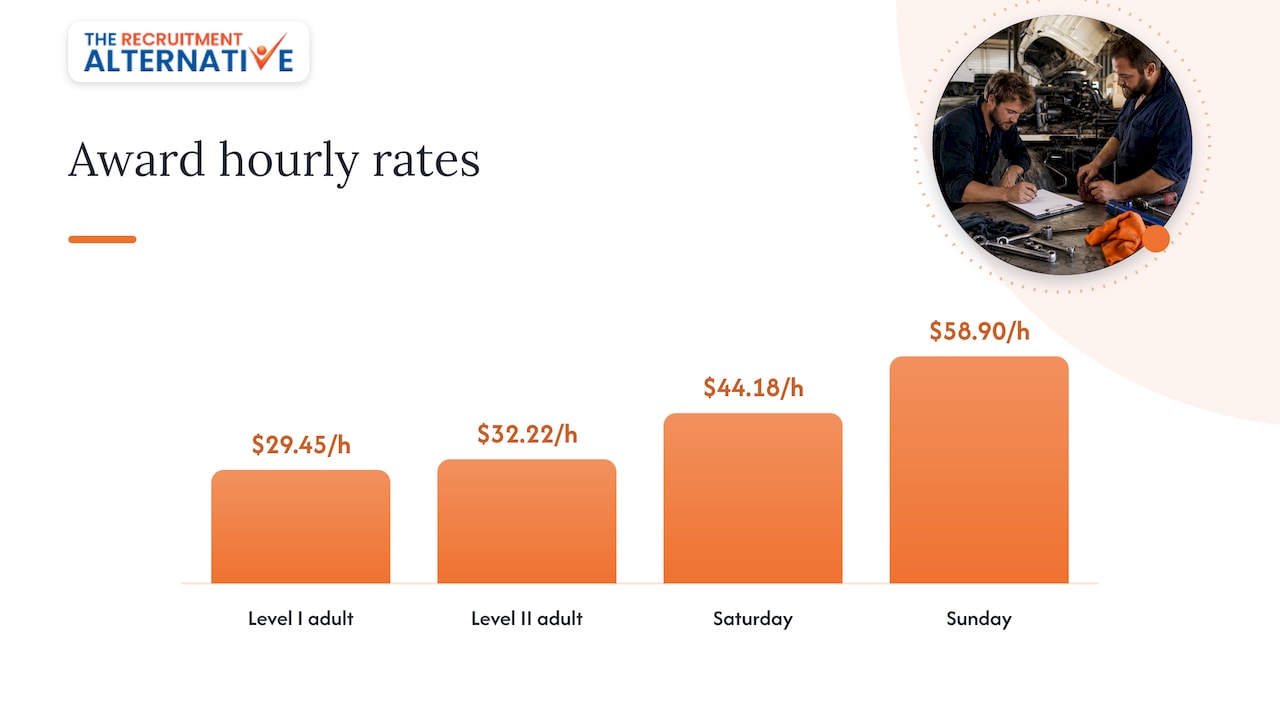
Many mechanics are covered by the Vehicle Repair, Services and Retail Award 2020 (MA000089). The Fair Work award page shows adult tradesperson rates from 1 July 2026 of $1,119.10 a week ($29.45 an hour) at Level I and $1,224.40 a week ($32.22 an hour) at Level II. Saturday work is paid at $44.18 an hour and Sunday work at $58.90 an hour. The Fair Work Ombudsman’s pay guide published 4 November 2026 confirms those penalty rates for the tradesperson classification, effective from the first full pay period on or after 1 July 2026.
A few rules affect how you roster and cost the role:
- Ordinary hours average 38 per week, worked on no more than five days.
- Superannuation guarantee is 12% of qualifying earnings, per the same award page.
- The ATO states that employers must pay super guarantee regardless of how much they pay the employee, and employees aged 18 or over are eligible regardless of hours worked.
- The award allows shifts over 10 hours, up to 12, only by agreement and with safeguards such as health monitoring, suitable rostering, supervision, adequate breaks and a trial or review process, as set out in the award text.
Award rates are a floor. Skilled heavy diesel mechanics are in demand across mining, transport and construction, and published job ads for the role show hourly rates, allowances and sign-on incentives well above minimums. Check your offer against current ads in your own city and against what the role is worth to your business. Not every mechanic is covered by this award: an enterprise agreement or a different industry award may apply, so confirm coverage with Fair Work or an adviser before you finalise a contract.
For older figures you may see quoted, note the dates. The MTA wage schedule effective 1 July 2025 listed Level I at $28.12 an hour and Level II at $30.76. Rates adjust each July, so always use the current pay guide.
The hiring process, step by step
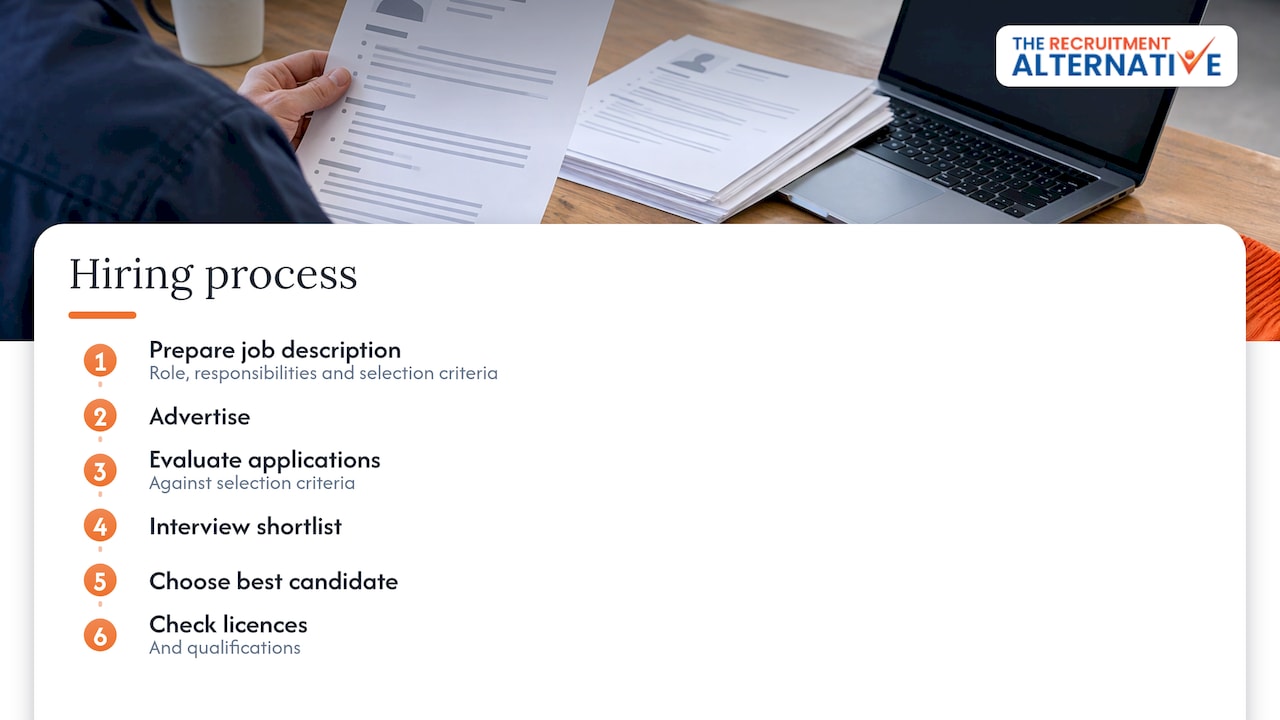
Business.gov.au sets out the basic sequence: prepare a job description with the role, main responsibilities and selection criteria, advertise, evaluate applications against those criteria, interview a shortlist, choose the best candidate and check licences and qualifications. For diesel mechanics, each step needs a trade-specific twist.
1. Write a position description that screens
List the equipment, the qualification required, the licences, the shift pattern and the supervision. Be specific about what is essential and what is desirable. Our guide to job ad requirements in Australia explains what to include and what the law says about pay and discriminatory wording.
2. Advertise where mechanics look
Job boards are full of competing diesel mechanic roles, so your advertisement has to stand out. Lead with the pay range, roster and equipment, not a list of company values. Mention tools, allowances, training and the career path. Strong employer branding for trades businesses helps a small workshop compete with larger operators for the same people.
Many qualified mechanics are already employed and not browsing. That is where direct sourcing, referrals and a recruiter’s network matter. Our overview of skilled trades hiring in Australia covers where demand is and how smaller employers win staff.
3. Shortlist against the criteria
Score each applicant on the same list: qualification, relevant equipment, years on comparable work, licences, roster fit and notice period. Look for stable tenure and evidence of progression, such as moving from servicing to diagnostics.
4. Test practical skills
A conversation does not show whether someone can diagnose a fault. A short practical task does. Options include:
- Diagnosing a seeded fault on a unit in your workshop, such as a no-start or a derate.
- Reading a wiring diagram or fault code output and explaining the next steps.
- A safety walk-through: lockout, jacking and stands, hot work, hazardous fluids.
Keep the task paid or short and tell candidates in advance. Make it relevant to the work they will do.
5. Interview with structure
Ask every candidate the same core questions, then follow up on detail. Useful prompts: describe the hardest fault you diagnosed and how you found it; how do you handle a vehicle you believe is unsafe to release; what do you do when a job runs over time. Our engineer interview questions guide shows how to keep technical interviews fair and consistent, and the approach carries over to trade roles.
6. Check before you offer
Verify the trade certificate, licence class and references. Where the job requires it, add a criminal history check and, for supervisory roles, a psychometric assessment. Confirm the candidate’s right to work in Australia.
Onboarding and keeping your mechanic
Hiring is only half the job. Sprintlaw recommends an induction covering tools and equipment, PPE, hazardous substances, incident reporting, manual handling and workshop rules. It also says each employee should know who supervises them, how overtime is approved and how to raise issues. Good onboarding reduces injuries and improves retention.
Beyond the first month, career paths keep people. Volvo Group Australia president Martin Merrick started as a diesel mechanic 37 years ago. He told Human Resources Director that career pathways across the whole enterprise are what make people stay. A small workshop can do the same on its own scale:
- Fund manufacturer or emissions-system training so the mechanic stays current on new technology.
- Offer a route into leading hand, workshop supervisor or fleet manager roles.
- Pay on time, roster fairly and keep overtime approvals clear.
- Invest in tooling and equipment, so skilled people can do good work.
The cost of replacing a tradesperson usually exceeds the cost of a training budget. If you want practical hints on holding on to people, see our SME guide to catching a keeper.
Our perspective: why fixed-fee recruitment suits trade hiring
Diesel mechanics are one of the harder trades to fill. Good candidates are often employed, they have choices, and a small workshop rarely has time to source, screen and interview while also keeping vehicles on the road.
Traditional agencies price this problem as a percentage of salary. The better the mechanic, the higher the fee. We think that model makes little sense for employers who need skilled trades. Our fixed-fee structure is designed so you know the cost before you start, whether the salary is modest or high.
We recruit permanent staff across trades, engineering, technology, healthcare, finance, sales, administration and executive roles, working with businesses of all sizes across Australia and New Zealand. Our process combines wide candidate sourcing with a clear brief, and our replacement cover applies if a hire does not work out in the first two to three months.
Our advice to employers is simple: write a precise brief, pay for the skill you need, test the practical side and make the first month count. We can help with the sourcing and screening so your time goes on the final decision.
Josh Townsend
What flat-fee recruitment costs for a diesel mechanic
We publish our fees. There are two service levels, and each has an engagement fee and a placement fee that depends on the candidate’s salary:
| Service | Engagement fee | Placement fee |
|---|---|---|
| Recruit | $895 | $3,900 to $5,000 |
| Recruit+ | $2,495 | $5,000 to $6,000 |
Optional extras are a criminal check at $129 and a psychometric evaluation at $199 per candidate. If a hire does not work out, a Replacement Campaign costs $1,000. See the full flat-fee price structure for the current detail, and our page on placement fee payment terms for how payment is structured.
For a sense of how this compares by type, a percentage-based agency fee rises with salary, so a well-paid senior mechanic can attract a much larger fee. Our own claim is that the flat-fee model delivers over 70% savings against commission-based agencies. Our flat fee recruitment benefits page explains the model in more detail.
Ready to hire a diesel mechanic?
We recruit permanent trade and technical staff for Australian and New Zealand employers on a fixed fee, so you know your recruitment cost before the search starts. Tell us the role, equipment and roster and we will source candidates against your brief.

See how fixed fee recruitment works, or read about our replacement cover if a hire leaves in the first months.
FAQ
Do I need a recruiter to hire a diesel mechanic?
No, but it helps when the role is hard to fill. Many qualified mechanics are already employed and do not respond to job ads, so a recruiter’s network and screening save time. A fixed-fee model keeps the cost the same whatever salary you offer.
What qualification should a diesel mechanic hold in Australia?
Look for a Certificate III in Heavy Commercial Vehicle Mechanical Technology or in Automotive Diesel Engine Technology, depending on the work. Ask for the certificate and a list of completed units. Check that the qualification matches your equipment, since mobile plant and agricultural work sit outside the heavy commercial vehicle occupation.
How much should I pay a diesel mechanic?
The award floor from 1 July 2026 is $29.45 an hour at Level I and $32.22 at Level II, with higher Saturday and Sunday rates. Competitive offers are usually above that, so compare current ads in your area. Confirm which award or agreement covers your workshop before you set pay.
What happens if my new mechanic leaves early?
We offer replacement cover if a hire does not work out in the first two to three months. A Replacement Campaign costs $1,000. Good onboarding and clear supervision also lower the risk of an early exit.
Sources
- Diesel Motor Mechanic (Heavy Commercial Vehicle), Vetassess
- AUR31516 Certificate III in Automotive Diesel Engine Technology, training.gov.au
- Diesel Motor Mechanic, Queensland Skills Gateway
- Position Description: Diesel Mechanic, ASQ
- Vehicle Repair, Services and Retail Award 2020, Fair Work
- Pay Guide, Vehicle Repair, Services and Retail Award, Fair Work Ombudsman
- Wage and Classification Schedule July 2025, MTA
- Vehicle Repair, Services and Retail Award 2020 text
- Work out if you have to pay super, ATO
- Guide to hiring employees, business.gov.au
- The workplace fleet safety system workbook, Queensland Transport
- Mechanic Employment Contracts, Sprintlaw
- Interview with Martin Merrick, Human Resources Director
- Diesel Truck DEF System Walkthrough for Technicians
- Jobmasters case study, Hummingbirds

