

To hire a DevOps engineer, define the problem the role must solve, budget for the full employment cost rather than the salary alone, test candidates on real production scenarios and check work rights before an offer. A small business can do all of that with a fixed-fee recruiter, so the cost of the placement is known on day one and does not grow with the salary. The Recruitment Alternative places permanent staff, including technology roles, on flat fees instead of a percentage of salary.
DevOps hiring is hard to get right because the title covers very different jobs. One employer needs a person to build deployment pipelines. Another needs someone to keep a cloud platform stable at 2 am. This guide explains how to tell which you need, what to pay, how to assess and what the law expects of you.
TL;DR
- A DevOps engineer automates how software is built, tested, released and run. Hire one when releases are slow, manual or risky, or when your cloud environment has outgrown whoever looks after it.
- Budget for the full cost: salary, 12% superannuation, leave, workers compensation and, above state thresholds, payroll tax.
- Test candidates with real scenarios (an incident, a design problem) and match the difficulty to the seniority you are hiring.
- Confirm the right to work in Australia before the offer, and keep the process documented.
- Percentage-based agency fees rise with every salary dollar. A flat fee stays fixed, which matters most for well-paid technical roles.
Table of Contents
- What a DevOps engineer does and when you need one
- Scope the role before you write the advertisement
- What a DevOps engineer costs in Australia
- Sourcing: where DevOps engineers are found
- Assessing candidates: test judgement, not tool trivia
- Your legal obligations as an Australian employer
- Adapting the search by role type
- How the fixed-fee model works for a DevOps hire
- Promo: hire your DevOps engineer on a fixed fee
- Our perspective
- FAQ
- Sources
What a DevOps engineer does and when you need one
DevOps is a way of working that brings the people who write software and the people who run it closer together, so changes reach customers quickly and safely. The Australian Bureau of Statistics lists DevOps Engineer as its own occupation. Its main tasks include leading continuous integration and delivery, automating deployment, promoting collaboration between development and operations, implementing containerisation, tuning performance and automating security testing and vulnerability scanning.
In plain terms, continuous integration and delivery (CI/CD) means code changes are tested and released automatically instead of by hand. Containerisation packages software so it runs the same way on any server.
Signs your business is ready to hire one:
- Releases take days, need a specific person and are scheduled around fear of breaking something.
- Your developers spend a large share of their week on servers, access and deployments instead of product work.
- Your cloud bill, uptime or security posture is managed informally by whoever knows the most.
- You are moving to the cloud, or have already moved and nobody owns the platform.
Before you start the search, work out how the role fits your plans. business.gov.au recommends workforce planning first: the tasks, the skills and qualifications needed, how busy the job will be and how long you need the person. For DevOps, the last question is the important one. If the work is a three-month migration, a contract may fit. If it is ongoing ownership of your platform, you need a permanent hire.
Scope the role before you write the advertisement
Most failed DevOps hires start with a job description that lists every tool in the industry. Candidates see through it, and strong ones skip it.
Start with three questions:
- What breaks today? Slow releases, outages, security gaps, cost blowouts.
- What will this person own? Pipelines, cloud infrastructure, monitoring, security tooling, or all four.
- Who will they work with? A team of five developers needs a different person from a business with a single developer and a software vendor.
For a sense of how larger Australian employers phrase it, the ASX’s DevOps Engineer posting asks for around five years of hands-on DevOps, cloud or platform experience, with a degree in computer science or IT, or equivalent practical experience. It names AWS, Terraform (infrastructure defined as code), Git, CI/CD tools, Docker and Kubernetes (software that runs containers at scale) and observability tooling. Treat that as a ceiling, not a template. A small business rarely needs every item, and a shorter list of what you actually use attracts better applicants.
A workable structure for the advertisement:
- Two sentences on what the business does and the problem this hire solves.
- Three to five core responsibilities.
- The cloud platform and two or three tools you really use.
- Must-have experience, separated from nice-to-have.
- Salary range, work arrangement and location.
Publishing a salary range gets more suitable applications and saves time on both sides.
What a DevOps engineer costs in Australia
Salaries vary widely by seniority, city and sector. One 2026 salary guide puts permanent cloud infrastructure and DevOps salaries at $115,000 to $175,000, and the top of the market for architects and platform leads sits above that. Sydney and Melbourne usually pay more than other cities. Check a current salary survey and live job advertisements for your city and level before setting a range, because these figures move.
The salary is only the start. Add:
- Superannuation. The super guarantee is 12% of qualifying earnings, and from 1 July 2026 it must be paid with each payday rather than quarterly.
- Leave. Annual leave, personal/carer’s leave and public holidays are part of the National Employment Standards.
- Workers compensation insurance, set by your state and your industry.
- Payroll tax, in states where your wages exceed the threshold.
- Equipment, software licences and training. Cloud certifications are a common request from DevOps hires.
A useful rule of thumb: model the real cost of a hire as noticeably more than the base salary, and build the budget on that figure. Our guide to engineering recruitment fees in Australia shows how the agency fee fits on top.
Why agency fees matter more for DevOps
Traditional agencies charge a percentage of the first-year salary. On a $150,000 salary, a percentage fee grows with every dollar you offer to win a candidate. Technical roles sit at the high end of salary scales, so percentage fees bite hardest here. A flat fee removes that link: the price of the placement does not change if the market forces your offer up.
Sourcing: where DevOps engineers are found
The best DevOps engineers are rarely scrolling job boards. The searches that top Google for this topic are job boards, which tells you where active candidates look. Passive candidates, who are employed and open to the right offer, are reached differently:
- Direct approaches on professional networks. Our piece on leveraging social media for recruitment covers how to do this without sounding like a mass message.
- Local technology meetups and cloud user groups.
- Referrals from your developers and your software vendors.
- Open-source contributions, which show how a person actually works.
It takes time to run all of these while you also run a business. That is where a recruiter earns its fee. With the Recruitment Alternative, you hand over the sourcing and shortlisting and pay a fixed amount for a permanent placement. Our technology recruitment guide explains how that search works for technology roles.
Assessing candidates: test judgement, not tool trivia
A certification quiz tells you someone studied. It does not tell you whether they can keep your service up when it fails. Better assessments look at how a person reasons.
GoCardless, a UK payments company, has published how it redesigned its DevOps interview. It separates technical knowledge, competency-based skills and personal characteristics. It uses a live hands-on challenge, a 90-minute pair-coding exercise with engineers and a final conversation about motivation, teamwork and influence. You do not need that scale, but the structure carries over to a small business.
A practical three-part process:
- Screen conversation (30 minutes). Ask about the last system they ran, what broke and what they changed afterwards.
- Scenario exercise (60 to 90 minutes). Describe an incident, such as a web service that starts returning errors with response times tripling. Ask how they would investigate, in what order and who they would tell. Then give a design problem and see whether they ask about release frequency and tolerance for downtime before they propose a solution. Good candidates ask questions first.
- Team conversation. Let a developer who will work with them join. DevOps is a collaboration role, and this is where you see whether they explain things clearly to people who are not infrastructure specialists.
Match the test to the level
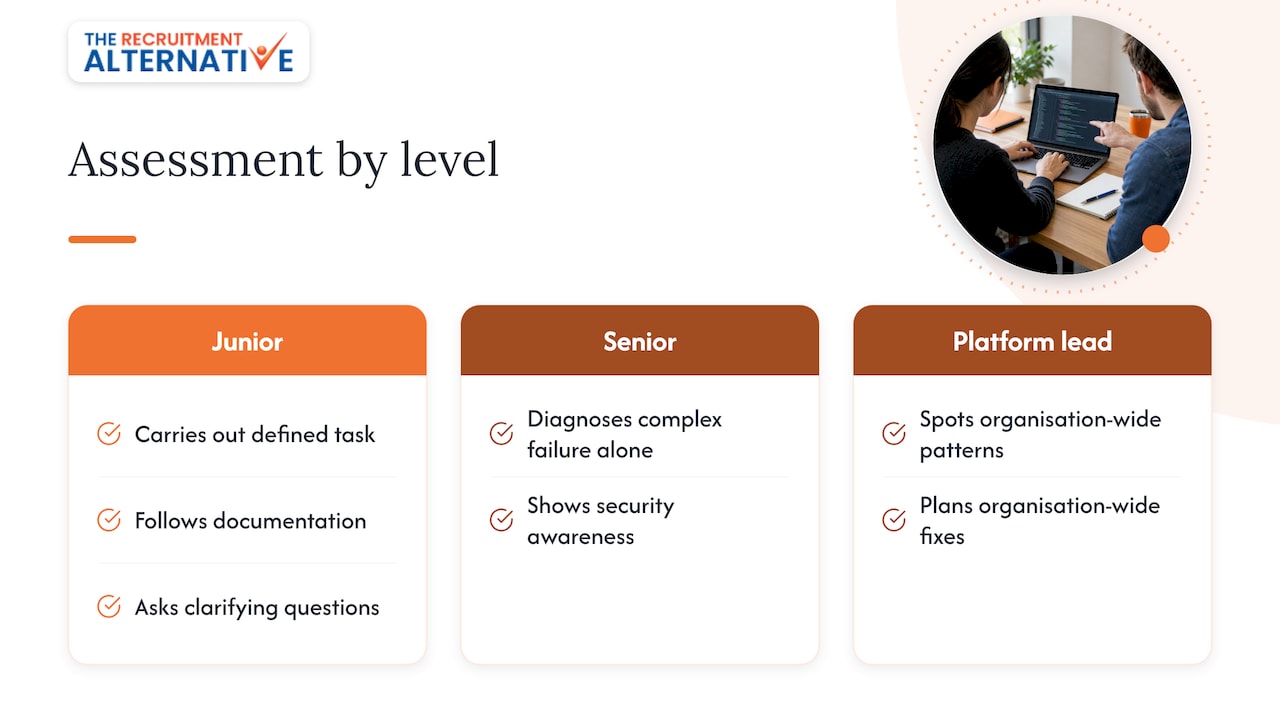
The same exercise will mislead you if applied to every level. A junior should be able to carry out a defined task, follow documentation and ask clarifying questions. A senior should diagnose a complicated failure independently and show security awareness. A platform lead should spot patterns that hurt the whole organisation and set out a plan to fix them. Hand a junior a senior’s problem and you lose a good trainee. Hand a senior a junior’s problem and you learn nothing.
For general interview fairness, our engineer interview questions checklist helps keep questions consistent and defensible. For wider planning, the technology role hiring checklist covers each stage.
If you want further checks, we offer a psychometric evaluation at $199 per candidate and an optional criminal check at $129.
Your legal obligations as an Australian employer
Right to work. business.gov.au states that employees must be Australian citizens or hold a visa that permits them to work in Australia, which generally includes permanent residents and New Zealand citizens. Check this before an offer, and keep a record. Our right to work check guide walks through it. If you are considering a candidate who needs sponsorship, take advice from a registered migration agent or the Department of Home Affairs before you promise anything.
Awards and minimum standards. The same government guide explains that most employees are covered by an award setting minimum pay, hours, allowances, penalty rates and leave. Those not covered still receive the minimum wage and the National Employment Standards. Many DevOps roles are paid well above award rates, but you should still check whether an award, such as the one covering professional employees, applies to your role. The Fair Work Ombudsman can confirm this for your situation.
Superannuation. Payday Super applies from 1 July 2026, so your payroll must pay super each pay cycle. Our summary of changes to superannuation explains what to update.
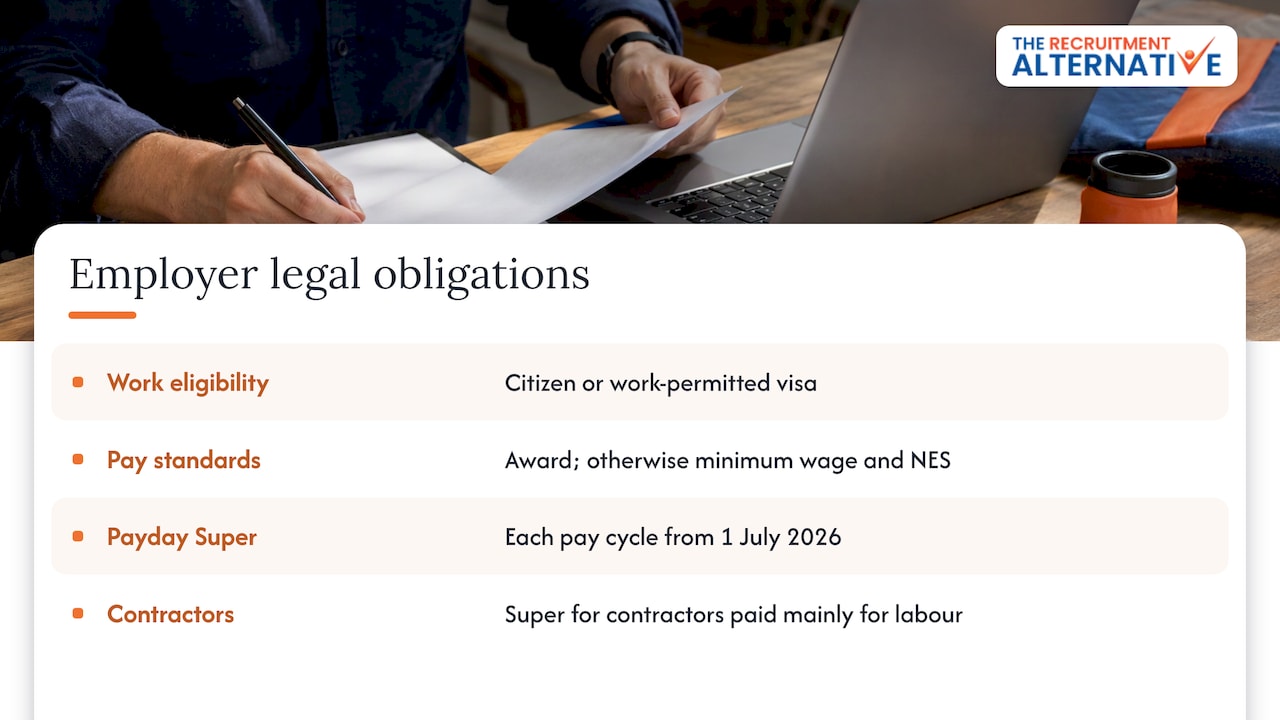
Contractor or employee. If you are weighing a contractor to avoid on-costs, be careful. The ATO says super is still payable for independent contractors paid mainly for their labour. For an ongoing platform role, a permanent hire is usually the simpler and more stable arrangement. If you are comparing a local hire with an offshore one, see our guide to hiring IT professionals locally or offshore.
Adapting the search by role type
- Junior or graduate. Look for curiosity and a home lab or small projects. Plan for mentoring time from a senior developer.
- Mid-level. The most contested group. Speed matters, because good candidates often hold several offers in a week.
- Senior. Test judgement and ownership. Expect them to ask about your risks, on-call expectations and authority to change things.
- Cloud-focused. Name your provider and ask for evidence of work on it, not only certificates.
- Platform or security-focused. These are rarer and more expensive. Define the scope tightly and be ready to move quickly.
For related infrastructure roles, our network engineer hiring guide follows a similar pattern.
How the fixed-fee model works for a DevOps hire
We recruit permanent staff across technology, engineering and many other fields, with fees based on candidate salary band instead of a share of pay. Two service levels are published on our flat fee pricing page:
| Recruit | Recruit+ | |
|---|---|---|
| Engagement fee | $895 | $2,495 |
| Placement fee | $3,900 to $5,000 | $5,000 to $6,000 |
The placement fee depends on the salary of the candidate. Fees are paid per successful permanent placement.
If a hire does not work out in the first two to three months, candidate replacement insurance applies, and a Replacement Campaign costs $1,000. For a high-salary technical hire, that predictability is the point: you know the cost of hiring before the offer is made. Our flat fee recruitment benefits page sets out the model in more detail.
Promo: hire your DevOps engineer on a fixed fee
If you need a permanent DevOps engineer and want a known cost from the start, our fixed-fee recruitment service is priced at $4,795 one-off. We source, shortlist and present candidates, and you decide who joins your team. See the fixed fee recruitment service to get started.
We place staff for small and mid-sized businesses across Australia and New Zealand.
Our perspective
Most small businesses we meet do not struggle to find a DevOps title. They struggle to afford the search, because a percentage fee on a technical salary is a large, unpredictable bill on top of the salary itself.
That is why we charge a flat fee. The price of the placement is set by the salary band, not by how hard the market pushes your offer. Our model is designed to deliver more than 70% in savings compared with traditional commission-based agencies, and a replacement guarantee covers the first two to three months.
Our advice is simple. Decide what the person will own, publish a realistic salary, test judgement with real scenarios and move quickly once you have a strong candidate. We handle the sourcing and shortlisting so you can spend your time on the interviews that matter.
Josh Townsend
FAQ
How long does it take to hire a DevOps engineer?
It varies with the seniority of the role, the salary you offer and how quickly you decide. Strong candidates are often considering several offers, so a short, well-organised process helps. Fixing your scope, salary range and interview steps before you start removes most delays.
Should I hire a permanent DevOps engineer or a contractor?
Hire permanently when the work is ongoing, such as owning your platform, pipelines and monitoring. A contractor suits a defined project with an end date. Remember that super can still be payable for contractors paid mainly for their labour, so the saving is smaller than it first looks.
Do I need a degree-qualified candidate?
Not always. Larger employers often ask for a degree or equivalent practical experience, as the ASX posting does. For a small business, proven hands-on experience with your cloud platform usually matters more than the qualification.
How much does a recruiter cost for a DevOps hire?
Traditional agencies charge a percentage of salary. Our Recruit service has a $895 engagement fee and a placement fee of $3,900 to $5,000, and Recruit+ has a $2,495 engagement fee and a placement fee of $5,000 to $6,000, depending on the candidate’s salary.
Can I hire a DevOps engineer from New Zealand?
New Zealand citizens can generally work in Australia, as business.gov.au notes, but you must still confirm their status before they start. We also recruit for businesses in New Zealand.
Sources
- Occupation 273332 DevOps Engineer, Australian Bureau of Statistics
- Guide to hiring employees, business.gov.au
- DevOps Engineer position, ASX Careers
- About Payday Super, Australian Taxation Office
- (Re)designing the DevOps interview process, GoCardless
- Contract vs Permanent Software Engineer Roles in Australia, 2026 salary guide

