
To hire a good logistics coordinator, write a precise position description, advertise where logistics candidates look, check right to work and any licences before an offer, and keep your hiring costs predictable. The same steps apply to warehouse workers and supervisors. This guide covers each one for Australian small and mid-sized businesses, including what a fixed-fee agency costs against a percentage-of-salary model.
TL;DR
- A logistics coordinator links suppliers, carriers and customers. Define the role by the freight, systems and compliance duties it carries, not by a generic title.
- Check right to work for every hire. Check a high risk work licence for anyone who will operate a forklift.
- Write the position description before you advertise, and score applicants against fixed criteria.
- Our fixed-fee model starts with an engagement fee of $895 (Recruit) or $2,495 (Recruit+), then a placement fee only when you hire.
- Warehouse and supervisor roles follow the same process, with more weight on safety, licences and team leadership.
Table of Contents
- What a logistics coordinator actually does
- Why logistics hiring is competitive right now
- Plan the role before you advertise
- Where to find logistics candidates
- How to assess applicants
- Hiring warehouse workers
- Legal checks every employer must complete
- What recruitment costs, and how fixed fees change the sum
- Our perspective
- Hire your next coordinator with a fixed fee
- A simple hiring timeline
- FAQ
- Sources
What a logistics coordinator actually does
Titles vary widely. Job boards list “logistics coordinator”, “transport allocator”, “dispatch coordinator” and “supply chain administrator” for overlapping work. Before you recruit, decide which of these you need.
The closest official occupation profile is Purchasing and Supply Logistics Clerks. Jobs and Skills Australia describes the work as preparing and processing orders, monitoring stock levels and supply sources, coordinating the flow of materials between departments, preparing production schedules, and coordinating storage and distribution.
In a small business this usually becomes a mix of:
- booking freight and liaising with carriers;
- tracking shipments and chasing exceptions;
- keeping stock and inventory records accurate;
- raising and reconciling purchase orders and delivery documents;
- answering customer questions about delivery status;
- working within safety and compliance obligations, including Chain of Responsibility.
The national training register lists “logistics coordinator” and “logistics supervisor” as possible job titles for the Certificate IV in Logistics, whose units include Chain of Responsibility safety and forklift operation. Note that this release has since been superseded, so a candidate may hold the current version. A qualification helps, but many strong coordinators come from dispatch, customer service or warehouse backgrounds.
Skills worth requiring
Keep the essential list short. Most coordinator roles need:
- Confident spreadsheet skills, plus experience with a transport or warehouse management system.
- Clear written and phone communication with drivers, suppliers and customers.
- Problem solving when a load is late, damaged or short.
- Attention to detail with documents and stock counts.
If your business imports or exports, add working knowledge of customs documentation as an essential or desirable criterion. If you do not, leave it off. Overlong requirement lists shrink an already tight candidate pool.
Why logistics hiring is competitive right now
Employers are not imagining the difficulty. The Australian Logistics Council’s September 2025 submission to Jobs and Skills Australia reports nearly 389,000 vacancies for warehouse technicians and distribution workers in August 2024. It also identifies forklift operators as a critical occupation, with shortages especially in regional centres.
A quick look at the major job boards shows the same thing from the candidate side. Thousands of coordinator and logistics listings are live across the country at any time, so a capable applicant often has several options. Your advertisement and process need to be clear and quick.
Plan the role before you advertise
The business.gov.au workforce planning guide suggests setting out your business goals, the roles and skills you need, your workforce gaps, the actions to close them, and who is responsible and by when. It recommends reviewing the plan every 6 to 12 months. For a small operator this can be one page.
Before advertising, it also advises reviewing your staff structure and writing a position description. Ask yourself:
- Is this a new role, or is it covering work the owner or an administrator now does?
- Does a coordinator, a supervisor or a general warehouse hand solve the actual problem?
- Is the role permanent full-time, part-time or casual?
- Who will this person report to, and will anyone report to them?
What goes in the position description
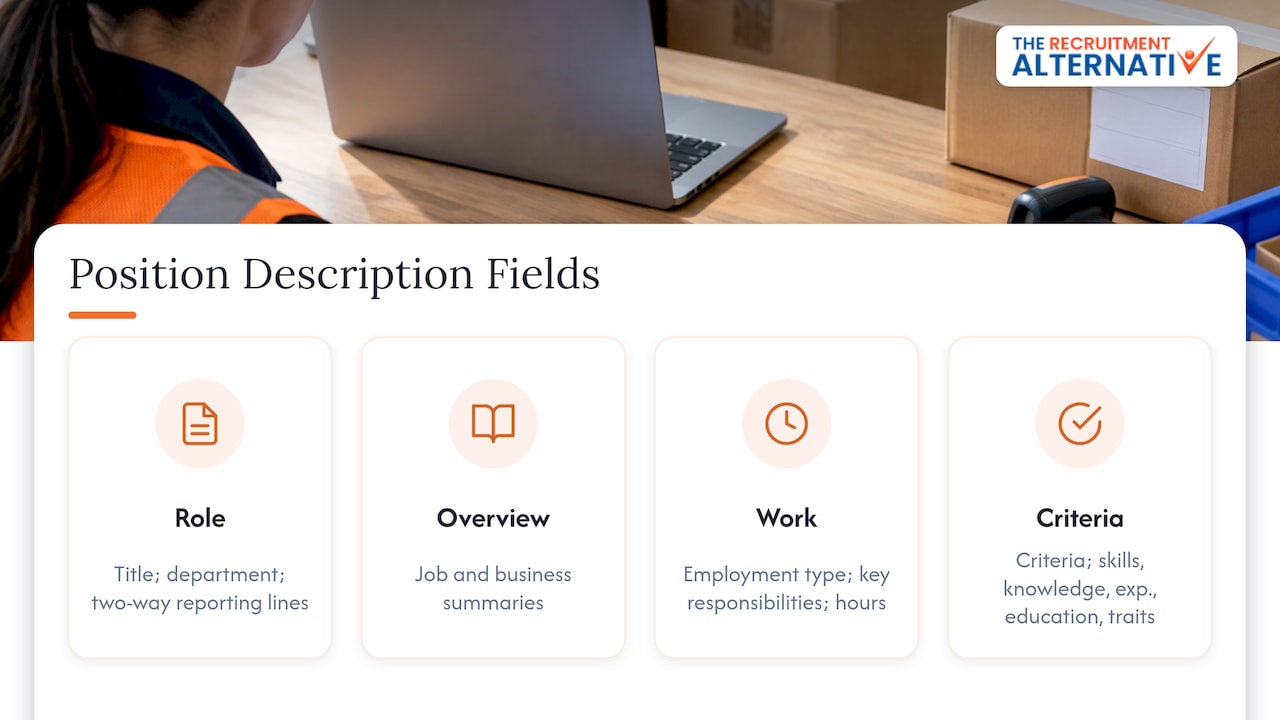
According to the business.gov.au guide to interviewing and recruiting employees, a good position description covers the job title, reporting lines both ways, the section or department, a job summary, a summary of the business, the employment type, key responsibilities, essential and desirable selection criteria, required skills, knowledge, experience or education, and desirable personal attributes.
For a logistics coordinator, make the responsibilities specific. “Book and track 30 to 50 outbound consignments a day” tells a candidate more than “manage logistics”. Name the systems you use. State the hours, including any early starts or cut-off times, because shift patterns decide whether many candidates apply.
Pay: check the award first
Many warehouse and logistics roles are covered by a modern award. The Storage Services and Wholesale Award 2020 lists a minimum hourly rate of $27.08 for a Storeworker grade 1 on commencement, in the version updated to 1 July 2026. Coordinators and supervisors may fall under this award or another, depending on duties and your industry, so confirm the correct classification on the Fair Work site or with an adviser before you set a salary. Rates change each year, so check the current figure at the time you advertise.
Where to find logistics candidates
business.gov.au suggests distributing advertisements through job websites, Workforce Australia, your own website and mailing list, social media, industry newsletters, trade journals, newspapers and university job boards. For logistics, a practical mix is:
- Major job boards for volume. Expect many applications, and expect to screen hard.
- Workforce Australia for entry-level warehouse and dispatch roles.
- Industry networks and trade newsletters for experienced coordinators who are not actively applying.
- Your own staff for referrals, particularly in warehouse teams.
- A recruitment agency when you need quality candidates quickly and cannot spend days on screening.
The last option is where cost matters most, which is covered below.
How to assess applicants
The same business.gov.au guide recommends a matrix rating system to evaluate applications. Put your essential and desirable criteria down one side, candidates across the top, and score each one before interviews. It keeps the decision tied to the position description rather than to first impressions.
For a coordinator, a short interview structure works well:
- Walk through a bad day. Ask for a time a shipment went wrong and what the candidate did, step by step.
- Test the systems. Ask which transport or warehouse system they used, and what they did in it daily.
- Run a small task. Give a sample set of orders and carrier cut-offs and ask them to sequence the bookings.
- Check communication. Ask how they would tell a customer a delivery will be late.
- Confirm references from a direct supervisor, not just HR.
Some employers add a psychometric evaluation for shortlisted candidates, which we offer at $199 per candidate.
Hiring warehouse workers
Warehouse hiring is a volume exercise with safety at its centre. A candidate’s attitude and reliability usually matter more than a long CV.
Check these before an offer:
- Right to work. See below.
- Licences and tickets. Safe Work Australia states that a person who operates a forklift must hold a high risk work forklift licence, and that training for the licence must be done through a Registered Training Organisation. A trainee may practise at your workplace only if enrolled with an RTO and directly supervised by a suitably licensed and experienced person.
- Physical capability for the manual handling the role involves, discussed openly and fairly in line with anti-discrimination rules.
- Induction. Every new starter needs a site-specific safety induction and the right PPE from day one.
If you want more on our approach to this sector, see our page on warehouse recruitment.
Hiring a warehouse supervisor
A supervisor is a different hire from a worker. The Australian Bureau of Statistics classifies the Warehouse Supervisor occupation at skill level 3. The main tasks include overseeing goods handling and organisation, managing inventory, allocating shipments and verifying orders, training and supervising staff, enforcing warehouse safety regulations and preparing records.
So when you recruit a supervisor, look for:
- proven team leadership, ideally with examples of rostering and handling performance issues;
- a current forklift licence if they will operate equipment;
- comfort with inventory and warehouse systems;
- a working understanding of WHS obligations and the ability to enforce them.
A strong picker is not automatically a strong supervisor. Ask how they have trained and corrected others. If you are also weighing a more senior operations role, our page on the warehouse and logistics manager career path shows how the roles connect.
Legal checks every employer must complete
The business.gov.au guide to hiring employees states that employers must provide a safe workplace, hold workers compensation insurance, check that employees have a legal right to work using the Department of Home Affairs’ free online service, and meet pay, minimum-condition and anti-discrimination requirements.
Two practical points for logistics employers:
- Right to work. Run the check before the first shift, and keep a record. Our right to work check guide explains the steps for employers.
- High risk work licences. Safe Work Australia’s High Risk Work Licences page states that workers must hold a valid, current licence before undertaking high risk work, including operating a forklift or reach stacker, and that the person conducting the business or undertaking must ensure they do. Ask to see the licence card and check it matches the equipment in your facility.
If your role involves a criminal history check, be clear with candidates about what you will check and why. For background on how record access is treated overseas, see this explainer on employers’ access to criminal records, which covers the Canadian position. In Australia, we offer an optional criminal check at $129 for employers who want one.
What recruitment costs, and how fixed fees change the sum
Traditional agencies commonly charge a percentage of the new hire’s salary. On a coordinator earning a mid five-figure or low six-figure salary, that fee grows with every salary dollar. A fixed fee does not.
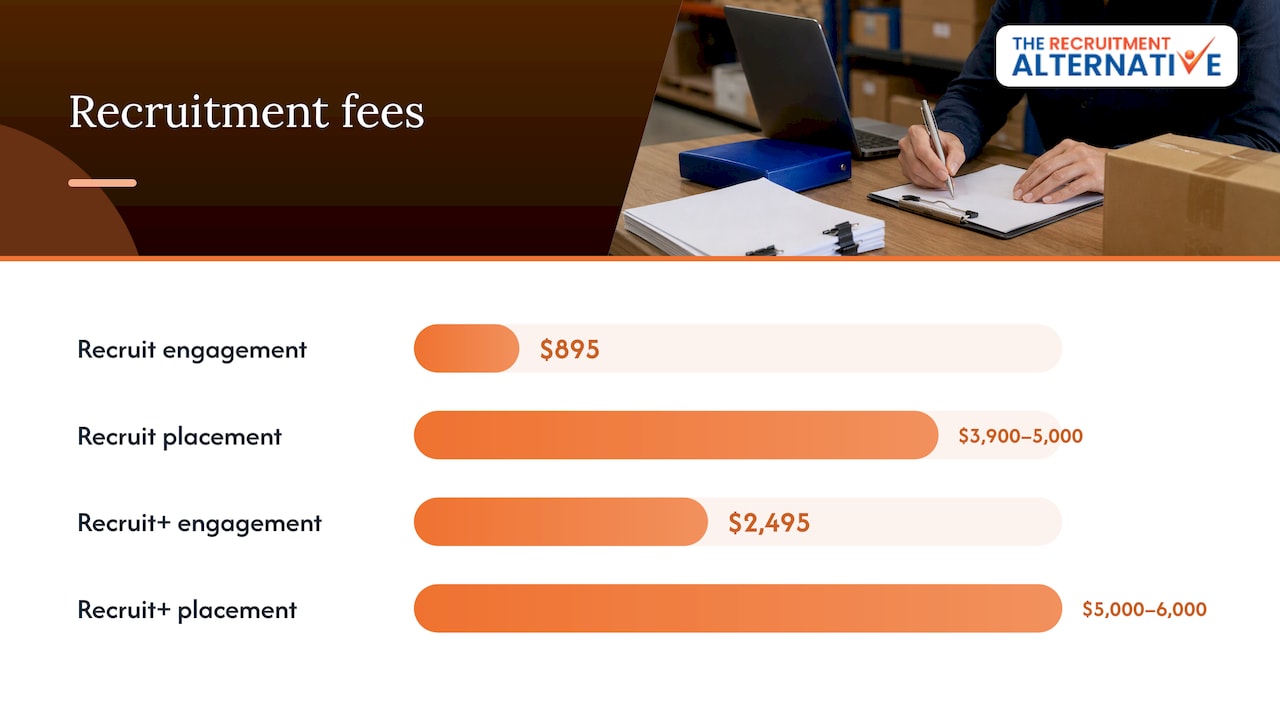
Here is how our published pricing works. The figures are from our fee structure page, and the exact tier depends on the candidate’s salary.
| Service | Engagement fee | Placement fee |
|---|---|---|
| Recruit | $895 | $3,900 to $5,000 |
| Recruit+ | $2,495 | $5,000 to $6,000 |
Add-ons are optional: a criminal check at $129 and a psychometric evaluation at $199 per candidate. If a hire does not work out in the first 2 to 3 months, our candidate replacement insurance applies, and a Replacement Campaign costs $1,000.
We estimate our model delivers savings of over 70% compared with traditional commission-based agencies. That is our own comparison, and your result will depend on the salary of the role. To see how the engagement fee works, read what you pay and why.
Our perspective
Most small logistics businesses we speak to are not short of applications. They are short of time. An owner who is also dispatching, invoicing and answering the phone cannot spend a week screening a few hundred résumés for one coordinator.
That is why we built a fixed-fee model. You know the cost before the search starts, and it does not rise because you picked a better candidate with a higher salary. For a business hiring one or two permanent staff a year, that predictability matters as much as the saving.
Our process is designed to find people who suit the role and the team, and our replacement cover is there for the first 2 to 3 months if a placement does not work out. We recruit across logistics, warehouse, administration, management and many other fields, so a coordinator, a supervisor and an office administrator can all go through the same transparent process.
Write a clear position description, be honest about hours and pay, and move quickly. Candidates in this field have choices, and the employers who act first usually win.
Josh Townsend
Hire your next coordinator with a fixed fee
If you want a shortlist of logistics, warehouse or supervisor candidates without a percentage-of-salary invoice, our fixed fee recruitment service is built for small and mid-sized employers across Australia and New Zealand. You pay an engagement fee to start and a placement fee when you hire.

See the full flat fee pricing to match a tier to your role.
A simple hiring timeline
A realistic sequence for one coordinator hire looks like this:
- Week 1: confirm the need, write the position description, set pay against the relevant award or market.
- Weeks 1 to 2: advertise and search your networks, or brief a recruiter.
- Weeks 2 to 3: score applications with your matrix and interview a short list.
- Week 3 or 4: check references, licences and right to work, then make the offer.
- Notice period and start: prepare the induction, systems access and PPE or equipment.
Notice periods often add several weeks, so start before the gap becomes urgent.
FAQ
What qualifications does a logistics coordinator need in Australia?
There is no single mandatory qualification. A Certificate IV in Logistics is a common pathway, and the national training register lists coordinator as a possible job title for it. Experience with dispatch, freight booking and a transport or warehouse system often counts for as much.
Does a warehouse worker need a forklift licence?
Only if they will operate a forklift. In that case Safe Work Australia states they must hold a high risk work forklift licence, obtained through a Registered Training Organisation. Ask to see the licence before they start on the equipment.
How much does it cost to hire logistics staff through a fixed-fee agency?
With us, the Recruit service has an $895 engagement fee and a placement fee of $3,900 to $5,000. Recruit+ has a $2,495 engagement fee and a $5,000 to $6,000 placement fee. The tier depends on the candidate’s salary.
What should I check before a new warehouse hire starts?
Confirm their right to work using the Department of Home Affairs’ free online service, check any required licences, and arrange a site-specific safety induction. Make sure workers compensation insurance is in place for the role.
Sources
- Purchasing and Supply Logistics Clerks, Jobs and Skills Australia
- TLI40319 Certificate IV in Logistics, National Training Register
- Australian Logistics Council submission, September 2025
- Workforce planning, business.gov.au
- Interview and recruit employees, business.gov.au
- Storage Services and Wholesale Award 2020, Fair Work Ombudsman
- Forklifts information sheet, Safe Work Australia
- Warehouse Supervisor occupation, Australian Bureau of Statistics
- Guide to hiring employees, business.gov.au
- High risk work licences, Safe Work Australia

