Hiring an HVAC technician comes down to three things: a role defined by the work the technician will actually do, licences checked against your state’s rules, and a process fast enough to beat the next employer. A fixed-fee recruiter helps with all three without taking a slice of the salary. At The Recruitment Alternative, permanent recruitment starts with a $895 engagement fee and a placement fee of $3,900 to $5,000 on our Recruit service, so the cost of a hire is known before the search begins.
TL;DR
- Define the role first: installation, service or commercial maintenance need different licences and experience, and the ABS treats this as a skill level 3 trade.
- Licensing differs by state and territory, so check the technician’s refrigerant and electrical credentials against the rules where they will work.
- Screen on five areas: HVAC-R systems, new refrigerants, electrical and controls, safety and compliance, and workplace skills.
- Budget for superannuation (now paid within 7 business days of payday from 1 July 2026), onboarding and a plan if the hire does not work out.
- A flat fee keeps agency cost predictable. Ours is $895 to engage and $3,900 to $5,000 on placement for Recruit.
Table of Contents
- Define the role before you advertise
- Licences and qualifications to check
- Where qualified HVAC technicians come from
- Screening and interviewing
- What a technician costs beyond the wage
- Checks before you make an offer
- Why a fixed-fee recruiter suits HVAC hiring
- Hire your HVAC technician with a fixed fee
- Our perspective
- FAQ
- Sources
Define the role before you advertise
Most failed HVAC hires start with a vague brief. “Air conditioning tech” can mean a residential split-system installer, a service technician on commercial rooftop units, or a refrigeration mechanic working on cold rooms. Each draws on a different mix of licences and experience.
The Australian Bureau of Statistics classifies air conditioning and refrigeration technicians at skill level 3. That corresponds to an AQF Certificate III with at least two years of on-the-job training, a Certificate IV, or at least three years of relevant experience. Use that as your baseline, then write down:
- The work mix: new installs, repairs, planned maintenance, or a combination.
- The equipment: split systems, ducted, VRF, chillers, commercial refrigeration.
- The licences that are essential and those that are desirable.
- Vehicle and tools: whether a company vehicle is supplied and who owns the tools.
- Travel and on-call: after-hours breakdown rosters are a common reason technicians say no.
Keep the “must have” list short. Employer demand is moving quickly: the May 2026 Powering Skills job functional analysis found job ads increasingly list CO2 systems, VRF experience and A2L refrigerant handling as desirable. If you list all of them as essential, you will shrink an already small pool. Decide what you can train and what you cannot.
Licences and qualifications to check
Australia does not have one national HVAC licence. Refrigerant handling is covered nationally by a licence through the Australian Refrigeration Council (ARC), while the right to do air conditioning and refrigeration work, and restricted electrical work, depends on the state or territory.
The ARC’s state and territory table (July 2023) lists refrigeration and air conditioning occupational licences in NSW, Queensland, South Australia (air conditioning installation only) and Victoria. It also shows that every jurisdiction except NSW lists a restricted electrical licence for this work. In practice that means the same candidate can be fully compliant in one state and need extra paperwork in another.
A few practical examples:
- NSW: the Building Commission lists the accepted qualifications for this work, including Certificate III qualifications such as UEE32225, UEE32220 and UTE30999, plus pre-10 December 2010 apprenticeships with a Certificate of Proficiency.
- Overseas-trained candidates in the ACT: Trades Recognition Australia describes a pathway that starts with an ARC trainee licence and a restricted electrical permit to work under supervision, followed by gap training and at least 12 months of supervision by a current full licence holder.
The rule for you is simple: ask for the licence cards, note the licence numbers and the issuing body, and confirm they cover the work you will assign. If a candidate lacks a required credential, business.gov.au points to hiring them as an apprentice or trainee as the route, which is a different job and a different timeline.
For wider context on trades demand and how it affects offers, see our guide to skilled trades hiring in Australia. If your technician is also an electrician or needs electrical authority, our piece on how hard it is to become an electrician explains the training behind that licence.
Where qualified HVAC technicians come from
Search results for this keyword are dominated by job boards, which tells you where your competition is. Sydney, Melbourne, Perth and Adelaide boards each carry hundreds of live HVAC listings, so a standard advert is one of many. Most qualified technicians already have a job, which is why passive candidates matter.
The channels that usually work for a small business:
- Your own team and customers. Referrals from existing technicians cost nothing and arrive pre-vetted by someone you trust.
- Job boards. Useful for volume, but expect many unqualified or unlicensed applicants for each real prospect. Name the licence in the headline.
- Trade and supplier networks. Wholesalers and manufacturers’ reps know who is moving.
- Direct approach. Contacting technicians who are not applying is slow when you are also running jobs, which is the point where a recruiter earns the fee.
- Apprentice-to-tradesperson pipeline. Slower, but it builds loyalty.
Owner-operators often tell us the real cost is not the advert, it is the weeks of site time lost to shortlisting. That is why many small firms hand the search to a recruiter and keep their own time for interviews.
Screening and interviewing
A CV tells you what a technician says they have done. Your screening should test what they can do and how they work.
The Powering Skills analysis groups the skills employers assess into five categories, which makes a useful interview framework:
| Area | What to ask about |
|---|---|
| HVAC-R systems | Fault-finding on the equipment you actually run, commissioning, maintenance routines |
| Emerging refrigerants and heat pumps | Experience with R-32, CO2, ammonia or hydrocarbons, and the handling controls for each |
| Electrical and controls | Restricted electrical licence work, building management systems, PLC interfaces |
| Safety and compliance | Familiarity with standards such as AS/NZS 5149 and AS/NZS 1668 |
| Workplace skills | Communication with customers, problem-solving, digital job-sheet use |
The same report notes that flammable-refrigerant risk controls and digital controls are not fully covered by current training packages, so a Certificate III alone does not prove competence there. Ask for examples: “Tell me about the last time you handled a flammable refrigerant on site. What did you do before you started?”
Practical steps that save time:
- Phone screen first (15 minutes): licences, availability, pay expectations, location.
- Structured technical interview: the same questions for every candidate, scored against your must-haves.
- Scenario questions: a no-cooling call at a restaurant on a Friday afternoon reveals more than a list of tasks.
- Reference calls with former supervisors, not just colleagues.
If you are screening many applicants across regions, video interviewing platforms can let candidates answer set questions in their own time, so you review them after hours rather than losing a day on site.
What a technician costs beyond the wage
Before you set a salary, compare it with live adverts for your city and the relevant modern award or enterprise agreement. Listings in the major cities currently show a wide spread, so use several recent adverts rather than one figure. Then add the on-costs:
- Superannuation. The rate has been 12% of ordinary earnings since 1 July 2025. From 1 July 2026 contributions must also reach the employee’s fund within 7 business days of payday, and the ATO’s Small Business Superannuation Clearing House closed on 1 July 2026. Check your payroll software handles this. Our summary of superannuation changes in Australia covers the detail.
- Workers’ compensation insurance, leave loading and payroll tax where it applies in your state.
- Vehicle, tools, uniform and PPE.
- Licence renewals and training, particularly if you want the technician qualified on newer refrigerants.
- Agency or advertising cost.
Checks before you make an offer
Once you have a preferred candidate, complete these before the contract goes out:
- Licence verification with the issuing body for each credential you rely on.
- Right to work. Confirm citizenship, permanent residency or a visa with work rights. Our right to work check guide walks through it.
- Reference checks with at least two previous supervisors.
- Driver’s licence check, since most roles involve a vehicle.
- Police or criminal history check where the role takes the technician into homes, aged care or schools.
- Written offer and contract that states the role, location, pay, hours and probation.
From 1 July 2025, employers must give every new employee the updated Fair Work Information Statement. The same source notes that nationally aligned WHS regulations on psychosocial hazards took effect on 1 December 2025, so your induction should cover how you manage workload, remote work and conflict as well as physical hazards.
On day one, a site induction and clear first-aid arrangements matter, especially for technicians working alone or on remote jobs. This overview of employer first aid duties is a useful checklist when you set up crews who work away from the office.
Why a fixed-fee recruiter suits HVAC hiring
Percentage-based agencies charge a share of the first-year salary. For a trade role that can run into several thousand dollars more than a flat fee, and the cost rises every time you raise the pay to win a candidate. A flat fee separates the two: you can offer a competitive wage without enlarging the invoice.
Here is how our published structure works for employers:
| Service | Engagement fee | Placement fee |
|---|---|---|
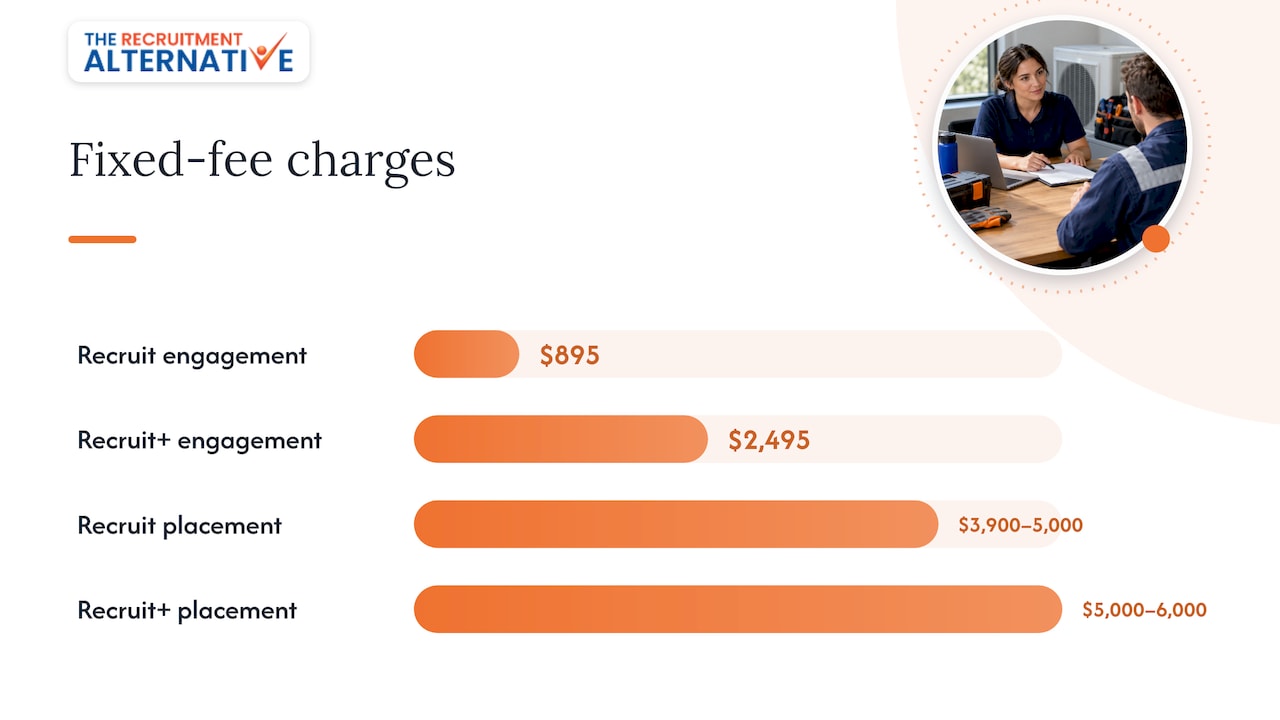
| Recruit | $895 | $3,900 to $5,000 |
| Recruit+ | $2,495 | $5,000 to $6,000 |
Optional extras are a criminal check at $129 and a psychometric evaluation at $199 per candidate. You pay the placement fee only on a completed permanent placement. Our own claim is savings of over 70% compared with commission-based agencies. The full breakdown is on our flat-fee pricing page, and our guide to flat fee recruitment benefits explains how the model compares.
We also include candidate replacement insurance if a hire does not work out in the first 2 to 3 months. If you need to run a new search, a Replacement Campaign costs $1,000.
If you are filling several trades roles, our guides to plumber hiring and diesel mechanic hiring follow the same approach.
Hire your HVAC technician with a fixed fee
We recruit permanent staff for small and mid-sized businesses across Australia and New Zealand, including trades and engineering roles. Fixed Fee Recruitment is listed at $4,795, and the engagement and placement fees above show how the cost is built for each service. If you have a technician role to fill, you can start on our Fixed Fee Recruitment page.

Tell us the licences, the equipment and the location, and we will work from that brief.
Our perspective
The pattern we see in trades hiring is that a small business loses weeks to a search it never planned for. The owner is on the tools, the adverts bring a pile of CVs, and the good technician takes another offer while the shortlist is still being written.
We built a flat-fee model so that cost does not become a reason to delay. When the fee stays the same whether the technician earns more or less, you can pay what the market demands and still know the recruitment bill in advance. For an HVAC role, where licences and refrigerant experience set the pay, that predictability matters.
Our advice is to write the role around the work, verify every licence, and decide quickly once you have found the right person. We back that with a 2 to 3 month replacement guarantee, because a placement is only a success if the technician is still there and doing the job.
Josh Townsend
FAQ
How do I hire an HVAC technician in Australia?
Define the role and the licences it needs, advertise or approach candidates directly, screen against your must-haves, verify licences and right to work, then issue a written offer. A recruiter can run the search and shortlisting while you handle the interviews.
What licences does an HVAC technician need?
It depends on the state or territory and the work. The ARC’s state table shows occupational licences for refrigeration and air conditioning in NSW, Queensland, South Australia (installation only) and Victoria, and restricted electrical licences in every jurisdiction except NSW. Confirm the details with your state regulator before you hire.
How much does HVAC recruitment cost?
With us, Recruit has an $895 engagement fee and a placement fee of $3,900 to $5,000. Recruit+ has a $2,495 engagement fee and a placement fee of $5,000 to $6,000. Fees are fixed and do not change with the candidate’s salary within the tier.
Can I hire an HVAC technician who is not fully licensed?
Only for work their licence permits. Business.gov.au suggests an apprenticeship or traineeship where a candidate lacks required qualifications. Check your state rules for supervised work before you assign tasks.
Sources
- Unit Group 3821 Air Conditioning and Refrigeration Technicians, ABS
- Defining HVAC-R Competence: Job Functional Analysis, Powering Skills
- State and territory regulatory requirements, Australian Refrigeration Council
- Air conditioning and refrigeration work, NSW Government
- Air-conditioning and Refrigeration Mechanic, Trades Recognition Australia
- Guide to hiring employees, business.gov.au
- What NSW small businesses need to know in 2026
- Tradie Legal Requirements in Australia, Made4Tradies
- Construction Industry Compliance Updates 2025-2026, WorkPro
- How Video Recruitment Platforms Work
- WHS First Aid: 4 Duties for Australian Employers at Remote Sites