

Hiring a digital marketing specialist goes well when you decide what one channel the business needs fixed first, write the role around it, and test real work before you make an offer. It goes badly when the job ad lists every channel and the shortlist is judged on a good interview. A fixed-fee recruiter takes the sourcing and shortlisting off your desk without a percentage of the salary attached: at The Recruitment Alternative, the Recruit engagement fee is $895 and the placement fee is $3,900 to $5,000.
TL;DR
- Hire for one or two channels in depth (SEO, paid media, content and social, or email and CRM), not a person who does everything.
- Write a proper position description first: reporting line, responsibilities, selection criteria and the tools you already use.
- Score applicants against the role on a simple 1 to 5 matrix, then test the shortlist with a short, paid task using real data.
- Budget for the salary plus 12% superannuation, and agree the recruitment fee model before you start.
- A flat fee keeps the cost of a permanent placement fixed, whatever salary the specialist negotiates.
Table of Contents
- What a digital marketing specialist actually does
- Decide the role before you write the ad
- Where to find candidates
- Assess the work, not the interview
- What the hire costs
- A 90-day plan once they start
- How we approach it
- Our view on hiring a marketer
- Hire your digital marketer with a fixed fee
- FAQ
- Sources
What a digital marketing specialist actually does
The title covers a wide range of jobs. The Australian Bureau of Statistics groups advertising and marketing professionals as a Skill Level 1 occupation. That means most roles need a bachelor degree or higher, though at least five years of relevant experience can substitute for the qualification. Its listed tasks include publishing content to social media and websites, analysing campaign data and recommending content updates to improve search metrics.
In a small business, that translates into a handful of practical jobs:
- Running paid campaigns on Google and Meta and reporting what they return.
- Improving search visibility through on-page SEO and local listings.
- Producing and scheduling content for the website, email and social channels.
- Reading analytics and turning them into a weekly plan.
A specialist usually owns one or two of these in depth. A guide for Australian businesses from ALC Consulting makes the same point: you hire a specialist when one channel matters enough to need dedicated expertise. If you need someone to run everything from the website to the newsletter, you are hiring a generalist, and the role, the salary and the interview questions are different.
Decide the role before you write the ad
Most weak hires trace back to a vague brief. Before anything is advertised, answer four questions:
- Which result do you want in 12 months? More enquiries, lower cost per lead, or a rebuilt email list. Pick one.
- Do you need someone to build the strategy or run it? A strategist is a different hire from an executor who delivers a plan you already have.
- Which channel is the priority? This sets whether you need a paid media person, an SEO person or a content person.
- Who will manage them? A marketer with no one to report to, or no one who can judge their work, struggles in a small team.
Then put it on paper. business.gov.au advises writing a position description from scratch that covers the job title, reporting lines, department, a job summary and business summary, employment type, responsibilities, selection criteria, required skills, knowledge, experience or education, and the cultural attributes you want. For a digital marketer, add the platforms and tools you already use (Google Ads, Meta Business Suite, Mailchimp, HubSpot, your CMS) so applicants can see whether they fit.
Skills and experience worth requiring
Keep the essential list short and tied to the channel. For a paid media role, that is platform experience, budget management and the ability to explain results in plain English. For an SEO or content role, it is demonstrable search results, copywriting and CMS experience. A degree or diploma is a reasonable preference, but evidence of past campaigns tells you more. ALC Consulting suggests looking for genuine channel depth, reporting tied to commercial outcomes and a verifiable track record, and treating promises of guaranteed rankings as a red flag.
Where to find candidates
The best marketers are often employed, so a single job ad rarely reaches them. business.gov.au lists the usual places: job websites, Workforce Australia, your own website and mailing list, personal networks, social media, industry newsletters and university job boards. Your ad should state the wage, benefits, location, start and closing dates and how to apply. It should also meet minimum pay and conditions, and anti-discrimination and equal opportunity requirements.
The broader picture of where to look is covered in our guide to candidate sourcing channels in Australia, and our piece on recruitment advertising for Australian SMEs explains what an ad should and should not do.
The constraint for a small business is time. Writing the ad, reading 80 applications, ringing referees and chasing candidates can take weeks of an owner’s attention. That is where an agency earns its fee, as long as the fee does not scale with the salary.
Assess the work, not the interview
Marketers are trained to present well. Your process should look past the presentation.
Score every applicant the same way
business.gov.au suggests a scored matrix: rate each applicant from 1 to 5 against every requirement in the position description, then use the totals to choose who to interview. It keeps the decision on the role rather than on who wrote the friendliest cover letter.
Look at real work
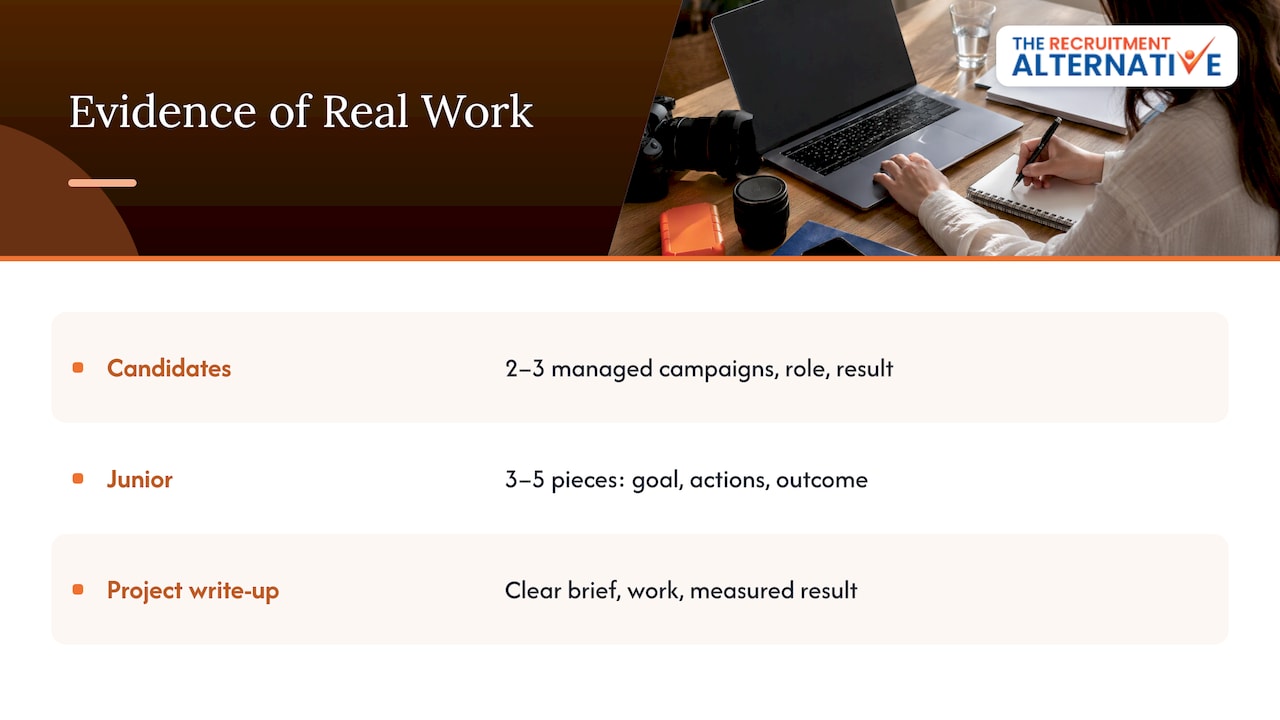
Ask for two or three campaigns or projects the candidate personally managed, with their role and the result. The Ranked playbook for Australian SMEs recommends exactly that, and the question separates the person who ran the campaign from the person who sat in the meeting. For junior candidates, a small portfolio of three to five pieces that show the goal, the candidate’s actions and the outcome can be more telling than a qualification, according to 20 Minute Marketing.
If you want to know what a strong write-up of a project looks like, reviewing marketing case studies gives you a benchmark: a clear brief, the work done and a measured result.
Run a short, paid task
A two to four hour task using sample data shows how a person thinks. Anahaw Media gives an example for Google Ads: review a search terms export, list negative keywords and suggest three changes with reasons. Pay for the time. The Fair Work Ombudsman says a brief work trial can be lawfully unpaid only in narrow circumstances: it must be no more than a demonstration of relevant skills and last only as long as needed. A paid task avoids the question entirely.
Interview questions that work
- Walk me through a campaign you set up from scratch. What was the budget and the goal?
- What did you change in the first month, and why?
- How do you report results to someone who does not know marketing?
- Which result would you not take credit for, and why?
Take notes against your matrix, check references and give the preferred candidate a written offer with the terms and conditions, as business.gov.au recommends.
What the hire costs
Budget more than the salary. Employers must pay superannuation on top, and the super guarantee rate rose to 12% on 1 July 2025, the final scheduled increase. Add equipment and software, leave, and the recruitment fee. Salaries for digital marketers vary widely by city, channel and seniority, so check current listings for the role you are hiring before you set a range.
The recruitment fee is the line you can control. Many agencies charge a percentage of the first-year salary, which means a stronger candidate costs you more. A flat fee removes that link: the price is set by the service you choose, not by what the person earns.
Our fixed fees
| Service | Engagement fee | Placement fee |
|---|---|---|
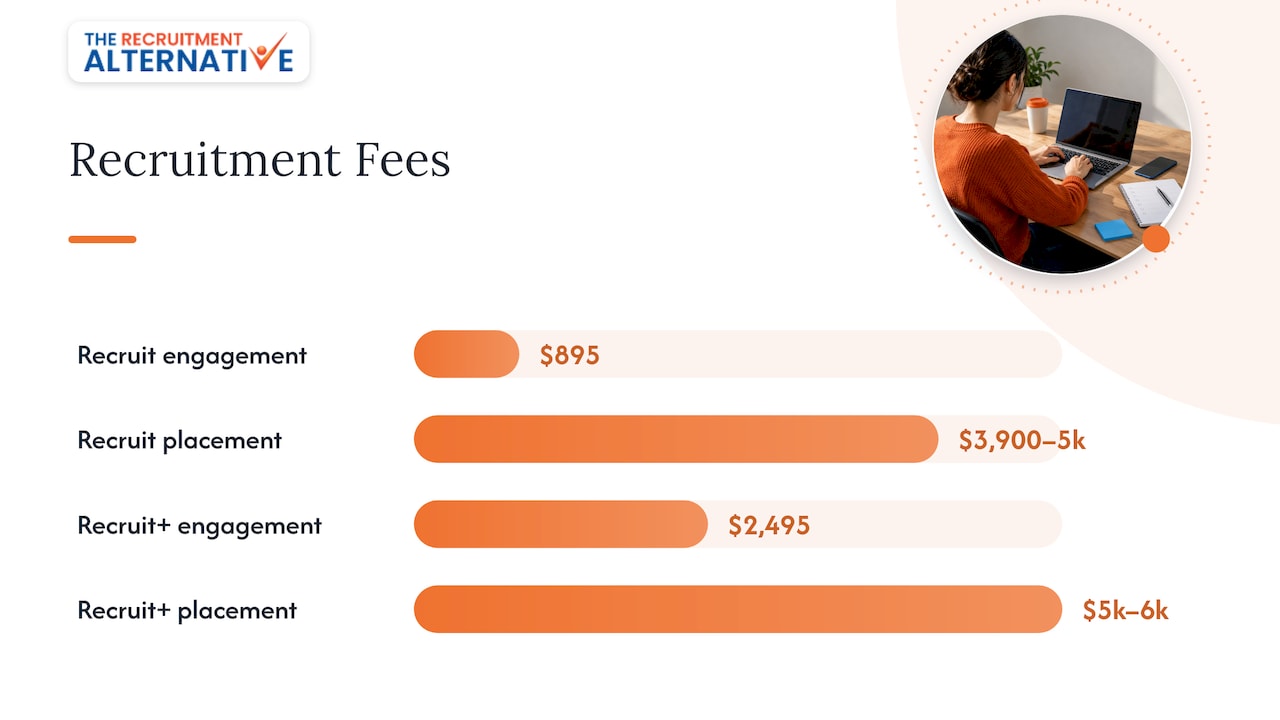
| Recruit | $895 | $3,900 to $5,000 |
| Recruit+ | $2,495 | $5,000 to $6,000 |
These are the published fees on our flat-fee pricing page. Placement fees are tiered by the salary of the role. As a worked example, the Recruit engagement fee of $895 plus a $3,900 placement fee comes to $4,795. At the top of the Recruit range, $895 plus $5,000 comes to $5,895. Optional extras are a criminal check at $129 and a psychometric evaluation at $199 per candidate. We state our own claim plainly: our flat-fee model is designed to deliver savings of over 70% compared with commission-based agencies.
If the hire does not work out, our candidate replacement insurance covers the first two to three months, and a Replacement Campaign is $1,000.
A 90-day plan once they start
The hire is not finished at the offer. Anahaw Media sets out a 90-day onboarding plan that suits a small business well:
- Days 1 to 30: a channel audit, some quick fixes, and taking over routine tasks.
- Days 31 to 60: weekly tasks run without reminders, a clear weekly update, and one or two small tests.
- Days 61 to 90: improving results, with management focused on output rather than hours logged.
Agree these targets in writing at the offer stage. A marketer who knows what good looks like by day 90 is easier to support, and easier to assess against the position description.
How we approach it
Our approach is built for owners who cannot spend a month on a hire. We recruit permanent staff across sales, management, administration, finance, engineering, healthcare, trades, technology and executive roles, for businesses of every size across Australia and New Zealand. If you would rather see how that works for a marketing agency, read our Big Ant Marketing case study. For a related role, see our guide to recruiting technology staff.
Our view on hiring a marketer
The most expensive part of a marketing hire is rarely the fee. It is the six months a business spends with the wrong person in the seat, while the campaigns stall and the owner wonders what went wrong.
We built our model around that. A flat fee means you know the cost of the placement before you start, and a replacement cover in the first two to three months means a poor fit is not a second full bill. Small businesses should not have to pay more simply because they found a better candidate.
Our advice on a digital marketing role is the same as for any other: decide the one result you want, write the role around it, and judge people on work they have actually done. We handle the engagement and the placement, and you keep the decision.
Josh Townsend
Hire your digital marketer with a fixed fee
If you are ready to fill a permanent marketing role, our Fixed Fee Recruitment service is a one-off $4,795. Choose between Recruit and Recruit+ on the pricing page, and the placement fee follows the salary of the role.
You pay for a completed permanent placement, not for a percentage of what your new marketer earns. For how the model works, see flat fee recruitment benefits for Australian employers.
FAQ
Should I hire a specialist or a generalist?
Hire a specialist when one channel, such as paid ads or SEO, drives most of your enquiries. Choose a generalist when you need one person to cover the basics across email, social and the website. Decide this before you write the ad, because it sets the skills, the salary and the interview questions.
How much experience should a digital marketing specialist have?
For a specialist role, one to three years in digital marketing, content or a related role is a common starting point, with more for roles that involve strategy or budgets. Evidence of results in your priority channel matters more than years alone. For junior roles, a small portfolio can show capability.
How long does it take to hire a digital marketer?
It depends on the channel, the location and how quickly you respond to candidates. Allow time for sourcing, a skills task, interviews, reference checks and the candidate’s notice period. A clear position description and a fast, consistent process shorten it more than anything else.
Do I have to pay candidates for a skills test?
Paying is the safe option. A brief work trial can be unpaid only in narrow situations, and it must be limited to demonstrating skills relevant to the vacant job. A short, paid task with sample data avoids the risk and respects the candidate’s time.
What does it cost to use us for a marketing hire?
Our Recruit service has an engagement fee of $895 and a placement fee of $3,900 to $5,000. Recruit+ has an engagement fee of $2,495 and a placement fee of $5,000 to $6,000. Fees are one-off, and a criminal check ($129) and psychometric evaluation ($199 per candidate) are optional.
Sources
- ABS: Unit Group 2251 Advertising and Marketing Professionals
- business.gov.au: Interview and recruit employees
- ATO: The final SG rate increase is coming on 1 July
- Fair Work Ombudsman: Unpaid work fact sheet
- ALC Consulting: What is a digital marketing specialist?
- Anahaw Media: How to hire a remote digital marketer in Australia
- Ranked: Hiring a digital marketing generalist
- 20 Minute Marketing: Junior marketers, a portfolio beats a qualification

