

The right electrician hiring process runs in this order: define the role by licence tier, verify that licence with the issuing board before you interview anyone, run a blended sourcing plan across apprentices, referrals and targeted lateral hires, then assess with a short structured interview that weighs safety heavily. With Jobs and Skills Australia report long vacancy periods for tradies, employers who move fast and verify properly win the better candidates. Some recruitment agencies offer a fixed-fee route for employers who want that speed without building the process from scratch.
TL;DR:
- Verifying licences directly with the issuing board before interviews is crucial to avoid costly hiring mistakes and reduce the timeframe to fill vacancies.
- Employers should specify the exact licence tier and relevant setting in their ads to attract qualified applicants and prevent unqualified or slow responses.
- Running multiple sourcing channels, including apprenticeships, referrals, and adjacent trades, ensures a steady pipeline despite current labour shortages and tight markets.
- Conducting fast yet thorough verification, including licences, safety credentials, and references, significantly shortens the hiring process and improves candidate quality.
- Using fixed-fee recruitment services that verify candidates beforehand helps save time and ensures a reliable shortlist, especially for urgent or large-scale projects.
Table of Contents
- What does the electrician hiring process actually look like?
- How do you define the role by licence tier and setting?
- Where do you find qualified electricians right now?
- What screening steps actually predict a good hire?
- How do you onboard an electrician so they actually stay?
- How does a fixed-fee recruiter handle electrician hires?
- What most hiring advice gets wrong about electricians
- When should you bring in a fixed-fee recruiter?
- Where to check licences and sector data yourself
- Sources
- FAQ
What does the electrician hiring process actually look like?
The full electrician hiring process runs on a tight, sequential timeline. Employers who treat each stage as a discrete task with its own deadline fill roles faster and lose fewer candidates to competitors.
- Define the role (1 to 3 days): lock in licence tier, work setting and non-negotiable credentials before you write the ad.
- Sourcing (ongoing, first 2 weeks active): push the ad across apprenticeship networks, referral channels and targeted outreach simultaneously.
- Screen and interview (1 to 2 weeks): verify licences, check references and run a short technical conversation.
- Offer and paperwork (3 to 7 days): confirm salary, super, and any conditions in writing quickly.
- Onboarding (first 30 days): site induction, mentoring assignment and a documented safety observation period.
Speed matters more than it used to. Major infrastructure and housing projects are pulling qualified electricians away from smaller employers within days of a job going live, and the Powering Skills Organisation is already flagging a shortfall of 72,000 electricians and related tradespeople by 2030. Copy this five-step sequence straight into your applicant tracking system as a project plan.
How do you define the role by licence tier and setting?
Vague job ads cost you good applicants. An electrician’s legal scope of work changes sharply between an apprentice, a journeyman (often called a licensed or fully qualified electrician) and a master electrician, and each tier carries different supervision requirements and insurance implications for your business.
An apprentice works under direct supervision while completing a registered training contract. A journeyman holds an unrestricted licence and can work independently on most jobs within their class. A master electrician typically carries additional endorsements, such as the authority to design systems or supervise other licensed workers, depending on the issuing state or territory board.
Match the tier to the setting before you post the ad:
- Residential: usually a journeyman licence with general electrical endorsement.
- Commercial: journeyman or master, often with fire and security system experience.
- Industrial: master electrician or journeyman with specific high-voltage or PLC experience.
- Maintenance: journeyman with breadth across HVAC-adjacent and general fault-finding work.
Your job-ad checklist should specify: licence tier, the state issuing authority, Certificate III (or the equivalent trade qualification), any relevant specialisation, and whether a current driver’s licence and PPE compliance are mandatory.
Pro Tip: Put the licence class number format in the ad itself (not just “must hold a licence”). It filters out unqualified applications before they hit your inbox.
Where do you find qualified electricians right now?
Sourcing electricians well means running several channels at once, not picking one and hoping. A multi-channel hiring programme that blends apprenticeships, trade schools, referrals, military transition pathways and adjacent-trade outreach is what keeps a pipeline moving when any single channel dries up.
- Registered apprenticeships and trade schools: the long-term supply line. Build a relationship with a local TAFE or Registered Training Organisation and take on apprentices even when you don’t have an immediate vacancy.
- Employee referrals: tier the bonus. A larger payout at the six-month mark (once the hire has proven reliable) reduces churn-driven referrals.
- Military transition programmes: ex-service tradespeople often bring strong safety discipline and are underused by smaller employers.
- Adjacent-trade outreach: solar installers and low-voltage technicians frequently hold transferable licence components and are worth a direct approach.
- Trade association listings: cheaper than most job boards and better targeted than general classifieds.
Run apprentices as a continuous background pipeline, then use referrals and lateral hires to plug urgent gaps. In your ad copy and referral messages, lead with pay transparency and rostering certainty. Both convert far better than generic “join our team” language.
What screening steps actually predict a good hire?
Screening an electrician properly means verifying documents before you trust a conversation. A résumé claim is not proof of an active licence, and checking directly with the issuing board is the only reliable step. A second verification pass, matching supporting documents and calling references, catches the gaps a single check misses and reduces insurance exposure down the track.
- Licence verification: confirm status with the state or territory board, check for restrictions, and confirm the Certificate III or equivalent.
- Safety card and training checks: verify white cards, working-at-heights tickets or any role-specific certification.
- Driving record check: essential for any role requiring a company vehicle or site travel.
- Reference checks: ask pointed questions about attendance, tool care, on-site safety behaviour and, for senior hires, mentoring capacity with apprentices.
- Structured interview and short practical task: scenario-based safety questions plus a brief troubleshooting exercise, scored against a rubric that weights safety above speed.
A significant share of employers report tradie vacancies taking at least a month to fill, according to reporting on the sector’s hiring pace. Cutting screening time without cutting verification rigour is where most employers gain the fastest advantage. A rubric that scores safety responses out of 10 and technical competence out of 10, with a minimum safety threshold to progress, keeps the process fast and defensible.
How do you onboard an electrician so they actually stay?
Onboarding starts on day one, not week two. Have the site induction, verified licence documentation, payroll and superannuation setup, and PPE and tool issue ready before the new hire’s first shift. Run an initial safety observation period, typically the first two to four weeks, where a supervisor actively checks work rather than assuming competence.

If you’re sponsoring an apprentice, assign a dedicated paid mentor rather than an informal “ask around” arrangement. Stage the apprentice’s responsibilities against a review cadence (monthly is common in the first year), and attach a small retention bonus to the mentor tied to the apprentice’s completion milestones. Cultural and systemic barriers to apprentice completion are well documented in sector reporting on the tradie shortage, and a structured mentor arrangement is one of the few levers an individual employer fully controls.
Beyond apprentices, a handful of retention moves matter more than most employers expect:
- Tiered referral bonuses that reward retention, not just placement.
- Rostering predictability, including advance notice for on-call rotations.
- A documented promotion path from journeyman toward supervisory or master-endorsed roles.
- Scheduled pay reviews, rather than reviews that only happen when someone threatens to leave.
Pro Tip: Ask departing electricians one question in every exit interview: “What would have made the roster easier?” The answers cluster fast and cost nothing to fix.
For a deeper look at building this out properly, see trade staff recruitment best practices and this guide on skills-based hiring for structuring your assessment rubric.
How does a fixed-fee recruiter handle electrician hires?
The Recruitment Alternative runs the same core sequence outlined above, but compresses it using established sourcing networks and a standing verification process. Role definition happens first, translating your operational need into a precise licence tier and credential brief. Targeted sourcing follows, drawing on trade-specific networks rather than a single job ad and a wait.
Verification is where the agency model earns its keep for many employers: licence checks against the issuing board, reference calls, and safety credential confirmation happen before a shortlist ever reaches you. You review a shortlist of pre-verified candidates and move straight to offer support, rather than manually chasing licence boards and past employers yourself.
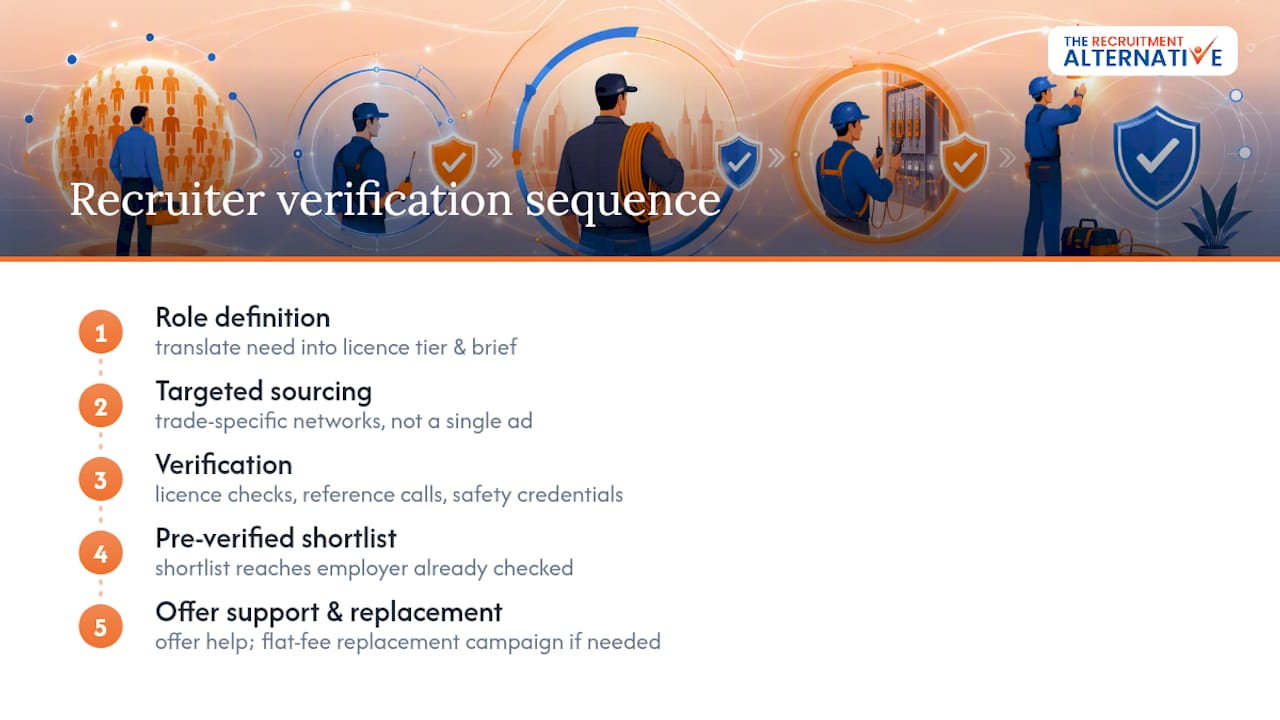
For employers who want cost certainty layered on top of that, the flat-fee model removes the percentage-of-salary calculation entirely. If a placement doesn’t work out in the first few months, a replacement campaign covers a second search rather than leaving you to restart the whole process at full cost. It’s a structured alternative to running every verification step in-house, particularly useful when your team doesn’t have a bench of electrical trade experience to draw on for interviews.
What most hiring advice gets wrong about electricians
Most hiring guides treat electrician recruitment like any other trade hire: post an ad, wait, interview whoever applies. That approach is exactly why vacancies for licensed tradespeople sit open for a month or longer. The research is clear that speed and verification aren’t competing priorities. They’re the same priority, because a slow process loses good candidates to faster bidders, and a shallow one hands you a licence claim instead of a checked fact.
The bigger miss, though, is treating apprenticeships as a cost centre instead of a pipeline. With Powering Skills Organisation modelling a national shortfall in the tens of thousands, employers waiting for the labour market to fix itself are betting on a multi-year policy timeline they don’t control. The employers doing this well aren’t waiting. They’re running a paid mentor structure now, treating apprentice completion as a KPI, and using lateral hires only to patch urgent gaps rather than as their entire strategy.
If you take one thing from this article, prioritise the licence verification step above everything else. It’s the cheapest, fastest check in the whole process, and skipping it is the single most expensive mistake on this list.
— Josh Townsend
When should you bring in a fixed-fee recruiter?
Some hiring situations call for outside help, and knowing which ones saves you from burning weeks on a search your team isn’t equipped to run. If you’re ramping up for a project on a hard deadline, have no internal bench of electrical trade knowledge to assess candidates against, or simply want licence and safety verification handled by someone who checks it for a living, that’s when a fixed-fee recruiter earns its keep.
The Recruit and Recruit+ services cover targeted sourcing, licence verification, a vetted shortlist and offer support, structured around the same process outlined above but run by a team that does it daily. If a placement doesn’t stick within the first few months, some services offer a replacement option to help cover a second search rather than leaving you to fund it from scratch.
If you’re staring down an urgent electrician vacancy right now, visit The Recruitment Alternative to see how the fixed-fee model applies to your role, or check the pricing structure directly to budget the search before you commit.
Where to check licences and sector data yourself
Before you sign off on any electrician hire, run these checks yourself rather than taking a recruiter’s or candidate’s word for it.
- Check an electrical contractor licence directly with your relevant state or territory board.
- Review sector reporting on tradie vacancy timeframes to benchmark your own time-to-fill.
- Read the Powering Skills Organisation’s workforce projections to understand the scale of the shortfall shaping your candidate pool.
- For employers who also manage their own job advertising and want better visibility for electrician vacancies, SEO services tailored to electrical businesses is a relevant partner resource.
- For sector-specific background on entering the trade, see how hard it is to become an electrician in Australia.
Sources
- You can earn a decent amount: Ash has a commerce degree but now he’s a tradie
- AI boom’s demand for skilled workers could hit housing pipeline – ABC News
- Check an electrical contractor licence – Northern Territory Government
- 2026 Electrician Hiring Strategies and Insights
FAQ
How long does it take to hire a permanent electrician?
Most employers should budget four to six weeks from job posting to start date, covering sourcing, screening and offer paperwork. Reporting on tradie hiring shows two-thirds of employers see vacancies open for at least a month, so building in that timeframe from the start avoids unrealistic expectations.
What licence tier should I specify in a job ad?
Specify the exact tier your work requires, journeyman for most independent site work or master for design and supervisory roles, along with the issuing state board. Vague ads asking for “a licensed electrician” without the tier attract unqualified applications and slow your screening down.
How much does it cost to use a recruitment agency for electricians?
The Recruitment Alternative’s Recruit and Recruit+ services use a flat-fee model rather than a percentage of salary, with full tier details available on the pricing page. Fixed pricing lets you budget the search upfront instead of it scaling with the candidate’s salary.
What’s the biggest mistake employers make when hiring electricians?
Skipping direct licence verification with the issuing board and relying on a résumé claim instead. A second common mistake is moving too slowly through screening, which costs you strong candidates to faster-moving employers in a tight labour market.
Should I hire apprentices or focus only on qualified electricians?
Both, run simultaneously. Apprentices build your long-term pipeline given the projected shortfall of 72,000 electricians and related tradespeople by 2030, while qualified lateral hires and referrals fill immediate vacancies without waiting years for training to complete.

