

Good customer service hiring comes down to three things: a role defined before you advertise, a way of assessing candidates that tests real behaviour rather than interview polish, and a recruitment cost you can predict. For a small business, the last one matters most. A percentage-of-salary agency fee grows with every dollar of pay, while our Fixed Fee Recruitment is a flat $4,795 however the role is paid. This guide covers the whole process, from the position description to the offer, for both frontline representatives and the manager who leads them.
TL;DR
- Define the work, the employment type and the pay rules before you write the advertisement. Most bad hires start with a vague role.
- Score every applicant against the same criteria, then use more than one assessment method: a structured interview plus a short, realistic task.
- A customer service manager is assessed differently from a representative: look for coaching, escalation ownership and results with numbers attached.
- Know your legal duties: no discrimination, reasonable adjustments, work rights checks, award or agreement pay, and 12% super.
- Flat-fee recruitment lets you budget the hire up front: an engagement fee of $895 plus a placement fee of $3,900 to $5,000 on our Recruit service.
Table of Contents
- Start with the role, not the advertisement
- Write a position description that attracts the right people
- What to assess in a customer service candidate
- Source, screen and interview
- Hiring a customer service manager
- Legal checks that apply to every hire
- What flat-fee recruitment costs for a customer service hire
- Put it to work: our offer for customer service roles
- Our perspective
- FAQ
- Sources
Start with the role, not the advertisement
Customer service means different things in different businesses. For one employer it is answering phones and emails all day. For another it is processing orders, handling complaints and escalating the difficult ones. The Australian Government describes contact and call centre work as communicating with current or potential customers by phone, webchat and email, and your role may sit anywhere inside that description.
Before you advertise, business.gov.au says to work out the tasks and the problem the hire will solve, the skills and qualifications needed, the workload, and how long you need the person. Its guidance also suggests reviewing your staff structure first, so you can see who owns which tasks and where there are gaps or overlaps. In a ten-person business this is quick, and it often reveals that the role is really two jobs: front-line service and back-office order handling, for example.
Write down answers to these questions:
- What are the three most common customer contacts this person will handle?
- Which channels: phone, email, webchat, in person?
- What can they decide alone, and what must they escalate?
- Which systems will they use on day one?
- Is this a permanent role with set hours, or does demand vary through the week?
Choose the employment type deliberately
Full-time, part-time, fixed-term, casual, trainee and apprentice arrangements each carry different obligations, and business.gov.au advises matching the type to the needs of the job. For customer service, permanent part-time often suits peak-hour coverage, while a permanent full-time hire suits a role that builds product knowledge and customer relationships over years. We recruit permanent staff, so the rest of this guide assumes an ongoing role.
Check the pay rules
Minimum pay depends on the award or enterprise agreement covering the role. The Fair Work Ombudsman publishes award pay guides showing minimum rates for full-time, part-time and casual employees, plus allowances and common penalty rates. They do not apply where an enterprise agreement covers the employee. Also budget for superannuation: the guarantee rose to 12% from 1 July 2025 of eligible ordinary-time earnings, up to the maximum contribution base.
Write a position description that attracts the right people
Business.gov.au says a position description should state the reporting line, department, role summary, employment type, responsibilities, essential and desirable criteria, skills, experience and education. The NDIS Commission’s 2025 guide adds that an advertisement should give practical duties, hours, the salary or hourly rate, location, essential requirements and key capabilities.
Two habits improve the response:
- Use an honest title. “Customer Service Officer” and “Customer Experience Specialist” attract different candidates. Pick the title that matches the actual duties.
- Separate essential from desirable. Essential criteria decide who is shortlisted. Desirable criteria separate applicants who are otherwise equal. Keep the essentials short, or you will screen out capable people who learn quickly.
Publish the pay. The market is transparent: customer service listings in Australia routinely show a rate, and a role with no figure looks like one that cannot compete.
What to assess in a customer service candidate
The skills that matter are communication and active listening, empathy, problem-solving and calm under pressure, accuracy in data entry and notes, comfort with CRM or help-desk software, and managing time across several queues. The Australian Government’s contact centre guidance points to the same traits: interest in customers, strong communication, computer and typing skills, accuracy, following instructions, teamwork and the ability to work independently.
Turn each of these into something you can observe:
| Skill | What to ask or set |
|---|---|
| Listening and communication | Role-play a customer who explains the problem badly. Do they ask clarifying questions before offering a fix? |
| Empathy | “Tell me about a customer who was upset and how you handled it.” Listen for what they did, not what they felt. |
| De-escalation | A short scenario with an angry customer and a refund your policy does not allow. |
| Accuracy | A typing or data-entry exercise using your own forms, kept short and realistic. |
| Systems | A walk-through of the tools they have used. If you run a CRM, a quick demonstration beats a claim on a résumé. |
| Multitasking | Ask how they prioritise when three customers are waiting and a chat is open. |
If your team already uses a CRM or automation to log contacts, it helps to know how those tools shape the daily work. A read on AI sales automation with a custom CRM shows how customer data and follow-ups can be organised, which is useful context when you describe the systems a new hire will use.
Source, screen and interview
Business.gov.au sets out a simple sequence: advertise and promote the position to your networks, assess applications against selection criteria, shortlist, interview, then choose the best candidate. The NDIS Commission suggests job boards, social media, your own website and personal networks as channels.
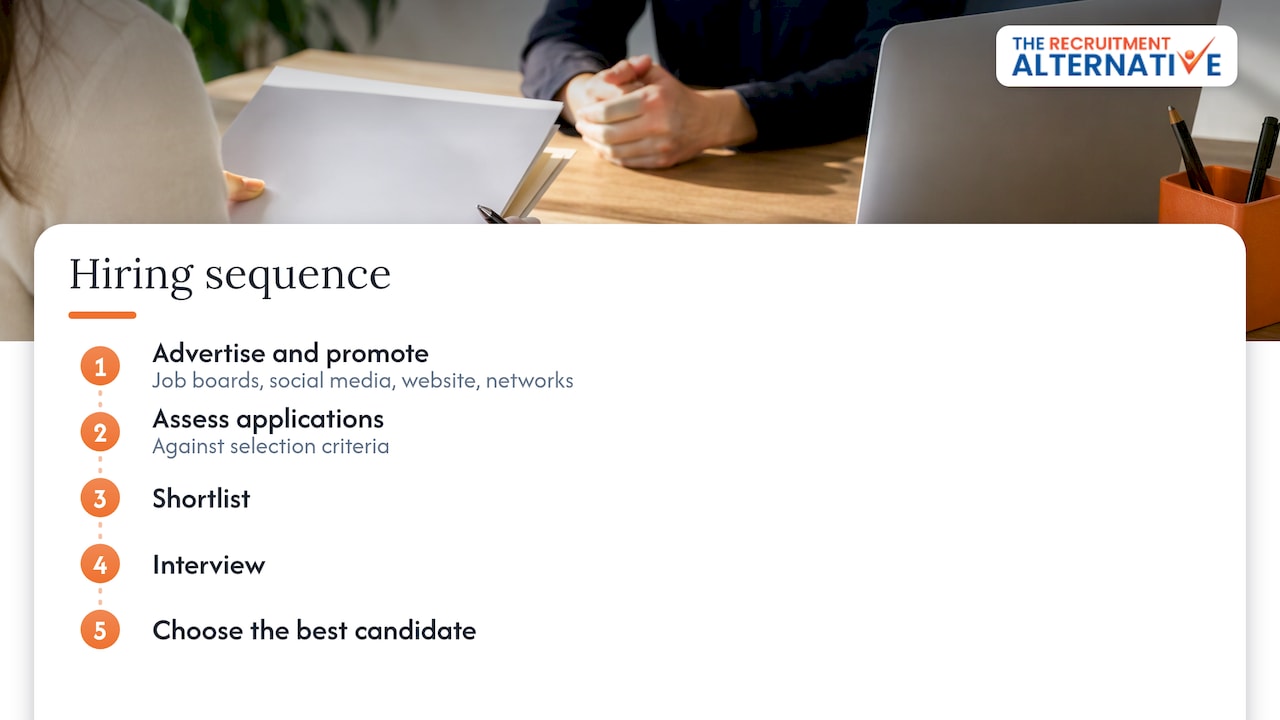
The practical problem for a small business is time. A customer service advertisement can attract hundreds of applications, and someone in your team must read each one while also serving customers. This is where an agency earns its fee: sourcing, screening and presenting a shortlist so you interview only people who meet your criteria. Our Recruit service is built around that, and you can see how the flat-fee structure works before you commit.
Score applicants consistently
Business.gov.au suggests a scoring matrix that rates each candidate against the role requirements, for example from 1 to 5, and shortlisting by score. Build the matrix from your essential and desirable criteria before you open the first application. It stops the last résumé you read from feeling the strongest, and it gives you a record of why you chose who you did.
Then interview shortlisted applicants with open-ended questions, asking every candidate the same core questions in the same order. Our guide on how candidates prepare for a customer service interview shows the answers a strong applicant will give, which helps you recognise them.
Use more than one assessment method
The NDIS Commission’s 2025 guide says that using more than one assessment method is likely to improve decision reliability, and that interviews alone are limited for roles that depend on interaction and applied skills. Business Victoria similarly notes that employers can use work-related problems or skills tests to judge the quality of work. For customer service, that means a structured interview, a role-play or a short written reply to a sample complaint, and reference checks.
Offer flexibility in how people show their ability. JobAccess recommends work trials or on-the-job assessments and sending interview questions in advance for neurodivergent candidates. Many strong service people are less polished in a cold interview than in a live task, so this widens your pool as well as being fair.
Hiring a customer service manager
A manager hire is a different exercise. You are not hiring someone to answer customers; you are hiring someone to make a team answer them well. Look for evidence of:
- Coaching and performance management: how they lift a weak performer and handle a conflict inside the team.
- Ownership of escalations: the customer issues that reached them, and what they changed afterwards.
- Operations and tools: experience with help-desk or CRM systems, rosters and queues.
- Managing workload and service measures: response times, backlogs, quality scores.
- Working with other teams: sales, fulfilment, finance and product.
Ask for concrete examples with outcomes, such as a shorter response time or a cleared backlog, and use a scenario from your own business to test judgement. A customer support team lead hiring guide recommends exactly this approach of examples plus a role-relevant scenario.
Management and leadership hires are within the roles we recruit. Our page on management recruitment explains what to expect, and the process is the same flat-fee model rather than a cut of the manager’s salary.
Legal checks that apply to every hire
These are not optional, and they apply from the advertisement onwards.
- No discrimination. Business.gov.au says employers must not discriminate on protected grounds and may need to make reasonable adjustments so an applicant with disability can take part in an interview. Maddocks notes that federal discrimination law covers recruitment arrangements, selection decisions and the terms offered.
- Work rights. You must make sure the person can legally work in Australia, and the Department of Home Affairs offers an online service to check what a visa permits.
- Background checks. References and, where relevant, police, medical or other checks are possible, but remain subject to discrimination, adverse-action and privacy laws. Only run checks that relate to the role, and tell the candidate.
- Correct pay and super. Use the applicable award or agreement, and pay the 12% guarantee.
If your role handles payments, personal data or vulnerable customers, a criminal check may be relevant. We offer an optional criminal check at $129 and a psychometric evaluation at $199 per candidate, which you can add to the Recruit service.
What flat-fee recruitment costs for a customer service hire
Commission-based agencies charge a percentage of the starting salary, so a better-paid manager costs you more to find. A flat fee fixes the figure. Our published structure has two services, each with an engagement fee and a placement fee:
| Service | Engagement fee | Placement fee |
|---|---|---|
| Recruit | $895 | $3,900 to $5,000 |
| Recruit+ | $2,495 | $5,000 to $6,000 |
The placement fee is paid on a successful permanent placement, and it depends on the candidate’s salary. Our Fixed Fee Recruitment service is listed at $4,795. The full details are on our flat-fee pricing page, and our page on engagement fee recruitment explains what the first payment covers.
We claim savings of more than 70% compared with traditional commission-based agencies. Work it through for your own role: take the percentage your current quote uses, multiply it by the salary you plan to pay, and set it beside the flat figures above.
If a hire does not work out in the first two to three months, our candidate replacement insurance applies. A Replacement Campaign is $1,000, described on our replacement insurance page.
Put it to work: our offer for customer service roles
We recruit permanent staff for businesses across Australia and New Zealand, in roles from administration and sales to management and executive leadership. For a small business hiring in customer service, the Recruit service starts with an engagement fee of $895 and carries a placement fee of $3,900 to $5,000 once you hire. If you want to compare how agencies work before deciding, our guide to choosing a recruitment agency in Australia sets out the questions to ask.
To start a customer service search, see our Fixed Fee Recruitment service.
Our perspective
Small businesses tend to feel the cost of a bad customer service hire more than large ones do. One person is a large share of your customer contact, and every month spent re-advertising is a month of slower replies.
That is why we built our model around certainty. You know the engagement fee at the start and the placement fee range before anyone is shortlisted. Our fees do not rise because you offer a higher salary, which suits growing businesses that want to pay well for a strong person.
Our advice is to put effort into the role definition and the scoring matrix, and let us carry the sourcing and screening. Your time then goes where it is most valuable: meeting a short list of people who meet your criteria and judging whether they fit your team. We also stand behind the placement with candidate replacement insurance if the hire does not work out in the first two to three months.
Josh Townsend
FAQ
How long should a customer service hiring process take?
The stages are the same whatever the timeline: advertise, screen against criteria, shortlist, interview, check references and offer. The steps are quicker when your position description and scoring matrix are ready before you advertise. Leave time for notice periods, because strong candidates are usually employed already.
Should I hire a customer service representative on a casual or permanent basis?
The employment type affects your obligations, so business.gov.au advises matching it to the needs of the job. If the work is steady and you want someone who builds product knowledge and customer relationships, a permanent role is the stronger fit, and that is the kind of placement we recruit.
What should I look for when I hire a customer service manager?
Look for coaching and performance management, ownership of customer escalations, experience with support tools, results measured in response times or backlog, and the ability to work with other teams. Ask for specific examples with outcomes, and test judgement with a scenario from your own business.
Do I need to make adjustments for candidates with disability?
Business.gov.au says you may need to make reasonable adjustments so an applicant with disability can take part in an interview. Examples include sending questions in advance or offering a work trial in place of a standard interview.
Sources
- Guide to hiring employees, business.gov.au
- Interview and recruit employees, business.gov.au
- Contact and Call Centres, Department of Employment and Workplace Relations
- Pay guides, Fair Work Ombudsman
- Employment Law in Australia overview, Addisons
- Recruitment and Selection Guide for Providers, NDIS Quality and Safeguards Commission
- Hire staff, Business Victoria
- How to support a neurodivergent workforce, JobAccess
- Global Employer Handbook, Australia chapter, Maddocks
- Customer Support Team Lead Hiring Guide

