

Hire a structured executive search matched to the CFO role’s risk level, not the cheapest or fastest option available. Set clear outcome targets before you speak to a single candidate, budget 8 to 16 weeks, and weigh a transparent fixed-fee model like The Recruitment Alternative against retained search before committing to either.
TL;DR:
- Effective CFO hiring requires outcome-based briefs tailored to the company stage, with clear performance targets set before engaging candidates.
- Confidential or highly specialized searches benefit most from retained or hybrid models, while fixed-fee recruitment suits standard, less sensitive roles.
- The CFO hiring process should include structured intake discussions, market mapping of passive candidates, and well-defined decision deadlines to avoid delays.
- Assessing a CFO involves testing technical skills, strategic influence, and cultural fit specifically aligned to the organization’s leadership style and objectives.
- A transparent, flat-fee recruitment approach offers upfront pricing, coverage for candidate replacement, and is ideal for companies seeking cost predictability without sacrificing rigour.
Table of Contents
- What does successful CFO hiring actually require?
- How do you choose between retained, hybrid and fixed-fee search?
- What’s the step-by-step CFO hiring process?
- How do you assess technical, strategic and cultural fit?
- What should CFO hiring cost, and how long does it take?
- What does a strong first 90 days look like?
- What do hiring teams consistently get wrong?
- A fixed-fee alternative to traditional CFO search fees
- Sources
What does successful CFO hiring actually require?
CFO hiring starts with a brief written around outcomes, not duties. Too many organisations copy an old job description, swap the company name, and wonder later why the shortlist feels generic. A CFO brought in to prepare a business for acquisition needs a different skill set from one hired to build a finance team from scratch, and the brief should say so explicitly.
Core responsibilities shift with company stage. An early-growth CFO is often still hands-on with cash flow and fundraising. A scale-up CFO is building systems and a team beneath them. An enterprise CFO is managing investor relations, M&A, and a finance function that already runs itself day to day.
Write outcome-based objectives into the brief rather than a duties list:
- Reduce month-end close from 12 days to 5 within two quarters
- Build a finance team capable of supporting a Series C raise
- Establish board-ready reporting within the first 90 days
- Lead due diligence on two acquisitions already in the pipeline
The CFO typically reports to the CEO or board and works closely with sales, operations, and legal. Naming those relationships in the brief helps candidates self-select and helps your panel probe for collaboration style, not just technical depth.
How do you choose between retained, hybrid and fixed-fee search?
The right search model depends on how scarce your ideal candidate is and how much confidentiality the search demands. A CFO replacing someone who was terminated for cause, or one being sourced ahead of a public announcement, usually warrants a more bespoke, confidential process than a straightforward like-for-like replacement in a stable business.
Fee benchmark: Retained executive search traditionally runs around 30–33% of first-year total compensation, while hybrid models blend a lower retainer with a success fee on placement.
Rules of thumb worth applying before you sign anything:
- High confidentiality or scarce skill set: retained or hybrid search, with market mapping to passive candidates
- Standard replacement in a competitive but not niche market: fixed-fee recruitment can deliver strong shortlists at a fraction of the cost
- Multiple finance hires planned this year: fixed-fee pricing gives budget predictability retained percentages cannot
Fixed-fee models suit most permanent CFO searches outside highly specialised or confidential mandates, though providers vary in how deeply they map passive candidates, so ask about sourcing method before signing.
What’s the step-by-step CFO hiring process?
A rushed intake is the single biggest cause of a stalled CFO search. Structured intake conversations that focus on outcomes rather than duties consistently produce stronger shortlists than a recycled job ad.
- Run an intake workshop with the CEO, board representative, and outgoing CFO if available. Cover the outcomes above, past incumbent gaps, and non-negotiables on culture and communication style.
- Map the market, including passive candidates who are not actively job-seeking. Most strong CFOs are currently employed and need to be approached directly, not found through job ads alone.
- Design a two or three-round interview panel: an initial screen for motivation and fit, a technical round with your finance team or an external advisor, and a final round with the CEO and board.
- Set decision SLAs before the search starts. Agree that feedback on each candidate will be delivered within 48 hours of interview. Searches typically slow down because stakeholders are unavailable, not because candidates are scarce.
- Build an offer strategy early, including salary band, equity if relevant, and start-date flexibility, so you can move fast once you find the right person.
Pro Tip: Agree your interview panel’s feedback turnaround before the search begins, not after you’ve already lost a strong candidate to a faster-moving competitor.
How do you assess technical, strategic and cultural fit?
Assessing a CFO candidate properly means testing three separate things: can they do the technical work, can they think strategically about the business, and will they fit how your leadership team actually operates.
On the technical side, ask for evidence rather than claims. Request a sample board pack they’ve prepared, or ask them to walk through how they’d restructure a messy chart of accounts. On strategic fit, probe how they’ve influenced decisions beyond finance, such as pricing, M&A, or capital allocation.
Cultural fit is where most hiring panels get lazy. Watch for candidates who talk only in control-and-compliance language with no mention of partnering with the CEO or sales team; that’s often a sign they’ll operate as a gatekeeper rather than a contributor.
Sample prompts worth using in interview:
- “Tell me about a forecast that turned out to be badly wrong. What did you change afterwards?”
- “Describe a time you disagreed with the CEO on a financial decision. What happened?”
- “How do you decide when a control matters more than moving fast?”
Pro Tip: Reference checks for CFOs should focus specifically on how they handled disagreement with a CEO or board, not just whether the numbers were accurate.
What should CFO hiring cost, and how long does it take?
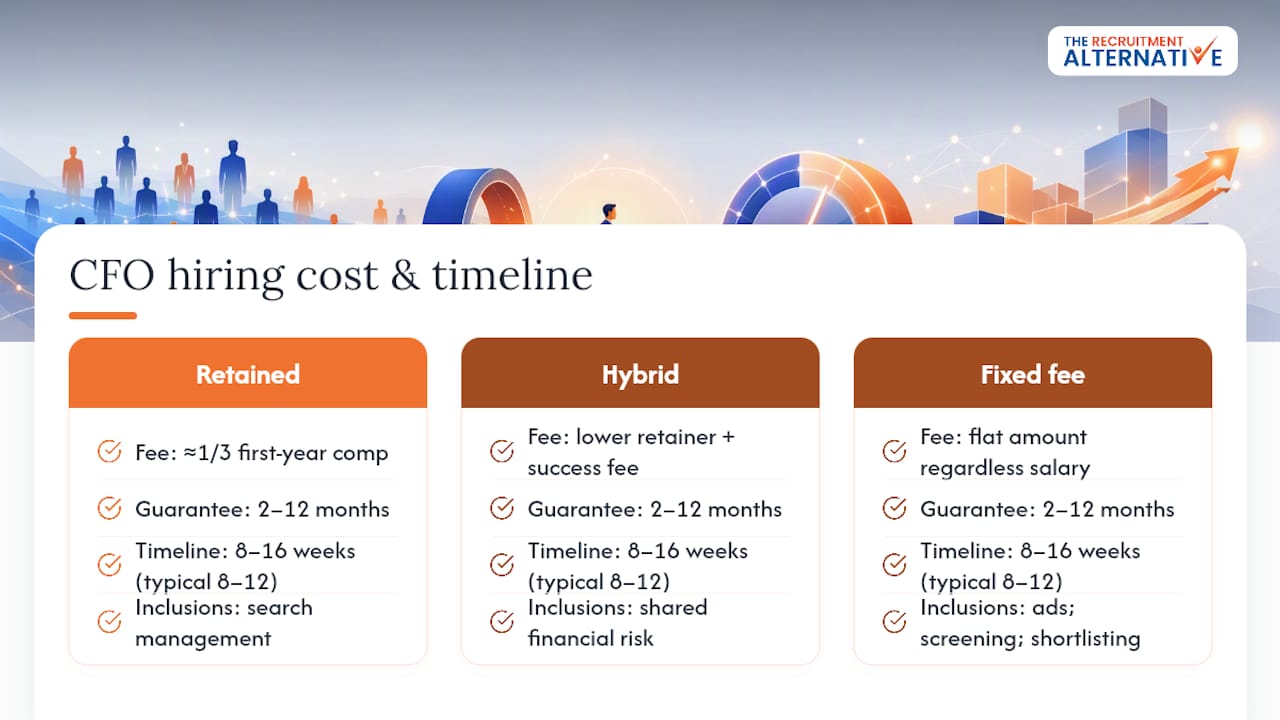
Budget matters as much as timeline here, and the two are connected. Retained search benchmarks are often quoted as roughly a third of first-year total compensation, while hybrid arrangements combine a lower retainer with a success fee, spreading the financial risk between client and recruiter.
Guarantee periods on executive placements commonly range from 2 to 12 months depending on provider and fee model, and this is a legitimate point to negotiate before signing.
Fixed-fee recruitment sits at the other end of the cost spectrum, charging a flat amount regardless of the final salary negotiated. It typically includes job advertising, screening, and shortlisting as standard inclusions.
Expect the search itself to run 8 to 16 weeks from brief to signed offer, with 8 to 12 weeks being typical when stakeholders respond quickly. Confidential searches or complex roles extend that window, usually because internal decision-making slows down, not because good candidates aren’t available.
What does a strong first 90 days look like?
Onboarding a CFO badly is one of the fastest ways to lose a good hire within their first year. A structured 30/60/90-day plan, agreed before their start date, keeps expectations aligned on both sides.
- First 30 days: diagnostic work. Review existing reporting, meet every direct report, and identify one visible quick win, such as tightening a reporting deadline or flagging a cash flow risk early.
- Days 31 to 60: begin implementing agreed changes. Hold a formal check-in with the CEO or board to confirm the diagnosis matches expectations set during hiring.
- Days 61 to 90: deliver against the outcome objectives set in the original brief. Run a probation review with clear metrics tied to those objectives, not vague impressions.
What do hiring teams consistently get wrong?
The biggest mistake I see is employers writing a job description instead of an outcomes brief, then wondering why every candidate sounds interchangeable. The second is treating the interview process as a formality once someone seems technically competent, skipping the harder conversation about how they’ll actually partner with the CEO.
Structured search works because it forces discipline at both ends: a sharper brief up front, and faster feedback loops during interviews. Employers who commit to that discipline consistently land stronger CFOs, regardless of which fee model they choose. A fixed-fee approach doesn’t mean cutting corners on rigour. It means paying for the search process, not a percentage of someone else’s salary.
— Josh Townsend
A fixed-fee alternative to traditional CFO search fees
Retained search benchmarks around a third of first-year compensation, and hybrid models still carry a retainer before you’ve seen a single candidate. The Recruitment Alternative takes a different approach to CFO hiring: a transparent, flat-fee structure with tiered pricing based on the role’s salary band, so you know the total cost before the search begins rather than after the offer is signed.
The engagement covers job advertising, candidate screening, shortlisting, and coordination through to offer, backed by candidate replacement cover if the hire doesn’t work out in the first two to three months. For businesses that need a capable CFO without the retained percentage or the long commitment structure of traditional search firms, it’s a genuinely different way to fill the role. Visit the flat-fee recruitment page to see current pricing tiers and get a quote for your next CFO search.
Sources
- Fixed Fee Recruitment: How It Works & Helps Cut Hiring Costs
- Retained search fee structures 2026: benchmarks
- The retained CFO search process: what CEOs should expect

