

If your bookkeeper will lodge BAS, hire a TPB-registered BAS agent. If not, prioritise software fit and run a paid trial period of suitable length before committing to anything permanent. Get those two things right and most other bookkeeper hiring mistakes never happen.
TL;DR:
- Ensuring the bookkeeper is a registered BAS agent with the Tax Practitioners Board is critical to avoid penalties and verify credentials quickly.
- Proficiency in your specific accounting software, such as Xero, MYOB, or QuickBooks, must be demonstrated through practical tasks during interviews.
- Sourcing candidates through accountant referrals and professional directories yields more reliable applicants than general job advertising.
- Conduct structured evaluations, including practical reconciliation exercises and technical questions, to accurately assess the candidate’s skills and communication.
- Using a fixed-fee recruitment service simplifies hiring, reduces compliance risks, and provides protections if the initial placement does not meet expectations.
Table of Contents
- Define the role and hiring model you need for bookkeeper hiring
- What compliance and credentials should you check before hiring?
- Does the candidate’s software fit your accounting system?
- Where do you find qualified bookkeeper candidates?
- How do you screen and evaluate bookkeeper candidates?
- How should you structure the offer and trial period?
- What red flags mean you should walk away
- Publisher perspective: why a fixed-fee recruitment partner reduces hiring risk
- Get a shortlist of screened bookkeepers, fast
- Sources
Define the role and hiring model you need for bookkeeper hiring
Bookkeeper hiring starts with a job brief, not a job ad. Write down the actual tasks before you post anything:
- Bank and credit card reconciliations
- BAS and GST preparation (and lodgement, if applicable)
- Payroll processing and Single Touch Payroll (STP) reporting
- Invoicing, accounts payable and accounts receivable
- Monthly or quarterly management reporting
Transaction volume and payroll complexity decide the hiring model. A business processing a few hundred transactions a month with no staff might need only a few hours a week, freelance or part-time. Once you’re running weekly payroll for a growing team, you’re likely looking at a full-time hire or a bookkeeping firm with backup capacity.
Budget shape matters just as much. Hourly rates suit low-volume, variable workloads but make cash flow unpredictable. A fixed monthly retainer gives budget certainty and works well for stable transaction volumes. A salaried in-house hire costs more upfront but buys full attention to your business and closer alignment with your team. If you’re still deciding whether you need bookkeeping help at all, the signs a business needs a bookkeeper are worth checking against your current admin load.
What compliance and credentials should you check before hiring?
Anyone preparing or lodging BAS on your behalf must be a registered BAS agent listed on the Tax Practitioners Board register. This isn’t optional, and it isn’t something you take on trust. A candidate can claim registration on their resume; only the TPB public register confirms it, and checking takes about two minutes.
Statistic Callout: Verifying TPB registration directly with the regulator, rather than relying on a candidate’s word, is the single check that protects you from lodging penalties if the person turns out not to be registered at all.
Beyond TPB status, look for these credentials:
- Certificate IV in Bookkeeping or Accounting
- Membership of a recognised body such as the Institute of Certified Bookkeepers (ICB), ABA or AAT
- Current professional indemnity insurance
- Evidence of continuing professional education (CPE)
CPE matters more than it sounds. Tax rules, STP requirements and software features change often, and a bookkeeper who hasn’t kept their skills current is a slow-moving compliance risk you won’t notice until it costs you.
Does the candidate’s software fit your accounting system?

Skip candidates who list “bookkeeping software” as a generic skill. You want someone who can name the platform, describe how they use it daily, and explain how it talks to your other systems.
Prioritise proficiency in whichever platform your business runs, whether that’s Xero, MYOB or QuickBooks. Xero is a common baseline many small businesses build around, and Xero’s own hiring guidance recommends keeping your bookkeeper and your external accountant working inside the same cloud platform. That alignment cuts manual data transfers and the errors that come with them.
Test the fit practically rather than taking their word for it: For more practical advice on bookkeeping processes that stay reliable through tax season, see small-business bookkeeping that survives tax season.
- Ask them to walk through reconciling a bank feed live
- Check their approach to STP-compliant payroll runs
- Review how they’d set up recurring invoicing
- Confirm they can produce a basic management report unprompted
A candidate who hesitates on any of these hasn’t used the software as much as their resume suggests.
Where do you find qualified bookkeeper candidates?
Sourcing well saves you from wading through a hundred unsuitable applications. Work through these channels in order of reliability:
- Ask your accountant for referrals. They already know who’s competent and who cuts corners.
- Ask other business owners in your network. Referrals from accountants and other business owners remain one of the most effective sourcing channels precisely because they carry real-world proof of reliability.
- Check professional directories for ICB or AAT members near you.
- Use agency sourcing if you need a shortlist fast without doing the screening yourself.
When resumes land, scan for industry-specific experience (retail bookkeeping differs from trades or professional services), named software certifications, and a TPB number if BAS work is part of the role. Anything vague on those three points goes to the bottom of the pile, not the bin.
How do you screen and evaluate bookkeeper candidates?
Resumes tell you what someone claims. A structured evaluation tells you what they can actually do.
- Set a practical task. Give shortlisted candidates a mock bank statement with deliberate discrepancies and a transaction list, then ask them to reconcile it. Watch for speed, accuracy, and whether they can explain their method, not just their answer.
- Ask technical interview questions. “Walk me through how you’d handle a supplier invoice that doesn’t match the purchase order” reveals more than “Are you good with Xero?” ever will.
- Probe problem-solving and communication. Ask how they’ve handled a client dispute over a reconciliation error, and listen for whether they explain calmly or get defensive.
- Run a structured reference check. Ask previous employers directly about accuracy, deadline reliability, and whether the candidate flagged issues proactively or waited to be asked.
Pro Tip: Score the reconciliation exercise on three separate criteria, accuracy, time taken, and clarity of explanation, rather than a single pass or fail. The candidate who’s slightly slower but explains every step clearly is usually the safer long-term hire.
Technical proficiency, attention to detail, deadline management and clear communication are the core skills worth testing at this stage, and a well-designed exercise surfaces all four at once.
How should you structure the offer and trial period?
A strong offer for a permanent bookkeeper covers more than the pay rate. Include:
- A competitive salary or hourly rate benchmarked to local roles
- Flexibility on hours or remote work where the role allows it
- A visible growth path (more responsibility, software training, eventual senior bookkeeping duties)
Before signing anyone to a long-term contract, run a paid trial or starter project. Set clear objectives, defined deliverables, evaluation criteria, and a reasonable fixed duration so both sides know what “success” looks like before the clock starts.
Onboarding should follow immediately with:
| Onboarding step | What it covers |
|---|---|
| System access | Software logins, bank feed permissions, document storage |
| Data security | Confidentiality agreement, access limits, backup protocol |
| Reporting cadence | Weekly check-ins, monthly reporting deadlines |
| — | Milestones for accuracy, independence, and process ownership |
What red flags mean you should walk away
Some warning signs are worth acting on immediately rather than hoping they improve:
- No TPB registration despite offering to prepare or lodge BAS
- References that contradict each other or seem rehearsed
- Inability to explain a reconciliation step by step, only the final number
- Reluctance to complete a sample task or reference check
Verify claims fast: check the TPB register yourself, confirm certifications with the issuing body, and review a redacted sample of past work. If any of these fail during a trial, end it early and go back to your shortlist rather than hoping the issue resolves itself.
Publisher perspective: why a fixed-fee recruitment partner reduces hiring risk
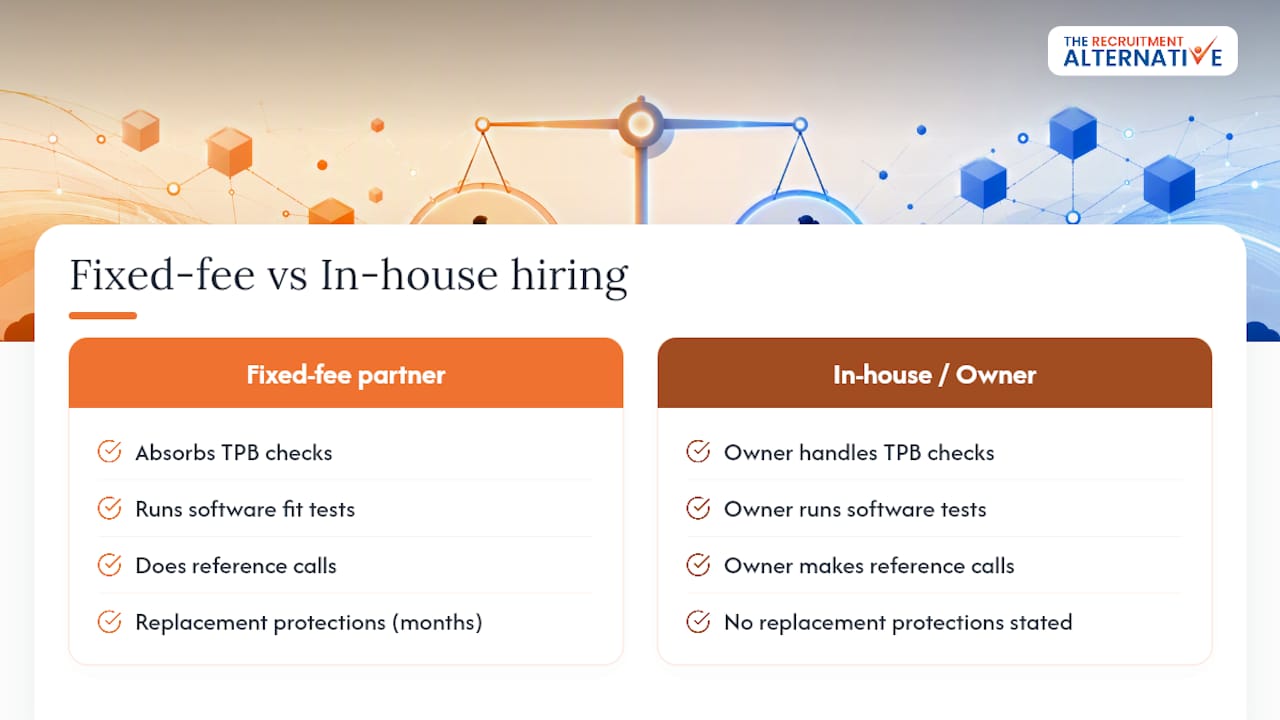
Most of the compliance and screening steps above take real time, TPB checks, software tests, reference calls, and that’s before you’ve even reached the trial period. A recruitment partner working on a fixed-fee model absorbs that workload, pre-screening for TPB status and software fit before a candidate ever reaches your desk.
That matters more for bookkeeping than most roles, because the cost of a bad hire isn’t just a wasted salary. It’s a compliance exposure. A structured flat-fee accounting recruitment process, backed by replacement protections if a placement doesn’t work out in the first few months, shifts that risk away from the business owner and onto the process itself.
— Josh Townsend
Get a shortlist of screened bookkeepers, fast
The Recruitment Alternative is the alternative to drawn-out, commission-based agency hiring for bookkeeper recruitment: one transparent fixed fee instead of a percentage of salary, with candidates pre-screened for TPB status, software fit, and reference checks before they reach your inbox.
Every bookkeeper placement runs on the same simple flat-fee structure, so you know the total cost before recruitment even starts, not after a percentage-based invoice lands. If your hire doesn’t work out in the first couple of months, replacement protections mean you’re not paying twice to fix the same gap.
If you’d rather skip the sourcing, TPB checks, and reference calls yourself, request a shortlist through The Recruitment Alternative’s dependable, fixed-fee recruitment service and get pre-screened bookkeeping candidates without the agency mark-up.
Sources
- Xero guide: how to hire a bookkeeper
- Tax Practitioners Board (TPB) — public register
- Indeed: how to hire a bookkeeper (Australia)
- How to choose a bookkeeper in Australia (2026 guide) — Finance Directory

