

The short answer: prioritise the roles your business needs for the next 12 to 18 months, write a scorecard before you speak to a single candidate, run a structured assessment process, and never juggle more than two executive searches at once. Skipping any one of these steps is where most mis-hires begin.
- Prioritise the one or two roles that will unlock your next stage of growth, not every gap on the org chart.
- Write a scorecard defining the outcomes the hire must deliver in year one, before sourcing starts.
- Run structured interviews and deep reference checks for every finalist, no exceptions.
- Cap concurrent searches at two so you and your leadership team can give each one proper attention.
- Plan onboarding with a 30-60-90 day framework before the offer is even signed.
A typical top-tier executive search runs around 130 days from brief to start date. Budget for that timeline now, not after you’ve already lost your first-choice candidate to a faster process.
Key Takeaways
Successful executive hiring depends on a written scorecard, structured assessment, disciplined search limits, and a planned onboarding period, not instinct or urgency.
| Point | Details |
|---|---|
| Hire for stage, not title | Match roles to what the business needs to achieve in the next 12 to 18 months. |
| Write the scorecard first | Define mission, outcomes, and competencies before sourcing any candidates. |
| Limit concurrent searches | Run no more than two executive searches at once to protect quality. |
| Budget realistic timelines | Expect 60 to 130 days from brief to signed offer for a senior hire. |
| Consider fixed-fee support | The Recruitment Alternative offers flat-fee executive recruitment covering sourcing, assessment, and onboarding. |
Table of Contents
- What is a senior leadership team and why does it matter?
- Which senior roles do you need, and when should you add them?
- How should you decide which executive to hire next?
- What does the executive hiring process actually look like?
- Which assessment methods actually predict executive performance?
- How long does an executive search take, and how many should you run at once?
- How should you structure compensation for a senior hire?
- How do you onboard a senior hire and measure early success?
- What are the most common executive hiring mistakes?
- How can The Recruitment Alternative help with your senior hire?
- Frequently asked questions
- Sources
What is a senior leadership team and why does it matter?
A senior leadership team is the small group of executives (CEO, and typically a COO, CFO, CTO, or CMO) who set strategy, own major decisions, and shape company culture from the top down. Their calls ripple through every department.
- One wrong hire at this level doesn’t just cost a salary. It can reach roughly 200% of the executive’s annual salary once you count lost productivity, team disruption, and the search you have to run again.
- A single bad call on pricing strategy or a culture-eroding leadership style can undo a year of good hiring decisions everywhere else.
Which senior roles do you need, and when should you add them?
Not every business needs a full executive bench from day one. Match the role to the stage, not the org chart template you found online.
- CEO — owns vision, capital allocation, and the board relationship.
- COO — turns strategy into operational rhythm once the business is too complex for one person to run day to day.
- CFO — brings financial discipline and investor-grade reporting, usually needed once revenue or fundraising complexity grows.
- CTO — owns technical architecture and product delivery, critical earlier in tech-led businesses.
- CMO — builds demand generation and brand, typically added once you have product-market fit worth scaling.
- Head of People — becomes essential once headcount growth outpaces informal culture management.
At early-scale, most businesses need one or two of these roles filled well rather than five filled thinly. Growth-stage companies usually add COO and CFO first; pre-IPO businesses need the full bench plus governance experience. Hire against what the business needs to achieve in the next 12 to 18 months, not against a five-year fantasy org chart.
Pro Tip: Before opening a new search, check whether an existing leader could grow into the role with support. Promoting and coaching is often faster and cheaper than an external search, and it avoids the credibility gap a brand-new executive faces walking into a team that already trusts someone else.
How should you decide which executive to hire next?
Work through this sequence with your board or leadership team before you write a single job ad:
- List your top three business priorities for the next 12 to 18 months.
- Identify which capability gaps are actually blocking those priorities.
- Translate each gap into a role with specific, measurable outcomes, not a job title.
- Stress-test the outcomes against trade-offs, budget, timeline, and what you’ll deprioritise to fund the hire.
- Get written sign-off from the board or leadership team before sourcing begins.
Use this checklist in the room:
- Does everyone agree on the role’s purpose in one sentence?
- Have you named the top three to five outcomes the hire owns in year one?
- Have you agreed what this role will NOT be responsible for?
Do lock the scorecard before interviews start. Don’t let the role definition drift mid-search because a strong candidate doesn’t quite fit the original brief. That drift is how you end up hiring the wrong person for the wrong job.
What does the executive hiring process actually look like?
A defensible executive hire follows the same sequence every time, whether you run it yourself or hand it to a specialist.
- Define the role and build a scorecard — mission statement, three to five measurable outcomes, and the core competencies required.
- Market map and source — identify who’s realistically available and approach them directly rather than waiting on applications.
- Screen — a structured phone or video conversation against the scorecard, not a general chat.
- Structured interviews and assessment — behavioural, situational, and technical questions tied to each competency.
- Deep reference checks — chronological, role-by-role, probing for specifics.
- Offer — clear terms, fast turnaround, documented decision rationale.
- Onboarding — a structured 30-60-90 day plan starting before day one.
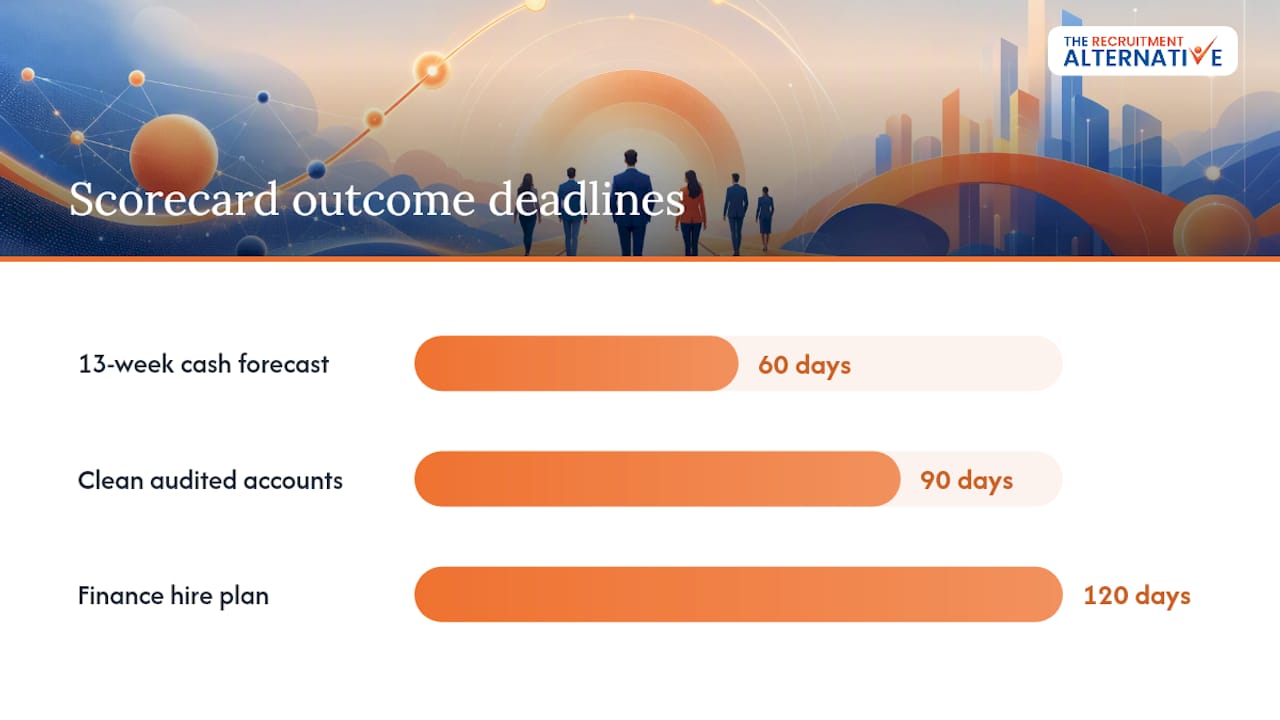
A sample scorecard might read: Mission: rebuild the finance function to support Series C readiness. Outcomes: clean audited accounts within 90 days, a 13-week rolling cash forecast live within 60 days, a finance hire plan delivered within 120 days. Competencies: financial rigour, stakeholder communication, team building.
Speed matters most at sourcing and screening, where streamlining unnecessary steps helps you close your preferred candidate before a competing offer appears. Slow down deliberately at references and offer structuring. Rushing those two steps is where the expensive mistakes happen.
Which assessment methods actually predict executive performance?
Structured assessment, interviews, work samples and consistent scoring predicts on-the-job performance far more reliably than an informal chat over coffee, and it’s harder for either side to talk themselves into the wrong outcome.
A structured interview keyed to your scorecard’s “stakeholder communication” competency might ask: “Walk me through a time you had to deliver bad news to a board or investor. What did you say, and what happened next?” Score every candidate against the same rubric, out of five, on specificity, ownership, and outcome.
For references, run a chronological deep-dive: cover every role, in order, asking for actual numbers, specific decisions made, and at least one failure with what the candidate learned. A polished storyteller falls apart under this level of detail far faster than a genuine operator does.
- Structured interviews carry higher reliability and are more defensible than unstructured conversations, particularly if a hiring decision is ever challenged.
- Use multiple assessment signals: interviews, scenario exercises, work samples, and references, rather than relying on any single conversation.
Pro Tip: Ask one reference the same question you asked the candidate about a past failure. If the two stories don’t roughly match, you’ve found your red flag before the offer stage, not after.
Our own reference-checking guide breaks down exactly how to structure that conversation.
How long does an executive search take, and how many should you run at once?
Plan for 60 to 130 days from brief to signed offer, and never run more than two active executive searches simultaneously. A CEO stretched across four searches gives none of them the attention a six-figure hiring decision deserves.
- Days 1 to 15 — scorecard built, market mapped, sourcing underway.
- Days 15 to 45 — screening and first-round structured interviews.
- Days 45 to 75 — finalist interviews, assessment exercises, reference checks.
- Days 75 to 130 — offer, negotiation, notice period, start date.
Search length stretches with market scarcity, long notice periods, confidentiality requirements, and how available your stakeholders actually are for interviews. If a search needs to stay quiet, that adds real time, and confidential search protocols are worth planning for early rather than improvising midway.
How should you structure compensation for a senior hire?
Executive packages have four moving parts: base salary, short-term incentives (annual bonus tied to scorecard outcomes), equity or long-term incentives, and benefits, plus clarity on notice periods on both sides.
Your offer letter should lead with headline terms, not buried detail: base, target bonus, equity grant and vesting schedule, start date, and an acceptance window of no more than five business days.
- Benchmark against role, industry, and location before you fall in love with a candidate, not after.
- Move fast once you’ve decided. A strong executive candidate rarely stays uncommitted for long, and a slow offer process reads as organisational indecision.
- Keep equity vesting standard for your stage. Custom terms slow negotiation and set an awkward precedent for the next hire.
How do you onboard a senior hire and measure early success?
Structure the first 90 days deliberately, and don’t leave it to the new executive to figure out on their own.
- Days 1 to 30: stakeholder introductions, access to real numbers, and a clear read on political context.
- Days 30 to 60: first scorecard outcome delivered, initial team assessment complete.
- Days 60 to 90: early wins visible, full alignment meetings held with peers and the board.
Onboarding is decisive for retention: giving a new hire early access to real numbers and honest political context materially improves the odds they succeed.
- Early signals: stakeholder confidence, visible progress against the scorecard, team stability.
- Twelve-month signals: retention, delivery on the original outcomes you agreed to.
- Run fortnightly check-ins for the first quarter, and intervene early if scorecard progress stalls rather than waiting for the annual review.
What are the most common executive hiring mistakes?
Watch for vague answers under pressure, reference ratings that feel lukewarm rather than enthusiastic, and stories that don’t match across conversations. These are the clearest signs you’re looking at a polished interview performance rather than a genuine track record.

On the process side, the recurring failures are an unclear scorecard, running too many searches at once, and redefining the role halfway through because a candidate doesn’t quite fit. The most common failure in senior hires is placing the right person in the wrong stage of business, not hiring an incompetent one.
Pro Tip: If two finalists both feel “almost right,” pause the process for a leadership alignment session rather than picking the less-wrong option. A rushed hire at this level is far costlier to unwind than a two-week delay.
A recruiter’s view on executive hiring
The CEO has to lead this decision personally. Delegating executive hiring away entirely is how businesses end up with polished candidates who’ve never been tested against the specific environment they’re inheriting. Structured assessment isn’t bureaucracy. It’s the difference between hoping and knowing.
How can The Recruitment Alternative help with your senior hire?
The Recruitment Alternative charges a fixed fee for permanent placements, not a percentage of the executive’s salary, which means the cost of getting your senior hire right doesn’t climb with the seniority of the role. That matters most when you’re weighing whether to run this search yourself or bring in outside support.
If you’re time-poor, running your first executive search without an internal talent function, or simply want a second set of eyes on candidate assessment, that’s exactly where a fixed-fee partner earns its keep. The Recruitment Alternative’s executive recruitment service covers role definition, targeted sourcing, structured assessment, and onboarding support, so the scorecard-driven process outlined above gets executed by people who run it daily. Read more about what executive recruitment involves and how it differs from filling a standard vacancy.
If cost predictability matters to your board as much as candidate quality, check the flat-fee pricing structure and get in touch to discuss your next senior hire.
Frequently asked questions
How long should it take to hire a senior leadership team member?
Budget 60 to 130 days from writing the scorecard to a signed offer, longer if the search needs to stay confidential or the market for that skill set is thin.
How many executive searches should a CEO run at the same time?
No more than two. Running more spreads your attention too thin to properly assess candidates or give references the depth they need.
What’s the biggest mistake CEOs make when hiring senior leaders?
Hiring the right person for the wrong stage of the business, usually because the scorecard wasn’t specific enough about the next 12 to 18 months of priorities.
Should you hire senior leaders internally or use an executive search firm?
It depends on your internal bandwidth and hiring experience. In-house hiring saves fees but demands significant CEO time; a fixed-fee firm like The Recruitment Alternative suits businesses that want structured assessment without the percentage-based cost of traditional executive search.
What should a reference check for an executive role actually cover?
Go role-by-role, chronologically, asking for specific numbers, decisions made, and at least one genuine failure with what the candidate learned from it.
Sources
- The first principles of executive hiring (Andreessen Horowitz)
- Executive hiring playbook: a step-by-step guide (Testlify)
- Your approach to hiring is all wrong (Harvard Business Review)
- Structured, unstructured and semi-structured job interviews (Australian Industry Group)
- How to reduce risk in senior-level hiring decisions (Olade Consulting)
Recommended
- Affordable Recruitment for CEO’s and General Management
- What is executive recruitment: a guide for employers – The Recruitment Alternative
- Hiring new staff is a critical part of a company’s growth and doing it right is paramount to success. – The Recruitment Alternative
- Hiring Tips for Small Businesses – The Recruitment Alternative

