

Pick one or two priority role families and give them an owner. That single decision, backed by a 30-minute fortnightly check-in, is the difference between a talent pipeline that works and a folder of old résumés nobody opens.
Do these three things before Friday:
- Run a 30-minute planning meeting to name your priority roles and whoever owns pipeline tracking for each.
- Create a five-field capture sheet (more on the exact fields below) so candidate details land somewhere other than someone’s inbox.
- Identify one internal employee worth developing into a future hire and one external referral source you can tap this month.
Frameworks from Cornerstone and operational guides like KORE1 both confirm the same thing: structure beats scale. You don’t need a talent acquisition department to run a pipeline properly. And if bandwidth is the real blocker, a fixed-fee partner like The Recruitment Alternative can seed and manage the pipeline for you while you keep running the business.
Key Takeaways
Small businesses build effective talent pipelines by assigning clear ownership, running a fixed cadence, and tracking five core fields rather than chasing enterprise-grade software.
| Point | Details |
|---|---|
| Start with ownership | Assign one named owner per priority role family before choosing any tool or template. |
| Use five fields | Track name, role family, comp range, last contact date, and readiness stage on a simple sheet. |
| Match tools to volume | Stay with a spreadsheet under 30 hires a year; upgrade to an ATS only once cadence is proven. |
| Nurture by tier | Adjust touch frequency from quarterly for identified contacts to weekly for active candidates. |
| Engage The Recruitment Alternative when stretched | Use a fixed-fee partner for specialist sourcing or urgent role families beyond your current bandwidth. |
Table of Contents
- How do you build a talent pipeline step by step?
- Which roles should you pipeline first?
- Do you need an ATS, a CRM, or just a spreadsheet?
- What’s a good nurture cadence for pipeline candidates?
- How do you measure whether your pipeline is working?
- How should onboarding connect to your pipeline stages?
- How do you build diversity into your talent pipeline?
- How often should you review and improve your pipeline?
- Author perspective: practical cautions and what success feels like
- Get pipeline support without the agency price tag
- Sources
How do you build a talent pipeline step by step?
A talent pipeline is really just a repeatable system for knowing who you’d hire before you need to. Six steps make that system work, and skipping any one of them is usually why pipelines stall after a promising start.
- Forecast your needs. Look at what’s actually happening in the business over the next two to three quarters, not abstract headcount targets. A new client contract, a product launch, or a store opening all translate into specific skill clusters you’ll need. Set a pipeline start date against each one, the same way you’d set a project milestone.
- Define success, not just a title. Write role success profiles around outcomes and skills rather than job titles. “Someone who can manage a $2 million project pipeline and mentor two juniors” tells you more than “Senior Project Manager” ever will.
- Source proactively, on multiple fronts. Internal mobility, employee referrals, targeted external searches, internships, and community or industry-body partnerships all feed the same pool. Relying on one channel is the most common reason pipelines run dry.
- Engage and nurture consistently. Decide what you’ll send candidates, how often, and what actually counts as a “warmed” candidate versus someone who filled out a form once and vanished.
- Assess continuously, not just at crunch time. Staged readiness tiers and light, low-friction assessments let you segment your pool honestly, so you’re not scrambling to work out who’s actually ready when a role opens.
- Measure and optimise. Track pipeline velocity, conversion rates, source effectiveness, and quality of hire, then adjust the channels and cadence that aren’t pulling their weight.
This sequence mirrors the proactive pipeline framework Cornerstone outlines for larger organisations, but the mechanics scale down cleanly. A five-person business can run all six steps with a spreadsheet and a calendar reminder. What changes at scale isn’t the framework, it’s the tooling underneath it.
Pro Tip: Don’t try to pipeline every role in the business. Focus depth on the one or two role families you hire for most often or struggle to fill, and let the rest stay reactive until those first pipelines are running smoothly.
Which roles should you pipeline first?
Rank your open and recurring roles against three questions: How often do you hire for it? How hard is it to fill when you do? And what happens to the business if the seat sits empty for six weeks? Roles that score high on all three, sales representatives, tradespeople, or specialist technical staff, are your starting point.
- Pick one to two role families maximum for your first pipeline. Trying to cover everything at once is how pipelines die within a month.
- Build your capture sheet with five fields: name, role family, comp range, last contact date, readiness stage.
- Assign one owner per role family. Shared ownership without a name attached usually means no ownership at all.
- Draft two outreach templates now: a light “just checking in” nurture message and a direct referral ask you can send to current staff.
A spreadsheet is genuinely fine at this stage. KORE1’s research on small-team pipelining backs this up directly: a disciplined five-field sheet, reviewed on a fixed schedule, consistently beats an expensive platform nobody updates.
Pro Tip: Set a recurring calendar reminder to review the sheet every two weeks. The tool matters far less than whether someone actually opens it.
Do you need an ATS, a CRM, or just a spreadsheet?
The right tool depends entirely on volume, not ambition. Buying software before you’ve proven you can run a cadence consistently is one of the most common ways small businesses waste recruitment budget.
Your five fields, name, role family, comp range, last contact date, and readiness stage, are the backbone of any system you choose. A sheet with those columns, sorted by readiness stage, tells you at a glance who’s ready to call the moment a role opens.
- Fewer than 30 hires a year: a spreadsheet with calendar automation for follow-up reminders is genuinely sufficient.
- 30 to 150 hires a year: an entry-level applicant tracking system (ATS) with tagging by role family and readiness stage earns its cost.
- More than 150 hires a year: pair an ATS with a lightweight CRM to manage nurture at scale across multiple role families.
- Low-cost automations worth adding early: mail-merge for nurture messages, scheduled check-in reminders, and simple tagging so you can filter by stage in seconds.
The trap to avoid is buying capability you haven’t earned yet. Prove the cadence and ownership work on a spreadsheet first; the software upgrade should follow demand, not precede it.
What’s a good nurture cadence for pipeline candidates?
Candidates don’t sit in one bucket forever, and treating them as if they do is why pipelines go stale. KORE1’s research describes five readiness tiers, each with its own entry signal and required next action.
- Identified: you know they exist and roughly what they do. Touch base quarterly, just enough to stay on their radar.
- Warm: they’ve responded once or shown mild interest. Check in every six to eight weeks with something worth their time.
- Engaged: they’re actively responsive and asking questions. Move to a four-week cadence with more specific content.
- Vetted: you’ve assessed their fit and they’ve cleared it. Tighten to every two to three weeks as a role approaches.
- Active: a role is genuinely open or imminent. Weekly contact, no exceptions.
Nurture content should earn its place in someone’s inbox: role previews that show what the job actually involves, short project showcases, brief skills-based micro-assessments, or invitations to team events. Generic “just checking in, any roles?” messages wear thin fast, and engagement from a talent community correlates directly with lower cost-per-hire on recurring roles.
Pair a recruiter or hiring manager with each role family and run a 30-minute fortnightly sync to review who’s moved tiers and who needs a nudge.
Pro Tip: If a candidate hasn’t responded to two consecutive touches, drop them back a tier rather than deleting them. People’s availability changes, and yesterday’s “not interested” is often next quarter’s “actually, yes”.
How do you measure whether your pipeline is working?
Five numbers tell you almost everything you need to know: pipeline velocity (days from identified to hired), pipeline conversion rate (percentage who move from one tier to the next), source effectiveness (which channel actually produces hires), quality of hire at 12 months (retention and performance), and offer acceptance rate.
Run a 30-minute monthly review against these five. Watch for red flags: conversion stalling at the “warm” tier, one source dominating with no backup, or velocity creeping upward month over month.
- Test small changes deliberately: swap one outreach template for a month and compare response rates before rolling it out further.
- Track quality of hire against the success profile you wrote, not against gut feel six months later.
- A concise KPI set tied to business outcomes makes pipeline work legible to leadership and easy to defend at budget time.
Structured pipelines shorten hiring timelines substantially. KORE1 estimates that a proactive pipeline can cut a typically reactive 170-day search down to roughly 60 days for comparable roles.
Three signals it’s time to bring in a recruitment partner: your internal sourcing has plateaued for a specialist skill set, you’re hiring faster than your current bandwidth allows, or a single role has sat unfilled long enough to cost the business measurably.
How should onboarding connect to your pipeline stages?
Onboarding shouldn’t start the day someone signs a contract. It should start the moment they move into the “vetted” tier, because that’s when they’ve already been assessed against your success profile and you know exactly what gaps to address.
Candidates who’ve spent time in your engaged and vetted tiers arrive with more context than a cold hire ever will. They’ve likely seen a role preview, maybe met the hiring manager informally, and understand roughly what the job involves before day one. Use that head start deliberately: build your onboarding plan around the specific skill clusters identified during the assessment stage, rather than running the same generic induction for everyone.
Practically, this means your onboarding checklist should reference the success profile document you wrote during the “define success” step of the framework. If the profile flagged a gap, say, strong on technical skills but light on stakeholder management, week one onboarding should address it directly rather than leaving it to chance.
It also means the recruiter or hiring manager who nurtured the candidate through the pipeline should stay involved for at least the first fortnight. That continuity matters more than most businesses credit. A candidate who’s built a relationship with one person over months of nurture, then gets handed to a stranger on day one, notices the disconnect immediately. Keep the same point of contact through the transition, and treat onboarding as the final tier of the pipeline rather than a separate process that starts from zero.
How do you build diversity into your talent pipeline?
Diversity in a pipeline isn’t a separate initiative bolted onto hiring. It’s a function of where you source and how you assess, decided early rather than patched in later.

Start with sourcing channels. If every candidate in your pipeline comes from the same two referral sources, you’ll keep pipelining the same demographic regardless of intent. Deliberately widen the funnel: community partnerships, industry associations with broader membership bases, and internships aimed at people without a traditional pathway into your industry all bring in candidates your existing network won’t surface.
Assessment matters just as much as sourcing. Skills-based selection focused on demonstrated capability rather than pedigree or years-in-title reduces the bias that creeps into title-based screening. Writing your success profiles around outcomes, as covered in the framework above, does double duty here: it forces you to assess what someone can actually do rather than defaulting to familiar-looking résumés.
Track it, too. If pipeline conversion data shows candidates from certain sources consistently stalling at the “warm” tier while others sail through, that’s worth investigating rather than ignoring. It might be a genuine skills mismatch, or it might be an assessment step quietly filtering out people who’d otherwise perform well.
None of this requires a formal diversity program if you’re a small business without the resources for one. It requires the same discipline the rest of your pipeline needs: deliberate sourcing choices and consistent, skills-first assessment, applied the same way for every candidate who enters the funnel.
How often should you review and improve your pipeline?
A pipeline that never gets reviewed slowly turns into a list of stale contacts nobody trusts. Build review into the same rhythm as your monthly KPI check, rather than treating it as a separate project.
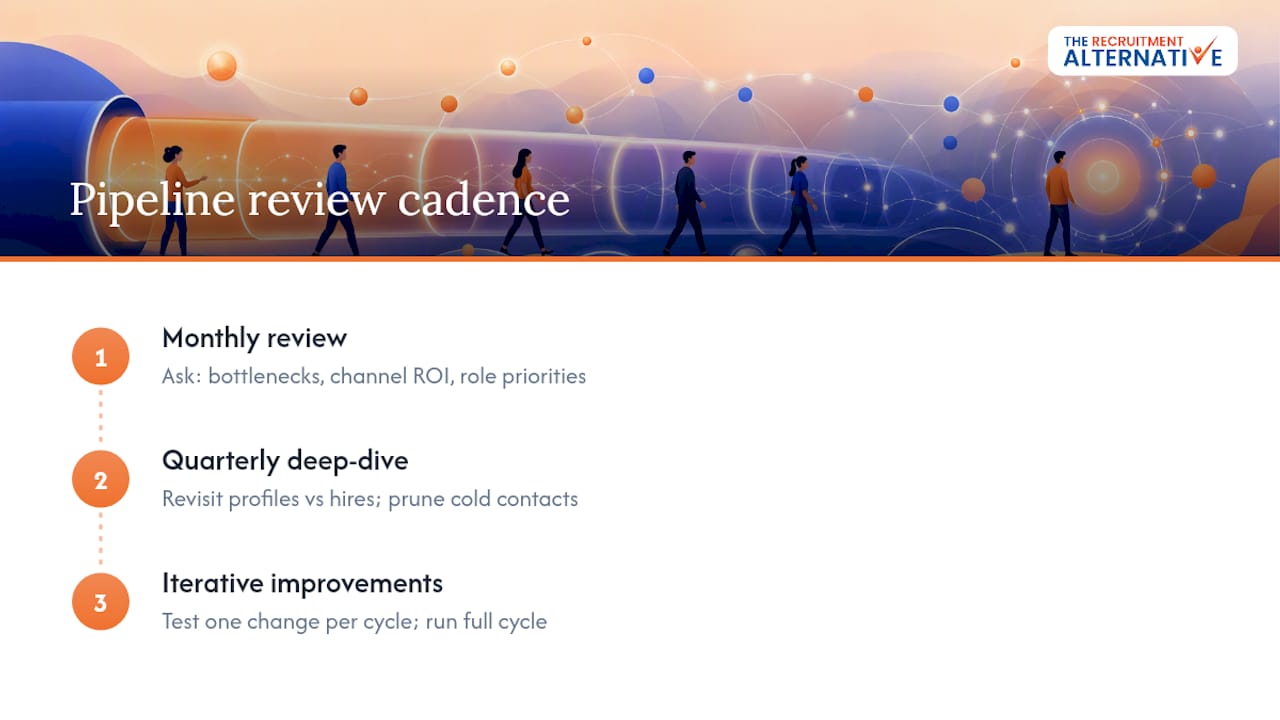
Each monthly review should ask three questions: Is any tier bottlenecking consistently? Is one sourcing channel underperforming against its cost or time investment? And has anything changed in the business that shifts your priority role families? A product launch that got delayed six months, for instance, means the pipeline you built around it can slow its cadence without guilt.
Quarterly, go a level deeper. Revisit your role success profiles against actual hiring outcomes: did the people you hired from the pipeline perform the way the profile predicted? If not, the profile needs rewriting, not the candidates. This is also the point to prune contacts who’ve gone cold for two or more cadence cycles despite genuine attempts to reach them; a pipeline with hundreds of unresponsive names looks impressive and helps nobody.
The improvement process itself should stay lightweight. Test one change at a time, whether that’s a new outreach template, a different sourcing channel, or a shortened cadence for one tier, and give it a full cycle before judging results. Small, measured adjustments compound over a year in a way that occasional dramatic overhauls never do, and they’re far easier to defend to a business owner asking what the pipeline is actually delivering.
Author perspective: practical cautions and what success feels like
The mistakes I see most in small businesses aren’t strategic, they’re operational: no named owner, cadence that dies after week three, or constant tool-switching mistaken for progress. Fix ownership and cadence first; the platform choice barely matters at this scale.
Success isn’t a full talent acquisition function. It’s being able to name three ready candidates the moment a role opens, instead of starting from zero. When that capability genuinely outstrips your bandwidth or needs specialist sourcing, that’s the point to bring in a fixed-fee recruitment partner rather than stretching your own team thinner.
Get pipeline support without the agency price tag
Most recruitment agencies charge a percentage of the new hire’s salary, which means the cost of getting pipeline help scales up exactly when you need it most, during a specialist search or an urgent role. The Recruitment Alternative works differently: a transparent, fixed-price fee structure regardless of how long the search takes or how specialist the role is.
That model fits the exact gap this guide has described. If you’ve mapped your priority role families but don’t have the bandwidth to run sourcing and nurture on top of everything else, or you need specialist candidates for engineering, healthcare, technology, or executive roles outside your usual network, a trusted recruitment partner can seed and manage that pipeline for you. The Recruitment Alternative handles candidate sourcing, screening, and shortlisting for permanent roles across most industries, with candidate replacement cover if a placement doesn’t work out in the first two to three months.
If a role has sat open longer than you’d like, or your internal pipeline for a skill set is thinner than it should be, get in touch about hiring your next permanent staff member and find out what a fixed-price search would look like for that role.
Sources
- How to develop a talent pipeline – Cornerstone
- How to build a talent pipeline before you hire – KORE1
- Talent acquisition strategy: CHRO playbook for 2026 – Jobful
- How to build a successful talent acquisition strategy – IBM
Recommended
- What Is a Talent Pipeline and Why It Matters – The Recruitment Alternative
- Recruitment Tips – towards a productive workplace. The Recruitment Alternative
- Key Insights from the Latest Recruitment Outlook Survey – The Recruitment Alternative
- Approaching Inefficient Talent Acquisition – The Recruitment Alternative

