

Recruiting across multiple industries delivers measurable gains in resilience, talent access, speed-to-hire and innovation — and the evidence backs it. McKinsey’s analysis of 1,265 companies found that organisations in the top quartile for board-gender diversity were 27% more likely to outperform financially than those in the bottom quartile. Forté Foundation experts go further, recommending that employers prioritise the long-term competitive advantage of diverse, high-performing teams over short-term diversity metrics to improve retention and engagement. For HR leaders, hiring managers and SME owners in Australia, the multi-industry recruitment advantages are no longer theoretical.
Here are the headline advantages this article covers:
- Greater resilience when market conditions shift
- Access to a larger, more diverse talent pool
- Faster time-to-hire through a broader candidate funnel
- Stronger career growth and retention for cross-industry hires
- Future-proofing workforce capability and sparking innovation
- Reduced groupthink and fresh problem-solving approaches
- Cost efficiencies when using a flat-fee, generalist recruiter
If you are an HR leader, hiring manager or SME owner looking to build a more adaptable workforce, this guide is written for you.
Key takeaways
Recruiting across multiple industries delivers measurable gains in resilience, talent access, speed-to-hire and innovation, provided employers invest in structured assessment and a deliberate onboarding plan.
| Point | Details |
|---|---|
| Diversity drives performance | McKinsey’s analysis of 1,265 companies found top-quartile diverse boards were 27% more likely to outperform financially. |
| Broader pool means faster hiring | Expanding sector scope can more than double the candidate pool, shortening time-to-fill from weeks to days. |
| Onboarding determines success | A 30/60/90-day induction plan with a domain mentor separates domain learning from early performance expectations. |
| Manage risks with structure | Competency-based assessment, replacement insurance and a training budget mitigate the main risks of cross-industry hiring. |
| The Recruitment Alternative | A flat-fee, generalist recruiter covering all major industries across Australia, with replacement insurance and fixed pricing per placement. |
Table of Contents
- What multi-industry (multi-sector) recruitment actually means
- Why Australian employers are widening their talent searches now
- 1. Multi-industry recruitment advantages: greater resilience during market shifts
- 2. Access to a larger, more diverse talent pool
- 3. Speed and flexibility in filling roles
- 4. Stronger career growth and retention for cross-industry hires
- 5. Future-proofing workforce capability and sparking innovation
- 6. Which employers and roles benefit most from this approach
- 7. Key risks and how to manage them
- 8. How to implement multi-industry recruitment step by step
- 9. How a flat-fee, generalist recruiter delivers these advantages in practice
- What actually makes cross-industry hiring succeed or fail
- The Recruitment Alternative: flat-fee, multi-industry recruitment across Australia
- Sources
What multi-industry (multi-sector) recruitment actually means
Multi-industry recruitment, also called multi-sector talent acquisition, is the practice of sourcing candidates from adjacent or entirely different industries rather than restricting a search to your own sector. It differs from specialist hiring, where the brief requires direct domain experience, by treating transferable skills, adaptability and problem-solving capability as primary selection criteria.
A few Australian-relevant examples make the distinction concrete:
- A technology company hires a clinical workflow specialist from healthcare to lead product design for a health-tech platform, valuing their end-user insight over software credentials.
- A logistics operator recruits an operations manager from retail, where high-volume, time-critical fulfilment is already second nature.
- A professional services firm brings in a marketing lead from consumer goods, where brand positioning and customer segmentation are practised at scale.
Employers typically turn to this approach during expansion projects, rapid scaling, capability gap programmes and innovation initiatives. The main complexity sits in assessment: evaluating transferable skills across different contexts requires structured frameworks, and onboarding must close domain knowledge gaps quickly. Both challenges are addressed in the risks section below.
Why Australian employers are widening their talent searches now
Several structural forces are pushing Australian HR teams toward cross-industry hiring at the same time, making the shift less a trend and more a practical necessity.
- Tight labour markets. Skill shortages across technology, engineering, healthcare and trades mean that restricting searches to sector-experienced candidates leaves roles unfilled for longer.
- Digital transformation. Roles that did not exist five years ago have no established talent pipeline. Employers who insist on direct experience simply wait.
- Agility demands. Organisations restructuring around projects and cross-functional teams need people who can operate across contexts, not just within one.
- Remote work. Geographic barriers have dropped significantly, widening the sourcing pool to candidates across Australia and, for some roles, internationally.
- Cost pressure. Prolonged vacancies cost more than a structured onboarding investment. Hiring from an adjacent sector and upskilling is often the faster, cheaper path.
Statistic callout: McKinsey’s research shows that diverse leadership correlates with stronger financial, social and environmental performance across 1,265 companies, making multi-sector talent acquisition part of a broader strategic capability play, not just a sourcing workaround.
1. Multi-industry recruitment advantages: greater resilience during market shifts
When a workforce draws capability from a single sector, it inherits that sector’s vulnerabilities. A downturn in construction, for example, can simultaneously empty a project management pipeline if every PM came from the same industry. Multi-industry hires break that dependency.
The mechanism is straightforward: complementary skills from different market cycles reduce the risk of simultaneous capability gaps. An operations team that includes people from retail, logistics and manufacturing will have encountered different demand shocks, different regulatory environments and different customer expectations. That breadth tends to hold up better when conditions change.
Practical functions where resilience gains are most visible:
- Operations and supply chain, where cross-sector experience with different supplier models reduces single-point-of-failure risk.
- Sales teams, where client knowledge drawn from multiple industries widens the addressable market and reduces revenue concentration.
- Customer service, where experience across B2B and B2C contexts improves adaptability to different client types.
To track resilience gains, measure time-to-fill during a market downturn compared with previous cycles, and monitor business continuity indicators such as coverage ratios and internal mobility rates.
2. Access to a larger, more diverse talent pool
Restricting a search to candidates with direct industry experience is, in practice, a decision to compete for the same small group of people as every other employer in your sector. Widening the brief to adjacent industries and transferable skills immediately expands the candidate pool.
The scale effect is real. Inc. notes that hiring outside your industry can bring specialised transferable skills, a customer mindset and novel perspectives that are often quicker to develop internally than waiting for a perfect industry-specialist candidate. Non-traditional pipelines, including career-changers, graduates with cross-disciplinary degrees and contractors moving between sectors, add further supply.
For Australian employers, practical sourcing channels include:
- Industry-agnostic job boards (Seek, Indeed) with skills-based search filters
- LinkedIn searches using capability keywords rather than job title or industry filters
- University partnerships targeting graduates with applied skills in adjacent disciplines
- Employee referral programmes that explicitly encourage cross-sector nominations
- Online recruitment to break geographic barriers and reach candidates across Australia
Screening signals that indicate transferable capability:
- Evidence of rapid domain learning in a previous role transition
- Quantified outcomes (revenue, cost savings, process improvements) that translate across sectors
- Problem-solving examples where the candidate applied a method from one context to a new one
- Adaptability indicators: multiple industries, project types or team structures in their history
Pro Tip: When briefing a recruiter or writing a job ad, replace industry-specific credential requirements with outcome-based criteria. “Managed a $2M project budget to completion” is a transferable signal; “five years in construction” is not.
3. Speed and flexibility in filling roles
A narrow hiring brief is one of the most common causes of extended time-to-fill. When the candidate pool is small, shortlists take longer to build, interviews stretch across more weeks and the risk of a failed search rises. Widening sector scope addresses all three.

Here is a typical before/after pattern: a technology company searching for a project manager with fintech experience might spend 10–12 weeks building a shortlist of four candidates. The same search, reframed around project management capability with financial services or regulated-industry experience, can produce a shortlist of eight candidates in four to six weeks, because the pool is two to three times larger.
The principle behind this is simple: a broader candidate funnel and parallel sourcing across sectors produce faster shortlists without sacrificing quality, provided the assessment framework is built around transferable evidence rather than industry checkboxes.
- Rewrite the brief. Replace sector-specific requirements with outcome-based criteria before the search begins.
- Parallel sourcing. Run searches across two or three adjacent industries simultaneously rather than sequentially.
- Structured screening. Use a consistent competency framework so cross-industry candidates are assessed on the same evidence as sector-experienced ones.
- Calibrate hiring managers. Brief them on what transferable evidence looks like before interviews start, not after the first round.
Pro Tip: The single biggest speed drag in cross-industry hiring is a hiring manager who reverts to industry-experience filters during interviews. A 30-minute pre-brief on transferable competencies, with two or three worked examples, eliminates most of this friction.
One quality control note: speed without a structured assessment framework produces poor hires regardless of industry. Maintain a consistent scoring rubric across all candidates.
4. Stronger career growth and retention for cross-industry hires
People who move between industries tend to be self-directed learners. They have already demonstrated the ability to enter an unfamiliar context, build credibility and deliver results. That disposition, when matched with a deliberate development plan, translates into higher engagement and lower attrition.
Forté Foundation’s guidance is direct on this point: organisations that focus on long-term inclusive culture and transferable capability, rather than short-term diversity metrics, see measurable improvements in retention and engagement. The practical implication for employers is to connect cross-industry hires to structured career pathways from day one.
A targeted onboarding checklist for cross-industry hires:
- Assign a domain mentor for the first 90 days, someone with deep sector knowledge who can answer context-specific questions without gatekeeping.
- Schedule a structured industry orientation in weeks one and two: regulatory environment, key clients, internal terminology and team interdependencies.
- Set 30/60/90-day milestones that separate domain learning from performance expectations, so the hire is not penalised for knowledge gaps during the ramp period.
- Build a development plan that explicitly maps the hire’s cross-sector skills to future internal opportunities.
For staff retention, the metric to track is six-month retention rate for cross-industry hires versus same-industry hires. In most cases, the former performs comparably or better once the onboarding period is complete.
5. Future-proofing workforce capability and sparking innovation
The most durable benefit of multi-sector talent acquisition is what happens when people with different industry practices work on the same problem. They do not just bring different answers; they bring different questions. That shift in framing is where genuine innovation tends to originate.
The Hindu BusinessLine’s commentary on cross-industry hiring makes the point plainly: bringing people from outside the sector reduces insular thinking and introduces creative problem-solving approaches that help businesses adapt. The mechanism is not mysterious. A logistics professional who spent five years in retail brings a customer-centric lens to supply chain design. A healthcare administrator who moves into financial services brings rigorous compliance habits to a sector that often underinvests in process discipline.
Metrics to track innovation outcomes from cross-industry hires:
- Number of new product or process ideas submitted per quarter, segmented by hire background
- Cross-functional project success rates where multi-industry teams are involved
- Revenue contribution from initiatives led or co-led by cross-sector hires
Statistic callout: McKinsey’s analysis found that ethnically diverse boards were 13% more likely to outperform financially than less diverse counterparts, alongside the 27% figure for gender diversity, reinforcing that diversity of background in leadership has a measurable impact on outcomes.
Aligning hiring to a strategic capability roadmap is the discipline that converts individual cross-sector hires into a systemic advantage. Identify the capabilities your organisation will need in three to five years, then map which adjacent industries already develop those capabilities at scale.
6. Which employers and roles benefit most from this approach
Not every organisation or role is an equally good candidate for cross-industry hiring. The approach works best where transferable skills genuinely substitute for domain experience, and where the organisation has the onboarding infrastructure to close knowledge gaps.
Organisations most likely to benefit:
- Growth-stage SMEs that need generalist capability across multiple functions simultaneously
- Project-based teams where the work cycle is short enough that domain ramp-up is manageable
- Innovation functions and product teams where fresh perspectives are a design requirement
- Leadership hires where strategic thinking, stakeholder management and change capability matter more than sector credentials
- Any organisation facing a genuine talent shortage in its own sector
Role examples with rationale:
- Marketing and brand: Consumer goods, media and FMCG professionals bring audience segmentation and campaign discipline that transfers directly to professional services or technology.
- Operations and project management: Retail, logistics and manufacturing operations experience translates well across sectors, particularly in high-volume or time-critical environments.
- Customer service and account management: B2C experience often produces stronger empathy and communication skills than B2B-only backgrounds.
- Executive leadership: At this level, executive recruitment increasingly prioritises strategic capability over sector pedigree.
Where to use caution:
Highly regulated or safety-critical roles, including certain engineering, clinical healthcare, legal and financial advisory positions, carry compliance and licensing requirements that cannot be substituted by transferable skills alone. In these cases, specialist hiring remains the appropriate default, with cross-industry sourcing reserved for adjacent or support functions.
A practical decision flow: pilot cross-industry hiring in one non-critical function, measure time-to-fill and six-month retention, then expand to adjacent roles. Maintain a specialist-hire fallback for regulated positions.
7. Key risks and how to manage them
Multi-industry hiring carries real operational risks. Acknowledging them and building mitigation into the process is what separates a successful pilot from an expensive lesson.
| Risk | Why it arises | Mitigation |
|---|---|---|
| Skills gaps in domain knowledge | Candidate’s sector experience does not cover industry-specific tools, regulations or client expectations | Structured 90-day induction; targeted upskilling budget; domain mentor assignment |
| Cultural fit challenges | Different industry norms around pace, hierarchy or communication create friction | Assess culture alignment explicitly during interviews; use a culture-fit framework alongside skills evaluation |
| Assessment complexity | Standard job-specific screening misses transferable capability or over-weights irrelevant credentials | Replace credential filters with competency-based assessment; use structured scoring rubrics |
| Onboarding cost and time | Cross-industry hires require longer ramp periods, increasing short-term productivity cost | Build ramp-period milestones into the role brief; separate domain learning from performance KPIs in the first 90 days |
| Coordination overhead | Running multi-sector searches without standardised briefs increases recruiter and hiring manager workload | Use standardised job description templates; consolidate with a single generalist recruiter rather than multiple specialist agencies |
On the question of using multiple recruitment agencies: consolidating with a single industry-agnostic partner reduces duplicated submissions, management overhead and conflicting candidate pipelines. Multiple agencies working the same brief often produce the same candidates and create confusion around ownership.
Additional mitigation practices:
- Design probation periods with explicit domain-learning milestones, not just performance targets
- Allocate a training budget per cross-industry hire in the first six months
- Use short practical tasks or work samples in the interview process to validate tacit skills
- For roles with compliance requirements, confirm licensing and registration status before offer. Australia’s Fair Work Act and relevant industry regulators set minimum credential requirements for certain roles; always verify these with the relevant authority or a qualified adviser before proceeding.
8. How to implement multi-industry recruitment step by step
A structured approach reduces the risk of a poorly scoped search and gives you clear decision points to evaluate before committing to a full roll-out.
- Build the business case. Identify the capability gap, the cost of the current vacancy and the estimated onboarding investment for a cross-industry hire. Compare this with the time-to-fill history for same-industry searches.
- Rewrite the role brief. Replace industry-experience requirements with outcome-based criteria and transferable competency descriptors. A hiring strategy framework can help structure this step.
- Expand sourcing channels. Activate industry-agnostic job boards, LinkedIn skills-based searches, employee referrals and, where relevant, remote sourcing to reach candidates across Australia.
- Apply a transferable-skills assessment framework. Use a consistent competency rubric across all candidates. Score on outcomes, adaptability evidence and problem-solving examples, not job titles.
- Brief hiring managers. Run a pre-interview calibration session. Show two or three examples of what transferable evidence looks like for this role.
- Execute a structured onboarding plan. Use the 30/60/90-day checklist from Section 4. Assign a domain mentor and separate learning milestones from performance KPIs.
- Measure and review. Track time-to-fill, cost-per-hire and six-month retention for the pilot role. Compare with your baseline before deciding to expand.
Typical timeline: A pilot search runs 8–12 weeks from brief to placement. A full programme roll-out across multiple functions typically takes 3–6 months, depending on the number of roles and the organisation’s onboarding infrastructure.
Cost shape to expect:
- Advertising and sourcing costs are comparable to a standard search, often lower when using a flat-fee recruiter
- Upskilling and onboarding investment per cross-industry hire: typically one to two weeks of structured induction plus a targeted training budget
- Time-to-fill savings offset onboarding costs when the cross-industry pool is two to three times larger than the specialist pool
- Replacement risk is reduced when the hire is selected for adaptability; a recruiter offering replacement insurance provides a further cost buffer
For SMEs, the practical starting point is a single pilot role in a non-critical function with defined success metrics before committing to a broader programme.
9. How a flat-fee, generalist recruiter delivers these advantages in practice
The following vignette illustrates how a multi-industry search works when run through a generalist, flat-fee recruiter. Details are illustrative, drawn from the engagement model at The Recruitment Alternative.
The brief: A mid-sized Australian professional services firm needed an operations manager. Previous searches restricted to professional services candidates had run for 14 weeks without a successful placement.
The cross-industry approach: The brief was rewritten around project coordination, process improvement and stakeholder management outcomes. Sourcing expanded to include candidates from retail operations, logistics and healthcare administration.
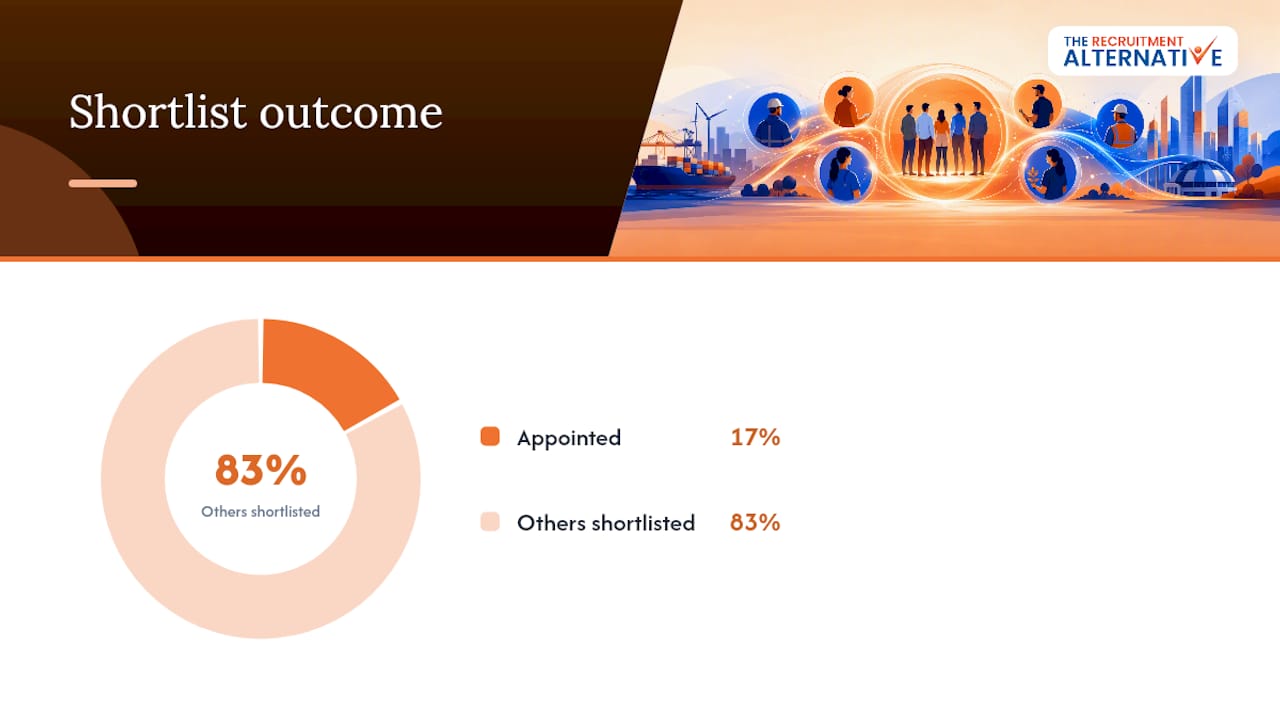
The outcome: A shortlist of six candidates was produced in five weeks. The appointed candidate came from a healthcare operations background, bringing process rigour and compliance discipline that the hiring manager later described as a direct capability uplift for the team.
Briefing checklist for employers using a flat-fee, generalist recruiter:
- Provide outcome-based role criteria, not a list of industry credentials
- Confirm the recruiter’s sourcing reach across adjacent sectors
- Ask how transferable skills are assessed in their screening process
- Clarify the replacement insurance terms upfront
- Agree on a communication cadence and shortlist timeline before the search begins
What to expect from The Recruitment Alternative’s engagement model:
- An initial consultation to scope the role and agree on the brief
- Active sourcing across multiple industries and channels
- Competency-based screening and shortlist delivery
- Replacement insurance if the hire does not work out within the first 2–3 months
- Fixed-fee pricing tiered by candidate salary, with no percentage-of-salary commission
The four case studies on The Recruitment Alternative’s website provide further illustrative examples of placement outcomes across industries.
What actually makes cross-industry hiring succeed or fail
Most cross-industry hires that underperform do not fail because the candidate lacked capability. They fail because the hiring manager never fully committed to the approach. The brief gets rewritten mid-search to add industry-experience requirements. The interview panel scores a cross-sector candidate lower on “cultural fit” without being able to articulate why. The onboarding plan treats the hire as a fully formed domain expert from week one.
The organisations that get the most from inter-industry recruitment do three things differently. They define success in terms of outcomes, not credentials, before the search begins. They invest in a structured 90-day onboarding period that explicitly separates domain learning from performance expectations. And they treat the first cross-industry hire as a pilot with defined metrics, not a permanent policy shift.
A few non-obvious tips from practitioner experience:
- Short practical tasks during the interview process, a 30-minute problem-solving exercise or a brief written response to a realistic scenario, reveal tacit skills that a CV cannot show.
- The best predictor of a successful cross-industry hire is not the candidate’s most recent role; it is the transition they made two or three roles ago and what they built in the new context.
- Employee retention strategies that work for same-industry hires often need adjustment for cross-sector ones; the development plan matters more than the salary package in the first year.
Run one constrained, measurable pilot. Pick a role where transferable skills genuinely substitute for domain experience, define your success metrics upfront, and evaluate honestly at the six-month mark.
The Recruitment Alternative: flat-fee, multi-industry recruitment across Australia
For employers ready to trial cross-sector hiring, the biggest practical barrier is usually the cost and complexity of running a wider search. The Recruitment Alternative removes both.
As a generalist recruitment agency covering sales, administration, finance, engineering, healthcare, technology, trades and executive leadership, The Recruitment Alternative sources across industries by design, not as an exception. The flat-fee model means you pay a fixed price per placement, tiered by candidate salary, with no percentage-of-salary commission eating into your hiring budget. Replacement insurance covers the first 2–3 months if a hire does not work out.
For a cross-industry pilot, the engagement is straightforward: an initial brief, active multi-sector sourcing, competency-based screening and a shortlist delivered to your timeline. To see the fee structure and start a conversation, visit the flat-fee recruitment page or get in touch directly. The Recruitment Alternative works with businesses of all sizes throughout Australia and New Zealand.
Sources
- Diversity matters even more: the case for holistic impact — McKinsey & Company
- The key to a competitive advantage: recruiting and retaining a diverse workforce — Forté Foundation
- 5 ways hiring outside your industry can boost success — Inc.
- What is Multi-Industry Recruitment? Key challenges & Solutions for today’s businesses — HRI

