

Candidate pipeline management is the proactive process of building, nurturing, and converting a segmented pool of pre-qualified candidates for current and future roles. Done well, it reduces time-to-hire, lowers cost-per-hire, and consistently delivers better-fit candidates than reactive, post-vacancy sourcing. The three core elements are straightforward:
- Build: identify and segment candidates before a role opens
- Nurture: maintain meaningful contact to keep candidates warm and engaged
- Convert: move the right candidates into active consideration at the right moment
Table of Contents
- Candidate pipeline vs talent pool vs ATS: what is the difference?
- The four core stages of a modern candidate pipeline
- Which tools support each stage of the pipeline?
- How to build and maintain a candidate pipeline: a practical checklist
- Metrics and KPIs to measure pipeline health
- Common pipeline problems and how to fix them
- Australian legal and privacy considerations for pipeline management
- How The Recruitment Alternative uses candidate pipelines: a practical example
- Key takeaways
- Why proactive pipelines are a competitive advantage right now
- Flat-fee recruitment and pipeline support from The Recruitment Alternative
- Useful sources and further reading
Candidate pipeline vs talent pool vs ATS: what is the difference?
These three terms are often used interchangeably, which creates real confusion about what tool or practice to apply to which problem. The distinction matters: a recruitment pipeline is role-specific and stage-based, while a talent pipeline is the ongoing, pre-qualified pool that feeds it.
Here is a practical breakdown:
- Candidate pipeline: — curated, engagement-focused subset of the talent pool, segmented by role category and readiness. Owned by the recruiter. Best for proactive hiring against known or anticipated vacancies.
- Recruitment pipeline / ATS: — role-specific, stage-based funnel tied to a live vacancy. Owned jointly by the recruiter and hiring manager. Best for tracking active applicants through screening, interview, and offer stages.
The practical flow is: talent pool feeds the candidate pipeline, which feeds the recruitment pipeline when a role opens. Understanding what a talent pipeline is and why it matters helps HR teams decide where to invest their sourcing effort.
Pro Tip: Use your ATS fields for role-specific stage tracking and compliance records. Use CRM tags or spreadsheet columns for engagement temperature, source channel, and readiness level. Mixing the two in one system creates reporting noise and makes segmentation harder.
The four core stages of a modern candidate pipeline
A practical pipeline structure) moves candidates through four stages, each with clear ownership, actions, and transition criteria.
Stage 1: Build and source
Targeted sourcing is the foundation. Rather than posting broadly and waiting, sourcers proactively identify candidates through LinkedIn, professional networks, industry events, referral programmes, and specialist job boards. Every candidate added to the pipeline should be tagged immediately for role-fit, engagement temperature, and source channel.
Key actions:
- What Is a Candidate Pipeline? Plus How To Build One
- What Is a Candidate Pipeline? Definition and Guide
- [Candidate Pipeline Management: Build, Nurture & Convert [2026]](https://augtal.com/blog/candidate-pipeline-management-build-nurture-convert-your-talent-pool/)
- Pipeline recruitment: how to manage and fill it effectively
- A Complete Guide on Candidate Pipeline Management for HR Teams
- What is a Recruitment Pipeline? (And How to Manage It) – Adeptiq)
- Top priorities for HR leaders (Gartner)
- Candidate Pipeline Management | Streamline Hiring with HRMantra
Stage 2: Engage and nurture
This is where most pipelines stall. Without a structured cadence, warm candidates go cold and the pipeline loses its value. Nurture is not about sending mass emails. It is about relevant, timely contact that keeps candidates interested without pressuring them.
- Hot candidates: contact every two to four weeks with role-relevant updates or a direct conversation
- Warm candidates: monthly or bi-monthly touchpoints via email, LinkedIn, or industry content
- Cold candidates: quarterly check-in or re-qualification survey
Strong candidate-recruiter relationships are built through consistency, not volume of contact.
Stage 3: Qualify and assess
When a role opens or a candidate signals readiness, move them into active qualification. This stage includes pre-screen calls, skills assessments, reference checks, and structured interviews. Clear stage-movement criteria prevent candidates from sitting in limbo.
- Define the trigger for moving a candidate from pipeline to active consideration
- Set an SLA for completing pre-screens (typically 48–72 hours from trigger)
- Document qualification outcomes in your ATS or CRM for future reference
Stage 4: Convert
Speed matters at this stage. Conversion velocity is the metric that separates effective pipelines from slow ones. Hot candidates who have been nurtured expect a responsive process. Delays at the offer stage are the most common reason pipeline hires fall through.
- Prioritise interview scheduling within 24–48 hours of qualification sign-off
- Have offer approval processes agreed with hiring managers before the role opens
- Track offer-acceptance rates by pipeline segment to identify where candidates are dropping out
Pro Tip: When a hot candidate signals active job searching, treat it as a 48-hour window. Brief the hiring manager the same day and schedule the first interview within two business days. Candidates in active search rarely wait longer than a week before accepting another offer.
Numbered checklist of responsibilities per stage:
- Sourcer: builds the initial pool, applies entry criteria, tags candidates on entry
- Recruiter: owns nurture cadences, manages engagement tiers, triggers qualification
- Hiring manager: approves shortlists, conducts interviews, signs off on offers within agreed SLAs
- HR/People team: maintains compliance records, manages data retention, audits pipeline health quarterly
Which tools support each stage of the pipeline?
The right technology depends on team size, hiring volume, and how mature your pipeline practice already is. Two categories of tool do the heavy lifting: applicant tracking systems (ATS) and candidate relationship management (CRM) platforms. They serve different purposes and work best together.
ATS strengths:
- Tracks candidates against live vacancies in a stage-based funnel
- Manages compliance records, interview scheduling, and offer documentation
- Generates role-specific reporting (time-to-fill, source-of-hire per vacancy)
- Best suited to active recruitment pipelines tied to open roles
CRM strengths:
- Manages long-term nurture across candidate segments regardless of live vacancies
- Supports drip email campaigns, engagement scoring, and pipeline analytics
- Enables tagging by role-fit, readiness, and source channel
- Best suited to talent pipeline management between hiring cycles
For small teams or businesses with low hiring volume, a well-structured spreadsheet with consistent tagging conventions can serve as a basic CRM. Candidate databases built around clear tagging taxonomies outperform large, unsorted contact lists regardless of the platform used.
Automation has a role, but it requires guardrails:
- Automate: initial acknowledgement emails, nurture drip sequences, interview scheduling reminders, and pipeline audit prompts
- Keep human: first outreach to passive candidates, re-engagement after a long gap, offer conversations, and any communication where tone or nuance matters
Sourcing tools such as LinkedIn Recruiter, Seek Talent Search, and Boolean search via Google complement the ATS/CRM stack by surfacing new candidates to enter the pipeline.
How to build and maintain a candidate pipeline: a practical checklist
Building a usable pipeline takes roughly 90 days from a standing start. The goal in that period is not a large database. It is a small, well-segmented pool with active engagement already running. Quality over quantity is the consistent finding: 500 well-tagged, engaged candidates outperform 5,000 cold contacts every time.
30/60/90-day build plan:
- Week 1–2: define two or three priority role categories; create ideal candidate profiles; agree entry criteria with hiring managers; set up tagging taxonomy in your ATS or CRM
- Month 1: source an initial cohort of 50–100 candidates per role category; send first outreach; tag by readiness and source; set nurture cadences
- Month 2: run first nurture cycle; qualify any hot candidates; document outcomes; identify gaps in sourcing channels
- Month 3: conduct first pipeline audit; prune candidates who have not responded to two or more touchpoints; refine entry criteria based on conversion data; brief hiring managers on pipeline status
Maintenance tasks (ongoing):
- Quarterly audit: review all candidates, update readiness tags, archive inactive contacts
- Pruning rule: candidates with no response after three outreach attempts move to a “dormant” archive, not deletion
- Source review: assess which channels are producing the highest-quality pipeline entries each quarter
Sample re-engagement email for a warm candidate:
Keep it short, specific, and low-pressure. Generic “checking in” emails produce low response rates.
Pro Tip: Start with one role category, not five. Build the process, prove the conversion rate, then replicate it. Trying to pipeline every role simultaneously is the fastest way to end up with an unmanageable, stale database.
Metrics and KPIs to measure pipeline health
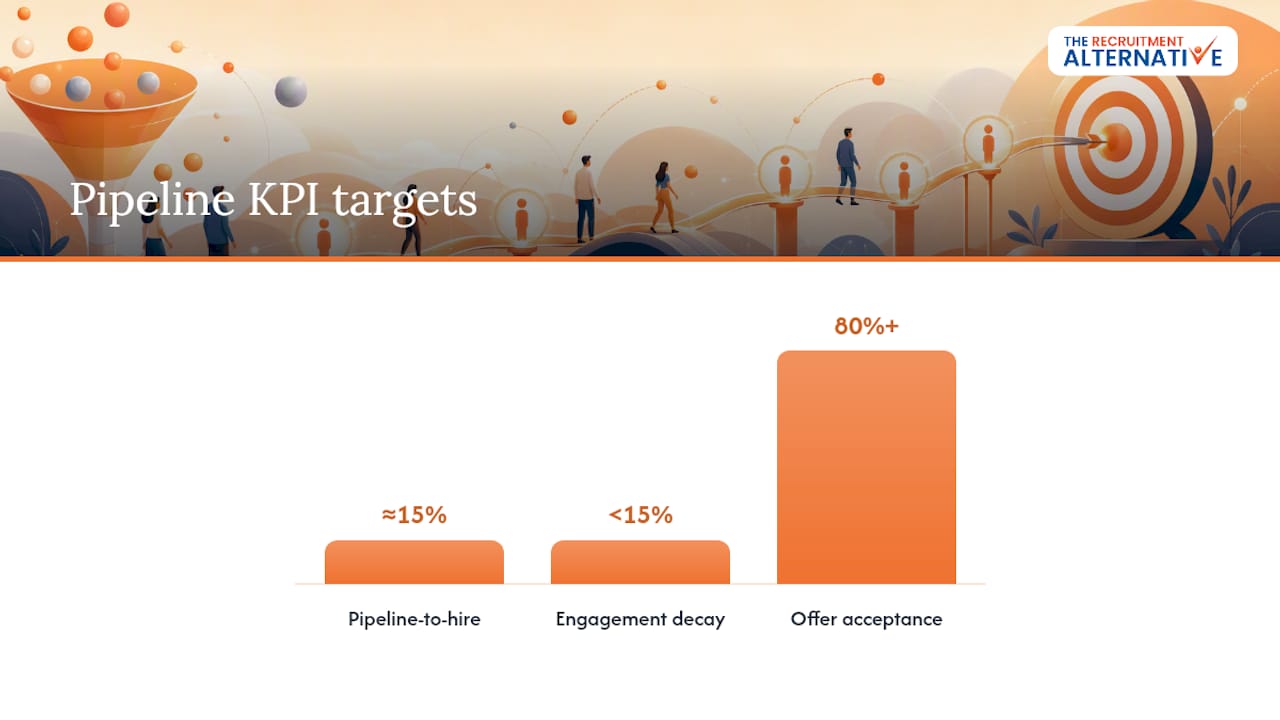
Pipeline metrics are most useful when tied to business outcomes rather than raw contact counts. The table below covers the core KPIs, how to calculate each, and practical targets.
| Metric | Formula | Purpose | Target / Benchmark |
|---|---|---|---|
| Pipeline-to-hire conversion rate | Hires from pipeline ÷ total pipeline candidates × 100 | Measures overall pipeline quality and nurture effectiveness | approximately 15% for active pipelines |
| Time-to-fill (pipeline vs sourced) | Days from role open to offer accepted, split by source | Quantifies speed advantage of pipeline over reactive sourcing | Pipeline fills should be materially faster than sourced fills |
| Source-to-hire rate | Hires from each channel ÷ total hires × 100 | Identifies highest-performing sourcing channels | Varies by role; track trends over time |
| Engagement decay rate | Candidates with no response in 90 days ÷ total pipeline × 100 | Flags pipeline staleness and nurture gaps | Keep below 15% |
| Cost-per-hire (pipeline vs sourced) | Total recruitment spend ÷ number of hires, split by source | Measures cost efficiency of pipeline investment | Pipeline hires should show lower cost-per-hire than sourced hires |
| Offer acceptance rate | Offers accepted ÷ offers made × 100 | Measures conversion at the final stage | Target 80%+ for pipeline candidates |
Report pipeline KPIs monthly to the recruiting team and quarterly to hiring managers and executives. A simple dashboard in your ATS or a shared spreadsheet works for most teams. The key is consistency: the same metrics, measured the same way, every reporting period.
Common pipeline problems and how to fix them
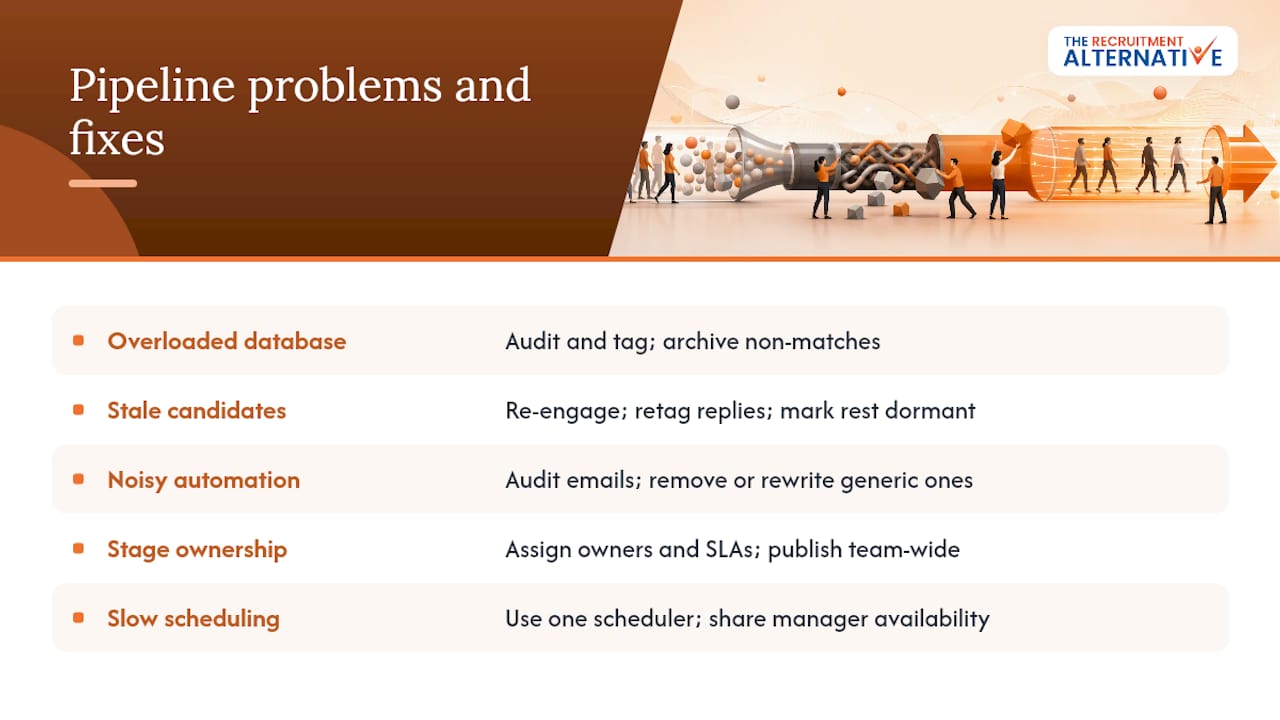
Most pipeline failures come down to four recurring issues. Each has a practical fix that can be applied without a technology overhaul.
Problem 1: Overloaded, unsorted database
Fix: apply entry criteria retrospectively. Audit the existing database, tag candidates who meet current role-fit thresholds, and archive the rest. Do this in one dedicated session rather than incrementally.
Problem 2: Stale candidates
Fix: run a re-engagement campaign to the full pipeline. Candidates who do not respond to two attempts move to dormant. Those who do respond get re-tagged with a current readiness level. Pipeline maintenance requires periodic outreach, tagging, and pruning to prevent candidate drop-off.
Problem 3: Noisy automation
Fix: audit every automated email in your sequence. If a message would feel generic or irrelevant to a candidate who receives it, rewrite or remove it. Automation should feel like a timely, relevant nudge, not a bulk mail-out.
Problem 4: Inconsistent stage ownership
Fix: document who owns each stage and what the SLA is for each transition. Post it somewhere the whole team can see it. Ambiguity about who is responsible for moving a candidate forward is the most common cause of pipeline bottlenecks.
Problem 5: Slow interview scheduling
Fix: use a single scheduling tool (Calendly, Microsoft Bookings, or equivalent) and give candidates direct access to hiring manager availability. Removing the back-and-forth email chain cuts scheduling time from days to hours.
Pro Tip: Run a quarterly “dead pipeline” audit. Any candidate with no activity in six months either gets a re-engagement attempt or moves to a clearly labelled archive. A dormant archive is not a failure; it is a resource for future sourcing. Deleting records entirely removes future value and may create compliance gaps.
Australian legal and privacy considerations for pipeline management
Managing a candidate pipeline in Australia means handling personal information under the Privacy Act 1988 (Cth) and the Australian Privacy Principles (APPs). The practical obligations for HR teams are straightforward.
Data collection: collect only the information you need for recruitment purposes. Name, contact details, work history, and skills are standard. Sensitive information (health, background checks) requires explicit consent and must be stored securely.
Consent for ongoing nurture: when a candidate enters your pipeline, tell them clearly how their information will be used and how long it will be retained. For passive candidates added without a direct application, send a brief consent confirmation before beginning nurture outreach.
Retention and pruning: the APPs require that personal information is not kept longer than necessary. A practical rule is to review and prune pipeline records annually, archive dormant candidates after 12–18 months of inactivity, and delete records on request.
Candidate access: candidates have the right to access their personal information and request corrections. Have a simple process in place to handle these requests promptly.
Keeping your pipeline compliant is not just a legal obligation. It is also good practice for candidate experience: people who trust that their data is handled respectfully are more likely to engage with your outreach and accept offers when the time comes.
Pro Tip: This section provides general guidance only and does not constitute legal advice. For bespoke pipeline data governance, particularly if you are managing sensitive roles or large candidate volumes, seek advice from a qualified privacy lawyer or consult the Office of the Australian Information Commissioner (OAIC) directly.
How The Recruitment Alternative uses candidate pipelines: a practical example
The Recruitment Alternative’s flat-fee model changes the incentive structure in a way that directly benefits pipeline quality. Traditional percentage-based agencies are rewarded for filling roles quickly from whatever candidates are available. A flat-fee model aligns the agency’s focus on conversion velocity and candidate fit, because the fee does not increase with salary and repeat business depends on outcomes, not invoiceable hours.
In practice, The Recruitment Alternative maintains specialised candidate databases across its core sectors: sales, administration, finance, engineering, healthcare, technology, trades, and executive leadership. When a client engages the agency, sourcing begins from a pre-existing, segmented pool rather than from a cold job ad. This compresses the early stages of the pipeline and reduces time-to-shortlist.
The agency’s process mirrors the four-stage framework described in this guide:
- Role-specific ideal candidate profiles created at engagement
- Targeted outreach to warm and hot candidates in the relevant database segment
- Structured pre-screening and shortlisting before candidates reach the hiring manager
- Replacement insurance if a hire does not work out within the first two to three months
Pro Tip: Building an in-house pipeline makes sense for roles you hire frequently (three or more times per year). For specialist, senior, or infrequent hires, an agency with a pre-built pipeline in that sector will almost always be faster and more cost-effective than starting from scratch internally.
For businesses weighing in-house pipeline capability against agency support, the honest answer is that both have a place. The decision turns on hiring frequency, internal resourcing, and the depth of your existing candidate network in the relevant sector.
Key takeaways
Candidate pipeline management works because it shifts hiring from reactive scrambling to proactive, relationship-based sourcing, producing faster fills, lower costs, and better candidate fit across every role category.
| Point | Details |
|---|---|
| Set entry criteria first | Define role-fit thresholds before sourcing begins to keep the pipeline usable and conversion rates high. |
| Use engagement tiers | Tag candidates as hot, warm, or cold and apply different cadences to each group to prevent pipeline staleness. |
| Track the right KPIs | Measure pipeline-to-hire conversion rate, time-to-fill by source, and engagement decay rate as your core health indicators. |
| Audit quarterly | Review, re-tag, and prune the pipeline every quarter to maintain data quality and comply with Australian privacy obligations. |
| The Recruitment Alternative | Offers flat-fee recruitment with pre-built candidate databases across key sectors, reducing time-to-shortlist for Australian employers. |
Why proactive pipelines are a competitive advantage right now
The Australian labour market has tightened considerably across skilled roles in technology, engineering, healthcare, and management. Employers who wait for a vacancy before sourcing are consistently losing candidates to competitors who have already built relationships with the same talent.
What strikes me most when looking at how Australian businesses approach hiring is the gap between what HR leaders say they want (strategic workforce planning, faster fills, lower agency spend) and what their current process actually delivers (reactive job ads, long time-to-fill, repeated agency fees). That gap is almost always a pipeline problem, not a sourcing problem. The candidates exist. The issue is that no one has been talking to them.
The teams that close that gap are not necessarily the ones with the biggest budgets or the most sophisticated technology. They are the ones that commit to a simple, consistent process: define who they want, find them before they need them, and stay in contact. A 500-person pipeline with active engagement beats a 5,000-person database of cold contacts every time.
For Australian HR professionals, the practical starting point is not a technology purchase. It is a conversation with your hiring managers about which two or three roles you hire most frequently, and building a small, well-curated pipeline for those roles first. Prove the model, measure the outcomes, and scale from there.
Flat-fee recruitment and pipeline support from The Recruitment Alternative
Filling roles faster without paying a percentage of salary is the concrete advantage The Recruitment Alternative offers Australian employers. Rather than starting every search from a cold job ad, the agency draws on specialised candidate databases built across sales, administration, finance, engineering, healthcare, technology, trades, and executive leadership, so the pipeline work is already done before your brief lands.
The flat-fee recruitment model means you pay a fixed price per placement, tiered by role salary, with no percentage markups and no surprises. Candidate replacement insurance covers the first two to three months if a hire does not work out. For small and mid-size businesses that cannot justify building a full in-house pipeline capability, this is a practical, cost-effective alternative to both DIY sourcing and traditional agency fees.
To see the pricing structure or get a quote for your next hire, visit The Recruitment Alternative’s simple flat-fee pricing page or contact the team directly.
Useful sources and further reading
- What Is a Candidate Pipeline? Plus How To Build One — AIHR’s HR glossary entry; a solid definitional starting point with practical scope guidance.
- What Is a Candidate Pipeline? Definition and Guide — covers measurable benefits including time-to-fill and cost-per-hire comparisons.
- Candidate Pipeline Management: Build, Nurture & Convert — detailed guide on segmentation, nurture tactics, and conversion velocity.
- Pipeline recruitment: how to manage and fill it effectively — practical maintenance cadences, tagging standards, and pruning rules.
- A Complete Guide on Candidate Pipeline Management for HR Teams — clarifies the distinction between recruitment pipelines and talent pipelines.
- What is a Recruitment Pipeline? (And How to Manage It) — five-stage pipeline structure with SLA guidance for stage movement.
- Top priorities for HR leaders (Gartner) — strategic context for pipeline capability within broader HR priorities.
- Candidate Pipeline Management with HRMantra — concise Q&A definitions useful for quick reference.
- Recruitment process improvement strategies — The Recruitment Alternative’s guide to improving hiring workflows, governance, and SLAs.
- What is a talent pipeline and why it matters — deeper reading on strategic talent pipeline development for Australian employers.

