

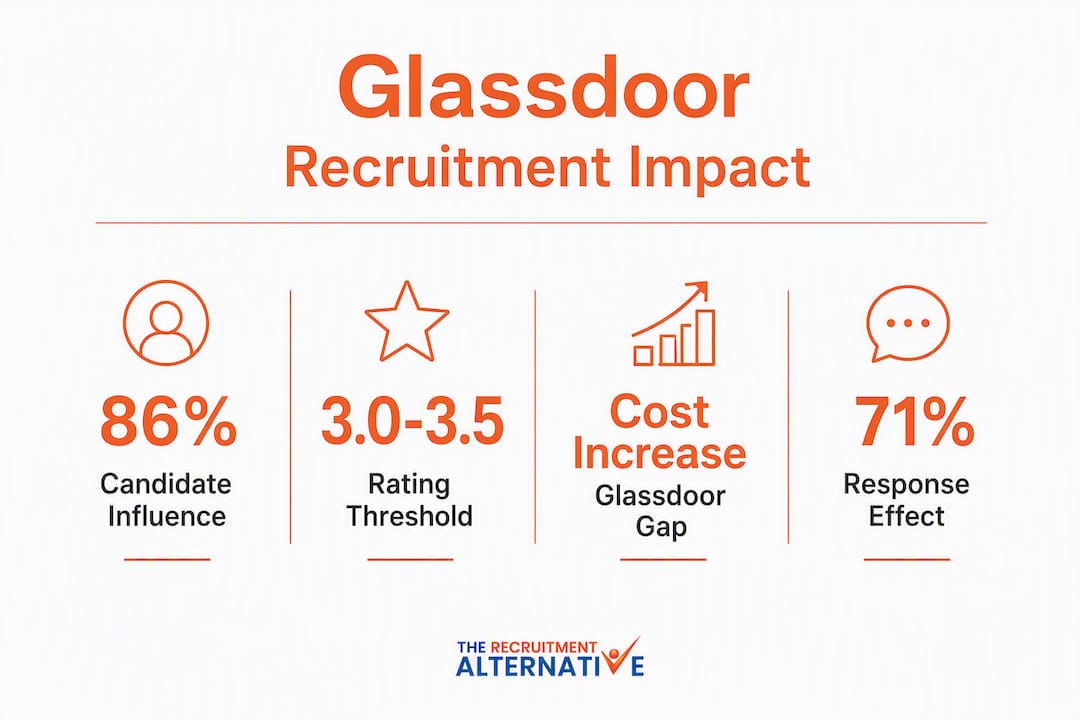
Glassdoor matters for recruitment, and the evidence is clear enough that inaction is the costlier choice. Around 86% of candidates check employer reviews before applying, and a profile with a relatively low star rating can deter a measurable share of applicants before your recruiter ever sees their name. The three things to do right now: set up monitoring so you know what is being said, respond professionally to recent reviews within a week of posting, and identify the one or two root causes (manager behaviour, pay, or process gaps) driving negative sentiment. Everything else in this guide builds on those three actions.
Table of Contents
- How Glassdoor shapes candidate decisions before they apply
- How Glassdoor ratings change your recruitment metrics
- How employer responses change what candidates think of you
- A practical three-step playbook: monitor, improve, promote
- When Glassdoor reviews matter less than you might think
- KPIs and tools for measuring Glassdoor’s effect on your hiring
- How a flat-fee recruiter can help when Glassdoor is hurting your hiring
- Legal and ethical considerations for Australian employers responding to reviews
- How Australian employers have managed Glassdoor reputation to improve hiring
- Integrating Glassdoor insights into your employer branding strategy
- Key takeaways
- What employers consistently get wrong about Glassdoor timelines
- Keep hiring while you fix your employer reputation
- Sources and further reading
How Glassdoor shapes candidate decisions before they apply
Candidates consult Glassdoor at two distinct moments: early in their job search when they are shortlisting employers, and again at the offer stage when they are deciding whether to accept. The shortlist check is the more consequential one for application volume because it happens before your job ad ever gets a click.

What candidates actually read varies by seniority. Early-career candidates tend to weight the overall star rating and the most recent five to ten reviews. Senior professionals and executives go deeper: they read CEO approval ratings, interview experience reports, and salary disclosures. They also use Glassdoor findings to prepare interview questions and negotiating points, which means a negative review about management style can surface directly in your hiring conversation.
Employer responses and recent activity carry more weight than an old aggregate rating. A company with a 3.2 rating that has responded to every review in the past six months reads differently to one with a 3.8 rating and no employer activity since 2022. Candidates interpret silence as indifference.
Glassdoor pages frequently rank on the first page for brand-name searches, which means your profile is visible to customers, partners, and investors as well as job seekers. Beyond human readers, AI tools now synthesise Glassdoor content when generating employer summaries, so your profile can shape candidate impressions through channels you cannot directly monitor.
How Glassdoor ratings change your recruitment metrics
The impact of Glassdoor on hiring is not abstract. It shows up in application volume, time-to-fill, offer-acceptance rates, and cost-per-hire in ways that compound over time.
Academic research finds that employers with higher local ratings than peers experience lower turnover, post fewer job openings, and offer higher posted wages. The causal direction runs both ways: a better reputation attracts better candidates, which reduces churn, which reduces the number of roles you need to fill. A weaker profile creates the opposite cycle.
Candidates commonly apply a personal rating threshold of around 3.0–3.5 stars, below which they will not apply regardless of the role or compensation. For Australian employers competing in tight talent markets, particularly in technology, healthcare, and engineering, a profile below that band can quietly eliminate a significant portion of the addressable candidate pool before a single application is submitted.
A stale or negative profile also creates a measurable “Glassdoor gap” that increases cost-per-hire because candidates perform due diligence and self-select out before screening begins. The cost shows up in longer time-to-fill and higher agency spend, not in a line item labelled “reputation damage.”
| Recruitment metric | How Glassdoor review signals affect it |
|---|---|
| Application volume | Drops when rating falls below candidate threshold (commonly 3.0–3.5 stars) |
| Time-to-fill | Increases as the qualified candidate pool shrinks; compounded by lower offer-acceptance |
| Offer-acceptance rate | Declines when candidates research the profile at offer stage and find unresolved negatives |
| Cost-per-hire | Rises with longer vacancy periods, more sourcing effort, and higher counter-offer pressure |
| Candidate quality | Improves with a strong profile; top performers have more options and screen employers more carefully |
For smaller Australian businesses, the effect is proportionally larger. Online reputation substitutes for the brand recognition that large employers carry automatically, so a 3.8-star profile on Glassdoor does more work for a 50-person firm than it does for a household name.
How employer responses change what candidates think of you
Roughly 71% of candidates report an improved view of a company when the employer responds to reviews. That figure holds even when the response does not resolve the underlying complaint, because candidates are reading for tone and accountability, not resolution.

A peer-reviewed study of 39,010 reviews found that visible employer responses affect the tone and content of later reviews, and that responding signals care even when responses are not closely read. The signal effect is what matters: candidates see that someone at the company is paying attention.
Dos and don’ts for responding to Glassdoor reviews:
- Do respond within five to seven business days of a review posting.
- Do thank the reviewer for their feedback, regardless of tone.
- Do acknowledge specific themes (workload, communication, process) without confirming or denying individual claims.
- Do describe what the business is actively doing to address the concern, even if briefly.
- Don’t identify or attempt to identify the reviewer, which raises serious privacy concerns under Australian law.
- Don’t dispute facts in a way that reads as defensive or dismissive.
- Don’t use a copy-paste template for every review; candidates notice identical responses and discount them.
- Don’t make promises you cannot keep or that could be construed as misleading under the Australian Consumer Law.
Sample response patterns:
For a neutral or mixed review: “Thank you for sharing your experience. We’re glad [positive element] has been valuable, and we take the feedback on [specific theme] seriously. We’re actively working on [general improvement area] and appreciate you helping us understand where we can do better.”
For a negative review about management: “Thank you for your candid feedback. Leadership and communication are areas we’re committed to improving, and we’ve been working with our management team on [general initiative]. We’d welcome the chance to hear more through our internal feedback channels.”
For a negative review about the recruitment process: “We appreciate you taking the time to share this. Candidate experience matters to us, and feedback like yours helps us identify where our process needs work. We’re reviewing our [interview/communication/offer] process and will use this to improve.”
Pro Tip: Respond to your three most recent negative reviews first, not your oldest ones. Candidates read chronologically from newest to oldest, so recent responses carry the most visible weight.
A practical three-step playbook: monitor, improve, promote
Step 1: Monitor (week one and ongoing)
Assign a named internal owner for Glassdoor monitoring, typically an HR manager or the person who owns employer branding. Set up a Google Alert for your company name plus “Glassdoor” and check the platform directly every fortnight. If you work with a recruitment agency, ask them to flag any candidate feedback that references your Glassdoor profile during screening calls.
Track your overall rating, the number of reviews, and the ratio of positive to negative reviews each month. A sudden drop in rating or a cluster of reviews in a short period usually signals a specific event (a redundancy round, a management change, or a poor candidate experience) that needs a targeted response.
Step 2: Improve (30–90 days)
Responding to reviews is visible, but fixing root causes is what changes the rating over time. The most common drivers of negative Glassdoor reviews in Australian workplaces are manager behaviour, compensation that lags market rates, and a poor candidate experience during the recruitment process itself.
For manager behaviour, structured coaching and clearer performance expectations tend to reduce the volume of management-related complaints within two to three review cycles. For compensation, a market benchmarking exercise against published salary data (the Australian Bureau of Statistics wage data and industry salary surveys are useful starting points) gives you a defensible position and identifies where you are genuinely uncompetitive.
Closing the candidate feedback loop is often overlooked. Structured use of candidate feedback can reduce negative review volume when organisations act on it. A brief post-interview survey, with results shared back to hiring managers, creates accountability and gives you data to act on before a negative experience becomes a public review.
Step 3: Promote authentic reviews (ethically)
Encouraging employees to leave reviews is legitimate and common. The ethical line is clear: invite all employees to share their experience, not just those you expect to rate positively. Glassdoor’s own guidelines prohibit incentivising reviews, and selectively soliciting only positive reviewers risks breaching those terms and creating a misleading profile that candidates will eventually see through.
90-day checklist:
- Week 1: Assign monitoring owner; audit current profile; respond to three most recent negative reviews.
- Week 2–4: Identify top two root causes from review themes; brief hiring managers.
- Month 2: Implement one process improvement (candidate communication, interview structure, or offer timing); invite all current employees to share feedback.
- Month 3: Review rating trend; run a candidate experience survey for recent applicants; adjust response templates based on new review themes.
When Glassdoor reviews matter less than you might think
Not every employer needs to treat Glassdoor as a first-priority reputation channel. Several contexts reduce its influence on recruitment outcomes.
- High-pay or high-growth roles: Candidates for senior executive positions or highly specialised technical roles often weigh compensation, career trajectory, and direct referrals more heavily than review scores. A flat-fee recruiter’s direct sourcing approach can reach passive candidates who are not actively browsing Glassdoor at all.
- Small local firms with strong community presence: A business with deep local networks, strong referral pipelines, and a well-known owner may find that word-of-mouth carries more weight than an online profile with only a handful of reviews.
- Post-reorganisation periods: A cluster of negative reviews following a redundancy round or a leadership change is often temporary. Candidates who read the review dates in context understand that a company in transition looks different from one with a persistent pattern of complaints.
- Low review volume: A profile with fewer than ten reviews carries a statistically unreliable signal. A single disgruntled former employee can move a small-sample rating by half a star. Candidates in professional roles generally understand this, particularly when the review dates are spread over several years.
- Privacy policy changes: Glassdoor’s policy changes around reviewer identity have raised concerns among some users, which may affect the volume and candour of reviews on the platform over time. Employers should not assume the current review volume will remain stable.
The practical implication: prioritise Glassdoor effort when you are a mid-sized employer in a competitive talent market, recruiting for roles where candidates have genuine choice, and where your profile has more than fifteen reviews and a rating below 3.5.
KPIs and tools for measuring Glassdoor’s effect on your hiring
Connecting Glassdoor activity to recruitment outcomes requires a baseline and a measurement cadence, not a complex analytics stack.
| KPI | Business question it answers | Measurement approach |
|---|---|---|
| Application volume (per role) | Are fewer candidates applying after a rating drop? | Track weekly via your ATS; compare before and after reputation events |
| Time-to-fill | Is a poor profile extending vacancies? | Compare average days-to-fill across quarters; segment by role type |
| Offer-acceptance rate | Are candidates declining at offer stage after researching the profile? | Track accepted vs declined offers; ask declined candidates for reason |
| Cost-per-hire | Is reputation damage increasing sourcing spend? | Total recruitment cost divided by placements; track trend over time |
| Glassdoor rating and review volume | Is engagement improving the profile? | Monthly snapshot; track rating to one decimal place and total review count |
| Candidate quality proxy | Are shortlisted candidates stronger or weaker over time? | Hiring manager rating of shortlisted candidates; offer-to-interview ratio |
Set a baseline for each KPI before you begin any reputation activity. The simplest A/B check is to post two similar roles simultaneously: one in a location or function where your Glassdoor profile is well-known, and one where it is less visible. Differences in application volume and time-to-fill give you a rough signal of the profile’s effect.
For monitoring tools, Google Alerts, Glassdoor’s free employer account (which includes basic review notifications), and your existing applicant tracking system cover most of what a mid-sized Australian employer needs. More sophisticated social listening platforms are available but rarely necessary until you are managing a profile with hundreds of reviews across multiple locations.
An effective recruitment process guide can help you identify where candidate experience gaps are generating negative reviews in the first place, which is often a more productive starting point than the monitoring tools themselves.
How a flat-fee recruiter can help when Glassdoor is hurting your hiring
When your Glassdoor profile is actively deterring candidates, you face a timing problem: the reputation fix takes months, but the vacancy is open now. This is where a flat-fee recruiter like The Recruitment Alternative provides a practical bridge.
A recruiter’s sourcing approach reaches candidates who are not actively browsing job boards or checking Glassdoor. Direct outreach to passive candidates, combined with a recruiter’s ability to frame the role and the employer’s situation honestly, bypasses the profile problem at the top of the funnel. The recruiter owns the candidate experience through the screening and shortlisting stages, which protects your employer brand during a period when your public profile may not reflect your current workplace accurately.
The decision to bring in a recruiter versus handling it in-house comes down to vacancy cost and internal capacity. If a role has been open for more than six weeks, or if you have had two or more offer declines in a single campaign, the cost of continuing in-house typically exceeds the cost of a fixed-fee placement. The Recruitment Alternative’s flat-fee model means you know the cost upfront, with no percentage-of-salary surprise at the end of the process, and replacement terms apply if the hire does not work out within the first two to three months.
For a business managing a reputation recovery alongside active hiring, the practical split is straightforward: the recruiter handles sourcing, screening, and candidate communication while the internal team focuses on root-cause fixes and review responses.
Legal and ethical considerations for Australian employers responding to reviews
Australian employers responding to Glassdoor reviews operate within several legal frameworks that are worth understanding before you type a public reply.
The Privacy Act 1988 (Cth) and the Australian Privacy Principles prohibit the collection of personal information without consent. Attempting to identify a reviewer from contextual clues in their review, or using your response to signal that you know who they are, likely breaches these principles. Keep responses generic and never reference details that could narrow down the reviewer’s identity.
The Australian Consumer Law (Schedule 2 of the Competition and Consumer Act 2010) prohibits misleading or deceptive conduct, which extends to public statements. A response that misrepresents your workplace conditions, makes false claims about the reviewer’s experience, or implies a resolution that has not occurred could expose the business to a complaint. Stick to what you can honestly say.
Defamation law is relevant in both directions. A reviewer who makes false statements of fact (not opinion) about your business may have published defamatory material, and you can seek legal advice about removal through Glassdoor’s reporting process. Equally, an employer response that makes false factual claims about a reviewer could be defamatory. The safest approach is to respond to themes, not to dispute specific factual claims in a public forum.
Finally, if your business is covered by an enterprise agreement or modern award that includes dispute resolution procedures, responding publicly to a review about a workplace grievance that is also the subject of a formal complaint requires care. Seek HR or legal advice before responding in those circumstances.
This section provides general information only and is not legal advice. Confirm current obligations with a qualified Australian employment lawyer or the Fair Work Ombudsman.
How Australian employers have managed Glassdoor reputation to improve hiring
Specific named case studies with verified outcomes are not publicly available for most Australian employers, as companies rarely disclose the internal metrics that would confirm a causal link between Glassdoor activity and recruitment results. What the evidence does show, across employer branding research and practitioner accounts, is a consistent pattern of actions that correlate with improved outcomes.
Mid-sized Australian employers in the technology and professional services sectors have reported, through industry forums and HR practitioner networks, that a structured response programme combined with a candidate experience improvement initiative typically produces a measurable rating improvement within two to three review cycles (roughly six to nine months). The common thread is that the improvement came from fixing the underlying issue, not from managing the review profile in isolation.
Smaller businesses, particularly those in healthcare and aged care where candidate shortages are acute, have found that proactively inviting all staff to share their experience on Glassdoor, rather than waiting for disgruntled employees to self-select into reviewing, shifts the review balance without manipulating the outcome. The result is a more representative profile that candidates read as credible rather than curated.
The broader lesson from employer reputation research is that the employers who see the largest recruitment lift from reputation improvement are those who were previously underrepresented on review platforms. Getting to twenty or thirty genuine reviews, even with a mixed rating, produces a more reliable signal than a five-review profile with a perfect score, and candidates treat it accordingly.
Integrating Glassdoor insights into your employer branding strategy
Glassdoor data is most useful when it feeds into a broader employer branding effort rather than sitting in a separate “reputation management” workstream. The review themes that appear repeatedly on your profile are, in effect, free qualitative research about how your employee value proposition is landing in practice.
If reviews consistently mention poor onboarding, that is a signal to fix onboarding and to update how you describe the onboarding experience in job ads and on your careers page. If salary reviews cluster around “below market,” that is a compensation benchmarking trigger, not just a PR problem. Treating Glassdoor as a feedback channel rather than a threat turns the data into an input for recruitment process improvement across the whole hiring cycle.
The integration point with employer branding is the employee value proposition (EVP). Your EVP should reflect what employees actually say about working for you, not what leadership believes the experience to be. Glassdoor reviews, read systematically, surface the gap between those two things. Closing that gap is what produces a sustainable improvement in both your rating and your recruitment outcomes.
Practically, this means bringing Glassdoor data into your quarterly HR review alongside turnover figures, time-to-fill data, and exit interview themes. The patterns across those four sources will tell you more about your employer brand than any one of them alone.
Key takeaways
A poor Glassdoor profile raises cost-per-hire and extends time-to-fill by deterring qualified candidates before they apply, but professional employer responses and root-cause fixes produce measurable improvements within six to nine months.
| Point | Details |
|---|---|
| Monitor from week one | Assign a named owner and check Glassdoor fortnightly; set Google Alerts for your company name. |
| Respond within a week | Roughly 71% of candidates report an improved view of a company when the employer responds to reviews professionally. |
| Fix root causes, not just reviews | Manager behaviour, below-market pay, and poor candidate experience drive most negative reviews; address these directly. |
| Track the right KPIs | Application volume, time-to-fill, offer-acceptance rate, and cost-per-hire are the four metrics that reveal Glassdoor’s effect on your hiring. |
| The Recruitment Alternative | Provides flat-fee permanent recruitment that keeps your hiring moving while you work on employer reputation, with transparent pricing and replacement terms. |
What employers consistently get wrong about Glassdoor timelines
Most employers who take Glassdoor seriously make the same mistake: they treat it as a communications problem rather than an operational one. They focus on crafting better responses, updating their company description, and adding photos to their profile. Those things help at the margin. They do not move the rating.
What moves the rating is the same thing that moves employee satisfaction scores: changing the actual experience. That takes longer than a response campaign, and it requires buy-in from people who are not in the HR team. Hiring managers need to understand that their behaviour generates reviews. Finance needs to understand that below-market pay generates reviews. The leadership team needs to understand that how they handle redundancies or restructures generates reviews, often in clusters that are hard to recover from quickly.
The realistic timeline for a meaningful rating improvement, assuming genuine operational changes, is six to nine months. Employers who expect to see their score move in six weeks after a response blitz are usually disappointed, and that disappointment sometimes leads them to stop the effort before it has had time to work.
The other thing worth saying plainly: a 4.0 rating is not the goal for most Australian employers. A credible, improving profile with a mix of genuine reviews and professional responses is more persuasive to a thoughtful candidate than a suspiciously perfect score. Candidates are not naive. They know that a 4.8 rating with forty reviews and no negatives looks managed. A 3.7 rating with eighty reviews, active employer responses, and a visible improvement trend over twelve months reads as a real workplace that is paying attention.
Keep hiring while you fix your employer reputation
A damaged Glassdoor profile does not have to freeze your hiring. The Recruitment Alternative offers flat-fee permanent recruitment across Australia, with fixed pricing that does not scale with salary and replacement terms if a hire does not work out in the first two to three months.
While you work on root-cause fixes and review responses, The Recruitment Alternative handles sourcing, screening, and candidate communication, reaching passive candidates through direct outreach rather than relying on job board applications from candidates who have already checked your Glassdoor profile and moved on. The agency covers roles across sales, administration, finance, engineering, healthcare, technology, trades, and executive leadership, for businesses of all sizes throughout Australia.
For employers who want predictable hiring costs and a recruiter who owns the candidate experience, view the flat-fee pricing structure or get in touch directly to discuss your current vacancies.
Sources and further reading
- Employee-Generated Disclosures and Labor Market Outcomes (Yale SOM) — Academic research on how Glassdoor ratings correlate with turnover, job postings, and wages; supports the impact-on-metrics section.
- 2026 Glassdoor statistics: what reviews do to hiring (Employer Branding News) — Aggregated statistics on candidate review behaviour, employer response effects, and rating thresholds; cited throughout the article.
- Employer Reputation and the Labor Market: Evidence from Glassdoor.com and Dice.com (REPEC) — Peer-reviewed study using causal identification to measure how employer ratings affect application behaviour; supports the impact-on-metrics and case study sections.
- How does Glassdoor affect corporate reputation and recruiting? (Five Blocks) — Covers search visibility, AI ingestion of Glassdoor content, and the cost-per-hire gap; supports the candidate behaviour and metrics sections.
- The Hidden Cost of a Bad Glassdoor or Indeed Review on Hiring (Digital Crisis Management) — Practical analysis of how negative reviews affect the hiring funnel; useful background for Australian hiring managers.
- Glassdoor now wants your real name and employer (Information Age, ACS) — Covers Glassdoor’s 2024 privacy policy changes and their implications for reviewer behaviour; supports the nuance and legal sections.
- How to use Glassdoor reviews to improve candidate experience (Starred) — Practical guidance on closing feedback loops to reduce negative review volume; supports the reputation playbook section.
- Is it okay to ask about a negative Glassdoor review during an interview? (LinkedIn) — Documents how candidates use Glassdoor content in interview conversations; supports the candidate behaviour section.
- What’s the inside scoop? Challenges in the supply and demand for information on employers (Journal of Political Economy) — Academic research on how smaller employers benefit disproportionately from online reputation signals; supports the nuance section.
Recommended
- Quick Guide to an Effective Recruitment Process – The Recruitment Alternative
- Why recruitment transparency matters for Australian employers – The Recruitment Alternative
- What Not to Do When You’re Applying for Jobs – The Recruitment Alternative
- A Guide for Employers to Enhance the Hiring Process – The Recruitment Alternative

