

LinkedIn is the primary talent discovery and engagement platform for professional hiring in Australia. It finds, qualifies, and helps attract both active and passive candidates — all within a single system that functions simultaneously as a search engine, messaging layer, content network, and analytics source.
For hiring managers and recruiters, that matters because over 1 billion professionals have a presence on the platform, and the vast majority of professional roles in Australia are now filled or influenced by LinkedIn activity at some stage of the process.
Three things you can do right now:
- Audit your company page and every recruiter’s personal profile for completeness and recent activity
- Set up at least two saved searches in LinkedIn Recruiter or Sales Navigator for your most common role types
- Commit to one piece of employer-brand content per week from your hiring manager or a team member
TL;DR: What LinkedIn does and why it matters
| What LinkedIn does | Practical hire-stage impact |
|---|---|
| Surfaces passive and active candidates | Expands your talent pool beyond job-board applicants |
| Enables Boolean and skills-based search | Delivers higher candidate relevance than title-only searches |
| Provides InMail and connection messaging | Reaches candidates who never applied to a job ad |
| Hosts company pages and content | Builds employer brand that improves reply and acceptance rates |
| Offers Talent Insights analytics | Informs salary benchmarking and market mapping |
| Integrates with ATS platforms | Preserves source attribution and pipeline data |
Table of Contents
- What LinkedIn provides recruiters: core products and how each maps to hiring tasks
- How recruiters use LinkedIn to find and contact candidates
- How to screen candidates effectively using LinkedIn profiles
- How LinkedIn supports employer brand and candidate attraction in Australia
- Costs, efficiency, and measurable ROI from LinkedIn recruitment
- Where LinkedIn falls short and what Australian recruiters must know about compliance
- A practical LinkedIn checklist for Australian hiring managers
- Australia-focused evidence and recruiter trends for 2026
- Key takeaways
- How LinkedIn actually works in day-to-day Australian recruiting
- How a flat-fee recruitment agency can complement your LinkedIn strategy
- Useful sources and where to read further
What LinkedIn provides recruiters: core products and how each maps to hiring tasks
LinkedIn is best understood as a layered system, not a single tool. Each product within it performs a distinct hiring job, and the most effective recruiters use several in combination.
| Feature | Primary recruitment job | Key capability |
|---|---|---|
| LinkedIn Profile | Qualify | Skills, history, endorsements, recommendations, activity |
| LinkedIn Recruiter | Discover + engage | Advanced filters, InMail credits, pipeline management |
| LinkedIn Jobs | Attract active candidates | Sponsored and free job postings with apply tracking |
| InMail | Engage passive talent | Direct message to any member outside your network |
| Talent Insights | Measure + plan | Market intelligence, talent pool sizing, competitor mapping |
| Skills Assessments | Qualify | Verified skill badges candidates earn on-platform |
| Company Pages | Attract + brand | Employer brand content, follower growth, job listings |
| LinkedIn Events and Groups | Engage + nurture | Community building, niche talent pools, event-based sourcing |
LinkedIn Recruiter is the flagship paid product for teams hiring at volume. It provides unlimited profile searches, 150 InMail credits per month per seat, advanced Boolean filters, and a built-in pipeline tool called Projects. For smaller teams, Sales Navigator offers many of the same search capabilities at a lower price point, though it lacks the dedicated recruiter-specific filters.
Talent Insights deserves particular attention. It gives hiring managers real-time data on talent pool size, skill supply and demand, attrition trends, and where competitors are hiring from. For Australian teams benchmarking salaries or planning a new office location, it removes a lot of guesswork.
Skills Assessments are short, LinkedIn-administered tests candidates can complete voluntarily. A verified badge on a profile for, say, Microsoft Excel or Python carries more weight than a self-reported skill tag because it has been independently validated. This matters most for technical and administrative roles where skill accuracy is critical.
The platform’s integration with ATS systems — including Workday, Greenhouse, Lever, and SmartRecruiters — means sourced candidates can flow directly into your existing workflow with source attribution preserved for later ROI measurement. That integration is what turns LinkedIn from a standalone tool into a genuine part of your hiring infrastructure.
How recruiters use LinkedIn to find and contact candidates
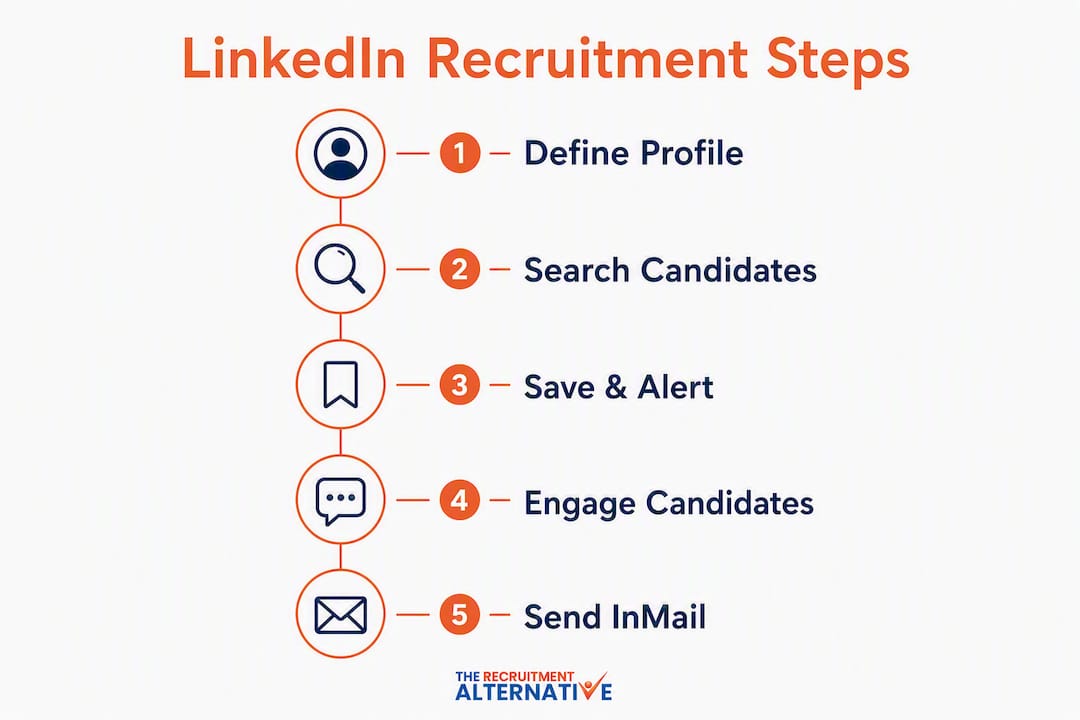
The most effective sourcing on LinkedIn follows a deliberate sequence. Here is a workflow that translates well for Australian hiring managers.

1. Define your target profile
Before opening a search, write a one-paragraph description of the ideal candidate: role title variants, must-have skills, industry background, and location. This prevents scope creep in search results.
2. Run a skills-based Boolean search
Skills-based filters deliver 40% higher candidate relevance scores than title-only searches. Combine Boolean operators (AND, OR, NOT) with skills tags rather than relying on job title alone. For example: ("account manager" OR "client success manager") AND ("SaaS" OR "software") NOT "intern".
3. Save the search and set alerts
LinkedIn Recruiter and Sales Navigator both allow saved searches with email alerts when new profiles match. This converts a one-off search into a passive sourcing channel.
4. Run the Warm-Up Funnel before outreach
High-performing recruiters engage with a candidate’s content or milestones for 7–10 days before sending a connection request or InMail. Like a post, comment on an article, or congratulate a work anniversary. This builds familiarity and materially increases receptivity.
5. Send a hyper-personalised InMail
Messages of 200–400 characters are approximately 16% more likely to receive a reply than longer ones. Reference something specific: a recent post, a shared connection, or a project mentioned in their profile. Two short examples:
For a passive candidate: “Hi [Name], your work on [specific project] caught my attention — we have a [role] at [company] that aligns closely with that experience. Worth a 15-minute chat?”
For an active candidate: “Hi [Name], I can see you’re open to opportunities. We’re hiring a [role] in [city] — your background in [skill] is exactly what we need. Happy to share details?”
6. Manage the pipeline in LinkedIn Recruiter Projects
Tag candidates by stage (sourced, contacted, replied, interviewing), add notes after each interaction, and track InMail-to-reply and reply-to-interview conversion rates. These numbers tell you whether your messaging or your target profile needs adjustment.
Recruiter vs Sales Navigator: Teams hiring more than 15–20 roles per year typically find LinkedIn Recruiter cost-effective given the InMail volume and pipeline tools. Smaller teams can achieve strong results blending Sales Navigator with employee advocacy and content, keeping costs lower while maintaining reach.
Metric to watch: Track InMail acceptance rate, InMail-to-reply rate, and reply-to-interview conversion as your three core sourcing KPIs. If acceptance is high but replies are low, your message content needs work. If replies are high but interview conversions are low, your role brief or screening criteria needs tightening.
How to screen candidates effectively using LinkedIn profiles
LinkedIn profiles are useful screening tools, but they require a calibrated eye. Not every signal is reliable, and treating the profile as a substitute for a structured interview is a common mistake.
High-value signals to look for:
- A complete, recently updated profile with a professional photo and detailed role descriptions
- Endorsements that align specifically with the skills your role requires (not just generic endorsements from colleagues)
- Written recommendations from managers or clients, which carry more weight than peer endorsements
- Consistent career progression with logical transitions between roles
- Active engagement: recent posts, comments, or articles that demonstrate current thinking in their field
- LinkedIn Skills Assessment badges for role-relevant competencies
Red flags worth investigating:
- Employment dates that don’t add up or leave unexplained gaps
- Inflated titles (e.g. “Head of” for a solo contributor role at a two-person company)
- A profile that hasn’t been updated in two or more years
- Endorsements from connections who share no obvious professional overlap
For verification, cross-reference the LinkedIn profile against the submitted resume. Date discrepancies between the two are worth raising directly in the interview. For technical roles, check any linked portfolios, GitHub repositories, or published work.
A useful complement is ResumeMint, which converts a LinkedIn profile into a formatted CV — helpful when a candidate has a strong profile but hasn’t submitted a formal resume yet.
Pro Tip: Research confirms that incomplete profiles lower perceived hireability when no resume is available. If you’re sourcing passively and a candidate’s profile is thin, don’t discard them — reach out and ask for a resume before making a hireability judgement. The profile incompleteness may reflect low job-search activity, not low capability.
How LinkedIn supports employer brand and candidate attraction in Australia
Employer branding on LinkedIn directly affects whether candidates reply to your outreach. A recruiter messaging from a company with an active, credible presence gets meaningfully better response rates than one messaging from a blank or inactive page.
A repeatable content plan for Australian teams:
- Employee posts: Encourage team members to share genuine reflections on their work, team culture, or recent projects. Authenticity matters more than polish.
- Hiring manager thought leadership: A short post from the hiring manager about a challenge the team is solving positions the role in context and attracts candidates who care about the problem.
- Role previews: A brief “what this role actually involves” post, written by the hiring manager, sets accurate expectations and filters for fit before the first conversation.
- Day-in-the-life content: Short video or text posts from current employees showing what a typical day looks like. Particularly effective for roles where culture fit is a key selection criterion.
- Company Page upkeep: Keep the About section current, post at least twice a week, and respond to comments promptly.
For Australian audiences, a few local signals carry extra weight: flexible work arrangements, leave entitlements, team diversity, and references to specific cities or regions. Australian professionals respond well to content that is direct and unpretentious. Avoid corporate-speak; write the way your team actually talks.
Cadence: Aim for one to two posts per week from the company page, supplemented by personal posts from two or three employee advocates. Consistency over six to eight weeks builds the algorithmic visibility that makes passive candidates aware of your brand before you ever reach out. For practical personal branding guidance, improving your personal brand is a useful starting point for hiring managers new to LinkedIn content.

Costs, efficiency, and measurable ROI from LinkedIn recruitment
LinkedIn’s cost structure has several components, and understanding each helps hiring managers make a clear-eyed investment decision.
| Cost component | Typical shape | Notes |
|---|---|---|
| LinkedIn Recruiter seat | Annual subscription, per seat | Best for teams hiring 15+ roles per year |
| Sales Navigator | Monthly or annual, per seat | Suitable for smaller teams or blended approaches |
| LinkedIn Jobs (sponsored) | Pay-per-click or flat budget | Cost varies by role type and competition |
| Content/time investment | Internal staff time | Often underestimated; 2–3 hours per week minimum |
| ATS integration tools | Varies by platform | Many major ATS platforms include native LinkedIn integration |
The ROI case for LinkedIn strengthens considerably when employer brand and inbound pipelines are established. Inbound leads convert at approximately 14.6% compared to 1.7% for outbound — a difference that compounds over time as your content builds an audience of warm, pre-qualified candidates.
On retention, LinkedIn-sourced hires can be 40% less likely to leave within six months when genuine relationships are built through the hiring process. For roles where onboarding costs are high, that retention advantage alone can justify the platform investment.
When LinkedIn Recruiter makes financial sense: If your team fills more than 15–20 permanent roles per year, a Recruiter seat typically pays for itself within the first two or three placements when compared to agency percentage fees. For smaller hiring volumes, a blended approach using Sales Navigator, organic content, and occasional sponsored job posts often delivers better cost-per-hire.
Measuring ROI: Tag LinkedIn as the source in your ATS for every candidate sourced or applied via the platform. Track time-to-offer, InMail-to-interview conversion, and six-month retention by source. These three metrics give you a clear picture of channel quality, not just channel volume.
Where LinkedIn falls short and what Australian recruiters must know about compliance
LinkedIn is a powerful tool, but it has genuine limitations. Recognising them protects both your hiring outcomes and your organisation’s legal standing.
Practical risks:
- Candidate experience: — Candidates who receive no follow-up after responding to an InMail form a negative impression of your employer brand. Every reply deserves an acknowledgement.
Australian compliance considerations:
Australian recruiters using LinkedIn must be aware of obligations under the Privacy Act 1988, administered by the Office of the Australian Information Commissioner (OAIC). Collecting, storing, and using candidate personal information sourced from LinkedIn constitutes handling of personal information under the Australian Privacy Principles. Candidates should be informed of how their data will be used, and records should be retained in accordance with your organisation’s privacy policy.
Anti-discrimination obligations under federal and state legislation apply to every stage of the recruitment process, including LinkedIn sourcing and shortlisting. Decisions based on protected attributes — age, gender, race, disability, religion, or pregnancy — are unlawful. Structured shortlisting criteria and documented decision rationales are your best operational protection.
For record-keeping, Fair Work obligations require that recruitment decisions be defensible. Preserve InMail threads, shortlisting notes, and rejection rationales in your ATS.
This section provides general information only, not legal advice. Consult the OAIC website or a qualified employment lawyer for guidance specific to your organisation.
A practical LinkedIn checklist for Australian hiring managers
Quick wins (do this week):
- Audit your company page: update the About section, add a current banner image, and check that all open roles are listed
- Review every recruiter’s personal profile for completeness, a professional photo, and a clear headline
- Set up two to three saved searches in LinkedIn Recruiter or Sales Navigator for your most common role types
- Tag LinkedIn as a source in your ATS so every candidate sourced via the platform is tracked from day one
Weekly actions:
- Post one piece of employer-brand content from the company page or a hiring manager’s personal profile
- Spend 20–30 minutes on warm-up engagements: like, comment on, or share content from candidates in your active pipeline
- Review InMail reply rates and adjust message length or personalisation if replies are below expectations
Monthly and quarterly actions:
- Run a Talent Insights report for your most critical role types to check talent pool size and salary benchmarks
- Audit your active pipelines in LinkedIn Recruiter Projects: archive stale candidates, update stages, and identify roles where sourcing velocity is low
- Review six-month retention data for LinkedIn-sourced hires in your ATS and compare against other channels
Key metrics to track:
| Metric | What it tells you |
|---|---|
| InMail reply rate | Whether your messaging and targeting are working |
| InMail-to-interview conversion | Whether your shortlisting criteria are well-calibrated |
| Time-to-offer (LinkedIn-sourced) | Channel speed vs other sourcing methods |
| Six-month retention (LinkedIn hires) | Long-term quality of LinkedIn as a source |
| Source NPS | Candidate experience quality from LinkedIn outreach |
For exporting and managing recruiter conversation data across tools, chat export methods for recruiters covers practical options for preserving InMail threads outside the platform.
Australia-focused evidence and recruiter trends for 2026
The shift from outbound volume to inbound authority is the defining strategic change in LinkedIn recruiting right now. Recruiters who publish consistent, niche content attract higher-quality candidate contacts over time, and those contacts convert at a materially higher rate than cold outreach.
LinkedIn reaches a high share of professionals in markets like Australia and Singapore, making it the default first stop for professional hiring across most sectors. In Australia, LinkedIn is particularly effective for professional services, technology, finance, engineering, and senior management roles. Trades and entry-level roles tend to see lower platform penetration, where job boards and referral networks often outperform.
Three research-backed findings worth building your strategy around:
Inbound leads convert at approximately 14.6% versus 1.7% for outbound — a nearly nine-fold difference that makes the case for content investment over message volume.
Messages of 200–400 characters are about 16% more likely to receive a reply — shorter, personalised outreach consistently outperforms longer templates.
LinkedIn-sourced hires can be 40% less likely to leave within six months when genuine relationships are built during the hiring process.
For Australian teams, the practical implication is clear: invest in a consistent content presence before you need to hire, not after. A hiring manager who has been posting monthly for six months will find their InMail reply rates noticeably higher than one who only activates LinkedIn when a vacancy opens. The growth of LinkedIn Jobs in Australia reflects this shift, with more candidates actively using the platform to research employers before they apply or respond.
Quick experiments to run on your team:
- A/B test InMail length: send 20 messages at 200–300 characters and 20 at 500+ characters for the same role, and compare reply rates after two weeks
- Test engagement-first vs cold outreach: run the Warm-Up Funnel on half your pipeline and compare acceptance rates against direct InMails
- Track content cadence vs InMail acceptance: measure whether weeks with a company post see higher InMail acceptance rates than weeks without
Key takeaways
LinkedIn is the most effective single platform for professional hiring in Australia when used as a system, not a job board.
| Point | Details |
|---|---|
| Inbound converts far better | Inbound leads convert at approximately 14.6% versus 1.7% for outbound — content investment pays off. |
| Message length and personalisation matter | InMails of 200–400 characters are about 16% more likely to get a reply; reference specific profile details. |
| Retention advantage is real | LinkedIn-sourced hires can be 40% less likely to leave within six months when relationships are built properly. |
| Australian compliance is non-negotiable | The Privacy Act and anti-discrimination laws apply to LinkedIn sourcing; document your decisions and handle data carefully. |
| The Recruitment Alternative complements LinkedIn | A flat-fee agency handles screening and placement while you build pipeline visibility — see how it works. |
How LinkedIn actually works in day-to-day Australian recruiting
The gap between LinkedIn’s theoretical capability and how most hiring managers actually use it is wider than it should be. Most teams treat it as a reactive tool: post a job, wait for applicants, send a few InMails when the pipeline is thin. The recruiters who get consistent results use it proactively and systematically.
A realistic weekly workflow looks something like this: one sourcing session of 45–60 minutes using saved searches and Boolean filters, 20 minutes of warm-up engagements on active pipeline candidates, one piece of content published or shared from the company page or a hiring manager’s profile, and a brief ATS sync to tag new candidates and update pipeline stages. That is roughly two hours per week. Not a large investment, but it compounds.
The Warm-Up Funnel is the tactic most teams skip because it feels slow. Spending 7–10 days engaging with a candidate’s content before sending an InMail seems counterintuitive when a role needs to be filled quickly. But the data supports it: candidates who recognise your name and company before receiving a message are meaningfully more likely to reply. For senior or passive candidates, that familiarity can be the difference between a response and a silence.
Automation has its place, but it narrows quickly. AI-assisted personalisation works well when you’re scaling outreach within a warm pipeline. Cold, mass-generated messages still underperform, and LinkedIn’s platform restrictions mean aggressive automation carries real account risk. The human touch in early-stage candidate contact is not a nice sentiment; it is a practical performance driver.
How a flat-fee recruitment agency can complement your LinkedIn strategy
LinkedIn builds your pipeline and visibility. What it doesn’t do is screen candidates, conduct structured interviews, manage offer negotiations, or guarantee a placement. That’s where a fixed-fee recruitment partner adds direct value.
The Recruitment Alternative is a flat-fee recruitment agency operating across Australia, covering permanent roles in sales, administration, finance, engineering, healthcare, technology, trades, and executive leadership. Unlike traditional agencies that charge a percentage of salary, The Recruitment Alternative charges a transparent fixed price per placement, with candidate replacement insurance if a hire doesn’t work out within the first two to three months.
For hiring managers already using LinkedIn, the combination works well: you build brand awareness and a warm inbound pipeline through content and saved searches; The Recruitment Alternative handles the time-intensive work of candidate screening, qualification, and interview coordination. The result is faster time-to-hire without the unpredictable cost of a percentage-based agency fee.
View the flat-fee pricing structure or learn how the service works for small businesses to see whether it fits your current hiring needs.
Useful sources and where to read further
These are the principal sources used in this article, with a note on what each is most useful for:
- Peer-reviewed study on profile completeness and hireability — academic evidence on how incomplete profiles affect hiring decisions
- Office of the Australian Information Commissioner (OAIC) — authoritative source for Privacy Act obligations relevant to candidate data handling
- LinkedIn Jobs on the rise 2025 — Australian-specific platform growth and usage trends
- How to optimise your LinkedIn profile — practical profile optimisation guidance for recruiters and hiring managers
For compliance specifics, consult the OAIC website directly and seek advice from a qualified employment lawyer for your organisation’s circumstances. For Talent Insights data, access is available through a LinkedIn Recruiter seat or via LinkedIn’s enterprise sales team.

