
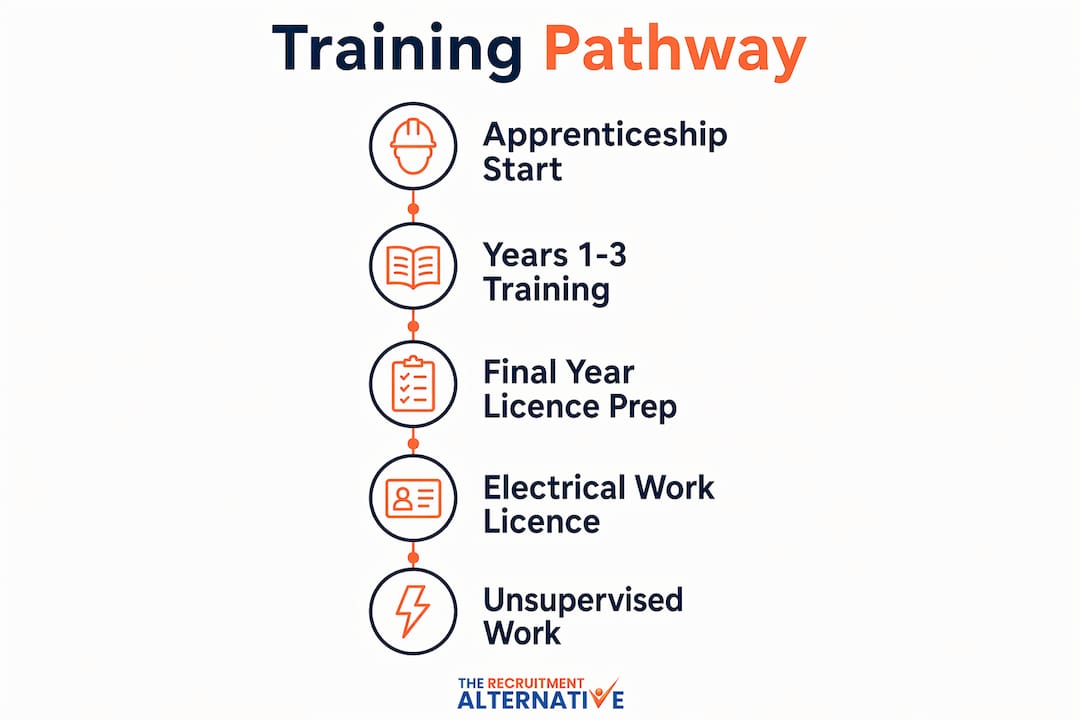
Becoming a licensed electrician in Australia is a substantial, regulated four-year pathway — achievable for the right candidate, but resource-intensive for employers who must budget for training, supervision, and licensing checks before a new hire can work unsupervised. The standard route is a 4-year apprenticeship culminating in the Certificate III in Electrotechnology Electrician (UEE30820), after which candidates must obtain a state electrical work licence from regulators such as Fair Trading NSW, Energy Safe Victoria, or the Electrical Safety Office (Queensland) before they can operate independently. Candidates who combine physical stamina with strong numerical reasoning tend to complete the pathway without major delays, while those who don’t often stall at the capstone exam stage, which directly affects your time-to-productivity planning.
Table of Contents
- What does the standard Australian training pathway involve?
- What timeline and costs should employers budget for?
- What should you test when vetting electrician candidates?
- Where do you find qualified electricians and apprentices?
- A step-by-step hiring and 90-day onboarding plan
- Common hiring pitfalls and how to avoid them
- Key takeaways
- What The Recruitment Alternative sees in the market
- Hire qualified electricians faster with The Recruitment Alternative
- Useful sources for employers
What does the standard Australian training pathway involve?
The formal route is well-defined. Apprentices complete a four-year programme combining on-the-job training with classroom instruction at a registered training organisation (RTO), working toward the Certificate III in Electrotechnology Electrician (UEE30820). The qualification covers selecting, installing, testing, fault-finding, and maintaining electrical systems in buildings and premises, and must meet the Electrical Regulatory Authority Council (ERAC) requirements for an unrestricted electrician’s licence.
Critically, no candidate can perform electrical work independently without a state-issued electrical work licence. Each state has its own regulator: Fair Trading NSW, Energy Safe Victoria, and the Electrical Safety Office (Queensland) are the three you will encounter most often. This is a legal requirement with no workaround.
Employers should also expect candidates to demonstrate familiarity with AS/NZS 3000 (the Australian Wiring Rules) and Safe Working Practice (SWP) standards. These are not optional extras — they are assessed in the capstone exam and form the basis of day-to-day compliance on site.
Candidate entry points employers will see:
- Full-time apprenticeship (most common): Year 10 minimum entry, four years to completion
- Certificate II in Electrotechnology (UEE22020) pre-apprenticeship: improves readiness and reduces early workplace training time
- School-based apprenticeships: candidates begin in Year 11, completing up to 600 paid hours per year on site
- Group Training Organisation (GTO) placements: the GTO employs the apprentice and hosts them with your business, carrying much of the administrative burden
Statistic callout: Capstone exam failure rates are frequently high, posing a significant risk for candidates, largely because the SWP and practical components have near-zero tolerance for procedural errors.
What timeline and costs should employers budget for?
| Candidate type | Typical timeline to unsupervised work | Employer cost factors |
|---|---|---|
| Domestic apprentice | 4 years (apprenticeship) + licence processing | Apprentice wages, supervision time, RTO fees, WHS compliance |
| Pre-apprenticeship graduate | 4 years | Reduced early training time; same licensing costs |
| Overseas-trained applicant | 4 years + 6–12 months gap training | Gap training fees ($3,000–$5,000), TRA assessment, bridging licence costs |
| International student (Job Ready Program) | Study period + paid work hours under JRP | Extended timeline before full unsupervised availability |
For overseas-trained candidates, gap training typically runs 6–12 months and costs an estimated $3,000–$5,000 to bridge overseas qualifications to Australian licensing standard. TAFE and NECA are the primary gap-training providers. Budget for this before you commit to an overseas hire.
Common causes of delays employers should anticipate:
- Capstone exam failures requiring re-sits and remedial training
- Administrative processing backlogs at state licensing authorities
- Incomplete TRA documentary evidence for overseas applicants
- Supervision gaps that slow competency sign-offs
Who pays what matters. Employers carry apprentice wages, supervision time, and WHS compliance costs throughout the apprenticeship. Candidates typically pay some training and licensing fees directly, though state and federal subsidies may offset a portion of RTO costs depending on the apprentice’s age and location.
What should you test when vetting electrician candidates?
Separating a well-prepared candidate from one who will stall mid-apprenticeship comes down to structured screening. Here is a practical sequence:
- Verify qualifications and status first. Request the Certificate III (UEE30820) or a current apprenticeship contract, state licence or provisional licence documentation, and a record of documented supervised hours mapped to ANZSCO tasks.
- Run aptitude assessments. Employers place heavy weight on numerical reasoning and mechanical comprehension tests. Candidates who have prepared for these tests perform materially better — which itself signals motivation and reliability.
- Test technical knowledge. Ask basic electrical theory questions and check AS/NZS 3000 familiarity. A candidate who cannot describe the Wiring Rules’ earthing requirements is not ready for unsupervised work.
- Conduct a practical check. Ask the candidate to read a wiring diagram or walk through a basic fault-finding scenario. This takes 15 minutes and reveals more than a resume.
- Validate references rigorously. Request documented supervised hours with supervisor signatures. Vague employer references and undocumented cash work history are clear red flags.
Pro Tip: Insist on documented SWP training records and evidence of recent toolbox talk attendance. A candidate who cannot produce these has likely not been working in a compliant environment — and that creates liability for you from day one.
Candidates with a Certificate II pre-apprenticeship or school-based apprenticeship background tend to hit the ground faster and require less early-stage hand-holding on site.

Where do you find qualified electricians and apprentices?
The trade is in shortage across nearly all Australian states, with demand outpacing supply in major cities. That means time-to-fill is longer than most employers expect, and sourcing strategy matters.
Primary channels:
- GTOs: Best for first-year apprentices. The GTO manages the employment contract, payroll, and much of the compliance paperwork, reducing your administrative load significantly.
- TAFE and trade school graduate pipelines: Useful for candidates finishing Certificate II who are ready to step into a full apprenticeship.
- Industry associations: Electrical Trades Union and Master Electricians Australia both maintain candidate networks.
- Targeted recruitment agencies: Fastest route for sourcing licensed or near-licensed electricians, particularly when credential verification and shortlisting are priorities. Understanding how recruitment agencies work helps you decide when to engage one versus managing the process directly.
For overseas-trained applicants, choose channels experienced with TRA assessments and bridging pathways. The recruitment trends in metropolitan markets show that competition for apprenticeship places is strong, and candidates who have prepared for aptitude testing consistently outperform those who haven’t.
A step-by-step hiring and 90-day onboarding plan
Pre-hire checks:
- Verify Certificate III (UEE30820) or signed apprenticeship contract
- Confirm state licence status or provisional licence documentation
- Check TRA assessment status for overseas-trained applicants
- Obtain a police check and right-to-work evidence
- Validate documented supervised hours and referee contacts
Offer and induction:
- Issue employment contract with correct award wage banding for apprentice year level
- Complete safety induction and site-specific training on day one
- Assign a licensed supervisor with capacity to provide direct, on-site supervision
90-day milestones:
- Days 1–30: Safety fundamentals, site orientation, basic task observation and initial competency documentation
- Days 31–60: Structured task rotation across core competency areas; first RTO coursework integration; supervisor sign-off on initial units
- Days 61–90: Supervised independent tasks; toolbox talk attendance recorded; mid-point competency review against training plan
Solid onboarding practices at this stage reduce early attrition and keep your training investment on track.
Common hiring pitfalls and how to avoid them
The most costly mistakes employers make when hiring electricians are predictable and preventable.
Hiring under-documented overseas candidates is the single biggest risk. TRA requires documentary evidence with exact dates, hours worked, and supervisor signatures mapped to ANZSCO tasks. Incomplete applications are refused, and you are left with a candidate who cannot legally work while their paperwork is resolved.
Underestimating supervision capacity catches small businesses off guard. A provisional licence holder must be supervised at all times by a licensed electrical worker. For a business with one senior electrician, that creates a real operational constraint from day one.
Ignoring capstone exam risk extends your timeline unexpectedly. With failure rates commonly exceeding 30%, budget for at least one re-sit and the associated remedial training costs before you assume a candidate will be fully licensed on schedule.
Pro Tip: Use a GTO for your first apprentice hire if your business has limited supervision capacity. The GTO carries the employment contract and provides compliance support, which reduces your exposure while you build internal training capability.
Mitigation is straightforward: insist on documented evidence at every stage, set clear supervision rosters, keep accurate time and task records mapped to ANZSCO, and build a contingency plan for capstone delays into your workforce planning.
Key takeaways
Becoming a fully licensed electrician in Australia requires a four-year apprenticeship under UEE30820, a state electrical work licence, and demonstrated AS/NZS 3000 competency — making it a significant but structured investment for employers who plan carefully.
| Point | Details |
|---|---|
| Four-year minimum pathway | Domestic apprentices need four years to complete UEE30820 before independent work is lawful. |
| State licence is non-negotiable | Candidates must hold a licence from Fair Trading NSW, Energy Safe Victoria, or Electrical Safety Office QLD before unsupervised work. |
| Overseas candidates cost more time | Gap training adds 6–12 months and an estimated $3,000–$5,000 for overseas-trained applicants. |
| Capstone exam risk is real | Failure rates commonly exceed 30%; budget for re-sits and remedial training in your workforce plan. |
| The Recruitment Alternative | Offers fixed-fee recruitment for trades roles, including credential screening and shortlisting, to reduce hiring cost and administrative burden. |
What The Recruitment Alternative sees in the market
The gap between what employers expect and what the electrician labour market actually delivers is wider than most hiring managers anticipate. Employers frequently underestimate two things: the supervision burden that comes with a provisional licence holder, and the documentary rigour required for overseas-trained candidates. Both are manageable, but only if you plan for them before the hire, not after.
The candidates who complete the pathway without major delays share a consistent profile: strong numerical reasoning, a track record of showing up reliably during the apprenticeship, and a supervisor who kept accurate competency records throughout. That last point is within your control as an employer, and it is the one most often neglected.
The practical advice is this: do not trade speed-to-hire for compliance shortcuts. A fast hire who stalls at the capstone exam or cannot produce documented hours costs you more in lost productivity than a slightly slower, well-screened placement. Use a GTO or a trades-experienced recruitment agency when your internal capacity to manage supervision and documentation is limited.
Hire qualified electricians faster with The Recruitment Alternative
Finding a licensed electrician or a work-ready apprentice in a tight labour market takes more than posting a job ad. The Recruitment Alternative offers flat-fee recruitment for trades roles across Australia, covering candidate sourcing, credential verification, and shortlisting at a fixed price — no percentage-of-salary commission, no hidden costs.

For employers hiring electricians, that means you get a pre-screened shortlist of candidates whose licence status, UEE30820 qualifications, and documented hours have already been checked, without paying a traditional agency fee that scales with salary. Whether you need a fully licensed electrician or are placing your first apprentice, The Recruitment Alternative’s affordable fixed-fee model keeps your hiring budget predictable. Contact The Recruitment Alternative today to discuss your next electrician hire.
Useful sources for employers
- Trades Recognition Australia (TRA): Skills assessment for overseas-trained electricians — tradesrecognitionaustralia.gov.au
- Electrical Safety Office (Queensland): Licensing and supervision rules — worksafe.qld.gov.au
- Fair Trading NSW: Electrical contractor and worker licence verification — fairtrading.nsw.gov.au
- Energy Safe Victoria: Electrical licence registration and compliance — esv.vic.gov.au
- QTIS (Queensland Training Information Service): UEE30820 apprenticeship requirements and Skills Assure Suppliers — qtis.training.qld.gov.au
- TAFE and NECA: Primary gap-training providers for overseas-trained applicants seeking Australian licensing
- MIGAS: Group Training Organisation with apprenticeship placement and aptitude testing guidance — migas.com.au
Employer next steps: Verify a candidate’s licence directly with the relevant state regulator before making an offer. Retain copies of all competency sign-offs, supervised hours records, and TRA assessment documents throughout the apprenticeship. For gap-training providers in your state, contact TAFE directly or ask your RTO for a referral to a recognised bridging programme.