

Recruitment transparency is the deliberate practice of openly sharing key hiring details with candidates, including role expectations, salary ranges, evaluation criteria, and process timelines. Australian employers who build this into their hiring process consistently see better candidate quality, faster decisions, and lower early turnover. Those who don’t are losing top talent before the first interview is even scheduled.
Why recruitment transparency matters: the core case
Transparent hiring shifts the entire dynamic of recruitment. Instead of persuading candidates to accept a role, you’re helping both sides assess genuine fit. That shift has real consequences for your pipeline, your employer brand, and your retention numbers.
At its most practical, recruitment transparency means candidates can answer five questions quickly:
- What does the role actually involve, including its challenges?
- What is the salary range and what influences placement within it?
- What are the interview stages and who makes the final decision?
- How will candidates be evaluated, and against what criteria?
- When will they hear back, and what happens if timelines change?
When candidates can answer all five, dropout rates fall, offer acceptance rates rise, and time-to-fill shortens. When they can’t, they fill the gaps with caution, not optimism.
What does recruitment transparency actually involve?

Transparency in hiring is not an all-or-nothing proposition. It exists on a spectrum of structured sharing, from publishing a salary band in a job ad through to sharing interview scorecards and evaluation weightings before the assessment stage.
The components that matter most to candidates include:
- Salary bands: Publishing a range, even a broad one, signals respect for candidates’ time and removes the awkward late-stage negotiation that kills offers.
- Interview format and stages: Telling candidates upfront how many rounds exist, who they’ll meet, and what format each stage takes reduces anxiety and improves performance.
- Evaluation criteria: Sharing the competencies you’re assessing, and how much weight each carries, lets candidates show their best work rather than guess what you want.
- Decision timelines: Committing to a feedback cadence, even if the answer is “we’re still deciding,” keeps candidates engaged and reduces ghosting.
- Role realities: Describing the genuine challenges of the position, not just the highlights, filters out candidates who would resign within the first 90 days.
Pro Tip: Transparency does not mean disclosing everything. Protect proprietary information, internal deliberations, and individual salary data. Focus on process clarity and role reality. The goal is to give candidates enough to self-assess fit, not to expose your internal operations.
Benefits of transparent hiring for Australian employers
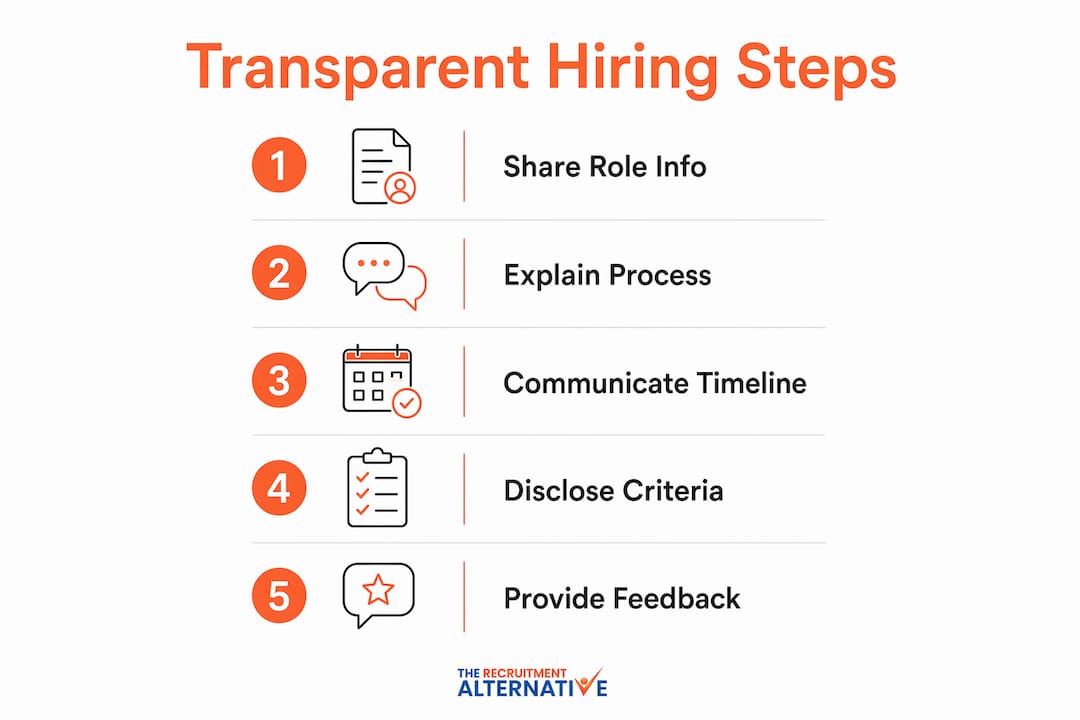
The business case for transparent hiring is grounded in measurable outcomes, not goodwill. Australian employers operating in a competitive talent market have the most to gain.
Job ads that include explicit salary ranges attract more applicants, and those applicants tend to be better matched from the outset. Candidates who self-select based on accurate role information arrive at interview with realistic expectations, which means fewer late-stage surprises and fewer declined offers.
Key benefits include:
- Higher offer acceptance rates: Candidates who understand the role and process are far more likely to say yes when the offer arrives.
- Shorter time-to-fill: Publishing salary ranges and hiring stages upfront reduces back-and-forth and speeds decision-making on both sides.
- Stronger employer brand: Candidates who experience a clear, respectful process become advocates, regardless of whether they receive an offer.
- Reduced early turnover: Being transparent about role realities filters out candidates likely to resign within the first 90 days, because there are no major surprises after day one.
- Improved diversity, equity, and inclusion: Sharing evaluation criteria in advance removes the “hidden curriculum” advantage that favours candidates who already know how corporate hiring works, levelling the playing field for diverse talent.
One talent acquisition team that implemented full process transparency, including a published process roadmap and shared scorecard weightings, saw pass-through rates increase significantly and time-to-fill shortened notably. Ghosting also fell sharply once candidates had a clear timeline to hold onto.
Research finding: A majority of candidates would reject a job offer due to a poor interview experience regardless of compensation. Transparent processes directly address the experience factors that drive that rejection.
What happens when hiring lacks transparency?
Opaque recruitment processes carry real costs, and most of them hit before a single offer is made.
The consequences of non-transparent hiring compound quickly:
- Higher dropout rates: Candidates who feel uninformed disengage mid-process. Silence becomes a signal of disorganisation, and they move on to employers who communicate clearly.
- Negative employer brand: Poor candidate experiences generate negative reviews on platforms like Glassdoor and SEEK, which deter future applicants. Word of mouth in tight professional networks travels fast.
- Early resignation from mismatched hires: When candidates accept roles based on incomplete or overly positive information, the reality gap after day one drives early exits. Non-transparent recruitment is a direct contributor to higher early turnover.
- Legal and compliance exposure: Collecting and using third-party data in hiring decisions without candidate knowledge or consent creates serious legal risk. A recent class action in the United States against an HR technology company centred on exactly this issue, alleging candidates had no opportunity to review or dispute third-party reports that influenced hiring decisions.
- Wasted recruitment spend: Every dropout mid-process, every declined offer, and every early resignation represents a direct cost. Transparency reduces all three.
Practical steps to build transparency into your hiring process
Embedding transparency into recruitment does not require a complete overhaul. It requires alignment on what you share, when you share it, and how you communicate throughout.
Start with these practices:
- Publish salary ranges in every job ad. Even a broad band removes ambiguity and saves time for both sides. Candidates who know the range self-select more accurately.
- Create a process roadmap. List every stage, the approximate timeline, and who the decision-makers are. Include this in the job description, your careers page, or the first outreach message.
- Share evaluation criteria before assessments. Tell candidates what competencies you’re measuring and how much weight each carries. This reduces anxiety and produces better results, because you’re assessing capability, not composure under uncertainty.
- Use structured interviews. Structured interviews and standardised evaluation support fairness and reduce bias by ensuring every candidate is assessed against the same criteria.
- Communicate on a defined cadence. Commit to a timeline and stick to it. If a decision slips, send a brief update. Candidates prefer delay with clarity over silence every time.
- Describe role realities honestly. Include the genuine challenges of the position alongside the opportunities. Authentic job descriptions attract candidates who are genuinely suited to the work.
- Provide meaningful feedback. A personalised rejection that acknowledges the candidate’s time and explains at a high level why they weren’t selected protects your employer brand and leaves a positive impression.
Pro Tip: Transparency is a leadership behaviour, not just a communications task. If your hiring team can’t explain your process clearly in three minutes, candidates will feel that confusion. Align internally first, then publish the truth.
How The Recruitment Alternative applies transparency in practice
The Recruitment Alternative’s approach to recruitment is built on the same principles that make transparent hiring effective: clarity, consistency, and honest communication at every stage.
The agency operates on a flat-fee recruitment model, which is itself an act of transparency. Employers know the cost upfront, with no percentage-of-salary surprises at the end of the process. That pricing clarity sets the tone for how the entire engagement is managed.
In practice, The Recruitment Alternative’s transparent process includes:
- Clear briefing sessions to define role requirements, success metrics, and realistic timelines before sourcing begins.
- Honest communication with candidates about role realities, including challenges and culture, to reduce the risk of early exits.
- Structured candidate assessment against defined criteria, so employers receive shortlists based on consistent evaluation rather than gut feel.
- Regular progress updates to hiring managers throughout the process, so there are no surprises on either side.
- Transparent candidate experience management, treating every applicant with respect regardless of outcome, which protects the employer’s brand in the market.
| Practice | Outcome |
|---|---|
| Fixed-fee pricing disclosed upfront | Employers plan costs with certainty; no hidden fees |
| Role reality communicated to candidates | Reduced early turnover from mismatched expectations |
| Structured candidate assessment | Consistent, fair shortlisting against defined criteria |
| Regular hiring manager updates | Faster decisions, fewer process delays |
| Respectful candidate communication | Stronger employer brand and positive market reputation |
The result is a candidate experience that builds trust from the first contact, which is exactly what the research says drives better hiring outcomes.
Legal and ethical considerations in transparent recruitment
Transparency in recruitment is not only good practice. In several areas, it is a legal obligation.
Australian employers must comply with the Privacy Act 1988 when collecting and handling candidate personal information. This means being clear with candidates about what data is collected, why it is processed, who it is shared with, and how it is protected. Publishing a candidate privacy policy is not optional for organisations of scale; it is a baseline compliance requirement.
Anti-discrimination law under the Fair Work Act 2009 and state-based equal opportunity legislation requires that hiring decisions are based on merit and documented criteria. Structured interviews and written evaluation scorecards provide the audit trail that demonstrates compliance if a decision is ever challenged.
Pay transparency is also gaining legislative momentum. Several Australian states and territories have moved toward requiring salary disclosure in job advertisements, reflecting a broader shift in community expectations. Employers who already publish salary bands are ahead of this curve, not behind it.
Ethically, the obligation extends to how AI and automated tools are used in screening. Candidates have a reasonable expectation that they understand how decisions about their application are made. Using third-party data sources or automated scoring without disclosure creates both ethical and legal exposure, as the US class action referenced earlier illustrates.
How technology can support transparency in hiring
The right tools make transparent hiring easier to execute consistently, particularly at scale.

Applicant tracking systems (ATS) are the foundation. A well-configured ATS can automate status updates so candidates always know where they stand, trigger communication at defined points in the process, and store evaluation scorecards that create a consistent record of how decisions were made. Candidates should be able to see their application status without having to chase a recruiter.
AI screening tools are now widely used in Australian recruitment, but they introduce a specific transparency obligation. Providing insight into AI use in hiring and maintaining human oversight builds candidate trust rather than eroding it. Candidates are not opposed to AI in hiring; they want to know when it is being used and where human judgement applies. Organisations that disclose their AI tools and explain the role of human review in final decisions consistently report stronger candidate engagement.
Understanding AI candidate screening methods and their limitations helps HR teams apply these tools responsibly and communicate their use clearly to candidates.
Video interviewing platforms, skills assessment tools, and structured interview guides all contribute to a more consistent and explainable process. The key is choosing technology partners who handle candidate data with proper consent mechanisms and clear privacy disclosures, and who allow you to communicate that compliance to candidates directly. Reviewing hiring process best practices that incorporate these tools helps HR teams build processes candidates actually trust.
Key takeaways
Transparent recruitment builds trust, reduces dropout rates, and improves retention by giving candidates the information they need to self-assess fit before accepting an offer.
| Point | Details |
|---|---|
| Transparency reduces dropout | Sharing process steps, timelines, and criteria keeps candidates engaged and reduces mid-funnel ghosting. |
| Salary clarity drives applications | Job ads with explicit salary ranges attract more applicants and produce better-matched candidates from the start. |
| Role honesty cuts early turnover | Describing genuine role challenges filters out candidates likely to resign within the first 90 days. |
| Legal obligations are real | Australian privacy law and anti-discrimination legislation require documented, disclosed, and consistent hiring practices. |
| Technology needs human oversight | AI screening tools must be disclosed to candidates, with human review at final decision stages, to maintain trust and compliance. |
Work with a recruitment partner who practises what they preach
The Recruitment Alternative has built its entire model around the principles covered in this article: fixed, transparent pricing, honest candidate communication, and structured processes that produce better hires. If you’re ready to put transparent hiring into practice with a partner who has already done the work, explore our award-winning approach to affordable, quality recruitment across Australia.

