

How recruitment actively reduces the risk of bad hires
Recruitment, done well, functions as a risk management system. Every stage of a structured hiring process is designed to surface the right information about a candidate before an offer is made, not after the damage is done. The most effective protection comes from combining structured interviews, validated assessments, thorough screening, and multiple assessors working from the same criteria.
The evidence is clear on structured interviews specifically. Research shows they are 2.5 times more predictive of job performance than unstructured conversations and reduce mis-hires by 30-40% compared to gut-feel interviewing. Training interviewers further improves hiring accuracy by an additional 30-40%. These are not marginal gains.
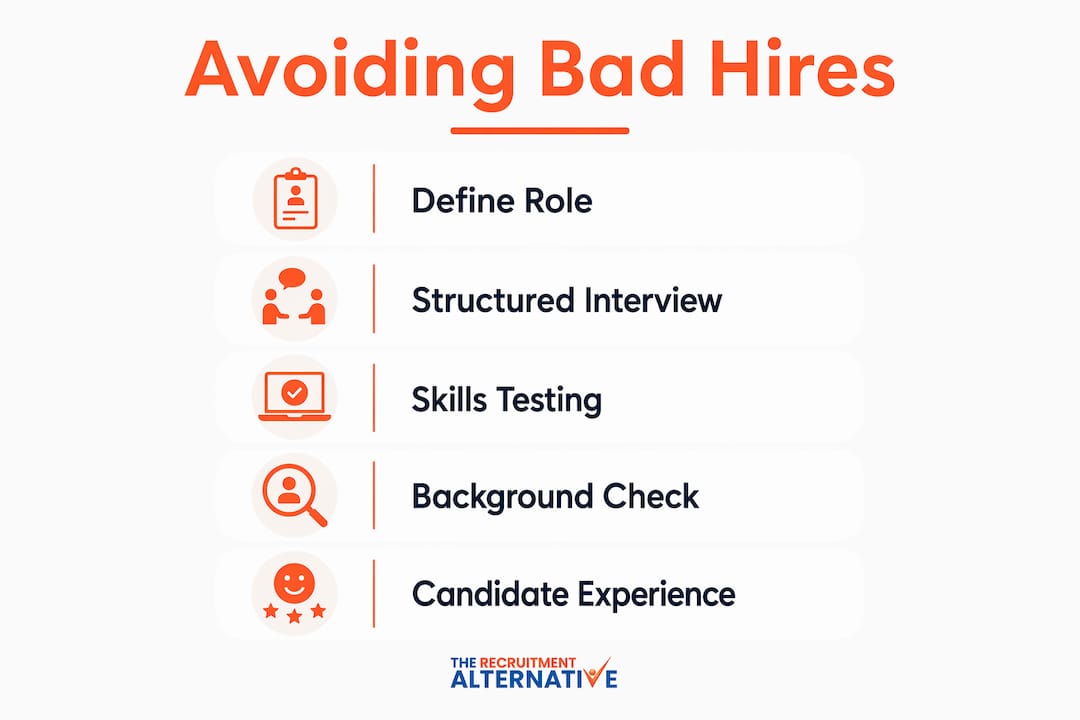
A well-built recruitment process protects against bad hires through several interconnected mechanisms:
- Defined success criteria set before sourcing begins, so every evaluation is measured against what the role actually requires after 12 months
- Structured interviews with consistent questions and scoring rubrics applied equally to every candidate
- Skills-based and psychometric assessments that evaluate demonstrated capability rather than credentials alone
- Thorough background and reference checks, including contact with prior peers or subordinates, not just formal referees
- Multiple assessors reviewing candidates independently before any group discussion, which prevents one voice from dominating the decision
- Post-hire monitoring at 30, 60, and 90 days to catch mismatches before they compound
Each of these elements removes a specific vulnerability from the hiring process. Together, they shift hiring from a subjective impression-based exercise to a defensible, evidence-based decision.

What bad hires actually cost Australian businesses
A bad hire is not simply someone who underperforms. The full picture includes a candidate who cannot do the job, will not do the job, or actively damages the team around them. All three types create measurable harm, and the costs accumulate faster than most hiring managers expect.
The financial exposure is real. Poor hiring decisions drain budgets through recruitment fees, onboarding time, lost productivity during the vacancy, and the cost of restarting the process entirely. Beyond the direct spend, there are productivity losses across the team while a poor performer is managed out, and potential legal exposure if the exit is contested.
Common causes of bad hires include:
- Rushed hiring decisions driven by urgency rather than fit, particularly when a role has been vacant for weeks
- Vague or inflated job descriptions that attract the wrong candidates and set unclear expectations from the start
- Over-reliance on gut feel during interviews, where likability substitutes for evidence of capability
- Insufficient assessment of traits and cultural contribution, with skills treated as the only dimension that matters
- Weak reference checking that relies solely on the candidate’s chosen referees, who rarely provide candid feedback
- Bias in the debrief, where the most senior voice in the room shapes the outcome before others have formed independent views
Toxic hires carry a compounding risk that goes beyond individual performance. A single person with poor interpersonal behaviour can drive out high performers, erode team morale, and create compliance exposure if their conduct crosses legal thresholds. Boards and leadership teams routinely underestimate this category of risk, treating each hire as a standalone event rather than a decision that affects the entire team’s trajectory.
Effective recruitment strategies that prevent bad hires
Preventing bad hires requires deliberate choices at every stage of the recruitment process, not just at the interview. The strategies below reflect what the evidence consistently supports.
Define role success before you write the job description
A polished hiring process cannot rescue a poorly framed brief. Before sourcing begins, hiring managers should describe in plain language what success in the role looks like after 12 months. Outcome-specific success criteria frame every subsequent evaluation decision and prevent the common trap of hiring someone who interviews well but cannot deliver against the actual requirements of the job.
Use structured interviews with scoring rubrics
Every candidate should answer the same questions, evaluated against the same criteria by interviewers using a shared scoring rubric. Google’s structured interviewing programme, documented through its re:Work research, found that structured interview rubrics save an average of 40 minutes per interview while producing more consistent and predictive outcomes. Rejected candidates who went through a structured process reported 35% higher satisfaction than those who did not.

Apply skills-based and psychometric assessments
Work sample tests rank just below cognitive ability tests as predictors of job performance and reduce hiring bias by focusing on demonstrated capability rather than credentials or presentation. Validated assessments give hiring teams a documented, defensible basis for their decisions, which matters both for quality of hire and for compliance readiness if a decision is ever challenged.
Build and maintain a talent pipeline
Reactive hiring, posting a role only when a vacancy opens, consistently produces worse outcomes than proactive sourcing. Organisations with pre-built talent pools hire faster and access passive candidates who are not responding to job ads. Employee referrals are particularly valuable: referred candidates show lower turnover, faster time to productivity, and stronger performance ratings than applicants from job boards. A referral programme with meaningful incentives and a simple submission process is one of the highest-return investments in candidate quality.
Invest in employer brand and candidate experience
Candidate experience directly affects whether the right people accept your offer. Negative interview experiences cause many candidates to reconsider a role, while organisations with top-tier candidate experiences see significantly higher referrals and offer acceptance rates. A disorganised or disrespectful process does not just lose one candidate. It damages your employer brand with everyone who experiences it.
Use HR technology to improve candidate discovery
AI-powered sourcing platforms read job requirements semantically rather than matching keywords, which surfaces candidates who are genuinely suitable but whose CVs do not mirror the exact language of the job description. This expands the qualified candidate pool and reduces time spent reviewing irrelevant applications. HR technology should improve candidate discovery and support recruiter judgement, not replace it.
Conduct thorough background and reference checks
Formal references provided by candidates rarely reveal the full picture. Backdoor reference checks through a candidate’s prior peers or subordinates uncover genuine behaviours, particularly under pressure, that formal referees are unlikely to share. This is especially important for senior appointments where the reputational and cultural stakes are highest.
Pro Tip: Hire for culture add rather than culture fit. Seeking candidates who bring values or perspectives your team currently lacks reduces homogeneity, improves decision-making diversity, and lowers the risk of groupthink taking hold in your hiring process itself. Culture add over culture fit produces stronger teams and better long-term outcomes.
Common interview pitfalls and how structured processes guard against them
Interviews are where most hiring decisions are made, and where the most preventable errors occur. Knowing the common failure points is the first step to building a process that avoids them.
Common pitfalls include:
- Unstructured conversations where each interviewer asks different questions, making candidate comparison impossible
- Reliance on first impressions and confirmation bias, where interviewers seek evidence that supports their initial read rather than testing it
- Rushing decisions under time pressure, particularly when a role has been open for an extended period
- Allowing the most senior person in the debrief to speak first, which anchors the group’s assessment before independent views are formed
- Failing to document feedback immediately after interviews, when recall is most accurate
Structured recruitment processes address each of these directly. Silent, written feedback completed before any group debrief prevents anchoring bias and groupthink. Senior hiring managers speaking last, not first, preserves the independence of other assessors’ views. Solomon Asch’s conformity research demonstrated how readily individuals align with a group direction once it is sensed, and hiring debriefs are particularly susceptible to this dynamic.
Interviewer training compounds the benefit of structured processes. Trained interviewers who understand legal compliance, structured questioning, note-taking, and bias awareness make materially better decisions. The investment pays back through fewer mis-hires and reduced legal exposure. For practical guidance on avoiding interview mistakes, reviewing common errors before conducting interviews is a straightforward way to sharpen the process.
Validated assessments strengthen the debrief by giving assessors structured evidence to discuss rather than impressions. When hiring decisions are based on documented, job-relevant criteria, the process is both more accurate and more defensible if it is ever questioned.
What Australian recruitment experts say about managing hiring risk
Experienced recruiters and HR directors who work across Australian businesses increasingly frame hiring as a form of enterprise risk management, not simply a staffing function. The shift in framing matters because it changes who is accountable and what counts as success.
Recruitment is not talent acquisition. It is risk management. An experienced recruiter acts as both a security officer and an auditor, identifying threats before an offer is signed. Every new person in an organisation is a potential vulnerability, whether through performance failure, reputational damage, or compliance exposure.
Key principles that Australian hiring experts consistently apply:
- Accountability must sit with leadership, not just HR. The person who owns the outcome 12 months later should be genuinely involved in the decision, not just the final sign-off. Conducting 12-month hiring reviews owned by the decision-maker, not the recruiter, materially changes how leaders engage at the outset.
- Behavioural interviews using the STAR method force candidates to describe specific steps they took, not general approaches they favour. Candidates who speak in processes rather than results (“I managed” instead of “I launched”) are a consistent signal worth probing.
- Backdoor referencing is standard practice among experienced recruiters. Contacting a candidate’s former subordinates or peers through professional networks, rather than calling the candidate’s chosen referees, reveals how someone actually behaves under pressure.
- Defensible hiring processes combine validated assessments with human judgement. Validated assessments document consistent, job-relevant criteria that hold up under scrutiny and support fairness across candidate groups.
- Post-hire monitoring at 30, 60, and 90 days gives hiring managers early signals of a mismatch before the cost of correction escalates. Most organisations can quote cost-per-hire precisely; far fewer track their actual hiring hit rate.
- Culture is behaviour, not values on a wall. It appears in how someone responds when a customer is angry or a colleague is struggling. If those behaviours are not assessed explicitly during the process, culture is not being assessed at all.
The organisations that hire well in Australia are not those with the most elaborate processes. They are the ones where leadership treats hiring as a core responsibility, where HR designs and protects the system, and where everyone involved understands that a polished process cannot compensate for a poorly defined decision. Identifying recruitment red flags early, before an offer is made, is one of the highest-value skills a hiring team can develop.
How The Recruitment Alternative helps you avoid costly hiring mistakes
The Recruitment Alternative works with Australian businesses of all sizes to reduce the risk of poor hiring decisions through a proven, structured recruitment process. As a flat-fee recruitment agency, The Recruitment Alternative delivers the same quality of candidate sourcing, screening, and assessment that larger organisations expect, without the percentage-of-salary fees that make professional recruitment inaccessible for many businesses.
Whether you are hiring in sales, administration, finance, engineering, healthcare, technology, or executive leadership, The Recruitment Alternative applies consistent, evidence-based hiring practices to every search. For businesses that need affordable recruitment support, the flat-fee model means you get a thorough process without the unpredictable cost.
Key takeaways
Structured, evidence-based recruitment reduces the risk of bad hires by replacing subjective impressions with validated, documented criteria applied consistently across every candidate.
| Point | Details |
|---|---|
| Structured interviews predict performance | Structured interviews are 2.5 times more predictive of job performance than unstructured conversations and reduce mis-hires by 30-40% compared to gut-feel interviewing. |
| Define success before sourcing | Outcome-specific role success criteria set before the process begins frame every evaluation and prevent well-presented but unsuitable candidates from advancing. |
| Assessments create defensible decisions | Validated, job-relevant assessments document consistent criteria that support fairness, compliance readiness, and quality of hire. |
| Candidate experience affects outcomes | Negative interview experiences cause 86% of candidates to reconsider a role; top-quartile candidate experiences see double referrals and 34% higher offer acceptance rates. |
| Post-hire monitoring catches mismatches early | Reviewing hires at 30, 60, and 90 days gives hiring managers early signals before the cost of a mismatch compounds. |

