

For most employers, the fastest and safest route to hire IT support is a fixed-fee recruitment agency rather than a slow in-house search or an expensive percentage-based firm. Agencies bring pre-vetted candidates and structured technical screening, which shortens time-to-hire and reduces the risk of a bad match. Your first move: define the role tightly, then bring in a specialist recruiter to build the shortlist.
TL;DR:
- Fixed-fee recruitment agencies deliver candidates with verified skills faster and at a predictable cost, especially for urgent or specialized roles.
- Clear job definitions and technical skill tests, including paid work samples, are essential to accurately assess candidate capability.
- Certifications like CompTIA A+, Network+, and Security+ are highly valued, but soft skills and practical experience are equally important.
- Using referrals, LinkedIn, and niche tech communities can improve candidate quality, though offshore support is viable for Level 1 and 2 roles.
- A structured onboarding process and ongoing engagement by recruiters during probation increase long-term retention and performance success.
Table of Contents
- Deciding between an in-house hire, a contractor, an MSP or an agency
- Defining the role: titles, responsibilities and must-have skills
- Where to find candidates who are actually ready to start
- How to test technical ability without guessing
- Timeline, cost and when an agency earns its fee
- Getting the new hire productive and keeping them
- What most employers get wrong about hiring IT support
- Hire IT support without the agency percentage tax
- Sources
- FAQ
Deciding between an in-house hire, a contractor, an MSP or an agency
The right model depends on volume, budget, and whether anyone on your team can actually assess technical competence. A single permanent help desk hire suits a direct search or a fixed-fee agency. A short-term skills gap suits a contractor. Ongoing, predictable ticket volume across many sites often suits a managed service provider (MSP). Specialist or urgent roles, particularly where HR lacks the technical fluency to judge candidates, justify an IT-specialist recruiter.
Match the model to the support tier. Level 1 (password resets, ticket triage) tolerates more flexible sourcing, including offshore or outsourced desks. Level 2 (desktop, network basics) needs a stronger technical screen. Level 3 (systems architecture, escalations) almost always warrants a direct, permanent hire.
- Speed: agencies and MSPs move faster than solo internal searches.
- Cost: DIY hiring is cheaper upfront but risks a slower, costlier mis-hire.
- Control: direct hires give you the most oversight; MSPs the least.
Before choosing, ask: do we have technical capability to screen candidates ourselves, and can we afford to get this wrong once?
Defining the role: titles, responsibilities and must-have skills
A vague job ad is the single biggest reason IT support hiring drags on for months. Recruitment teams need to know exactly where the role sits before writing anything.
- Help desk / Service desk technician — first point of contact, ticket logging, basic troubleshooting.
- Desktop support technician — hardware, software installs, on-site or remote fixes for end users.
- Systems administrator (L2/L3) — servers, networks, escalations, and infrastructure changes.
Essential technical skills to list include Windows and macOS troubleshooting, Active Directory basics, ticketing systems, and networking fundamentals. Certifications carry real weight here: CompTIA A+, Network+ and Security+ are widely recognised alternatives to a degree, and CompTIA itself recommends limiting job descriptions to the tasks the role actually performs rather than a wish list.
Soft skills matter just as much. Look for clear written communication, patience under pressure, and a demonstrated habit of self-directed learning.
Must-have vs nice-to-have, in a paste-ready format:
- Must-have: relevant certification or equivalent hands-on experience, clean written communication, availability for the shift pattern.
- Nice-to-have: cloud platform exposure, scripting basics, prior helpdesk software experience.
Where to find candidates who are actually ready to start
Referrals from current technical staff tend to produce the strongest hires, because someone already vouches for the person’s real-world competence. LinkedIn and local tech meetup groups work well for desktop and systems roles where reputation within a community matters. General job boards remain effective for entry-to-mid IT support roles, especially when paired with a clear, skills-focused ad.
- Referrals: highest quality, slowest volume.
- LinkedIn and niche tech communities: good for L2/L3 and specialist skills.
- Job boards: reliable volume for L1 help desk roles.
- Specialist recruitment agencies: best when you lack technical screening capability or need speed.
For after-hours coverage or high ticket volume, offshore or Employer of Record arrangements can extend your bench without the overhead of a local entity. L1 and much of L2 support translates well to offshore delivery once documentation, tooling and privacy controls are in place, though L3 work is best kept onshore or phased in slowly.
Run sourcing in a tight 7 to 14 day sprint: post everywhere at once, triage applications daily against your must-have list, and move fast on anyone who clears the first cut.
Pro Tip: Ask short-listed candidates to complete a small paid task before the interview. Even 30 to 60 minutes of real troubleshooting work filters out embellished resumes far more reliably than another round of questions.
How to test technical ability without guessing
Résumé screening alone misses too much, particularly now that AI tools make it easy to polish a CV beyond what someone can actually deliver. HR teams frequently struggle to separate genuine technical skill from confident-sounding claims, which is exactly why a structured process matters more for IT support than for many other roles.
Build the evaluation around four steps:
- Paid work sample. Give candidates a real (anonymised) ticket or scenario and pay them for the time. Have a senior technician, not HR alone, review the output.
- Structured interview. Fixed questions for every candidate, covering both behaviour (“talk me through a time a user was frustrated with you”) and technical scenarios (“walk me through diagnosing a workstation that won’t connect to the network”).
- Competency scoring rubric. Score each answer against a fixed scale so candidates can be compared fairly, not judged on gut feel.
- Reference and validity checks. Confirm certifications directly with the issuing body and ask referees for a specific example of a past fix, not a general character reference.
Hiring for demonstrated ability rather than credentials alone is increasingly the standard recommendation across IT hiring more broadly, particularly in specialisms facing shortages such as cybersecurity and data.
Watch for these red flags: vague answers to specific technical scenarios, certifications that can’t be verified, and resumes with suspiciously uniform, generic phrasing throughout.
Weight cultural fit and growth potential into the final score, but only after the technical bar is cleared. A great personality can’t compensate for someone who can’t diagnose a network fault.
Timeline, cost and when an agency earns its fee
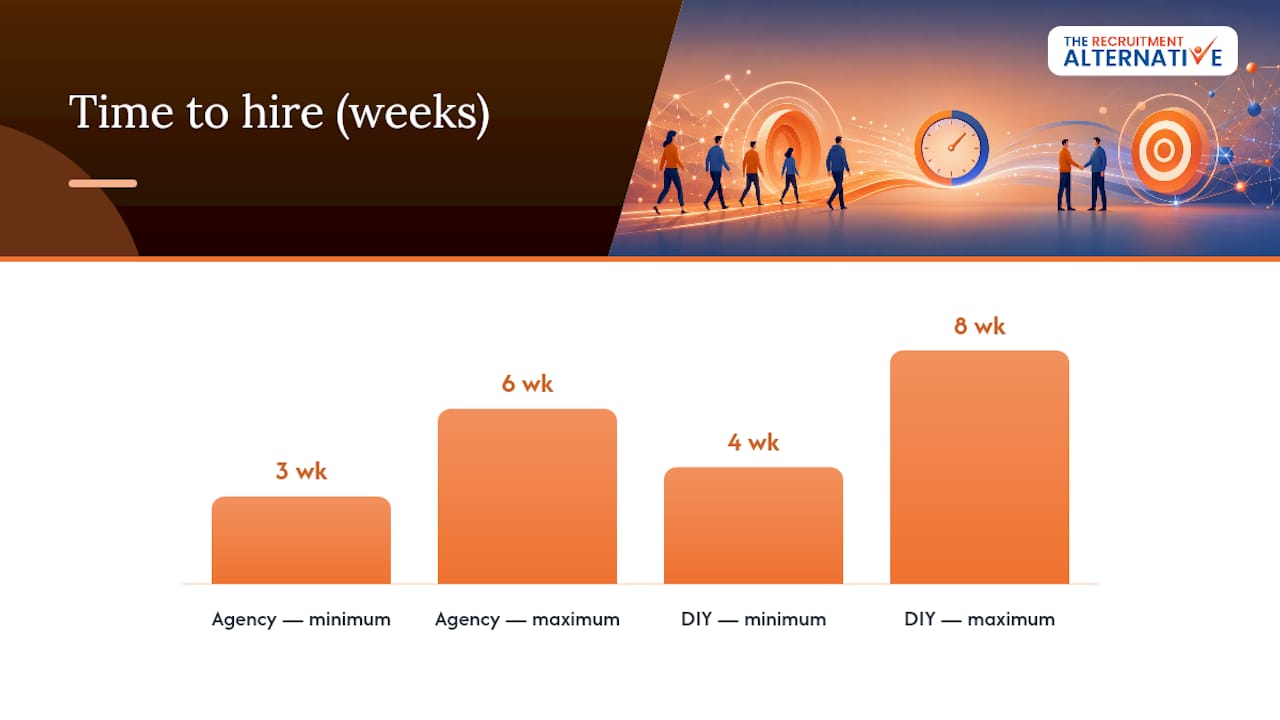
A DIY in-house hire for IT support typically takes 4 to 8 weeks from ad to acceptance, longer if the hiring manager is juggling the search alongside a full workload. A well-run agency engagement usually lands a shortlist and an offer in 3 to 6 weeks, because sourcing and initial screening happen in parallel rather than in sequence.
Cost is where the models diverge sharply. Traditional recruitment agencies commonly charge an agency fee based on a percentage of the first-year salary, which may be disproportionate for standard help desk or desktop support roles. A fixed-fee model removes that variability: you know the cost before you start, regardless of the final salary negotiated.
- What to expect from a fixed-fee agency: transparent pricing set upfront, a defined pipeline of screened candidates, and a replacement guarantee if the hire doesn’t work out early.
- What to check before signing: how candidates are sourced and screened, what happens if no suitable candidate is found, and how long replacement cover lasts.
- When it’s worth it: when speed matters, when nobody internally can confidently assess technical skill, or when the cost of a bad hire (rework, lost productivity, re-advertising) outweighs the fee.
Getting the new hire productive and keeping them
The first 90 days decide whether an IT support hire becomes a long-term asset or a fast exit.
- Days 1 to 30: system access provisioned before day one, documentation handed over, a named mentor assigned.
- Days 30 to 60: independent ticket handling begins, with regular check-ins against a simple competency framework.
- Days 60 to 90: full caseload, first formal performance conversation, and a documented path for skill growth.
Micro-learning modules and short coaching sessions tend to outperform long onboarding manuals for support roles, because technicians learn fastest by doing. Career pathing (help desk to systems administrator, for example) is one of the strongest retention levers available for this workforce, alongside regular, specific feedback rather than an annual review.
Pro Tip: A recruitment partner that stays engaged through probation, not just to the offer stage, catches early friction faster and can help manage a handover if a hire doesn’t stick.
What most employers get wrong about hiring IT support
The biggest mistake I see is treating an IT support hire like any other administrative role, then being surprised when the resume looks perfect and the person can’t actually fix anything on day one. Skills-based screening isn’t optional for this category of hire, it’s the whole job.
Fixed-fee placements work well here precisely because the incentive lines up: the agency gets paid for a good match, not for pushing a high salary through the door. My three tactical tips: pay for the work sample, verify every certification directly, and never skip the structured interview even when a candidate feels like an obvious fit.
— Josh Townsend
Hire IT support without the agency percentage tax
There are alternative fixed-fee recruitment services to traditional percentage-based agencies for IT support hiring that provide sourcing, screening and shortlisting at a transparent, fixed price agreed before you start, regardless of the salary offered.
Our fixed-fee recruitment model covers sourcing, technical screening support and a shortlist of genuinely assessed candidates, backed by replacement cover if a hire doesn’t work out in the first two to three months. We recruit IT support roles alongside sales, admin, finance, engineering and healthcare positions for businesses across the country, so we understand how to write a brief that gets the right technicians applying, not just the loudest resumes. Check our simple flat-fee structure to see exactly what a placement costs before you commit, or get in touch to start an engagement and have a shortlist moving within days.
Sources
- Why does it take so long to hire technical talent? | HR Dive
- IT hiring is under pressure. Here’s how leaders are responding | InformationWeek
- Shrewd IT hiring strategies have never been more critical | CIO
- Ultimate guide to IT hiring | CompTIA
- IT support outsourcing and offshore help desk guidance | Satellite Office AU
FAQ
How long does it take to hire an IT support technician?
An in-house search typically takes 4 to 8 weeks, while a specialist or fixed-fee agency engagement usually lands a shortlist and an offer in 3 to 6 weeks.
What certifications matter most for IT support roles?
CompTIA A+, Network+ and Security+ are the most widely recognised entry points and are treated as valid alternatives to a degree by hiring guides across the industry.
Is it worth using a recruitment agency for IT support hiring?
A fixed-fee agency is worth it when speed matters or when nobody internally can confidently screen technical skill, since it removes the unpredictable cost of a traditional percentage-based fee.
What’s the best way to test a candidate’s technical skill?
A short paid work sample reviewed by a senior technician, combined with a structured interview scored against a fixed rubric, catches gaps that a resume alone will miss.
Can IT support roles be hired offshore?
Level 1 and much of level 2 support work offshores well once documentation, tooling and privacy controls are established, while more complex level 3 work is best kept onshore.

