

Six copy-ready job ad examples, a headline formula, and a formatting checklist are all you need to publish a working ad quickly. The templates below cover short posts for high-volume roles and longer outlines for specialist hires, with the exact CTA wording and headline structures that keep unfit applicants from clicking through.
TL;DR:
- Short ads are best for high-volume roles and should include a clear headline, one responsibility bullet per line, and a specific CTA by a set deadline.
- Long ads suit specialist or management roles, offering detailed responsibilities, must-have skills, benefits, and a precise application instruction.
- Headlines should combine role with a benefit, seniority, or urgency, and opening lines must be specific to attract suitable candidates while filtering out the unfit.
- Vague requirements or unclear CTAs are common pitfalls that cause candidates to drop off; ads should clearly state what applicant should submit and by when.
- Employers and recruiters prioritize salary range and the CTA during screening and prefer realistic must-have lists to avoid self-elimination of good applicants.
Table of Contents
- What makes a good job ad example (checklist before you post)
- Six job ad examples you can adapt today
- Short ad or long ad: how to pick the right structure
- Headlines and opening lines that attract the right candidates
- CTA wording that stops candidates dropping off mid-application
- Common job ad mistakes and quick fixes
- A recruiter’s perspective: what we scan for first
- Want the ad written, posted, and screened for you?
- Sources
What makes a good job ad example (checklist before you post)
Run any draft through this before it goes live. It catches the mistakes that cost employers good applicants.
- Headline names the role and the audience — “Warehouse Team Leader, Night Shift” beats “Exciting Opportunity”
- One-line lead that hooks interest, followed by 3 to 5 responsibility bullets, no more
- Benefits and logistics stated plainly — pay range, hours, location, start date
- One clear CTA telling candidates exactly what to send and by when
- Bullets capped at one line each; total ad length matched to the role’s complexity
The AIDA framework (attention, interest, desire, action) is worth pinning above your desk. Your headline earns attention, the opening line builds interest, the benefits create desire, and the CTA converts that desire into an application.
Pro Tip: Write your CTA first, then work backwards. If you can’t state what you want a candidate to do in one sentence, the rest of the ad won’t fix that confusion.*
Six job ad examples you can adapt today
1. Frontline retail (short ad)
“Retail Team Member, Weekends — $28-32/hr. Busy homewares store in Fortitude Valley needs a friendly face for Saturday-Sunday shifts. No experience needed, just a good attitude and reliable transport. Apply with a two-line note on why retail suits you to jobs@example.com by Friday.”
2. Professional/admin role (long ad)
Office Coordinator, $65,000-$70,000. Lead: “Keep a 15-person consulting firm running smoothly while you build genuine admin experience.” Responsibilities: manage diaries, coordinate supplier invoices, greet clients, maintain office supplies. Skills: two years’ admin experience, confident with Xero, clear phone manner. Benefits: hybrid working, career progression into operations. CTA: “Send your resume and a short note on your favourite organisational tool to [email] by [date].”
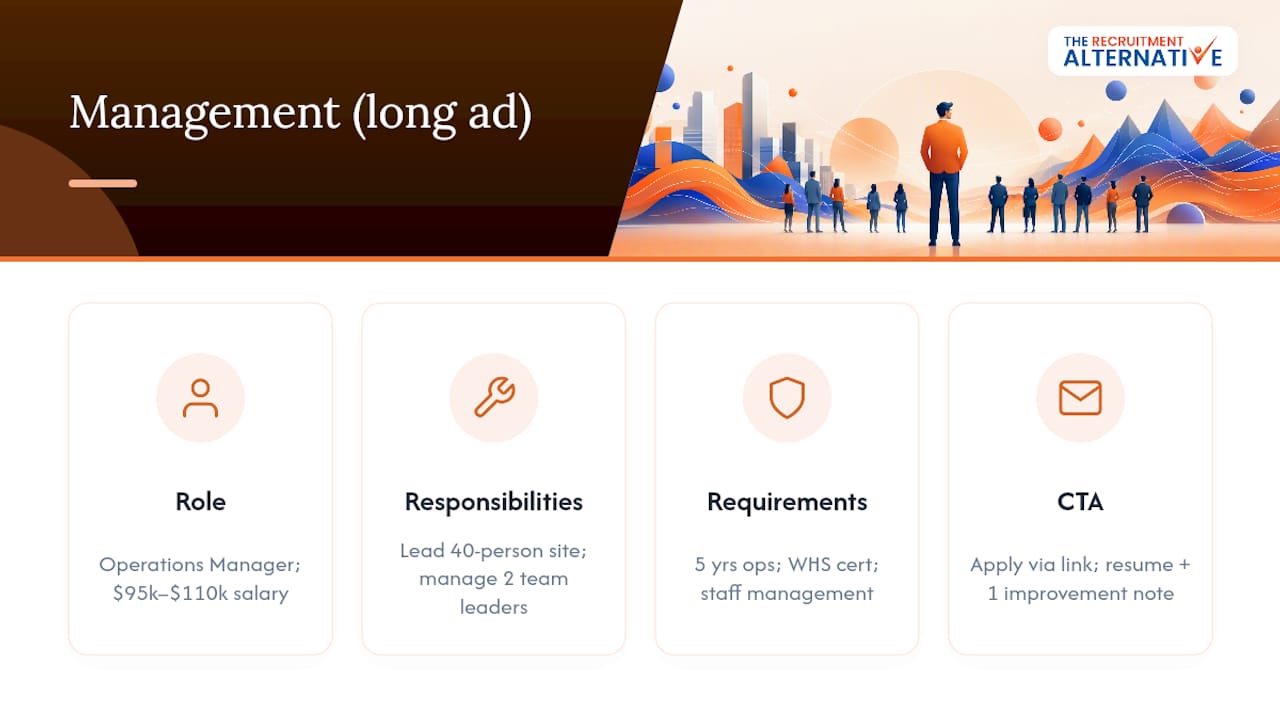
3. Management (long ad)
Operations Manager, $95,000-$110,000. Lead: “Take ownership of a 40-person distribution site with genuine autonomy to improve how it runs.” Responsibilities: oversee daily logistics, manage two team leaders, own the safety program. Skills: five years in operations, WHS certification, staff management experience. Benefits: vehicle allowance, performance bonus. CTA: “Apply via the link with your resume and a cover note addressing one operational improvement you’d prioritise.”
4. Technical/trade (short ad)
“Licensed Electrician, $45-52/hr plus super. Established Brisbane sparkie needs an A-grade electrician for residential and light commercial jobs. Ute and tools supplied. Apply with your licence number and start availability to [email].”
5. Healthcare (long ad)
Registered Nurse, Aged Care, $38-44/hr. Lead: “Join a 60-bed residential facility where nurse-to-resident ratios actually let you do the job properly.” Responsibilities: medication management, care plan reviews, family liaison. Skills: current AHPRA registration, aged care experience preferred. Benefits: salary packaging, paid parental leave. CTA: “Submit your resume and registration number through the online form by [date].”
6. Remote/technology (short ad)
“Remote Customer Support Specialist, $60,000-$68,000. Fully remote SaaS company hiring a support specialist across AEST hours. Must have two years in a support role and a reliable home setup. Apply with resume and a one-paragraph answer on how you’ve handled a difficult customer, sent to [email].”
Short ad or long ad: how to pick the right structure
A short ad runs 80 to 150 words and suits high-volume, entry-level, or urgent roles. Think retail, hospitality, warehouse, or trade positions where the market moves fast and candidates decide quickly. Government job-ad templates for print placements show exactly how much can be cut without losing clarity: a single-line CTA and a phone number can outperform a paragraph of detail.
A long ad runs 250 to 400 words and suits specialist, management, or executive hires, and works best on careers pages or LinkedIn where candidates expect more context before applying.
Every ad, short or long, needs these elements present in some form:
- A lead line that states the role and one compelling reason to read on
- Responsibility bullets (fewer for short ads, more detail for long ones)
- Required skills, split into must-haves and nice-to-haves
- Benefits beyond salary, and key logistics like hours or location
- One CTA with no ambiguity about what to send
Short ads compress the middle three elements into a sentence each. Long ads give each its own short paragraph or bullet cluster.
Headlines and opening lines that attract the right candidates
Your headline does the heaviest lifting in the whole ad. Three formulas work reliably:
- Role + benefit: “Bookkeeper, $75K + Flexible Hours”
- Role + seniority + drawcard: “Senior Developer, Fully Remote, Equity Included”
- Urgency: “Hiring Now: Delivery Drivers, Start This Week”
Follow the headline with an opening line that filters as much as it attracts. “We need a detail-obsessed bookkeeper who genuinely enjoys reconciling accounts” pulls in the right applicant and quietly repels the wrong one. Government hiring guidance consistently backs short, specific headlines over vague, enthusiasm-heavy openers.
CTA wording that stops candidates dropping off mid-application
A vague CTA is one of the biggest reasons candidates start an application and never finish it. Be specific about what to submit and when:
- “Apply with your resume and a short cover note by Friday 5pm”
- “Send your resume and portfolio link to [email]”
- “Click apply and answer two short screening questions”
A clear, easy-to-follow application process is one of the most common reasons candidates complete an application, according to AIHR’s job posting guidance — unclear CTAs are a direct cause of drop-off. Keep application fields to what you’ll actually use for screening; asking for a full work history when you only need a resume and one writing sample just adds friction. For guidance on where to publish once your ad is written, see this complete guide to posting jobs online.
Common job ad mistakes and quick fixes
- Vague requirements → Before: “Must be a team player with great communication.” After: “Must have handled inbound customer calls for at least one year.”
- Long, unbroken paragraphs → Before: a 120-word block describing the role. After: a one-line lead plus four bullets.
- Missing benefits → Before: salary only. After: salary, plus two concrete benefits (flexible hours, training budget).
- Everything marked “essential” → Before: ten must-haves. After: three must-haves, the rest listed as nice-to-haves.
Pro Tip: Read your ad back and remove any phrase that could unintentionally discourage a qualified candidate from applying, like “must have X years” when transferable skills would do the job just as well. Neutral, skills-based language widens your pool without lowering your bar.
A recruiter’s perspective: what we scan for first
When we screen an ad, salary range and the CTA get read before anything else. If either is missing or vague, we assume the employer hasn’t thought the role through, and candidates make the same judgement in seconds. Realistic must-have lists speed up hiring more than any other single change, because they stop good candidates from self-selecting out. Writing a strong ad still takes time most hiring managers don’t have, which is exactly why flat-fee recruitment exists as a practical middle ground between doing it all yourself and paying a commission-based agency.
— Josh Townsend
Want the ad written, posted, and screened for you?
The Recruitment Alternative offers a fixed-fee recruitment service, where you pay one fixed fee set upfront, regardless of how senior the role is.
Here’s what that looks like in practice:
- One transparent, fixed-fee structure instead of a percentage-of-salary commission
- Candidate sourcing and screening handled for you across a broad range of roles and industries
- Replacement cover if a placement doesn’t work out in the first months
- A faster path to a shortlist than writing, posting, and filtering applications solo
If you’d rather hand the ad writing and screening to specialists who do it daily, get a clear picture of the fixed-fee model and see how it compares to the DIY approach outlined above.
Sources
- FREE Job Posting Template and All-You-Need Guide for 2026 – AIHR
- Writing an effective job advertisement | Services – ANU
- Job ad for print example

