

An employer brand is the reputation candidates and staff hold about your organisation as a place to work. Employer branding is the deliberate work you do to shape that reputation, from the careers page copy to how a manager handles a hybrid-work request. Get this right and you see it in the numbers: more applications per role, fewer offer knockbacks, and staff who stay past the twelve-month mark.
Candidates read the signals whether you manage them or not. Two show up constantly:
- Culture messaging — what your careers page, job ads and LinkedIn posts claim about how people are treated.
- Review-site ratings — what current and former staff say on Glassdoor, and whether you respond to it.
When those two signals contradict each other, candidates trust the second one every time.
Key Takeaways
A credible employer brand only works when internal experience matches external promise, and that alignment drives measurable gains in applications, offer acceptance and retention.
| Point | Details |
|---|---|
| Definition matters | Employer brand is the reputation candidates hold; employer branding is the deliberate work to shape it. |
| EVP must be evidence-based | Build it from employee listening and exit data, not leadership aspiration, to avoid early turnover. |
| Audit against four pillars | Check People, Purpose, Place and Product separately to find your specific credibility gaps. |
| Measure five simple KPIs | Track applications, offer acceptance, six to twelve month retention, cNPS and review sentiment quarterly. |
| Fix the say-do gap first | One or two tangible policy fixes buy more credibility than rewritten messaging. |
| Convert brand interest into hires | The Recruitment Alternative’s flat-fee model and candidate replacement insurance turn employer brand credibility into completed placements. |
Table of Contents
- What is an employer brand? The definition and where it came from
- Why employer branding matters for hiring and retention
- The four pillars: people, purpose, place, product
- Building an evidence-based EVP, step by step
- Measuring employer brand impact without a data team
- Where the say-do gap wrecks employer brands
- A 90-day plan to start fixing your employer brand
- How company culture shapes your employer brand
- How social media and online reviews shape employer branding now
- Candidate experience, recruitment marketing and the employer brand link
- What employer branding looks like from inside SME recruitment
- How The Recruitment Alternative turns employer brand work into hires
- Sources
What is an employer brand? The definition and where it came from
The term traces back to Simon Barrow and Tim Ambler, who defined the employer brand as the package of functional, economic and psychological benefits an employee gets from working somewhere, according to MindTools. That framing still holds: it is not a logo or a tagline, it is what employment actually feels like.
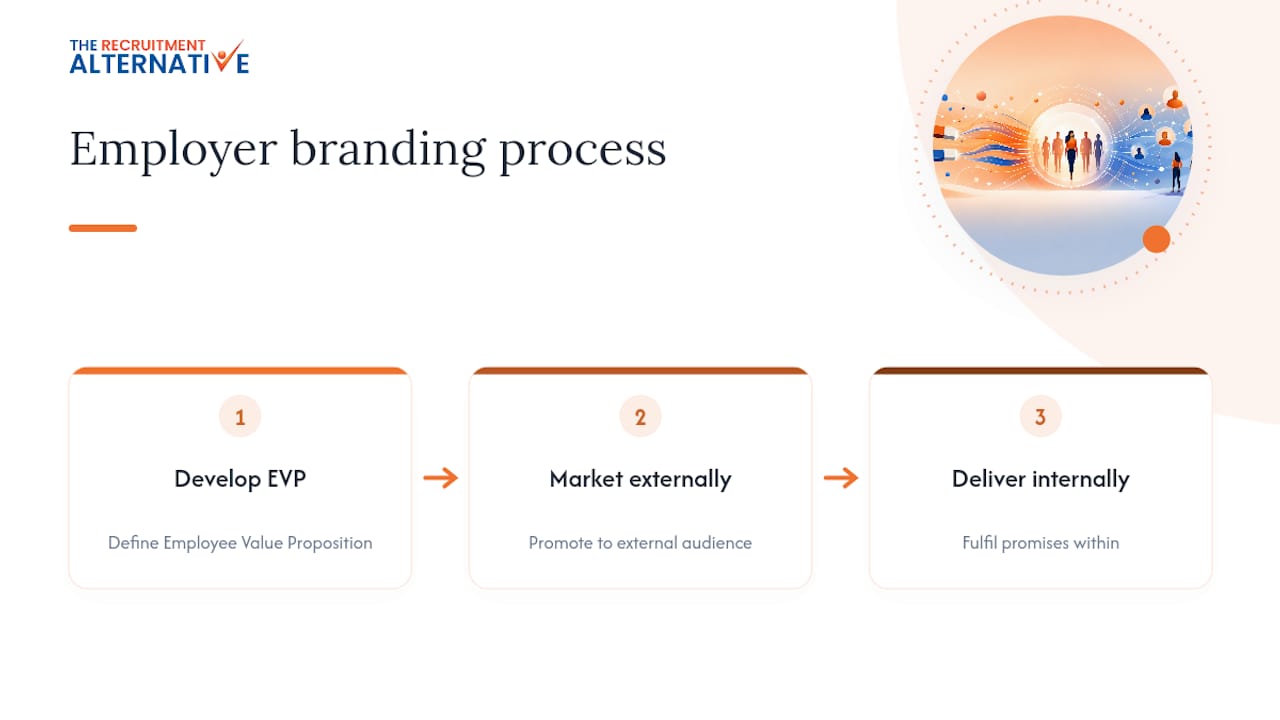
Universum describes employer branding as the strategic discipline of deliberately shaping how an organisation is perceived as a place to work. The brand is the perception; the branding is the activity that shapes it. Researchers Backhaus and Tikoo sharpened this further, framing employer branding as a three-stage process: develop an Employee Value Proposition, market that proposition externally, then deliver on it internally. Most employer brand failures happen because a business does stage two and skips stage three.
Practitioners now commonly audit employer brand against four pillars: People, Purpose, Place and Product. It is a workable structure for anyone trying to figure out where their own reputation actually stands.
Why employer branding matters for hiring and retention
A weak or invisible employer brand shows up as a cost line, even when nobody labels it that way. Roles take longer to fill, more candidates drop out between offer and start date, and agency spend climbs because internal sourcing keeps underperforming.
CIPD’s recruitment brand factsheet links a clear employer brand to an organisation’s ability to differentiate itself in the labour market and to attract, recruit, retain and engage the right people. That differentiation matters more in tight labour markets, where candidates can afford to be selective about who they even apply to.
A credible employer brand pays back in three places at once: stronger application volume per role, higher offer acceptance rates, and lower reliance on paid agency search because your own pipeline does more of the work.
Retention follows the same logic. Staff who joined because the brand promise matched reality tend to stay longer, because there is no gap between what they signed up for and what they experience day to day. CIPD’s own framing ties employer brand directly to values and inclusion, not just recruitment marketing, which is worth remembering before you treat this as a purely external exercise.
The four pillars: people, purpose, place, product
Auditing your employer brand against the four pillars gives you a practical structure, rather than a vague sense that “our culture is good.” Each pillar points to specific evidence you can actually go and collect.
- People — manager behaviour, peer relationships, how promotions and feedback actually happen.
- Purpose — whether the stated mission shows up in day-to-day decisions, not just the About page.
- Place — physical or remote work environment, flexibility policies, and how consistently they are applied.
- Product — what the business does or sells, and whether staff feel proud enough to talk about it.
Universum’s pillar framework is designed for exactly this kind of gap analysis: external messaging tells candidates what to expect, while internal delivery is what determines whether that message survives someone’s first ninety days.
Pro Tip: Pull your last twelve exit interviews and sort the comments against these four pillars. The pillar with the most complaints is your real priority, not the one your marketing team assumes is weakest.
Building an evidence-based EVP, step by step
Your Employee Value Proposition, or EVP, is the specific bundle of value you offer in exchange for someone’s skills and effort. It sits at the centre of employer branding because every other activity, from job ads to onboarding, either reinforces it or contradicts it.
The mistake most businesses make is writing the EVP from leadership aspiration rather than employee reality. Great Place to Work’s guidance is blunt about this: an EVP built without genuine employee listening and exit data risks attracting the wrong candidates, or losing new hires fast once the gap becomes obvious.
Here is a practical sequence that works without a research budget:
- Plan the listening. Run short pulse surveys and structured exit interviews across at least one full quarter, not a single snapshot.
- Draft pillar statements. Turn recurring themes into three or four short, specific claims. “We genuinely support flexible hours” beats “we value work life balance.”
- Test the draft. Show it to a handful of current staff across different tenures and ask where it feels inaccurate.
- Integrate it. Push the validated language into careers page content, job ads and interview scripts, so hiring managers describe the role the same way the careers page does.
A validated EVP does not need to be clever. It needs to survive contact with a new hire’s first month, which is the only test that actually matters.
Measuring employer brand impact without a data team
You do not need enterprise analytics to track whether your employer brand is working. Five numbers, tracked consistently, tell you most of what you need to know:
- Applications per role, tracked against a rolling three-month baseline.
- Offer acceptance rate, which drops fast when candidates sense a say-do gap during interviews.
- Retention at six and twelve months, the clearest signal that reality matched the pitch.
- Candidate Net Promoter Score (cNPS), gathered via a short post-interview survey.
- Review-site sentiment, tracked monthly rather than reacted to only when a bad review appears.
Set a baseline in month one using whatever applicant tracking and HR data you already hold, then report against it quarterly. Responding to reviews with transparency, rather than ignoring them, is itself a measurable employer branding activity that candidates notice.
Where the say-do gap wrecks employer brands
The say-do gap is the distance between what your employer brand promises and what a new hire actually experiences. It usually surfaces in the first few weeks, when promised flexibility, development, or team culture fails to materialise. That gap does more damage to recruitment than having no employer brand messaging at all, because candidates feel misled rather than merely uninformed.
Exit interviews and short pulse surveys are the cheapest way to catch the gap before it compounds across multiple hires. If three consecutive exits mention the same broken promise, that is not a coincidence, it is a pattern worth fixing before you write another job ad.
Review-site criticism deserves the same discipline. A defensive or absent response to a critical Glassdoor review often does more reputational harm than the review itself, because prospective candidates read the response as much as the complaint.
Pro Tip: Fix one or two tangible policies, not ten. A clear hybrid-work rule or a transparent promotion map, applied consistently, buys back more credibility than a rewritten mission statement ever will.
A 90-day plan to start fixing your employer brand
- Days 1 to 30: listen and baseline. Run pulse surveys, review exit data, and set your starting numbers for applications, acceptance rate and retention.
- Days 31 to 60: build the EVP and close credibility gaps. Draft evidence-based pillar statements and fix one or two visible say-do problems.
- Days 61 to 90: update and train. Refresh careers content and job ads, brief hiring managers on consistent language, and start quarterly reporting.
How company culture shapes your employer brand
Culture is the daily operating system your employer brand promises describe from a distance. It is the accumulated pattern of how decisions actually get made: who gets heard in a meeting, how mistakes are handled, whether flexibility policies apply evenly across the team or only to favourites.

This matters because culture is nearly impossible to fake convincingly at scale. A careers page can claim “collaborative and supportive” all it wants, but if new hires experience siloed teams and unresponsive managers, that claim collapses within weeks, and it collapses publicly, because people talk.
The relationship runs in both directions. Culture shapes what your employer brand can honestly claim, and a well-articulated employer brand can also clarify culture, by forcing leadership to name specific behaviours rather than vague values. A business that writes “we support flexible hours” as an EVP pillar has to define what that actually means in practice, which manager behaviour has to follow, and how it gets enforced when someone pushes back.
Smaller businesses often have an advantage here that larger ones envy: culture is more visible and more attributable when there are twenty staff rather than two thousand. A single manager’s behaviour can define the entire employer brand experience for a small team, which means culture fixes at SME scale tend to move faster and show up in retention data sooner.
How social media and online reviews shape employer branding now
Candidates now research an employer the same way they research a purchase: they check reviews before they check the job description in detail. Glassdoor, LinkedIn comments, and even Google reviews left by former staff all function as informal employer brand audits that happen entirely outside your control.
This shifts where the real branding work happens. A polished careers page matters less than it used to, because candidates increasingly weight peer reviews over corporate messaging when the two disagree. Glassdoor’s own guidance for employers treats responding to reviews as a core branding activity rather than an optional reputation-management chore, because a thoughtful, non-defensive response signals more about your culture than the review itself.
Social media adds a second layer. Employee posts, whether a genuine celebration of a work anniversary or a pointed complaint about restructuring, now travel further than most recruitment marketing campaigns, because they carry the credibility of a real person rather than a brand account.
The practical implication for a business without a large marketing team is simple: monitor review platforms monthly, respond to criticism with specifics rather than boilerplate, and encourage genuine employee advocacy rather than scripted posts. Authentic employee voice, even a handful of unprompted LinkedIn posts from happy staff, tends to outperform paid employer branding content on trust, because readers can tell the difference.
Candidate experience, recruitment marketing and the employer brand link
Every touchpoint a candidate has with your business, from the job ad to the interview scheduling email to the rejection message, either reinforces your employer brand or quietly undermines it. Candidate experience is where employer branding gets tested in practice, one interaction at a time.
Recruitment marketing is often confused with employer branding itself, but the two sit in different places. Employer branding is the underlying strategy, research and evidence base; recruitment marketing is the campaign activation of that strategy, according to Employerbranding.news, covering the job ads, social content and careers site copy that put the EVP in front of candidates. A recruitment marketing campaign built on an EVP that has not been validated against employee reality will generate applications, but it will not generate retention.
Consistency matters more than polish across every touchpoint. A job ad promising autonomy followed by an interview process that feels rigid and scripted tells a candidate more about your actual culture than either piece of content intended to. Generic, inconsistent language across job ads, the careers page and social media damages credibility faster than saying nothing at all, because it reads as either careless or dishonest.
The fix is largely procedural rather than creative: audit every candidate-facing document against your validated EVP pillars, and remove language nobody on the team can actually stand behind in an interview.
What employer branding looks like from inside SME recruitment
Working across sales, admin, finance, engineering, healthcare and trades roles for businesses of every size shows one pattern repeatedly: the employers who fill roles fastest are rarely the ones with the flashiest careers page. They are the ones whose job ads, interview conversations and onboarding experience actually match.
Flat-fee placement work across that many industries also exposes something else. Say-do gaps are rarely deliberate. They are usually the accidental result of nobody auditing candidate-facing language against what hiring managers actually do day to day.
How The Recruitment Alternative turns employer brand work into hires
A credible employer brand gets candidates interested. What converts that interest into a signed offer is a recruitment process that matches the promise, quickly, and without the employer absorbing a percentage-of-salary agency fee that eats into the very budget you need for culture and retention work.
The Recruitment Alternative works on a transparent flat-fee recruitment model, so the cost of finding your next hire is fixed and known upfront, regardless of the final salary negotiated. That matters directly for employer brand credibility: a fixed-fee process tends to move faster than commission-based search, which means candidates spend less time in limbo wondering whether the role, and the culture promise attached to it, is real. Every placement also comes with candidate replacement insurance if the hire does not work out in the first two to three months, a practical safeguard while you are still closing say-do gaps internally. Check the simple flat-fee structure for your role’s salary band and get a placement moving this week.
Sources
- Conceptualizing and researching employer branding (Backhaus & Tikoo)
- CIPD recruitment brand factsheet
- What is employer branding? — MindTools
- Glassdoor employers guidance

