

A winning sales recruitment strategy defines the role and its success metrics first, sources candidates through channels where quota carriers actually spend time, validates capability through short simulations rather than gut feel, moves to offer within days, and locks in a structured 30/60/90 ramp. Industry sourcing research and hiring frameworks back each step. Start today by drafting a one-page role brief and booking a 15-minute simulation for your next shortlist.
TL;DR:
- Sales hiring should prioritize clear role definitions, success metrics, and quick decision-making to reduce costly mis-hires and high turnover rates.
- Sourcing must target active channels like LinkedIn Sales Navigator, industry communities, and referrals, rather than rely solely on job postings.
- Structured assessments, including quota history and simulation-based interviews, outperform traditional behavioral questions in predicting sales performance.
- Fast onboarding with well-defined 30/60/90 day milestones enhances ramp-up speed and improves first-year retention.
- Regular measurement of hiring metrics such as time-to-fill, speed-to-offer, and ramp attainment is essential for continuous improvement and controlling costs.
Table of Contents
- Why sales-specific recruitment strategies matter more than you think
- Define the sales role and the metrics that predict success
- Where to find high-quality sales candidates: sourcing that actually works
- Screening and assessments that actually predict sales performance
- Interviews as simulations: how to structure and score them
- Compensation and offer practice that convert without overpaying
- Onboarding and the first 90 days: ramp plans and retention
- Measure, iterate, and control your hiring costs
- The evidence behind this approach
- A hiring philosophy worth defending
- Consider a flat-fee recruiter: what The Recruitment Alternative offers
- Sources
- FAQ
Why sales-specific recruitment strategies matter more than you think
Sales roles don’t behave like other roles when a hire goes wrong. A mis-hire in administration costs you productivity. A mis-hire in sales costs you productivity, a stalled pipeline, and often a damaged client relationship that took months to build.
Sales positions carry roughly 35% annual turnover, well above most other functions, and replacing a single rep is expensive once you count recruitment costs, ramp time, and lost deals. That figure alone should change how much time you invest before you write the job ad, not after.
The broader cost-of-bad-hire research from SHRM shows the damage compounds: onboarding spend, lost productivity, and the drag on team performance while a manager tries to coach someone who was never going to hit quota. In sales, that drag shows up as missed forecasts, not just an awkward review.
The fix isn’t more interviews. It’s better evaluation criteria set before you source a single candidate:
- Agree on the selling motion you’re hiring for (hunter, farmer, or hybrid) before writing the ad.
- Set a target time-to-fill and a speed-to-offer benchmark so strong candidates don’t walk to a faster-moving competitor.
- Define what “ramped” looks like at 30, 60, and 90 days so everyone, including the new hire, knows the bar.
Get those three things right and you’ve already fixed most of what causes sales mis-hires.
Define the sales role and the metrics that predict success
You can’t screen for what you haven’t defined. Most sales hiring goes wrong at this exact step, before a single résumé lands.
- Map the selling motion. A hunter chases new logos and needs resilience, cold-outreach stamina, and a track record of building pipeline from nothing. A farmer grows existing accounts and needs relationship depth, renewal discipline, and account planning skill. A hybrid rep needs both, in smaller doses, and is harder to screen for because generalists often look good on paper without excelling at either.
- Set measurable success criteria into the brief itself. Quota expectations, ramp milestones (first deal by day 45, full quota by month four, for example), and leading activity metrics such as calls, demos, or qualified opportunities per week.
- Write the role brief to filter, not just attract. State the OTE range, the commission split, and the realistic ramp timeline in the ad. Vague ads pull volume; specific ads pull candidates who already know they fit.
A role brief built this way does double duty. It gives your screening team an objective scorecard before the first call, and it gives candidates enough detail to self-select in or out, which cuts wasted interviews on both sides. Past quota attainment, more than job titles or brand-name employers on a résumé, is the strongest predictor of future sales performance, so build your success criteria around evidence of that, not pedigree.
Where to find high-quality sales candidates: sourcing that actually works
The best sales candidates aren’t scrolling job boards. They’re closing deals, which means your sourcing has to go where they already are rather than waiting for them to come to you.
Priority channels for active and passive candidates:
- LinkedIn Sales Navigator for filtering by quota-carrying titles, tenure, and industry vertical.
- Sales-specific communities such as Bravado and Pavilion, where reps discuss roles, comp, and market movement long before they update a public profile.
- Industry conferences and sales meetups, which surface passive candidates who aren’t actively job hunting but are open to the right conversation.
- Customer and partner referrals, since sales leaders often know who’s quietly outperforming at a competitor.
High-signal sourcing depends on going where sellers actually reveal activity and intent, not on posting a job ad and hoping. That’s the practical difference between a strategy and a wish list.
When you reach out, lead with numbers. A message that opens with “we’re hiring a BDR” gets ignored. A message that opens with “you’re carrying $1.2M quota now, this role has a $1.8M OTE ceiling and warm inbound pipeline” gets a reply. Multi-channel cadences, mixing email, LinkedIn messages, and even SMS for senior candidates, lift response rates compared with a single-channel approach, particularly with passive candidates who aren’t checking their inbox for recruiter messages.
Timing matters too. Reps are least likely to move mid-quarter when commission is close to landing, and most likely to explore new roles just after quarter close. If you know a vacancy is coming, start warming your pipeline a full quarter ahead rather than starting from zero the week someone resigns.
Pro Tip: Build a “always warm” list of five to ten strong passive candidates in your target segment, even when you have no open role. When a vacancy does open, you’re reaching out to people who already know your business, not cold strangers.
If your outbound sourcing is stretched thin, a partner that handles CRM and campaign automation, like Sun State Digital’s CRM and automation services, can help you track and sequence candidate outreach the same way you’d manage a sales pipeline.
Screening and assessments that actually predict sales performance
Résumé gloss tells you almost nothing about whether someone can sell. What predicts performance is quota history, tenure stability, and how someone behaves under a structured task, not how polished their LinkedIn headline is.
Start with quota attainment. A candidate who consistently hit 85 to 95% of quota across two or three years is usually a safer bet than one who hit 130% once and missed badly the other two years. Look for the pattern, not the peak. Harvard Business Review’s hiring research backs this directly: past quota attainment is one of the strongest predictors of how someone will perform in a new sales role.
Tenure stability matters almost as much. A candidate who’s changed jobs every eight months has either been chasing sign-on bonuses or has been managed out repeatedly. Neither is a great sign, and it’s worth asking about directly rather than assuming the worst.
Build these filters into your process before interviews start:
- Score quota attainment history as a hard filter, not a nice-to-have on the scorecard.
- Set a short, timed skills task, such as a written prospecting email or a five-minute discovery-call role play, as a pre-interview gate.
- Structure reference checks around specific questions: What was their quota? Did they hit it? How did they respond to coaching feedback?
Reference checks are where most hiring managers waste an opportunity. Asking “would you rehire them?” gets a polite non-answer nine times out of ten. Asking “what quota did they carry, and what percentage did they hit in each of their last four quarters?” gets you a fact you can verify.
Interviews as simulations: how to structure and score them
The interview format most companies use, a panel asking behavioural questions, tells you how well someone talks about selling. It tells you almost nothing about how well they sell.
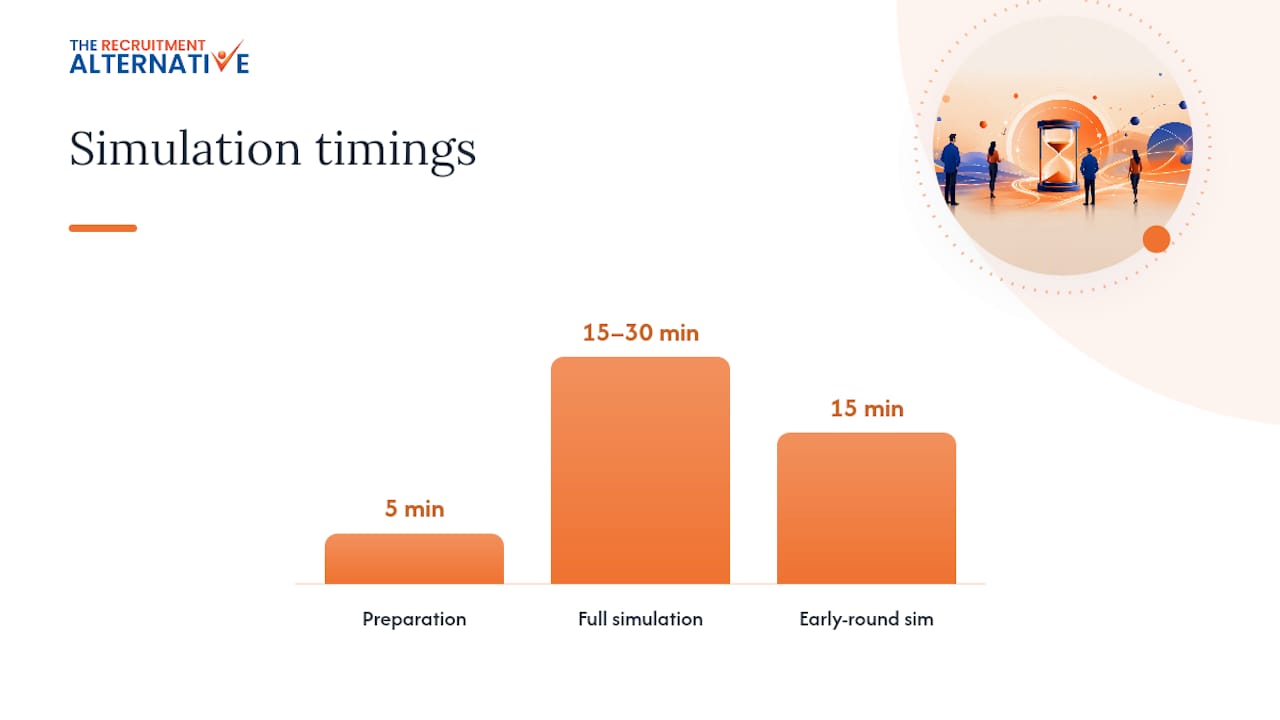
A simulation-based interview fixes that. Set aside 15 to 30 minutes and run the candidate through a realistic scenario:
- Cold pitch simulation. Give them a product brief five minutes beforehand and have them pitch it cold to an assessor playing a sceptical buyer.
- Discovery role play. Have them run a discovery call against a persona with a hidden pain point they need to uncover through questioning, not assumption.
- Objection handling. Throw two or three realistic objections mid-pitch (price, timing, competitor lock-in) and watch how they adjust rather than freeze or over-explain.
- Structured debrief. Score each stage against a fixed rubric immediately afterwards, before the next candidate resets your memory of what “good” looked like.
Score consistently across candidates using the same rubric each time. Rate discovery questioning, objection handling, and clarity separately rather than one gut-feel “did well” tick, because a strong pitcher and a strong discoverer aren’t always the same person.
Recruiting practitioners consistently find that simulation-based interviews and structured scorecards reduce the risk of hiring on charisma alone, which is the single most common failure mode in sales hiring. Simulations also do something panel interviews can’t: they expose coachability in real time. Give a candidate feedback mid-simulation and watch whether they adjust immediately or get defensive. That reaction alone often tells you more about their trainability than the rest of the interview combined.
Run simulations early, not as a final-round formality. A 15-minute simulation in round one saves you from running three more rounds with someone who was never going to hit quota.
Compensation and offer practice that convert without overpaying
Good sales candidates are usually talking to two or three companies at once, and the one that’s transparent about money and moves fastest tends to win, not necessarily the one offering the biggest number.
State base salary, OTE, commission split, and realistic ramp timeline in the job ad or the first conversation, not buried until a final offer call. Candidates who understand exactly what they’re walking into are more likely to stay once they’re in the seat. Hiding OTE and quota until late in the process damages both conversion and early retention, because reps who feel misled about earning potential in month one rarely stick around past month six.
A few practical levers worth building into your offer strategy:
- Offer a sign-on payment for candidates leaving guaranteed commission on the table mid-quarter, rather than asking them to absorb that loss unpaid.
- Use a guaranteed draw for the first one to three months on genuinely new territories or products where pipeline won’t exist from day one.
- Reserve accelerated commission tiers for candidates who are genuinely choosing between your offer and a competitor’s, not as a default sweetener.
Speed is its own form of compensation. Top candidates often accept an offer within days of finishing interviews, and industry benchmarks show strong candidates typically field competing offers within two to three weeks of entering the market. If your process from final interview to signed offer takes longer than a week for a high-signal candidate, you’re losing people to whoever moved faster, not whoever offered more.
Onboarding and the first 90 days: ramp plans and retention
The hire isn’t finished when someone signs the offer letter. It’s finished when they’re consistently hitting quota, and that depends almost entirely on what happens in the first 90 days.
- Days 1 to 30: foundation. Product training, CRM setup, shadowing senior reps on live calls, and no live pipeline pressure yet. This is where coachability from the simulation stage either gets confirmed or exposed.
- Days 31 to 60: protected ramp. Assign a smaller, protected pipeline with realistic early-stage targets. Expect activity metrics, calls, demos booked, to be the primary measure, not closed revenue yet.
- Days 61 to 90: full accountability. Move to standard quota expectations, with a manager coaching cadence of at least one structured pipeline review per week.
Track ramp attainment against these milestones, not just final quota numbers, so you catch a struggling hire in week five rather than month five. Structured onboarding with clear 30/60/90 milestones correlates with faster ramp and better first-year retention than an unstructured “figure it out” approach.
Retention doesn’t stop at day 90. Clear career paths (senior AE, team lead, sales management), regular manager coaching rather than only pipeline reviews, and comp calibration that keeps pace with market rates are what keep a ramped rep from being poached six months later.
Pro Tip: Schedule an informal “stay conversation” at day 45, not just a performance check-in. Ask what’s working and what’s frustrating before small issues turn into a resignation letter.
Measure, iterate, and control your hiring costs
You can’t improve a sales recruitment process you’re not measuring. Most businesses find out their process is broken only after a bad hire, which is the most expensive way to learn it.
Track these metrics against realistic targets, and revisit them every quarter:
| Metric | What it tells you | Target range |
|---|---|---|
| Time-to-fill | Speed from role opening to accepted offer | 2 to 4 weeks for most sales roles |
| Speed-to-offer | Days from final interview to offer extended | Under 5 business days for high-signal candidates |
| Ramp attainment | % of new hires hitting quota by day 90 | A high percentage signals a healthy process |
| Retention over the first 90 days | % of hires still in role after one year | High percentages are a strong benchmark |
| Source ROI | Cost per hire against revenue that hire generates | Track by channel, not just overall |
When time-to-fill blows out past a month, that’s usually a sourcing problem, not an interviewing one. Use post-hire performance reviews at the six-month mark to check whether your scorecard actually predicted the outcome, and adjust it if it didn’t. A structured, repeatable hiring process, covering preparation, sourcing, screening, interviewing, selection, and onboarding as distinct stages, consistently produces more predictable ramp outcomes than an ad hoc approach. If your recruitment workflow needs a broader overhaul beyond sales roles specifically, a process improvement framework built for small business hiring is worth reviewing alongside these targets.
The evidence behind this approach
The playbook above isn’t guesswork. It’s built on a consistent pattern across sales hiring research: process discipline beats gut feel, and speed matters as much as accuracy.
- A flat-fee recruitment agency can recruit sales talent using a fixed-fee model, sometimes with pricing tiered by candidate salary rather than a percentage-of-salary commission structure.
- Some recruitment services include candidate replacement insurance covering the first two to three months, reducing the financial risk of a mis-hire.
- Harvard Business Review’s research on sales hiring confirms quota attainment history predicts performance better than credentials or interview charisma.
- SHRM’s cost analysis shows bad hires carry costs well beyond the visible salary, reinforcing why upfront screening investment pays for itself.
Together, this research and the client-side data point the same direction: define the role precisely, screen on evidence rather than polish, and move fast once you’ve found a genuine fit.
A hiring philosophy worth defending
Most sales hiring advice tells you to slow down and interview more thoroughly. I’d argue the opposite: speed and simulation together beat length and volume of interviews, almost every time.
A five-round interview process doesn’t catch more bad hires than a well-run simulation does. It just gives a good candidate more time to accept a competing offer while you deliberate. The businesses that hire well aren’t the ones asking the cleverest behavioural questions. They’re the ones who’ve already decided what quota attainment and coachability look like before the first call, then test for exactly that within thirty minutes.
If you take one thing from this, make it this: draft your role brief today, and put a 15-minute simulation in front of your next shortlist before you schedule a single panel interview.
— Josh Townsend
Consider a flat-fee recruiter: what The Recruitment Alternative offers
If everything above sounds right but you don’t have the bandwidth to run sourcing, simulations, and reference checks on top of your day job, that’s precisely where a flat-fee model earns its keep. The Recruitment Alternative charges a fixed price for permanent sales placements instead of the traditional percentage-of-salary commission, so a $90,000 hire and a $130,000 hire don’t carry wildly different agency bills for the same amount of work.
The service covers sourcing, screening, and candidate presentation using the same evidence-based approach outlined here, quota history, structured evaluation, and reference verification, backed by candidate replacement insurance if a placement doesn’t work out in the first two to three months. It’s not the right call for every business; if you’ve already got a sharp internal recruiter and the sourcing reach to fill a pipeline, this article gives you what you need to run it yourself. But if sales hiring keeps stalling or costing you good candidates to slower competitors, the sales representative hiring guide walks through exactly how the fixed-fee process works for this role type, and you can check current tiers on the simple flat fee structure page before requesting a quote.
Sources
- How to Recruit Sales Talent: The Complete Sourcing Guide (2026)
- The best ways to hire salespeople (Harvard Business Review)
- Cost of bad hires (SHRM)
- The complete sales hiring process: from job post to first sale
FAQ
What are the five C’s of recruitment?
Definitions vary across sources, but common versions include Candidate experience, Communication, Consistency, Culture fit, and Cost control, all of which apply directly to sales hiring where speed and clarity of communication strongly affect offer acceptance.
What are the top sales strategies for building a pipeline?
The strongest sales talent pipelines combine active sourcing through platforms like LinkedIn Sales Navigator with passive sourcing through sales communities, referrals, and pre warmed candidate lists built before a vacancy opens.
What are the five recruitment strategies every business should use?
A well-rounded approach combines defining clear role and success metrics, multi-channel active and passive sourcing, skills-based screening, simulation-led interviews, and structured onboarding, the same sequence covered throughout this article.
What are the key steps in a sales hiring process?
A reliable sales recruitment process runs through preparation and role definition, sourcing, screening, simulation-based interviewing, selection and offer, and structured onboarding, a six-phase framework linked to more consistent hires and stronger ramp outcomes.
How fast should a sales hiring process move?
Aim for two to four weeks’ time-to-fill and under five business days from final interview to offer for high-signal candidates, since strong sales candidates typically field competing offers within two to three weeks of entering the market.

