

Hiring a physiotherapist comes down to four things: a clear role, a verified AHPRA registration, a salary that matches the market, and a sourcing method that does not cost a slice of the new clinician’s pay. This guide walks an Australian or New Zealand clinic owner through each one. It also shows why a fixed-fee recruiter, such as The Recruitment Alternative, suits a small practice better than a percentage-of-salary agency.
TL;DR
- Define the role, employment type and award conditions first. Most failed hires start with a vague brief.
- Check the candidate on the AHPRA online register yourself before any offer. It is the only accurate source.
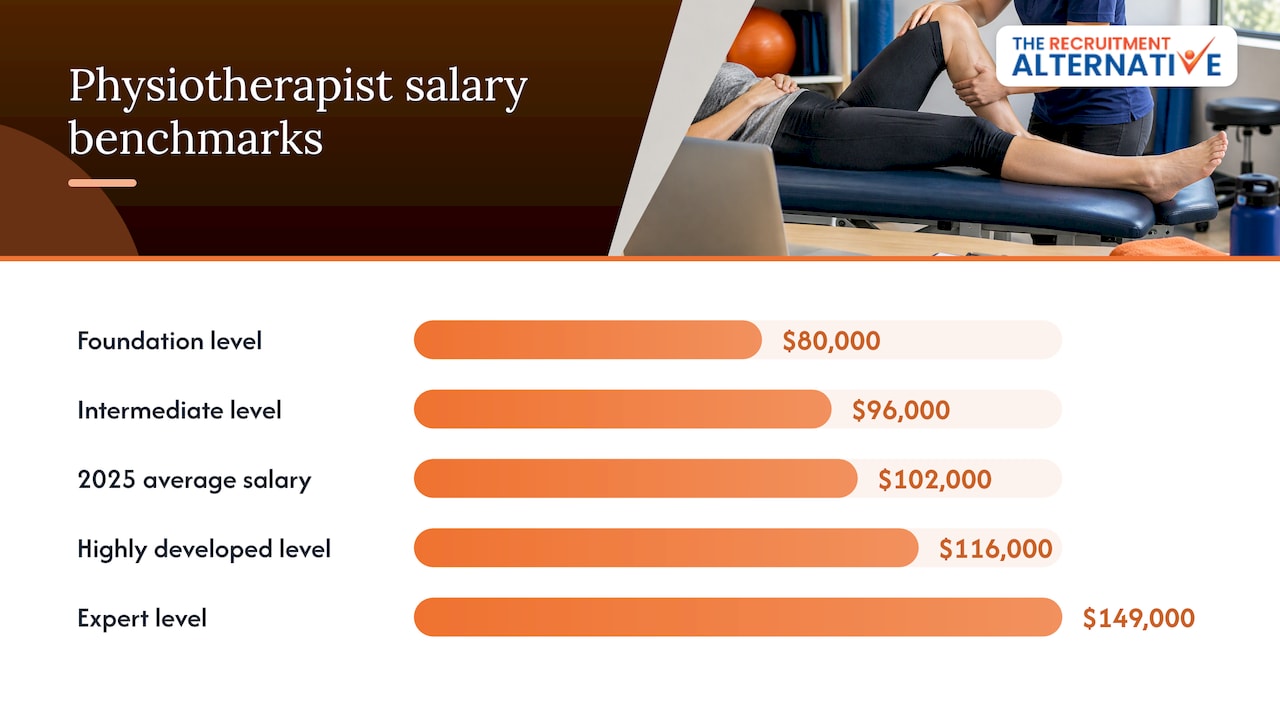
- Budget around the benchmarks: the APA’s 2025 census puts the average full-time physiotherapy salary at $102,000, with foundation-level clinicians at $80,000.
- A percentage fee rises with every salary dollar. A flat fee does not: Recruit starts at an $895 engagement fee, with a placement fee of $3,900 to $5,000.
- Replacement cover for a hire who does not work out in the first 2 to 3 months protects the investment.
Table of Contents
- Start with the role, not the advertisement
- Know the market you are hiring into
- What a physiotherapist costs: salary benchmarks
- The AHPRA check you cannot skip
- Screening and interviewing physiotherapists
- Making the offer and onboarding
- What recruiting a physio costs, and where the fee model matters
- How a fixed-fee search for a physiotherapist runs
- Perspective
- Ready to hire your next physiotherapist
- FAQ
- Sources
Start with the role, not the advertisement
Before you write an ad, business.gov.au advises employers to work out the tasks or problem the hire will address, the skills and qualifications needed, how busy the job will be and how long you need someone. Then you choose the employment type (full-time, part-time, fixed-term or casual) and check pay and conditions under the applicable award and the National Employment Standards.
For a physiotherapy clinic, that brief should answer a few specific questions:
- Caseload mix. Musculoskeletal, sports, neurological, paediatric, aged care or NDIS work each call for different experience.
- Seniority. Are you hiring a new graduate who needs supervision, or a clinician who can run a caseload and mentor others?
- Hours and rostering. Fixed hours, set rosters and control over appointments point to employment rather than a contractor arrangement. Settle that before you advertise.
- Location. Where the clinic sits shapes the candidate pool, as covered below.
Write this into a position description. It becomes the yardstick for screening, interviewing and the contract.
Employee or contractor
Many clinics assume a physio with an ABN is a contractor. Australian law looks at the substance of the relationship, not the label. A clinician who works your roster, uses your systems and brand, and is allocated your patients usually looks like an employee. If you want a permanent member of the team, hire an employee and build the offer around the award and the National Employment Standards. Take legal advice from an employment lawyer if your arrangement is unusual.
Know the market you are hiring into
The Australian Physiotherapy Association’s 2025 Workforce Census, published in April 2026, gives a useful picture of the candidate pool:
- 65% of the workforce is female, and nearly half of practitioners are under 35.
- 69% work in metropolitan areas, 15% in regional areas and 15% in rural or remote areas.
- 64% worked in private practice in 2025, up from 57% in 2023, while public hospital work fell from 16% to 13%.
- 63% of working physios were employed and 22% were self-employed, up from 19%.
Two things follow for a small clinic. First, you compete with other private practices for the same people, and many of them are young and mobile. Second, one in five is self-employed, so some strong candidates will ask about arrangements you need to be ready to answer. Know before you advertise whether you are offering a salaried position.
If your clinic is outside a capital city, the sourcing challenge is sharper. Our guide to regional recruitment in Australia covers what small employers need to plan for.
What a physiotherapist costs: salary benchmarks
Set your range before you talk to anyone. Three official or professional figures anchor it.
| Benchmark | Figure | Source |
|---|---|---|
| Median full-time earnings, physiotherapists (May 2025) | $1,888 a week, about $50 an hour | Jobs and Skills Australia |
| Average full-time salary, 2025 | $102,000, up 7.4% from 2023 | APA 2025 Workforce Census |
| Foundation level | $80,000 | APA census |
| Intermediate level | $96,000 | APA census |
| Highly developed level | $116,000 | APA census |
| Expert level | $149,000 | APA census |
Jobs and Skills Australia also reports that 72% of physiotherapists work full-time hours, averaging 41 hours a week. Superannuation and leave sit on top of these figures, so build your total employment cost from them.
The advertised pay in job boards will vary by city and by role. Use the census levels to place your own vacancy. A clinician who can run a full caseload unsupervised sits in the intermediate to highly developed bands, and offering foundation-level pay for that work is a common reason ads draw no suitable applicants.
The AHPRA check you cannot skip
Physiotherapists must be registered with the Physiotherapy Board of Australia, through AHPRA, to practise. AHPRA’s guidance for employers is direct: it is your job to check the practitioner’s registration on the online register before offering a job. The register is the only accurate source, so a certificate or printout is not enough. AHPRA also expects you to monitor registration status and any restrictions during employment, and it offers a free bulk-check service and status-change alerts through the Practitioner Information Exchange.
When you read the register entry, look for:
- the type of registration (general, limited or non-practising);
- any conditions, undertakings or notations, such as supervised practice;
- the practitioner’s name matching their identity documents.
NSW Health’s policy directive on monitoring practitioners’ compliance sets a good benchmark for any clinic: verify registration, including conditions, before the practitioner starts, check the register annually, and keep a written supervision plan for any practitioner with conditions.
International applicants
Overseas-trained physiotherapists are assessed by the Australian Physiotherapy Council before registration. The Council advises employers to ask for an APC Final Certificate and to confirm the certificate status on the AHPRA registry. All registrants must also meet five standards: English language skills, criminal history, continuing professional development, professional indemnity insurance and recency of practice, as AHPRA’s international practitioner page sets out. The Board’s registration standards page lists the current versions, including the English language requirements that changed in 2026.
Right to work
Registration shows a person may practise. It does not show they may work for you in Australia. Confirm work rights in writing before an offer. Our right to work check guide explains how.
Screening and interviewing physiotherapists
A structured process protects you from hiring on charm and gives you a defensible record.
- Score against the position description. business.gov.au recommends a matrix that rates each candidate from 1 to 5 against every role requirement. Shortlist on qualifications, fit and work rights. Do not ask unlawful personal questions about age, family or health.
- Interview with a common set of behavioural questions. NSW Health’s recruitment and selection policy suggests mapping questions to the seven key roles in the Physiotherapy Practice Thresholds: clinical reasoning, red-flag referral, ethics and consent, communication, use of evidence, teamwork and caseload management. Ask for real examples, such as a time the candidate referred a patient on because of a red flag.
- Use at least two assessment techniques. The same policy suggests combining an interview with something else. A short case discussion or a trial treatment session with a colleague works well in a clinic.
- Take referee checks and validate qualifications. Speak to people with first-hand experience of the candidate’s clinical work.
- Make a written offer to your top candidate. Keep a second or third in reserve.
Optional checks matter in a health setting. Through us, a criminal check costs $129 and a psychometric evaluation costs $199 per candidate. Both are listed on our flat fee structure page.
Making the offer and onboarding
The offer pack should include two copies of the letter of offer and contract, the position description, and the mandatory Fair Work Information Statement. employ.business.gov.au recommends giving the candidate a few days to consider and negotiate before both parties sign. Terms must meet the award and the National Employment Standards.
For a physio contract, include a duty to maintain registration and professional indemnity insurance, and a duty to tell you immediately about any condition, restriction or investigation. Since 9 April 2025, the National Law makes it an offence to include a non-disclosure clause that stops a practitioner notifying AHPRA. Have your contract reviewed by an employment lawyer.
The APA suggests structuring induction in three stages: before commencement (contract, systems, telling the team), the first days (tour, WHS briefing, job description, KPIs and probation timeframes) and the early weeks (on-the-job training and a work mentor). A new physio with a named mentor reaches a full caseload with fewer false starts, and that is the cheapest retention step you have. For more, see our notes on how to hold on to good staff.
What recruiting a physio costs, and where the fee model matters
You can advertise yourself, which costs time you may not have in a busy clinic. You can use a traditional agency, which usually charges a percentage of the new hire’s salary. Or you can use a flat-fee recruiter.
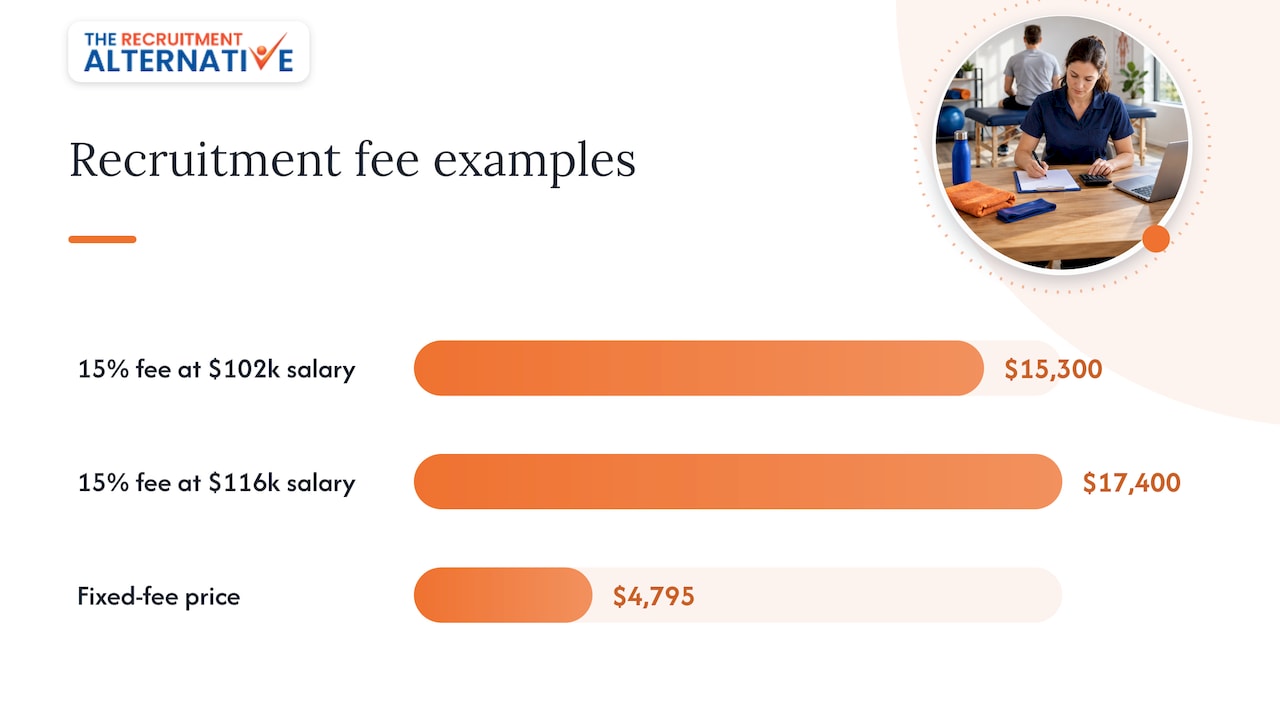
The difference is plain arithmetic. As an illustration only, a hypothetical 15% fee on the $102,000 average salary would be $15,300. On the $116,000 level it would be $17,400. The fee climbs with every pay rise you offer to win a good clinician, so a competitive salary makes the recruitment bill bigger as well.
Our fees stay fixed. They depend on the salary tier of the role, not a percentage. The published structure is:
| Service | Engagement fee | Placement fee |
|---|---|---|
| Recruit | $895 | $3,900 to $5,000 |
| Recruit+ | $2,495 | $5,000 to $6,000 |
Both are one-off amounts paid per successful permanent placement. Our headline Fixed Fee Recruitment price is $4,795 one-off. Full details are on the flat fee structure page, and our healthcare recruitment fees guide explains what you pay for healthcare roles. We claim savings of more than 70% against commission-based agencies.
For a clinic owner, a known cost per hire means you can offer the market salary a strong physio expects without the fee growing alongside it.
If a hire does not work out
Our candidate replacement insurance applies if a hire does not work out in the first 2 to 3 months. A Replacement Campaign costs $1,000 one-off, set out on the candidate replacement page. Compare that with starting again from the beginning.
How a fixed-fee search for a physiotherapist runs
We recruit permanent staff across healthcare and many other fields, working with businesses of all sizes throughout Australia and New Zealand. Our healthcare recruitment process is laid out in six stages, and our guide to recruiting healthcare workers permanently goes deeper on the permanent route.
In practice, you bring us the position description from the first section of this guide: the caseload, the seniority, the hours and the salary range. We source candidates and present a shortlist, and you run the interviews and the register check. You pay the placement fee only when you hire.
Perspective
Most clinic owners we speak to are clinicians first. They did not train to run a recruitment campaign, and they feel every hour spent away from patients.
The percentage model is the part that surprises them. A good physiotherapist costs more, so the agency fee rises too. We built a flat-fee model because the cost of finding someone should not depend on how well you pay them.
Our approach is to put the fee up front and keep it fixed, with the engagement fee and placement fee tiered by salary. Add the replacement cover for the first 2 to 3 months, and a small practice can budget a hire the same way it budgets equipment.
If you are hiring your first or fifth physiotherapist, start with the role, the salary band and the AHPRA register. Get those right and the rest is far easier.
Josh Townsend
Ready to hire your next physiotherapist
If you want permanent physiotherapy staff without a percentage fee, our Fixed Fee Recruitment service is built for small and mid-sized Australian and New Zealand employers. Send us your position description and salary range, and we will start sourcing.

The engagement and placement fees, the optional criminal check and psychometric evaluation, and the Replacement Campaign are all on our flat fee structure page.
FAQ
How do I check a physiotherapist’s registration?
Search the AHPRA online register of practitioners and read the entry yourself. AHPRA says it is the only accurate source, so a certificate or printout is not enough. Look at the registration type and any conditions, undertakings or notations, and re-check during employment.
How much should I pay a physiotherapist in Australia?
The APA’s 2025 census records an average full-time salary of $102,000. Foundation-level clinicians average $80,000, intermediate $96,000, highly developed $116,000 and expert $149,000. Jobs and Skills Australia puts median full-time earnings at about $50 an hour. Add superannuation and leave to these figures.
Should I hire a physio as an employee or a contractor?
The test is the substance of the arrangement, not whether the person has an ABN. If you set the hours, roster, branding and patient allocation, the person is likely an employee. For a permanent team member, plan an employment contract under the relevant award and take advice from an employment lawyer.
Can a flat-fee recruiter find physiotherapists?
Yes. We recruit permanent staff in healthcare among many other fields, charging a fixed engagement fee and placement fee instead of a percentage of salary. Recruit starts at an $895 engagement fee with a $3,900 to $5,000 placement fee.
Sources
- Guide to hiring employees | business.gov.au
- Interview and recruit employees | business.gov.au
- Steps to make an offer of employment | employ.business.gov.au
- Know your obligations when employing health practitioners | AHPRA
- International practitioners | AHPRA
- Registration Standards | Physiotherapy Board of Australia
- 2025 Workforce Census | Australian Physiotherapy Association
- Inducting new employees | APA
- Physiotherapists | Jobs and Skills Australia
- Trusted pathways for hiring physios | Australian Physiotherapy Council
- Monitoring and Managing Health Practitioners’ Compliance | NSW Health
- Recruitment and Selection of Staff to the NSW Health Service

