

To hire an estimator well, define the job first (trade, project type, software, tender volume), test candidates on a realistic small task, and budget for the full first-year cost rather than the salary alone. Estimators are in short supply, so the recruitment fee matters. At The Recruitment Alternative we recruit permanent staff for Australian and New Zealand businesses on a flat fee: an engagement fee of $895 and a placement fee of $3,900 to $5,000 on our Recruit service, rather than a percentage of the salary.
TL;DR
- Write a role description that names the trade, project type, estimating software, bid volume and level of client contact. Generic ads attract generic applicants.
- There is no single mandatory qualification in Australia. Look for a trade, building or quantity surveying background plus proven tender pricing on jobs like yours.
- Test every finalist on the same realistic small task, and judge how they think, not only the final number.
- Published salary benchmarks for estimators range from about $90,000 to well over $150,000 depending on city, sector and seniority, so budget for the whole package.
- A flat-fee recruiter keeps the cost of the hire predictable: the fee does not climb with the salary you offer.
Table of Contents
- What kind of estimator do you actually need?
- Write the role description before the advert
- Qualifications and experience to look for
- What an estimator costs in Australia
- Where to find estimators
- How to assess an estimator
- A sensible hiring sequence
- What flat-fee recruitment looks like for an estimator hire
- Our view on hiring estimators
- Ready to hire an estimator?
- FAQ
- Sources
What kind of estimator do you actually need?
The word “estimator” covers several jobs. The Australian Bureau of Statistics describes the Construction Estimator occupation as preparing and delivering estimates and cost plans for construction projects up to tender settlement. The main tasks include reviewing plans and specifications, visiting sites, negotiating quotes with suppliers and subcontractors, and presenting cost plans to clients.
In practice, that splits into a few profiles:
- Contractor-side tender estimator. Procore’s overview notes that in Australia estimators usually focus on tender pricing and cost certainty on the contractor side, while quantity surveyors are more often client-side or in consultancies.
- Trade or residential estimator. Prices from plans, supplier quotes and your own cost history for builders, renovators and trade businesses.
- Commercial or civil estimator. Handles larger packages, subcontractor levelling, risk and contingency, and tender assembly.
- Estimating manager. Runs a team and the bid pipeline. This is a leadership hire, closer to an executive search.
Match the profile to your work. A high-volume project home builder needs different strengths from a bespoke custom builder, as Campbell Estimating observes. If you are unsure whether you need an estimator or a project engineer, our guide to project engineer hiring helps separate the two roles.
Write the role description before the advert
A strong estimator brief states the trade, the project type, the software, the expected bid volume, the deliverables, the deadline style and the amount of client contact, according to a contractor hiring guide from QuantifyNA. That is the checklist to work from, and each line saves interview time later.
A useful brief answers these questions:
- What do you price: residential, commercial, civil, a single trade?
- How many tenders or quotes a month, and what is the typical value?
- Which takeoff and estimating platforms do you use?
- Does the estimator talk to clients, or only produce numbers for you?
- What is already in place: cost library, templates, job cost history?
That last point matters. Tenfold Coaching recommends having standardised quoting templates, a cost library, job cost history and clear approval workflows in place before the new estimator starts. A new hire with good tools is productive sooner.
Qualifications and experience to look for
There is no single licence that makes someone an estimator. Master Builders Australia’s career guide says construction estimators usually hold a Diploma or Advanced Diploma through the VET system, and may have a tradesperson or building background. Quantity surveyors are typically university educated, for example with a Bachelor of Construction Management and Property. The Australian Institute of Quantity Surveyors (AIQS) is the pathway to becoming a Certified Quantity Surveyor.
For skills assessment purposes, VETASSESS lists Construction Estimator as requiring an AQF Diploma or higher. That is a useful reference point if you are considering an overseas candidate, but treat it as a guide, not a hiring rule.
Employers set the bar differently depending on the job. TasWater’s Senior Estimator position description asks for a relevant degree or equivalent, experience estimating complex capital works, first-principles estimating and benchmarking, and digital estimating software skills. ElectraNet’s Senior Project Estimator description makes a tertiary qualification essential, and lists seven years’ experience and White Card training as desirable. A small builder rarely needs that formality, but both documents show how to separate essential from desirable requirements.
For most small and mid-sized businesses, the best predictor is experience pricing work like yours, in the software you use. EstimateOne’s overview of the role says estimators need in-depth knowledge of materials, building methods, market prices and regulatory standards, plus the ability to build relationships with vendors and trade partners.
What an estimator costs in Australia
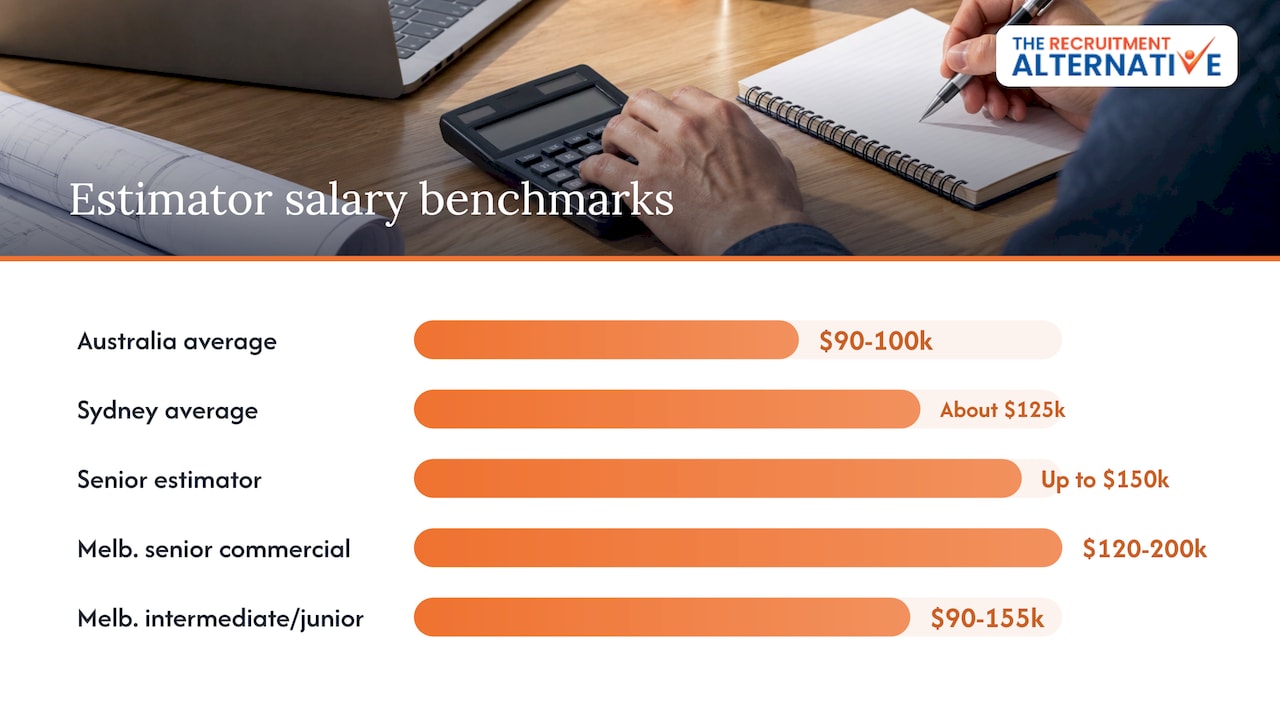
Salary figures vary widely by source, city and sector, so read them as ranges and check the latest edition of any guide.
| Benchmark | Figure | Source |
|---|---|---|
| Average building estimator salary, Australia | $90,000 to $100,000 | EstimateOne |
| Sydney average | About $125,000 | EstimateOne |
| Senior estimator | Up to $150,000 | EstimateOne |
| Melbourne senior commercial estimator, Hays FY25-26 | About $155,000 (range $120,000 to $200,000) | Tenfold Coaching, citing Hays |
| Melbourne intermediate or junior commercial estimator | About $100,000 (range $90,000 to $155,000) | Tenfold Coaching, citing Hays |
| Melbourne residential senior / junior | About $110,000 / $80,000 | Tenfold Coaching, citing Hays |
Salary is only part of it. Add superannuation, leave and leave loading, workers compensation, payroll tax where your wages exceed the state threshold, software licences and the recruitment fee. Our 2026 breakdown of the cost to hire an employee in Australia walks through those on-costs line by line.
The recruitment fee is the part you can control. With a percentage-based agency, the fee rises with the salary. On a $110,000 estimator, a 20% fee would be $22,000 (an illustration of the arithmetic, not a quote). With our flat-fee model, the fee is set by the service tier and the candidate’s salary band, not by a percentage.
Where to find estimators
Estimators are a small pool. EstimateOne reports about 7,000 building estimators servicing the whole Australian construction industry, and Build Australia’s reporting on the 2025 Occupation Shortage List shows quantity surveying is in shortage in every state and territory. Our overview of the Australian skills shortage explains why good people are often employed and not browsing job boards.
Channels that work:
- Your own network. Master Builders Australia’s guide notes many construction businesses recruit by word of mouth and interview rather than written applications. Ask subcontractors, suppliers and your accountant.
- Job boards. Good for reach, but expect a stack of applications from people who have not priced your type of work.
- A recruiter who approaches people directly. This reaches estimators who are not actively applying, and screens before you spend time.
A fixed-fee recruiter suits a small business because the cost is known before the search begins. Our budget recruitment for construction page explains how that works for builders and trade businesses.
How to assess an estimator
Test thinking, not only the number
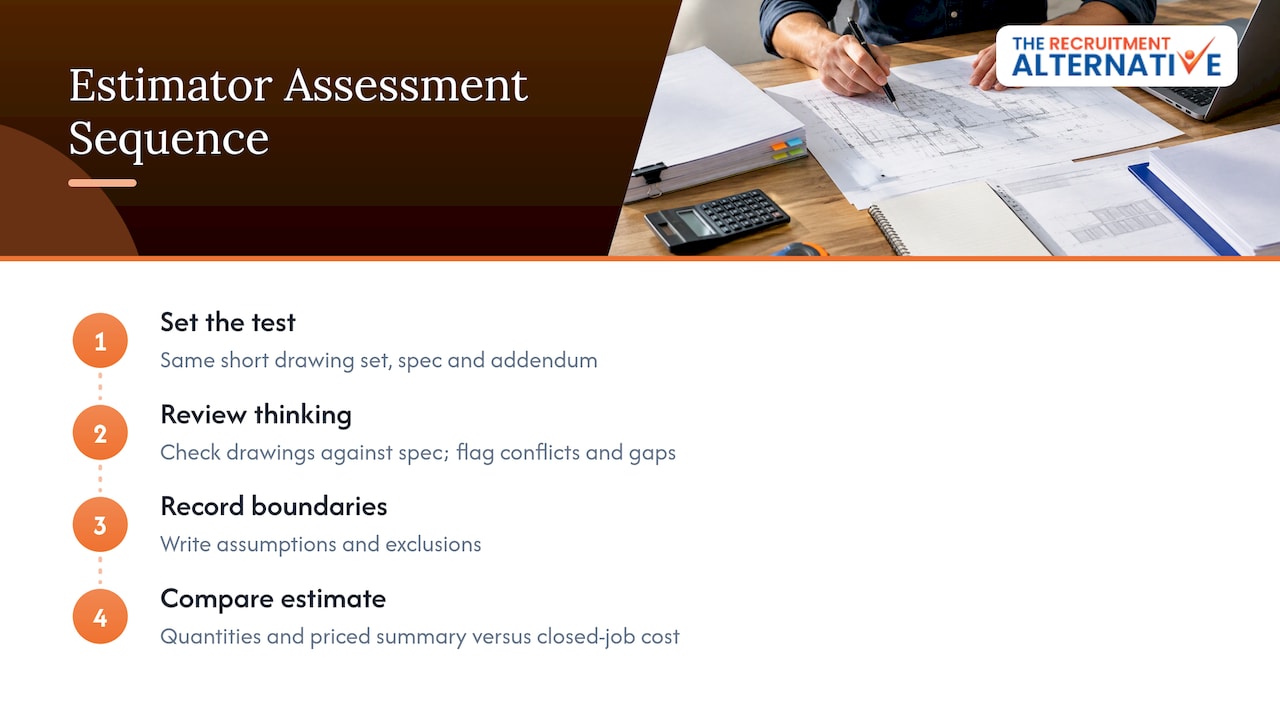
The fairest test is a realistic small project: a small drawing set, one specification section and an addendum. QuantifyNA’s guide says to review how the candidate thinks: did they check drawings against the spec, catch conflicts, flag missing information and write their assumptions clearly?
Keep the test short and identical for every finalist. If it runs long or asks for a full estimate, pay for the time. Compare quantities, a priced summary and written assumptions and exclusions against a closed job where you know the real cost.
Ask scope and rate questions
Good questions are specific to your work:
- Tell me about a scope gap you found that would have cost the builder money. How did you spot it and how did you handle it in the price?
- How do you build a rate for something you have not priced before?
- How do you decide on waste, productivity loss and contingency?
Ask for a sample quote
Campbell Estimating suggests asking to see a sample quote or scope document, because the way someone presents numbers to a client says more about their communication than a conversation does. It also suggests checking fluency in the platforms you use, such as Buildxact or Wunderbuild, and how steady the candidate stays when scope changes.
Check the person, not just the CV
On our Recruit and Recruit+ services you can add a psychometric evaluation at $199 per candidate and an optional criminal check at $129. Both give you more to go on before an offer. Reference checks with previous employers should still confirm the jobs and tender values the candidate claims.
A sensible hiring sequence
- Confirm you are ready. Tenfold Coaching lists signs such as quoting 15 to 20 or more jobs a month, rising project complexity, stable job types, historical cost data and known target margins.
- Write the brief using the questions above, and set a salary range from current benchmarks.
- Prepare your systems: templates, cost library, approval workflow, software access.
- Source widely, through your network and a recruiter who approaches estimators directly.
- Screen on pricing experience similar to your work, then run the same test for each finalist.
- Interview with a scorecard. Score takeoff accuracy, pricing judgement, bid management, risk, software and communication straight after each interview.
- Check references and make the offer promptly. Good estimators receive several approaches.
- Plan the first 90 days, with a live tender priced alongside you.
Much of the time sink sits in steps 4 and 5. It also helps to protect your new estimator’s time: if tenders are priced in the same hours the phone is ringing, an option such as an AI receptionist for contractors can keep calls away from the estimating desk.
What flat-fee recruitment looks like for an estimator hire
Our pricing is published and tiered by the candidate’s salary. Each service has an engagement fee to start and a placement fee when you hire.
| Service | Engagement fee | Placement fee |
|---|---|---|
| Recruit | $895 | $3,900 to $5,000 |
| Recruit+ | $2,495 | $5,000 to $6,000 |
Our Fixed Fee Recruitment service is listed at $4,795. If a hire does not work out in the first two to three months, our candidate replacement insurance applies, and a replacement campaign is $1,000. See the full flat-fee price structure and the replacement terms.
We recruit across construction-related roles including engineering, management, trades and technology, for businesses of all sizes across Australia and New Zealand. For estimator searches in particular, if you want to see how the engineering side works, read our guide to engineering recruitment fees in Australia.
Our view on hiring estimators
Most small builders and trade businesses we speak to do not struggle to write an estimator’s job description. They struggle with the price of finding someone. A percentage fee on a $120,000 salary turns a single hire into a five-figure decision before the new estimator has priced a job.
We built our model on the opposite idea: a published engagement fee, a published placement fee, and no percentage of salary. Our own positioning is that this delivers savings of more than 70% against traditional commission-based agencies, and it lets you put the money saved into the things that make an estimator effective: software, a proper cost library and a fair salary.
Our advice is to define the role tightly, test on real work, and keep the recruitment fee fixed so the budget goes to the person, not the agency.
Josh Townsend
Ready to hire an estimator?
If you have your brief and salary range, we can start the search on a fixed fee. Our Fixed Fee Recruitment service is $4,795, and the Recruit and Recruit+ services start with an engagement fee of $895 and $2,495 respectively. Start at The Recruitment Alternative or compare the options on the flat-fee price page.

FAQ
Do I need a quantity surveyor or an estimator?
In Australia, estimators usually price tenders for contractors, while quantity surveyors more often work for clients or consultancies. If you are a builder or trade business winning work by tender, an estimator is usually the closer fit. Master Builders Australia notes that cost estimator and cost planner titles also sit within the quantity surveying profession, so read the candidate’s actual experience, not just the title.
How long does it take to hire an estimator?
It depends on the role and location, and senior estimators in major cities are in demand. Preparing the brief, systems and salary range before you advertise is the part you control, and it shortens the search.
What should I pay an estimator?
Benchmarks vary: EstimateOne reports an average of $90,000 to $100,000 nationally and about $125,000 in Sydney, and Hays figures cited for Melbourne run higher for senior commercial roles. Check the latest salary guide for your city and sector, then add superannuation, leave and other on-costs.
What if the estimator does not work out?
Our candidate replacement insurance covers hires that do not work out in the first two to three months. A replacement campaign is $1,000.
Sources
- Occupation 312331 Construction Estimator, Australian Bureau of Statistics
- Construction Estimator, VETASSESS
- Construct Your Career, Master Builders Australia
- Senior Estimator position description, TasWater
- Senior Project Estimator position description, ElectraNet
- The role of the Estimator, EstimateOne
- Construction Estimator: Essential Skills and Career Path, Procore
- Finding Qualified Estimators: Contractor Hiring Guide, QuantifyNA
- 5 Key Factors to Consider When Hiring a Construction Estimator, Campbell Estimating
- Hiring an Estimator: Advice from a Business Coach, Tenfold Coaching

