

A job board is an online two-sided marketplace where employers post vacancies and job seekers search, filter, and apply — all in one place. If you’re a job seeker, your immediate next step is to set targeted alerts on one or two boards and prioritise listings posted within the last 48 hours. If you’re an employer, your first decision is whether to post manually to a destination board or distribute programmatically across multiple sites, and which pricing model suits your hiring volume.
The most common board categories you’ll encounter in Australia:
- Generalist boards (Seek, Indeed, LinkedIn) — broad reach across industries and role types
- Niche or industry boards (healthcare, engineering, technology verticals) — lower applicant volume, higher relevance
- Aggregators (Jora, Adzuna) — pull listings from multiple sources into one searchable index
- Company career pages — direct postings on an employer’s own website, often feeding into their applicant tracking system (ATS)
Key takeaways
Job boards are two-sided marketplaces connecting employers and candidates; using them well means choosing the right board type, applying early, and combining board activity with direct outreach and proactive sourcing.
| Point | Details |
|---|---|
| Apply within 48 hours | Applications submitted in the first 48 hours of a listing going live consistently receive more attention from employers. |
| Choose board type deliberately | Generalist boards suit broad hiring; niche boards reduce competition for specialised roles; aggregators extend reach automatically. |
| Programmatic can cut costs | Industry analysis suggests programmatic job advertising can reduce recruitment costs by roughly 25–50% versus flat-fee postings for high-volume campaigns. |
| Salary transparency lifts results | Listings that disclose a salary range attract more applications and a higher proportion of suitable candidates. |
| Boards have limits | Ghost postings, ATS filtering, and high applicant volume are real constraints; a flat-fee recruiter adds value when role complexity or time pressure is high. |
Table of Contents
- How job boards fit into the hiring ecosystem
- How job boards work behind the scenes
- What types of job boards should you use?
- How job seekers can use job boards effectively
- How employers post and manage vacancies on job boards
- Programmatic job advertising versus manual posting
- How job boards differ from aggregators and company career pages
- Benefits and limitations of job boards for both audiences
- Typical posting durations and pricing in Australia
- Your quick-reference checklist for job seekers and employers
- What job boards do with your data and how to protect it
- How job boards handle candidate screening and application tracking
- Mobile and app-based job searching: what you need to know
- How AI and emerging technology are changing job boards
- How to stand out on job boards when competition is high
- What support and dispute resolution do job boards offer?
- When job boards alone aren’t enough: a recruiter’s perspective
- Sources
How job boards fit into the hiring ecosystem
A job board is an online platform where employers list vacancies and job seekers search and apply, with boards commonly offering resume databases and employer branding pages alongside the core listing function. That definition is straightforward, but the platform’s role in a hiring strategy is more nuanced.
Job boards operate as destination platforms (candidates come to them directly) or as distribution channels (postings are pushed out to them from an employer’s ATS or programmatic platform). Most large Australian boards, including Seek and Indeed, function as both. Seek, for instance, is Australia’s dominant destination board, drawing active candidates who search with intent. LinkedIn straddles destination and professional network, making it particularly effective for management, technology, and executive roles.
Key terms worth knowing:
- Poster — the employer or recruiter who creates and pays for a listing
- Applicant — the job seeker who responds to a listing
- Listing — the individual job advertisement, including role details, salary (where disclosed), and application instructions
- ATS integration — a connection between the board and the employer’s applicant tracking system so applications flow directly into the employer’s workflow
Job boards centralise postings from multiple employers and let candidates filter by location, salary, and job type. That centralisation is their core value: one search surfaces roles from dozens of employers simultaneously. Where they differ from aggregators is origin — a destination board hosts original listings created on its platform, while an aggregator scrapes or syndicates listings from elsewhere.
How job boards work behind the scenes
Understanding the mechanics helps both job seekers and employers get better results from the same platform.
Indexing and search ranking
When an employer publishes a listing, the board’s indexing engine reads the title, description, location, salary, and category fields. Search results are then ranked by a combination of keyword relevance, recency, and paid visibility. Modern job boards increasingly combine semantic search with keyword scoring to surface relevant roles even when a candidate’s search terms differ from the employer’s language — so a search for “people and culture manager” may surface listings titled “HR manager” or “talent acquisition lead.”
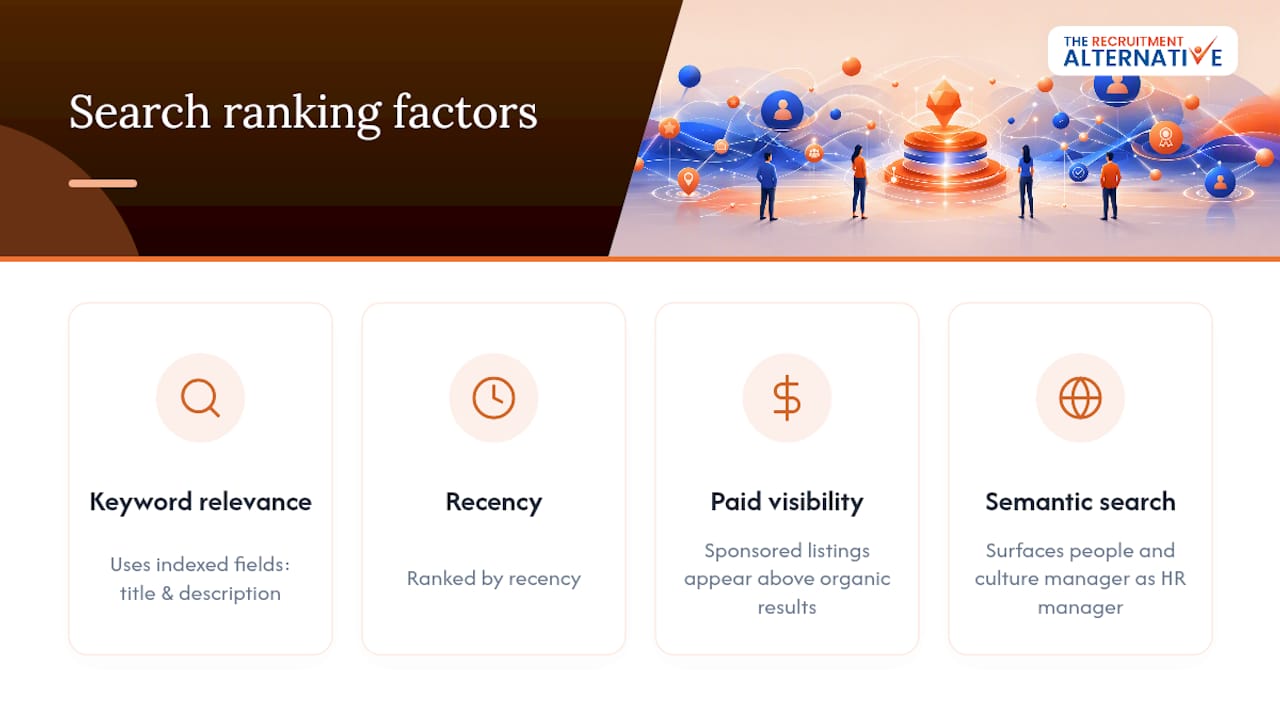
Sponsored or featured listings appear above organic results. On Seek, for example, employers can pay for premium placement that keeps their listing visible even as newer posts arrive.
Application flow
Once a candidate clicks “Apply,” one of three things happens:
- On-board application — the candidate submits a resume and cover letter directly within the board’s interface; the employer receives it via the board’s dashboard
- Redirect to career site — the candidate is sent to the employer’s own website or ATS to complete the application there
- ATS integration — the board passes application data directly into the employer’s system (Workday, PageUp, Greenhouse, and similar platforms are common in Australian enterprise hiring)
The application route matters. Redirecting to an ATS can introduce drop-off if the process is lengthy, but it gives employers cleaner data and a single source of truth for candidate tracking.
Resume databases and analytics
Most major boards maintain a searchable resume database. Employers pay for access — either as part of a subscription or as an add-on — and can proactively search for candidates rather than waiting for applications. Seek Talent Search and LinkedIn Recruiter are the two most widely used tools in Australia for this purpose.

Analytics dashboards show employers how many candidates viewed a listing, the click-through rate to the application, and where drop-off occurs. AI resume screening tools can further filter inbound applications before a recruiter reviews them manually.
Pro Tip: If your listing is getting views but few applications, the problem is usually the job description itself — salary transparency, clear must-have criteria, and a concise role summary consistently improve conversion from view to apply.
What types of job boards should you use?
Guides recommend prioritising niche boards for specialised roles because they surface lower-competition, higher-quality postings. The right board type depends on your goal.
| Board type | Best for | Typical pricing model | Reach | Key features | Application flow | Programmatic suitability |
|---|---|---|---|---|---|---|
| Generalist (Seek, Indeed, LinkedIn) | Broad hiring across industries | Flat fee per listing or subscription | Very high | Resume database, alerts, company pages, analytics | On-board or ATS redirect | High |
| Niche/industry vertical | Specialised roles (tech, health, trades) | Flat fee or subscription | Targeted | Sector-specific filters, community features | Usually on-board | Moderate |
| Aggregator (Jora, Adzuna, CareerOne) | Broad reach via syndication | CPC or free (aggregated) | High | Consolidated search, alerts | Redirect to source board or career page | High |
| Company career page | Employer brand, direct ATS entry | No listing fee (internal cost) | Low (direct traffic only) | Full brand control, direct ATS | Direct ATS entry | Low |
Choosing the right type — decision cues:
- Use a generalist board when you need volume and your role suits a broad candidate pool
- Use a niche board when the role requires specific credentials or sector experience
- Use an aggregator when you want maximum distribution with minimal manual effort
- Use your career page as the primary record, then syndicate outward to boards for reach
- Combine two or three board types rather than relying on one channel alone
How job seekers can use job boards effectively
A structured approach to job boards consistently outperforms random browsing. Focusing on 2–3 boards, saving searches, using advanced filters, and applying within the first 48 hours are the habits that separate efficient job seekers from those who spend hours with little return.
Step-by-step routine
-
Set up your profile and upload your resume. Use keywords from real job descriptions in your target field — boards match your profile against listings, so generic language reduces your visibility. Check your privacy settings: most boards let you hide your profile from your current employer’s account.
-
Run your first searches with tight filters. Filter by location, job type (full-time, part-time, contract), and salary range. On Seek and Indeed, the “title only” filter narrows results to listings where your search term appears in the job title itself, cutting noise significantly.
-
Save your searches and activate alerts. Set alerts to deliver new listings by email or push notification, ideally daily. Configure two or three slightly different saved searches to catch variations in job title wording — “marketing coordinator” and “marketing assistant” may surface different listings.
-
Apply early. Applications submitted in the first 48 hours of a listing going live receive disproportionately more attention. Listings older than 30–45 days often have reduced active screening, and some may no longer be genuinely open.
-
Decide where to apply. If a listing redirects you to an employer’s career page, apply there rather than through the board where possible. Direct applications enter the ATS cleanly and avoid the risk of data being lost in transit. Understanding how AI in the job market affects candidate preparation can help you tailor your resume for ATS screening.
-
Track every application. A simple spreadsheet with the role title, employer, date applied, board used, and current status prevents duplicate applications and helps you follow up at the right time.
-
Spot and avoid scams. Legitimate postings include a named employer (or a named recruiter agency), a specific role description, and a clear application process. Be cautious of listings with no salary range, vague duties, requests for personal financial information, or contact addresses that don’t match the employer’s domain.
Pro Tip: Practical career guidance consistently recommends combining board use with direct networking and company career page monitoring. Boards are research tools as well as application channels — use them to identify target employers and salary benchmarks, then follow up via LinkedIn or a direct email to the hiring manager.
How employers post and manage vacancies on job boards
Employers interact with job boards through a workflow that starts well before the listing goes live.
Account and company profile setup is the foundation. A complete company profile — logo, description, culture statement, and links — increases application rates because candidates research employers before applying. On Seek and LinkedIn, an incomplete company page is a visible gap that reduces credibility.
Writing the listing is where most employers lose candidates. The fields that matter most are:
- Job title (use the market-standard title, not an internal one)
- Salary or salary range (disclosed salary consistently attracts more applications)
- Clear responsibilities and must-have criteria (three to five, not fifteen)
- Location and work arrangement (on-site, hybrid, remote)
- Application instructions and closing date
Visibility upgrades include sponsored placements, featured listings, and social distribution (LinkedIn’s “Boost” feature, for example). Resume database access — Seek Talent Search, LinkedIn Recruiter — lets employers search proactively rather than waiting for inbound applications. Candidate databases can significantly reduce time-to-hire when inbound volume is low.
Pricing models employers encounter in Australia:
| Model | How it works | Typical use case |
|---|---|---|
| Flat fee per listing | Fixed price per posting, regardless of applications received | Standard Seek or Indeed post |
| Subscription | Monthly or annual fee for a set number of postings or unlimited access | High-volume hirers |
| Cost-per-click (CPC) | Employer pays each time a candidate clicks the listing | Programmatic distribution |
| Cost-per-application (CPA) / pay-per-apply | Employer pays only when a completed application is received | Performance-based campaigns |
Metrics to monitor:
- Cost per applicant — total spend divided by number of applications received
- Click-through rate — percentage of candidates who viewed the listing and clicked to apply
- Time to hire — days from listing going live to offer accepted
- Application quality rate — percentage of applicants who meet the minimum criteria
Programmatic job advertising versus manual posting
Programmatic job advertising distributes listings automatically across multiple boards and channels, adjusting spend in real time based on performance data. Manual posting means placing a listing on one or more boards individually, paying a flat fee or subscription for each.
Industry analysis finds programmatic job advertising can reduce recruitment costs by roughly 25–50% compared with traditional flat-fee postings, by concentrating spend where applications are actually converting. The trade-off is complexity: programmatic campaigns require monitoring, budget management, and some technical setup.
When programmatic distribution makes sense:
- High-volume hiring (10 or more similar roles simultaneously)
- Multi-region campaigns where manual posting to each local board is impractical
- Hard-to-fill roles where you need maximum reach across niche and generalist boards
- When you want performance data to inform future spend decisions
When manual posting is the better fit:
- Single or low-frequency roles where the setup cost of a programmatic campaign outweighs the benefit
- Roles where a specific board (Seek for most Australian roles, LinkedIn for professional/executive) is clearly the right channel
- Employers who prefer predictable, fixed costs per hire
Employers should treat programmatic distribution as an optimisation layer within a multi-channel strategy, not a replacement for destination boards. A listing on Seek still captures active candidates who search with intent; programmatic extends reach to passive candidates across additional channels.
Pro Tip: Test a small programmatic campaign on a role you’ve already filled manually. Compare cost per applicant and application quality before scaling the approach across your hiring programme.
How job boards differ from aggregators and company career pages
The three channels route applications differently, and confusing them leads to duplicated effort or missed candidates.
Aggregators (Jora, Adzuna, CareerOne) do not host original listings. They index and pull listings from destination boards, employer career pages, and other sources. A candidate searching on Jora may see the same listing that originated on Seek — clicking it typically redirects them to the source. Implications:
- Duplicate listings can appear across aggregators if the same role is posted on multiple source boards
- Applying via an aggregator usually means being redirected to the original board or the employer’s ATS
- Aggregators are useful for candidates who want a single search across many sources; for employers, they extend reach without additional posting effort
Company career pages sit outside the board ecosystem entirely. Employers control the brand experience, the application form, and the ATS entry point. For candidates, applying directly via a career page often means your application enters the employer’s system without passing through a third-party board’s data layer. That can improve visibility in some ATS configurations. The limitation is discoverability — career pages rely on candidates already knowing the employer or finding the listing via Google for Jobs or an aggregator.
Application routing summary:
- Destination board (Seek, Indeed, LinkedIn) → on-board apply or redirect to employer ATS
- Aggregator (Jora, Adzuna, CareerOne) → redirect to source board or employer career page
- Company career page → direct ATS entry, full employer brand control
Benefits and limitations of job boards for both audiences
Benefits
For job seekers:
- Access to thousands of current listings in one place, filterable by location, salary, and role type
- Passive discoverability via resume databases — employers can find you without you applying
- Salary benchmarking: browsing listings reveals what the market pays for your skills
- Automated alerts reduce the time spent actively searching
For employers:
- Broad reach to active candidates quickly, often within hours of posting
- Employer branding exposure even when candidates don’t apply
- Resume database access for proactive sourcing of passive candidates
- Analytics data to measure listing performance and refine job descriptions
Limitations and mitigations
- Ghost postings — listings that remain active but are no longer being filled. Mitigation: deprioritise listings older than 45 days; send a brief verification message to the listed contact before investing time in a tailored application.
- High applicant volume — popular listings on Seek or Indeed can attract hundreds of applications, making it harder for individual candidates to stand out. Mitigation: apply early, tailor your resume to the listing’s specific language, and apply directly via the employer’s career page where possible.
- ATS filtering — many resumes are screened automatically before a human reviews them. Mitigation: mirror the language of the job description in your resume; avoid tables, headers, and graphics that ATS software may not parse correctly.
- Noise for employers — high application volume includes many unsuitable candidates. Mitigation: use screening questions in the listing, set clear must-have criteria, and use resume database searches to supplement inbound applications.
Privacy and data use
Job boards collect significant personal data: resume content, search behaviour, application history, and sometimes salary expectations. Before uploading your resume, check the platform’s privacy policy for how long data is retained, whether it is shared with third parties, and how to request deletion. On Seek and LinkedIn, you can control who sees your profile and limit visibility to specific employer types. Employers should also review their obligations under the Australian Privacy Act 1988 when handling candidate data collected via board integrations.
Typical posting durations and pricing in Australia
Posting durations on Australian job boards generally run 30–90 days, though the effective window is shorter. Most applications arrive in the first two weeks of a listing going live; after 30 days, application rates typically decline sharply as the listing drops in search rankings and candidates assume the role may be filled.
Practical timeline advice for applicants:
- Apply within the first 48–72 hours of a listing appearing for the best chance of early-stage screening
- Treat listings older than 30–45 days with caution; they may still be open, but active screening is often reduced
- Use the posting date filter on Seek and Indeed to surface only recent listings
Indicative pricing for Australian employers (illustrative ranges — confirm current rates directly with each platform):
Pricing on Seek and LinkedIn changes periodically; always confirm current rates on the platform directly. For employers weighing the cost of multiple postings against a fixed-fee recruitment model, The Recruitment Alternative’s simple flat-fee pricing structure offers a predictable alternative, where you pay per successful permanent placement rather than per listing.
Your quick-reference checklist for job seekers and employers
Job seekers
- Upload a keyword-optimised resume and set privacy controls on each board
- Focus on 2–3 boards rather than spreading effort across ten
- Set daily alerts with tight filters and “title only” search where available
- Apply within 48 hours of a listing going live
- Track every application in a spreadsheet to avoid duplicates and manage follow-ups
- Combine board applications with direct outreach via company career pages and LinkedIn
- Verify listings older than 30 days before investing time in a tailored application
Employers
- Write a clear job brief before posting: title, salary, must-haves, work arrangement
- Choose your pricing model: flat fee for single roles, subscription for high volume, CPC/CPA for programmatic reach
- Complete your company profile on each board before the listing goes live
- Monitor cost per applicant, click-through rate, and application quality weekly
- Use resume database searches to supplement inbound applications for hard-to-fill roles
- Test a small programmatic campaign before committing to large-scale distribution
Decision one-liner: If you’re filling one or two roles per quarter, a flat-fee listing on Seek or Indeed is usually sufficient. For high-volume or hard-to-fill roles, consider programmatic distribution or a flat-fee recruitment partner who manages sourcing, screening, and placement for a fixed cost.
What job boards do with your data and how to protect it
Job boards are data businesses as much as they are hiring platforms. When you upload a resume or create a candidate profile, the platform stores your contact details, employment history, skills, and behavioural data (which listings you viewed, how long you spent on each, whether you applied). This data is used to improve search matching, serve targeted advertising, and, in some cases, share aggregated insights with employers or third-party partners.
For job seekers, practical steps to protect your data:
- Read the privacy policy before creating an account — look specifically for data retention periods and third-party sharing clauses
- On Seek, use the “profile visibility” setting to limit who can find your resume; select “recruiters only” or “hidden” if you’re in a sensitive role
- On LinkedIn, review your “data privacy” settings and disable “allow LinkedIn to use your data for training” if that option is available
- Request data deletion when you’re no longer actively searching; most Australian boards are required to comply under the Privacy Act 1988
For employers, handling candidate data collected via board integrations carries obligations under the Australian Privacy Act 1988. Candidate information should be stored securely, used only for the purpose it was collected, and deleted or de-identified when no longer needed. If your ATS receives data from a board integration, confirm that the integration is compliant and that your data retention policy covers third-party-sourced candidate records.
How job boards handle candidate screening and application tracking
Most job boards offer at least basic screening tools built into the listing workflow. Employers can add screening questions — typically three to five yes/no or short-answer questions — that candidates must answer before their application is submitted. Boards like Seek and Indeed use these responses to flag applications that don’t meet minimum criteria, reducing the volume of unsuitable candidates reaching the employer’s inbox.
Beyond screening questions, the application tracking function varies significantly by board. Seek’s employer dashboard lets recruiters move applications through stages (new, reviewed, shortlisted, rejected) and send templated responses. Indeed’s ATS-lite interface offers similar functionality. LinkedIn’s hiring tools integrate more deeply with its professional network, allowing recruiters to view a candidate’s full profile, mutual connections, and activity alongside the application.
For employers using a dedicated ATS (PageUp, Workday, Greenhouse, Lever, and similar platforms), the board’s built-in tracking is usually bypassed in favour of the ATS workflow. Applications flow from the board into the ATS via an integration, and all candidate communication, interview scheduling, and offer management happens within the ATS. This is the standard approach for mid-size and enterprise employers in Australia.
AI resume screening adds another layer: automated tools can rank inbound applications by relevance before a recruiter opens a single resume, which is particularly useful when a listing attracts several hundred applications. The risk is that poorly configured screening criteria can filter out strong candidates whose resumes use different terminology — another reason for job seekers to mirror the language of the job description closely.
Mobile and app-based job searching: what you need to know
The majority of job searches in Australia now begin on a mobile device. Seek, Indeed, LinkedIn, Jora, and Adzuna all offer dedicated iOS and Android apps with near-full feature parity to their desktop versions. For job seekers, the apps add genuine convenience: push notifications for new listings matching saved searches, one-tap application for roles where a pre-loaded profile is sufficient, and the ability to research employers on the go.

The practical limitation of mobile applying is resume quality. Uploading a freshly formatted resume from a phone is awkward, and quick-apply features that use a pre-loaded profile can result in a generic application that doesn’t address the specific role. For roles you’re genuinely interested in, take the time to apply from a desktop with a tailored resume and cover letter.
For employers, mobile-optimised job listings and application flows matter because a listing that renders poorly on a phone loses candidates before they read the role description. Seek and Indeed automatically optimise listings for mobile display, but employer-hosted career pages vary in quality. If your career page redirects candidates to a multi-step ATS form that isn’t mobile-friendly, expect drop-off.
How AI and emerging technology are changing job boards
AI is reshaping job board functionality at both the search and matching layers. Semantic search, now standard on Seek, Indeed, and LinkedIn, means the platform interprets the intent behind a search query rather than matching exact keywords. A candidate searching “project delivery manager” may see listings for “programme manager” or “delivery lead” roles that the algorithm judges as relevant based on skills and context.
AI-powered matching goes further: some boards now proactively suggest roles to candidates based on profile data, application history, and behavioural signals, without the candidate running a search at all. LinkedIn’s “Jobs You May Be Interested In” and Seek’s recommended listings are both driven by this logic.
Chatbots and automated messaging are increasingly used for initial candidate engagement. After a candidate applies, an automated message may ask clarifying questions, schedule a screening call, or provide status updates — reducing the manual workload for recruiters while keeping candidates informed. The quality of these interactions varies; well-configured chatbots improve the candidate experience, while poorly scripted ones frustrate applicants.
For employers, AI’s broader impact on recruitment extends beyond job boards to candidate sourcing, resume analysis, and predictive hiring. Understanding where AI assists and where human judgement remains critical is increasingly important for hiring managers.
How to stand out on job boards when competition is high
High-competition listings on Seek or Indeed can attract hundreds of applications within days. Standing out requires deliberate choices at every step.
For job seekers:
- Tailor your resume to each listing rather than submitting a generic document. Mirror the exact language of the job description, particularly for skills and qualifications listed as must-haves.
- Apply early. Applications submitted in the first 24–48 hours are more likely to be reviewed before the employer reaches screening fatigue.
- Write a concise, specific cover letter that addresses the role’s key requirements directly. Generic cover letters are easy to identify and easy to discard.
- If the listing includes screening questions, answer them fully and specifically. Vague answers to screening questions are a common reason for early rejection.
- Consider applying via the employer’s career page rather than the board, particularly for roles where the listing redirects to an ATS. Direct applications sometimes receive different weighting in ATS ranking algorithms.
For employers:
- Salary transparency consistently increases application volume and quality. Listings without a salary range attract fewer applications and a higher proportion of unsuitable ones.
- A clear, concise job description with three to five genuine must-have criteria outperforms a lengthy list of desirable attributes. Candidates self-select more accurately when expectations are clear.
- Respond to applications promptly. Candidates in active job searches apply to multiple roles simultaneously; slow response times result in offer losses to faster-moving employers.
- Use resume database searches alongside inbound applications to proactively identify candidates who match your criteria but haven’t applied. Effective recruitment for SMEs often combines inbound and outbound sourcing for the best results.
What support and dispute resolution do job boards offer?
Support quality varies considerably across Australian job boards, and it’s worth knowing what recourse you have before a problem arises.
Seek offers employer support via phone and online chat during business hours, with a dedicated account management team for high-volume clients. Job seekers can report fraudulent listings directly from the listing page, and Seek’s trust and safety team reviews reports and removes listings that violate its policies. Seek’s candidate support is primarily self-service via a help centre.
Indeed provides employer support via email and chat, with response times that vary by account tier. Free-posting employers typically receive slower support than sponsored advertisers. Candidates can flag suspicious listings, and Indeed’s automated fraud detection removes listings that match known scam patterns.
LinkedIn offers employer support through its business help centre, with priority access for LinkedIn Recruiter subscribers. Dispute resolution for job postings — including fraudulent listings or policy violations — is handled via the reporting function on each listing. LinkedIn’s professional network context means fraudulent postings are somewhat easier to identify (a legitimate employer will have a verifiable company page).
Jora and Adzuna, as aggregators, have limited direct support for individual listings because they don’t host original content. Disputes about a specific listing are typically referred back to the source board.
For job seekers who encounter a scam or fraudulent listing, the Australian Competition and Consumer Commission’s Scamwatch is the appropriate reporting channel alongside the board’s own reporting function.
When job boards alone aren’t enough: a recruiter’s perspective
Job boards are a powerful starting point, but they’re not the whole answer for every hiring situation.
The most common mistake employers make is treating a job board posting as a complete recruitment strategy. Posting on Seek and waiting for applications works well for high-demand roles with a clear candidate pool. For specialist, senior, or hard-to-fill positions, the candidates you most want are often not actively searching — they’re employed, performing well, and not checking job boards daily. Reaching them requires proactive sourcing, direct outreach, and a network that takes time to build.
There’s also the quality-of-hire question. A board listing generates applications; it doesn’t screen for cultural fit, assess soft skills, or verify claims. Employers who rely entirely on boards for screening often find themselves interviewing a high volume of technically qualified but ultimately unsuitable candidates. That’s time and cost that doesn’t show up in the cost-per-listing figure but absolutely shows up in time-to-productivity and turnover.
The decision to bring in a recruiter usually comes down to three factors: role complexity (the more specialised the role, the more value a recruiter’s network adds), time constraints (a board listing takes weeks; a recruiter with an active candidate database can move faster), and quality-of-hire goals (when the cost of a bad hire outweighs the cost of a recruiter’s fee). For employers who want the benefits of professional recruitment without percentage-of-salary fees, a fixed-fee model is worth considering. Working with a recruiter also offers job seekers access to roles that never reach a public board.
Sources
- Job boards vs programmatic job advertising | DirectEmployers
- What is a job board? Definition, Tips and Top List – Workable
- What is a Job Board? A Guide to Online Hiring Platforms – Refhub
- What Is a Job Board? Complete Guide to Types, Business Models & the AI Revolution | Cavuno
- How to Use Job Boards Efficiently: A Complete Guide – Resumly

