

Hiring a UX designer well comes down to three decisions: whether the work justifies a permanent role, what the brief asks for, and how you judge a portfolio. Get those right and the cost of recruiting is the smaller part of the bill. With a flat-fee model, that cost is also known before you start: our Fixed Fee Recruitment service is $4,795, not a slice of a six-figure salary.
This guide is written for small and mid-sized employers in Australia and New Zealand who want a permanent UX hire and do not have an in-house HR team.
TL;DR
- Hire a permanent UX designer when your site or product has several user paths, such as booking, checkout, gated content or a catalogue, and the work is ongoing rather than a one-off project.
- Write the brief around outcomes and tasks, not tool names. Include reporting line, responsibilities, selection criteria and pay.
- Budget for more than base salary: superannuation, equipment, software, management time and recruitment all count.
- Judge portfolios on process and results: research done, decisions explained, accessibility considered, outcomes measured.
- A fixed recruitment fee keeps the cost of the hire predictable, whatever the salary turns out to be.
Table of Contents
- What a UX designer actually does
- When a small business should hire a permanent UX designer
- Writing the role brief
- What to budget
- Where to find UX designers
- Assessing portfolios and fit
- Making the process efficient
- Our approach to permanent hires
- Our view on hiring UX designers
- FAQ
- Sources
What a UX designer actually does
Many small business owners picture a UX designer as someone who makes screens look good. The work is broader. The Australian Bureau of Statistics describes a UI/UX designer as someone who designs, develops and optimises the interfaces and experiences of apps, websites and products, using user research, consultation, interactive and visual design, and usability testing.
Its task list is a useful starting point for your own brief. It includes:
- analysing user requirements
- creating flows and journey maps
- building wireframes (basic layout sketches) and prototypes (clickable mock-ups)
- running discovery work and usability tests
- turning research into designs
- balancing user and business needs
- considering accessibility
RMIT’s career guide puts it in plain terms: UX design is about making digital experiences work better and more easily by finding out what users need, not just about appearance. It also lists personas, stakeholder collaboration, iterative refinement and documenting design decisions among the common tasks.
The practical point for you: decide which of these tasks matter most in your business. A designer who excels at research and testing is a different hire from one who mainly builds polished interface components.
When a small business should hire a permanent UX designer
Not every business needs a dedicated designer. One Australian digital agency suggests that a straightforward brochure site with a handful of pages and one contact form does not need a UX specialist. Anything with multiple user paths, a booking or checkout flow, gated content or a product catalogue benefits from UX thinking before visual design starts, because structural mistakes are expensive to fix once the visuals are built on top.
That tells you when the work exists. Whether it justifies a permanent employee is a separate question. A guide for Australian first-time employers says the right moment for a permanent hire is when recurring workload is constraining service or growth, the responsibilities are clear and conservative cash-flow modelling supports the full cost of employment. A short-lived spike may call for temporary help instead.
A few signs that a permanent UX designer makes sense:
- You release changes to a website, app or internal system every month, not once a year.
- A key number, such as checkout completion, sign-ups or support tickets, has stalled and nobody agrees why.
- Design decisions are currently made by whoever has the strongest opinion.
- You have a product roadmap that needs someone to turn research into screens and flows week after week.
One caution from an Australian studio is worth heeding: if nobody in the business has the authority to act on design recommendations, the work ends up unused. Before you hire, name the person the designer reports to and who signs off on decisions.
If you are also weighing up related roles, our guides to product manager hiring and QA tester hiring cover the people a UX designer works with most closely. Our technology role hiring checklist covers the steps common to all of them.
Writing the role brief
The Australian Government’s business.gov.au recommends that a role description state the title, reporting line, department, summary, employment type, responsibilities, selection criteria, required skills and experience, and desirable attributes. It also recommends starting by reviewing your staff structure and identifying which roles handle which business tasks, before you define the new one. For a UX designer that step matters: if your developer or marketing manager currently makes layout decisions, say so, and agree what changes.
Skills worth requiring
There is no licence or degree required to work as a UX designer in Australia. One Australian insights site notes that no formal qualification is mandated, and that employers typically expect experience with tools such as Figma, wireframing and prototyping, user research and testing, and familiarity with the WCAG accessibility standards (the Web Content Accessibility Guidelines). Basic HTML, CSS and JavaScript is a bonus.
So write selection criteria around evidence rather than credentials:
- Research execution. Ask what research the candidate ran, how many sessions, and what changed as a result.
- Information architecture. Can they organise a complex site or product so people find things?
- Tool fluency beyond the basics. Component libraries and design systems, not just drawing screens.
- Accessibility. Contrast, keyboard navigation and screen-reader support. A 2026 hiring guide calls this non-negotiable, and it is the sort of requirement that protects you from complaints.
- Data fluency. Reading funnels, heatmaps and analytics to decide what to fix first.
Seniority
Match seniority to the gap in your team. The same guide suggests that a mid-level designer stretches a budget further if you already have a design lead, while you need a senior designer when design decisions are made by whoever is loudest in the room. It also notes that years of experience is a weak proxy: four sharp years of shipped work under real constraints can beat eight years of concept redesigns.
For a small business with no design lead, that usually points to a senior or strong mid-level hire who can set direction alone.
Employment type
Full-time suits stable, ongoing work, part-time suits predictable hours below full-time, and casual suits irregular work, according to the first-employee guide. Choose the type that reflects the actual arrangement, and state it in the ad.
What to budget
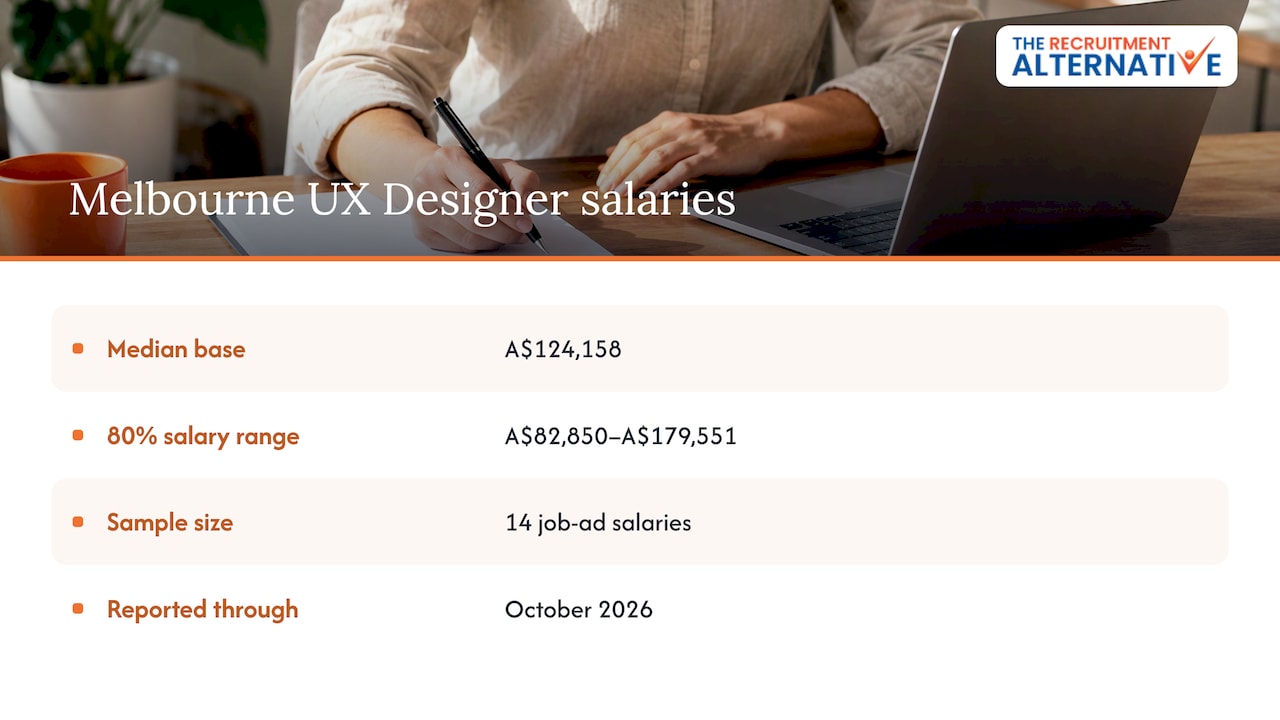
Salaries move with the market, so treat any figure as a snapshot. A Melbourne UX Designer market page reported a median base salary of A$124,158 from 14 job-ad salaries through October 2026, with 80% of declared salaries between A$82,850 and A$179,551. The sample is small, so use the range for orientation and compare it against live job listings in your city and against what your own candidates ask for.
Base salary is only part of the cost. The first-employee guide lists superannuation, payroll tax where thresholds apply, workers’ compensation, paid absences, recruitment, equipment, software, training and management time as costs to plan for. Add the designer’s software licences to that list, since design tools are typically charged per seat.
Owners sometimes compare costs across countries when thinking about where to hire. If you are curious how a UX designer’s pay and employer on-costs are built up in another market, see this breakdown of the UX designer salary in South Africa. For an Australian permanent role, the Australian components above are what you need to model.
Recruitment cost: percentage versus fixed
The largest single line you can control is the recruitment fee. Traditional agencies charge a percentage of the first-year salary, so a $125,000 designer costs you more to recruit than a $90,000 one, simply because the salary is higher. A flat fee removes that link.
Our published fees work like this (full structure here):
| Service | Engagement fee | Placement fee |
|---|---|---|
| Recruit | $895 | $3,900 to $5,000 |
| Recruit+ | $2,495 | $5,000 to $6,000 |
Placement fees are tiered by the salary of the role, and you pay the placement fee when a permanent hire is made. Optional extras are a criminal check at $129 and a psychometric evaluation at $199 per candidate. We estimate that this model saves more than 70% against commission-based agencies. You can see how the engagement stage works on our engagement fee page.
Where to find UX designers
Business.gov.au lists the usual channels for advertising a role: job websites, Workforce Australia, your own website and mailing list, networks, social media, industry newsletters, trade journals and university job boards. For UX, the practical mix is a job board, your own network and any design community you already belong to.
The trouble with advertising alone is volume. A UX ad on a major job board competes with thousands of listings, as the number of open roles in any search shows. Each application then needs a portfolio review, which is where time disappears for a business owner who is also running the business. Recruitment support exists to take the sourcing and screening off your plate. We recruit across technology, administration, finance, engineering, healthcare, sales, trades and executive roles, for businesses of all sizes across Australia and New Zealand.
A good ad also does some of the screening. Business.gov.au says ads should include pay, benefits, location, start and closing dates, a contact person and application instructions, and they must meet minimum pay, conditions, anti-discrimination and equal-opportunity requirements. Stating the salary range up front attracts candidates who can afford the role and saves everyone time.
Assessing portfolios and fit
A UX portfolio is not a gallery. It is a record of how someone thinks. Look for case studies that show:
- The problem and the constraint. What was the business trying to achieve, and what limited the solution?
- Real research. Interviews, usability tests or analytics, not just assumptions. Strong candidates do real user research, ideation workshops, detailed prototyping and usability tests and can explain and back up their design choices.
- Process, not just final screens. Flows, wireframes, iterations and what was discarded.
- Measured results. A credible case study gives an outcome, such as a reduction in checkout abandonment, and says how it was measured.
- Accessibility decisions. Evidence the candidate designs for people using keyboards, screen readers and low-contrast conditions.
Score candidates consistently
Business.gov.au recommends a 1-to-5 scoring matrix against the role requirements to help choose who to interview. Build it from your selection criteria and score every candidate the same way. It stops a polished visual style from outweighing a weak process.
Interview and test the thinking
Ask the candidate to walk you through one project in detail: what they would do differently, who disagreed with them and how they handled it. Then give a short, realistic scenario from your own business, such as a confusing booking flow, and ask how they would find out what is wrong. You are listening for questions about users and data before they sketch any answer.
Our psychometric evaluation, at $199 per candidate, can add a structured view of working style to your shortlist. Fit matters as much as skill in a small team where the designer will work directly with the owner.
Making the process efficient
Hiring slowly costs you candidates, since good designers are often interviewing in several places. A few habits keep the process tight:
- Settle the brief first. Agree the reporting line, salary range and must-have criteria before the ad goes live.
- Fix the timetable. Decide the dates for shortlisting, interviews and the decision, and tell candidates.
- Use one scoring sheet for everyone involved in the decision.
- Keep stages to what is useful: portfolio review, one structured interview, one practical scenario, references.
- Decide quickly after the final interview. Put the offer in writing with the salary, employment type and start date.
If the hire does not work out, our candidate replacement insurance applies where the hire does not work out in the first 2 to 3 months, and a Replacement Campaign is $1,000.
Our approach to permanent hires
If you would rather not carry the sourcing and screening yourself, our Fixed Fee Recruitment service is a one-off $4,795 for a permanent hire. Choose Recruit or Recruit+ depending on how much support the role needs, with the fees set out on our pricing page.
The fee is set before you start, so the cost of the hire does not depend on how highly a UX designer is paid. That helps when you are comparing a salary of $100,000 with one of $140,000: the recruitment cost does not rise with it.
Our view on hiring UX designers
We see small businesses make the same mistake in hiring for design roles: they treat recruitment cost as something that grows with the salary, so they put off the hire or settle for the first applicant who looks affordable.
Our flat-fee model is built to remove that pressure. When the fee is set in advance, you can spend your effort on the part that matters, which is choosing a designer whose process you trust and who can work with the people already in your business.
Our advice is to write the brief around outcomes, score every candidate against the same criteria, and ask to see how they think, not only what they have made. Add the replacement cover for the first 2 to 3 months, and a hire becomes a managed decision rather than a gamble.
Josh Townsend
FAQ
How much does it cost to hire a UX designer in Australia?
A Melbourne market page reported a median base salary of A$124,158 through October 2026, on a small sample. On top of that, budget for superannuation, equipment, software and management time. Our recruitment fee is a flat $4,795 for Fixed Fee Recruitment, regardless of salary.
Do UX designers need a degree?
No. There is no formal degree, certification or licence required to work as a UX designer in Australia. Look for evidence of research, prototyping, testing and accessibility in their portfolio rather than a particular qualification.
Should I hire a freelancer or a permanent UX designer?
Freelancers suit short projects, but they need more management and a detailed brief. A permanent designer suits ongoing work, such as a product that changes every month. If the workload is steady, a permanent hire builds knowledge of your customers over time.
What should a UX designer’s portfolio show?
It should show the problem, the research, the design process and the measured result of each project. Case studies that explain why decisions were made are worth more than a set of finished screens. Check that the candidate has considered accessibility.
Sources
- Occupation 242132 UI / UX Designer, Australian Bureau of Statistics
- Interview and recruit employees, business.gov.au
- How to Become a UX Designer, RMIT
- UX UI Design Principles That Convert (2026 Guide)
- Hiring Your First Employee: A 2026 Guide
- What a UX consultant does, and when to hire one
- How to Become a UX Designer in Australia
- How to Hire a UX Designer: A Practical 2026 Guide
- User Experience (UX) Designer salary in Melbourne
- How to Hire a UX Designer That Best Suits Your Needs
- UX designer salary in South Africa

