

The fastest reliable way to hire software developers is a structured, scorecard-driven funnel: a short async technical screen to filter at scale, live interviews to confirm judgment, and consistent rubrics throughout. Anchor the process to Google re:Work’s structured interviewing standard and a platform like HackerRank for assessment, and you can move from job posting to signed offer inside five weeks.
TL;DR:
- A structured, stage-by-stage hiring process with strict deadlines reduces time-to-hire to around 25 to 35 days.
- Building a shared rubric around core competencies and conducting calibration sessions significantly decreases bias and disagreement among interviewers.
- Incorporating AI tools into assessments aligns with real-world skill use and enhances detection of judgment and decision-making abilities.
- Fast candidate sourcing, clear role definitions, and a quick decision SLA of 48 hours after the final interview increase offer acceptance rates.
- Outsourcing hiring through vetted partners can be more efficient for low-volume hiring, saving HR hours and ensuring consistent screening quality.
Table of Contents
- Staged software developer hiring funnel and time budgets
- How do you build a scorecard that removes gut-feel bias?
- Should you let candidates use AI during technical assessments?
- Where should you source developer candidates beyond job boards?
- How fast should you move from final interview to signed offer?
- Why reference checks and 90-day reviews catch what interviews miss
- Why defining the role clearly matters more than the interview process
- What actually moves the needle on diversity in developer hiring
- How do you benchmark pay and negotiate offers without losing candidates?
- What onboarding practices actually keep developers past year one?
- What legal and compliance issues should hiring managers watch for?
- How does employer branding help you win developer talent?
- When does outsourcing the hiring funnel make more sense than building one?
- A practical next step for employers hiring developers
- Sources
Staged software developer hiring funnel and time budgets
Software developer hiring falls apart when stages blur into each other. A recruiter screen drags into three weeks because nobody owns the calendar, and by the time a live technical interview gets scheduled, your best candidate has already accepted somewhere else. The fix is a staged funnel with a day-by-day target attached to every step.
HackerRank’s research into modern engineering hiring backs a full async screen to offer window of roughly 25 to 35 days, and that number is achievable if each stage has a deadline rather than a vague “as soon as possible.”
- Recruiter screen (days 1 to 3): confirm salary expectations, notice period, and core requirements before anyone’s time is spent on technical evaluation.
- Async technical assessment (days 4 to 7): a scored coding exercise candidates complete on their own schedule, reviewed within 48 hours.
- Live technical interview (days 8 to 14): a calibrated interviewer walks through the candidate’s assessment and probes reasoning in real time.
- System design or architecture round for senior hires (days 12 to 18): run in parallel with reference checks where possible to save time.
- Culture and collaboration interview (days 15 to 20): assesses how the candidate works with others, not just how they code.
- Offer (days 21 to 30): decision made within 48 hours of the final debrief.
Delays almost always come from one of two places: interviewers who won’t commit to calendar slots, or hiring managers who want “just one more round” after the scorecard already points to a clear decision. Block interview slots a week in advance and treat the scorecard, not gut feel, as the tiebreaker.
How do you build a scorecard that removes gut-feel bias?
A shared scorecard only works if every interviewer scores the same competencies the same way. Google re:Work’s structured interviewing guidance found that four well-designed structured interviews capture around 86% of the predictive signal of a full panel, provided each interview uses a consistent rubric and scores distinct dimensions rather than overlapping ones.
Build your rubric around five or six core competencies, each rated on a 1 to 4 scale with a written behavioural anchor for what a 1 versus a 4 actually looks like:
- Technical depth: can the candidate explain trade-offs, not just produce working code?
- Debugging and problem-solving: how do they approach an unfamiliar bug under time pressure?
- Communication: can they explain a technical decision to a non-technical stakeholder?
- Collaboration: how do they respond to pushback on their approach?
- Ownership: do they take responsibility for outcomes, or deflect?
Interviewers score independently, write evidence notes before the debrief, then compare scores as a group. A shared scorecard that forces evidence before discussion is the single most impactful lever for reducing disagreement and bias in the whole process. Set one or two “must-have” competencies where a score of 1 fails the candidate outright, regardless of how well they scored elsewhere.
Pro Tip: Run a 20-minute calibration session with your interview panel before the first candidate goes through. Score a mock transcript together and argue out your disagreements then, not during a live debrief.
Should you let candidates use AI during technical assessments?
Banning AI tools from your async technical screen is a losing strategy. Candidates use Copilot and ChatGPT on the job, so an assessment that pretends those tools don’t exist tests the wrong skill. HackerRank’s guidance for 2026 hiring recommends designing assessments and platforms that record how candidates use AI suggestions, so you’re evaluating judgment and decision-making rather than raw recall.
Set your async screen at 60 to 90 minutes, long enough to see how a candidate structures a problem but short enough that it doesn’t feel punitive. HackerRank’s recommendation is a pass band built around code correctness, reasoning quality, and how a candidate handles a curveball requirement change mid-task, not just a final score.
- Async platform assessment: best for high-volume roles where you need fast, consistent filtering across dozens of applicants.
- Take-home project: higher signal on real-world coding style, but slower and prone to candidate drop-off if it runs longer than a few hours.
- Paid short trial: gives a stronger signal than an unpaid take-home for mid-level and senior hires, and signals respect for the candidate’s time.
Structured skills assessments materially reduce false positives compared with resume-only screening, and they save your engineers from wasting live interview time on candidates who were never going to pass the coding bar. Use the live technical round to confirm what the async screen suggested, not to repeat it.
Where should you source developer candidates beyond job boards?
Job boards fill a funnel with volume, but volume isn’t your problem. Quality-per-hour spent screening is. Referral hires convert at a materially higher rate and stay longer than candidates sourced cold, which makes an internal referral bonus one of the cheapest levers you have. After referrals, targeted outbound on GitHub and in curated developer communities beats mass job board posting for anything beyond junior volume roles.
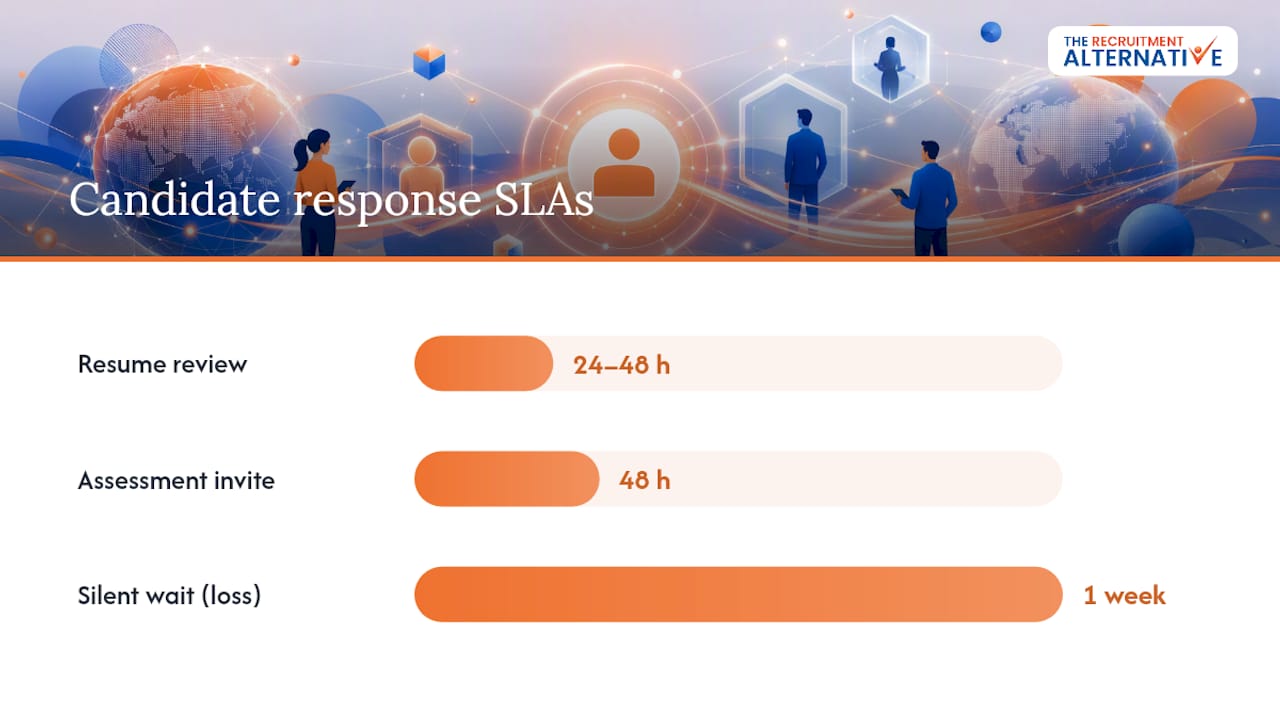
Whichever channel a candidate comes through, the experience they get once they’re in your funnel determines whether they stay in it. A tight funnel needs internal service-level agreements: resume reviews within 24 to 48 hours, assessment invites within 48 hours of the recruiter screen, and scheduling windows offered rather than dictated. Candidates who sit in silence for a week assume you’ve lost interest, and the good ones move on to whoever replies faster.
Your role page itself does more sourcing work than most hiring managers credit it for. Three details consistently lift response and acceptance rates:
- Tech stack specifics, not “modern technologies,” so candidates can self-select.
- Team size and structure, so candidates know who they’d actually work with day to day.
- A stated salary range, which filters mismatched expectations before anyone wastes a screening call.
Speed itself is a competitive advantage in this market. Faster-moving employers consistently win more offer acceptances than slower ones, even when the roles and pay are comparable. If your organisation is exploring remote-first sourcing, the same SLA discipline applies, just with more time zone coordination built into the scheduling step.
How fast should you move from final interview to signed offer?
The gap between final interview and offer is where good hires quietly disappear. Set an internal decision SLA of 48 hours after the last debrief, and put the offer in front of the candidate the same week. A staged process with fast decisions keeps candidate interest live rather than letting it cool while your panel schedules “one more sync.”
- Anchor the offer number to scorecard evidence, not to how much you liked the candidate personally.
- Prepare for counter-offers before you make the offer, not after. Have non-financial levers ready: flexible hours, learning budget, a faster promotion pathway.
- Run structured checks at 30, 60, and 90 days post-start against the original scorecard.
Pro Tip: If a new hire’s day-30 performance diverges sharply from what their scorecard predicted, log exactly where. That gap is the fastest way to spot a weak interview question or a miscalibrated interviewer before it costs you the next five hires.
Why reference checks and 90-day reviews catch what interviews miss
Interviews test how a candidate performs under interview conditions. They don’t reliably test how someone behaves on a real team, under real deadline pressure, six months in. That’s what reference checks and post-hire validation are for, and most hiring processes skip both or treat them as a formality.
The most diagnostic reference-check question isn’t “would you recommend this person.” It’s asking the referee whether they’d rehire the candidate, and if not, in what specific context they wouldn’t. Answers that name a limit, a working style clash, or a scenario where the candidate struggled are worth far more than a blanket positive reference. A referee who hedges on rehiring but can’t articulate why is telling you something too.
Once the candidate starts, the scorecard’s job isn’t finished. A 90-day validation loop, with structured check-ins at day 30, 60, and 90 measured against the original interview scorecard, is how you audit whether your hiring funnel is actually predicting on-the-job performance. If a new hire scored a 4 on technical depth but is visibly struggling with the codebase at day 30, that’s not just a performance issue. It’s a signal your technical assessment may be miscalibrated.
This is also the window where replacement-insurance style protections matter most. If a hire genuinely isn’t working out within the first two to three months, catching it early through structured reviews, rather than six months of hoping it improves, gives you and the candidate a cleaner outcome.
Why defining the role clearly matters more than the interview process
Most bad hires trace back to a vague job description, not a weak interview. If your hiring manager and your recruiter can’t agree in one sentence what “senior” means for this role, your interview panel will score candidates against three different bars without realising it.
Before you post a single job ad, write down: the specific tech stack the role touches, the seniority level defined by scope of ownership rather than years of experience, and what success looks like at 90 days. “Owns the checkout service end-to-end” is a role definition. “Strong backend developer” is not.
This matters doubly for hybrid or ambiguous roles, where a developer who’s also expected to do some DevOps or some product work needs that split stated explicitly, or you’ll interview for one job and onboard someone into a different one. Misalignment here shows up later as attrition, not as a hiring failure, which makes it easy to miss until it’s already cost you a good hire.
Write the job posting with the same specificity you’d want from a candidate’s answer to “walk me through your last project.” Vague postings attract vague applicants, and specific postings filter themselves before your recruiter screen even starts.
What actually moves the needle on diversity in developer hiring
Diversity in software developer hiring is mostly won or lost in the sourcing and screening stages, not in the final interview. If your candidate pool is drawn entirely from referrals inside a homogeneous existing team, a perfectly fair interview process still produces a homogeneous shortlist.
Widening sourcing beyond your immediate network, through targeted outbound on platforms with broader developer representation and partnerships with coding bootcamps and community groups, changes who reaches your funnel in the first place. That’s a sourcing decision, made before any scorecard gets used.
Inside the funnel itself, structured interviewing does real work here. Consistent rubrics and independent scoring before group discussion reduce the room for unconscious pattern-matching toward “people who remind me of our current team.” Anonymising resumes or take-home submissions during the early screen removes another point where bias creeps in unchecked.

Salary transparency on the job posting also does more for equitable hiring than most employers expect: candidates from groups historically underpaid in tech are more likely to walk away from an opaque negotiation rather than push back on a lowball offer. Stating the range upfront removes that asymmetry before it starts.
How do you benchmark pay and negotiate offers without losing candidates?
Guessing at a salary range is one of the most common ways employers lose developers they’ve already spent three weeks screening. Benchmark against current market data for the specific stack, seniority level, and location you’re hiring for, not last year’s figure or a number pulled from a generic salary survey.
Build in some negotiation room from the start rather than opening at your absolute ceiling. A candidate who counters and gets nothing to work with often walks, even when your original number was fair. Non-salary levers matter here too: flexible working arrangements, learning and conference budgets, and a clear promotion pathway can close a gap that a purely financial counter-offer can’t.
Anchor every negotiation conversation to the evidence in the candidate’s scorecard. If a candidate scored exceptionally on system design and you’re hiring for an architecture-heavy role, that’s your justification for moving toward the top of your range, not a gut feeling that “they seemed good.” Keep the conversation grounded in what the interview process actually surfaced, and you’ll make faster, more defensible decisions when a counter-offer lands.
What onboarding practices actually keep developers past year one?
A great hire poorly onboarded becomes a resignation within twelve months. Onboarding is where the offer you made either gets confirmed or quietly regretted, and the first 90 days set the tone for everything that follows.
Give a new developer a clear 30/60/90 day plan tied to the same competencies you scored them on during interviews. If you assessed them on ownership and system design, their onboarding plan should have concrete milestones building toward exactly that, not a vague “get settled in” period with no defined output.
Pair every new developer with a dedicated buddy who isn’t their manager, someone they can ask “dumb questions” without it affecting a performance review. Schedule structured check-ins at day 30, 60, and 90, the same cadence used for validating the hire itself, and use those check-ins to surface friction early rather than waiting for an exit interview to find out what went wrong.
What legal and compliance issues should hiring managers watch for?
Software developer hiring carries the same compliance obligations as any other permanent role, and getting them wrong is expensive regardless of how strong your technical process is. Job postings need to comply with anti-discrimination obligations in how they’re worded, avoiding language that implicitly excludes candidates on the basis of age, gender, or other protected attributes.
Structured interviewing helps here too, beyond its predictive benefits. A consistent rubric applied to every candidate creates a defensible record if a hiring decision is ever challenged, because you can show every applicant was assessed against the same criteria rather than an inconsistent, subjective standard.
Keep evidence notes and scorecards on file for a reasonable retention period, and make sure any reference checks are conducted with the candidate’s knowledge and consent. If you’re hiring remote developers across state or national borders, check employment classification and tax obligations for that jurisdiction before you extend an offer, not after.
How does employer branding help you win developer talent?
Developers with options don’t apply blind. They check your engineering blog, your GitHub presence, and what current employees say about the team before they’ll even respond to outreach. A strong employer brand does sourcing work your recruiter never has to do manually.
Publishing honest technical content, showcasing real engineering challenges your team has solved, and making your tech stack and team structure visible on your careers page all reduce the friction between “developer sees your role” and “developer applies.” This matters more in a market where the best candidates are rarely actively job hunting. They’re persuaded, not found.
Consistency matters as much as polish. A careers page promising flexibility and autonomy that contradicts what current employees say in reviews will cost you candidates at the offer stage, once they’ve done their own research.
When does outsourcing the hiring funnel make more sense than building one?
Building the funnel described above, with calibrated scorecards, staged interviews, and fast SLAs, takes real infrastructure. For a company hiring developers regularly, that investment pays for itself. For a business hiring one or two developers a year, building and maintaining that machinery often costs more in HR hours than it saves.
That’s the gap a vetted fixed-fee partner fills. Instead of building an internal funnel from scratch for occasional hires, you get access to established sourcing channels and screening rigour without carrying that overhead year-round. The Recruitment Alternative’s flat-fee model fits naturally into lower-volume technology hiring, where the cost of a traditional percentage-based agency fee is hard to justify against one or two roles.
The trade-off is straightforward: you’re paying for someone else’s sourcing network and screening discipline instead of building your own. For many small and mid-sized employers, that’s the more pragmatic route to a hire that lasts.
— Josh Townsend
A practical next step for employers hiring developers
Running the full staged funnel described above, structured scorecards, calibrated interviewers, async screens, live confirmation rounds, works well if you’re hiring developers often enough to keep that machinery tuned. If you’re not, The Recruitment Alternative gives you a way to skip the build-out entirely and pay a transparent, fixed price instead of a percentage of salary that climbs with every senior hire.
The Recruitment Alternative recruits permanent developers and other technology staff across Australia and New Zealand using a flat-fee structure, so the cost of filling roles does not escalate like with commission-based agencies. Every placement includes a candidate replacement window if a hire doesn’t work out in the first two to three months, which supports early identification of fit without extra effort on your part.
If you want to see how the pricing tiers work for a role at your salary band, or you’d rather talk through your next technology hire directly, get in touch with The Recruitment Alternative and find out whether outsourcing this hire makes more sense than running the funnel in-house.
Sources
- A guide to structured interviewing for better hiring practices — Google re:Work
- Software hiring in 2026: A practical guide for engineering leaders — HackerRank

