

Hire to a scoped role with clear day-90 and day-180 metrics, require practical licences such as a forklift licence, and publish the pay band and roster upfront. If you want faster, cost-controlled results, engage a flat-fee recruiter to run sourcing and screening while you focus on final interviews. Start by defining the operation, not the job title.
TL;DR:
- Clear role scoping and specific metrics for 90 and 180 days are essential to avoid mismatched expectations and ensure operational success.
- Job descriptions must include current licences, relevant certifications, key operational facts, and transparent pay and shift details.
- A structured hiring process with multiple sourcing channels, scenario-based interviews, and reference checks significantly improves candidate quality.
- Onboarding should involve immersive shift participation and goal setting at 30, 90, and 180 days to establish credibility and track progress.
- Using a fixed, flat-fee recruitment service reduces costs, speeds up hiring, and provides guarantees against bad hires, especially for permanent management roles.
Table of Contents
- Scoping the role and what the job description must include
- The hiring process, step by step
- Interview questions that separate operators from observers
- Onboarding and setting 90-day and 180-day goals
- Keeping the warehouse manager you just hired
- Legal and compliance considerations when hiring
- Building diversity into your warehouse manager search
- What to actually evaluate beyond the resume
- Our take on making the right permanent hire
- Get a flat-fee warehouse manager search started
- Sources
Scoping the role and what the job description must include
Warehouse manager is not one job. A fulfilment centre manager lives and dies by pick rates and same-day dispatch. A production-plant warehouse manager coordinates raw materials feeding a line and finished goods moving out. A 3PL manager juggles multiple client contracts, each with different service levels and reporting demands. The ASCM employer guidance makes the point plainly: these are distinct hiring profiles, not variations on the same theme, and treating them as interchangeable is how businesses end up with a manager who is technically capable but operationally mismatched.
Before you write a word of the ad, decide who owns inventory accuracy, whether transportation sits inside the role, and who the manager reports to. That single exercise stops the most common hiring mistake: advertising a “warehouse manager” role that is actually two jobs stitched together.
Your job description should treat these as non-negotiable:
- A current forklift licence, and often a separate high-risk licence depending on the equipment on site.
- Certificate III or IV in supply chain operations or logistics, which employers increasingly expect from candidates stepping up into management.
- Building size, average daily inbound and outbound volumes, headcount, and shift pattern, stated as facts rather than left vague.
- The pay band and roster should be clearly stated in the ad itself to avoid ambiguity later.
SEEK’s forklift licence guidance confirms Australian employers commonly treat the forklift ticket as a baseline requirement, with a vocational qualification such as a Certificate IV valued highly for anyone moving into a leadership seat.
The hiring process, step by step
A rushed hiring process is how you end up interviewing five candidates who all sound confident and none of whom can actually run your floor. Follow a structured sequence and you cut wasted interviews dramatically.
- Scope the role with metrics and decision rights. Before advertising, agree on what “good” looks like at 90 and 180 days, and decide who has authority over rostering, overtime, and disciplinary action.
- Write a concise job description. State which KPIs the manager owns (OTIF, inventory accuracy, cost-per-unit), the reporting line, and the shift pattern. Ambiguity here is expensive later.
- Source candidates through multiple channels. Consider internal promotion first, industry-specific job boards, your own network, and a flat-fee recruiter if you need a wider net without a percentage-of-salary fee eating into the hire’s value. The Recruitment Alternative’s warehouse recruitment service is one option worth weighing against running the search entirely in-house.
- Screen, interview, and test. Run a short phone screen for licences and availability, then a structured interview built around scenario questions, and where practical, a short technical exercise (cycle counting or a WMS walkthrough).
- Check references and build the offer. Speak to a former direct report, not just a former boss, and construct the offer around total package, training plan, and what happens if the placement doesn’t work out.
Indeed’s hiring guidance backs this sequencing, and notes that for ongoing, high-volume operations, a permanent hire consistently outperforms a short-term or freelance arrangement because continuity with staff, carriers, and systems compounds over time.
Pro Tip: Ask every shortlisted candidate to bring one metric they personally moved in their last role, along with the baseline and the timeframe. Candidates who can’t produce a number were usually reporting on someone else’s results, not driving their own.
Interview questions that separate operators from observers
Plenty of candidates can describe a warehouse. Fewer can prove they ran one. The gap shows up fast if you ask for specifics instead of accepting general claims.
Start with a short screening checklist: current forklift licence, availability for the actual roster (including any night shifts), prior headcount managed, and hands-on experience with a warehouse management system relevant to your operation.
Then move to behavioural questions that force detail:
- “What was your inventory accuracy when you started, and what was it when you left? Over what period?”
- “Walk me through a peak period where volume outstripped your rostered labour. What did you decide, and what happened?”
- “Describe a stock discrepancy you found. How did you trace it, and what changed afterwards?”
Vague answers are the red flag to listen for. If a candidate says accuracy “improved significantly,” ask for the actual before-and-after numbers. If they can’t supply a denominator, a timeframe, or a specific decision they made, they were likely adjacent to the result rather than accountable for it. Genuine operators can also speak fluently about cycle counting frequency, ABC analysis for prioritising stock checks, and how OTIF (on-time-in-full) gets tracked and reported. Someone who has run a floor for years but stumbles on these basics is worth a longer look before you proceed.
Pro Tip: Ask candidates to explain a metric to you as if you’d never heard of it. Genuine operators simplify without losing accuracy. Pretenders reach for jargon to cover gaps.
Onboarding and setting 90-day and 180-day goals
The first two weeks decide whether your new hire earns credibility on the floor or spends months trying to claw it back. Best practice has the new manager walking every process on every shift, including nights and weekends, so they’ve actually met the teams and agency staff they’ll rely on rather than just reading a handover document.
- Weeks one and two: immersion across every shift, meetings with every supervisor, and time alongside agency labour if you use it.
- Days one to 30: document agreed decision rights for overtime approval, agency labour use, and disciplinary matters, so there’s no ambiguity about what the new manager can act on alone.
- Day 90: set a measurable target, for example lifting OTIF by a defined percentage, closing an inventory accuracy gap, or reducing cost-per-unit against a stated baseline.
- Day 180: extend those targets, and add a staff turnover or engagement measure specific to the warehouse team.
Treat these milestones as evaluation gates, not just check-ins. The ASCM guidance is direct on this point: agreeing decision rights and shift immersion in the first quarter is what makes later performance conversations fair, because both sides know what “on track” actually looks like. If a target is missed at day 90, define the corrective step then, not at the annual review six months later.
Keeping the warehouse manager you just hired
Recruiting a strong warehouse manager and then losing them within eighteen months is one of the more expensive mistakes an operation can make, given how much context they’ve absorbed about your suppliers, your systems, and your team.

Retention in this role rarely comes down to salary alone. It comes down to whether the manager still has the decision rights they were promised at onboarding. If overtime approval or disciplinary authority quietly gets pulled back to head office six months in, you’ve effectively demoted someone without telling them, and good managers notice immediately.
Career pathing matters more in warehouse management than in many office-based roles, because the next step (regional operations, multi-site oversight) is often not obvious from the floor. Map out what progression looks like and revisit it at the day-180 review, not as an afterthought.
Recognise operational wins publicly and specifically. A manager who lifted OTIF by a measurable margin or cut a persistent discrepancy problem wants that acknowledged in numbers, not a generic “great job this quarter.” Pair that with genuine investment in their team, budget for training, and support for hiring decisions on their own floor. Managers who feel undermined on staffing calls they should own tend to leave for operations that let them actually run the show.
Finally, protect them from scope creep. If the role you hired for quietly expands to cover transportation, procurement, or a second site without a conversation about pay or support, you’re testing their patience against every recruiter now calling them.
Legal and compliance considerations when hiring
Warehouse manager hiring carries compliance obligations that are easy to overlook when you’re focused on finding the right skill set.
Licensing verification comes first. If the role requires a forklift licence or another high-risk work licence, confirm it’s current and valid for the equipment on your site before the offer stage, not after the first shift. Don’t take a resume claim at face value.
Work health and safety obligations extend directly to how you hire. A warehouse manager typically carries delegated WHS responsibility for their team, so your hiring process should confirm the candidate understands their obligations under the relevant safety framework, not just that they’ve worked in a warehouse before.
Anti-discrimination law applies at every stage, from the wording of your job ad through to interview questions. Questions about age, family status, or physical ability framed as “can you handle the physical demands” rather than genuine, job-related inherent requirements can create legal exposure. Keep questions tied to the actual tasks of the role.
Background and reference checks should be consistent across every candidate for the same role. Applying a criminal history check to one candidate and not another, without a documented, consistent policy, is a discrimination risk. If the role involves managing high-value inventory, a police check may be a genuine requirement, but apply it as policy, not on a case-by-case whim.
Finally, keep records of your hiring process, including interview notes and the reasons for your final decision. If a hiring decision is ever challenged, a documented, consistent process is your best protection.
Building diversity into your warehouse manager search
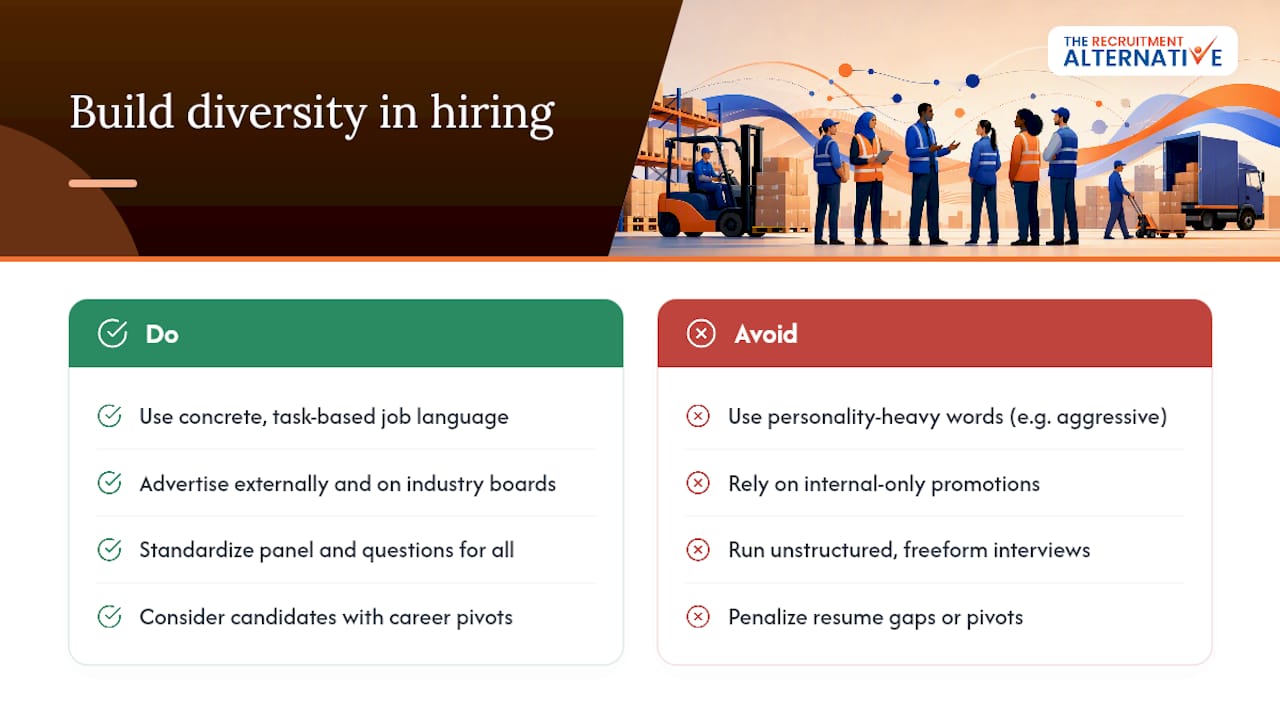
Warehouse management has historically drawn from a narrow pool, often promoted internally from supervisors who look and sound like the managers before them. That pattern is a missed opportunity as much as a fairness issue, because it filters out candidates with different problem-solving approaches before they ever reach an interview.
Start with the job ad itself. Language that leans heavily on terms like “aggressive,” “dominant,” or “must thrive under pressure” tends to discourage female applicants disproportionately, even when the actual role doesn’t demand anything unusual. Stick to concrete, task-based language: what the role does, not personality traits you assume the right person will have.
Widen your sourcing beyond the obvious internal shortlist. If your supervisor pool is homogenous, an internal-only promotion path will simply reproduce that pattern at manager level. Advertise externally alongside any internal consideration, and use industry job boards and networks that reach candidates from adjacent sectors, such as manufacturing or retail distribution, who may have transferable operational experience.
Structure your interview panel and your questions consistently for every candidate. Unstructured interviews, where questions shift based on how the conversation is flowing, are where unconscious bias creeps in hardest. The behavioural and scenario questions outlined earlier in this guide, asked the same way to every candidate, do more for fairness than any diversity statement in your job ad.
Finally, look past a resume gap or a career pivot. Someone who moved from hospitality management into logistics often brings exactly the people-management and pressure-handling skills a warehouse floor demands, even without a traditional supply chain pedigree.
What to actually evaluate beyond the resume
Technical competence gets a candidate to the interview. What determines whether they succeed in the role is harder to see on paper.
Leadership potential shows up in how a candidate talks about their team, not just their targets. Listen for whether they credit specific people when describing a win, and whether they take ownership when describing a failure. A candidate who blames “the agency staff” or “head office” for every setback is telling you how they’ll talk about your team in twelve months.
Communication style matters more in warehouse management than many hiring managers expect, because the role sits between the floor and the executive team, translating operational reality upward and strategic decisions downward. Ask a candidate to explain a technical process, like a cycle count schedule, to someone unfamiliar with warehousing. Their ability to simplify without losing accuracy tells you how they’ll brief your leadership team.
Adaptability under pressure is worth testing directly with a scenario question, not just asking whether they’re “good under pressure.” Every candidate will say yes. The value is in how they walk through an actual peak-period decision, including what they got wrong.
Finally, weigh cultural fit against team dynamics realistically. This isn’t about finding someone who fits a personality mould. It’s about honestly assessing whether their management style, collaborative, directive, hands-off, matches what your current supervisors and floor staff actually respond to. A brilliant operator with the wrong management style for your team can do more damage than a competent generalist who reads the room correctly.
Our take on making the right permanent hire
The mistake we see most often isn’t a bad candidate slipping through. It’s a business advertising a role so loosely scoped that even a strong candidate can’t tell what they’re actually being asked to own. Fix the scoping problem before you fix the interview questions, because no amount of clever screening rescues a job description that never decided who’s accountable for inventory accuracy.
The Recruitment Alternative built its model around fixed, transparent fees precisely because warehouse manager hiring shouldn’t cost a business a percentage-based fortune every time it needs to fill a critical operational seat. When speed matters and budget certainty matters more, a flat-fee search with a defined replacement guarantee gives you both without the commission-driven incentives that can push a traditional agency toward the fastest placement rather than the right one.
— Josh Townsend
Get a flat-fee warehouse manager search started
Warehouse manager hiring is easier to get right when the cost and the process are both predictable from the outset. That’s the entire premise behind The Recruitment Alternative’s model: one fixed fee, set upfront, regardless of how long the search takes or how the final salary negotiation lands, instead of a percentage that climbs with every dollar of package you offer.
For an operation ready to fill a permanent warehouse manager seat, the process starts with a short briefing call covering the same scoping questions this guide walks through: operation type, KPI ownership, shift pattern, and pay band. From there, The Recruitment Alternative sources and screens against that brief, delivering a shortlist rather than a folder of unfiltered resumes. If a placement doesn’t work out in the first few months, replacement terms are built into the flat-fee structure from day one, so the risk of a bad hire doesn’t sit entirely on your shoulders.
Check the pricing breakdown and get in touch to scope your next warehouse manager hire against a fixed cost rather than an open-ended commission.
Sources
- How to hire a warehouse manager: ASCM employer guidance (2026)
- Forklift driver career advice — SEEK
- How to hire a warehouse manager — Indeed
Recommended
- Stressed About Hiring Warehouse Staff? Let us help you! – The Recruitment Alternative
- Do you want a job as a Warehouse and Logistics Manager?
- The Management at The Recruitment Alternative- Leaders not Bosses! – The Recruitment Alternative
- Job Seeking Tips During Covid-19 Virus | The Recruitment Alternative


