

The fastest sensible route to hiring a permanent operations manager is to define three measurable success KPIs for the role, then pick one sourcing channel and start immediately, either a targeted internal search with a structured assessment, or a fixed-fee recruiter if you want speed and a placement guarantee without percentage-based fees. Operations manager hiring typically runs several weeks from brief to start date when the process is disciplined; expect longer if the brief is vague or the salary band is unrealistic for the responsibilities you’re listing.
Get moving today with these three actions:
- Write down three KPIs the new operations manager must hit in their initial months.
- Decide whether you’re sourcing directly, posting on a job board, or engaging a fixed-fee recruiter.
- Set your budget expectation: fixed-fee models often cost significantly less than a percentage-of-salary agency fee for the same calibre of candidate.
Key Takeaways
Operations manager hiring succeeds when a clear brief, a structured assessment process, and either disciplined internal sourcing or a fixed-fee recruiter combine to fill the role in eight to twelve weeks.
| Point | Details |
|---|---|
| Define KPIs before sourcing | Three measurable first-six-month outcomes align employer and candidate from day one. |
| Screen for transferable skills | Systems thinking and process improvement can outweigh strict sector experience. |
| Use a weighted scorecard | Score technical competence, leadership, culture fit, impact, and references independently before debriefing. |
| Practical tasks beat theory | A short, business-specific case task predicts performance better than interview talk alone. |
| Fixed-fee recruitment lowers risk | The Recruitment Alternative offers transparent, tiered flat fees and a replacement guarantee across Australia and New Zealand. |
Table of Contents
- What does an operations manager hiring process need to prioritise?
- What’s the step-by-step operations manager recruitment process?
- How do you write an operations manager job description that attracts the right candidates?
- What interview questions actually predict operations manager success?
- How should you score and compare operations manager candidates?
- What should the offer and first 90 days look like?
- What legal and compliance issues matter when hiring an operations manager?
- How do you keep operations manager hiring inclusive?
- Do operations manager requirements change across industries?
- When should you bring in a fixed-fee recruiter instead of running the search yourself?
- How does The Recruitment Alternative make operations manager hiring simpler?
- Sources
What does an operations manager hiring process need to prioritise?
An operations manager owns the machinery of the business: processes, people, budgets, and the metrics that prove it’s all working. SEEK’s role guide describes the role as overseeing production of an organisation’s products and services, including staff management, budget control, performance targets, and process improvement, and that scope spans almost every industry from manufacturing to professional services.
The capabilities worth screening hardest for are systems thinking (can they see how one change ripples through the whole operation?), process improvement experience, genuine people leadership rather than task supervision, vendor and contractor management, and comfort with the ERP or operations software your business already runs on.

Qualification versus experience is where most hiring managers get stuck. A formal operations or business qualification helps, but it’s rarely the deciding factor. Employers commonly weigh transferable skills like process improvement and people leadership just as heavily as sector-specific background, according to SEEK’s analysis of the role.
Pro Tip: Test for systems thinking directly by asking a candidate to walk you through how they’d diagnose a recurring bottleneck in a process they’ve never seen before. Their reasoning matters more than the specific industry example they choose.
What’s the step-by-step operations manager recruitment process?
A disciplined operations management hiring process moves through five stages, each with its own checkpoint.
- Write the brief and set KPIs (days 1 to 3). Document scope, direct reports, budget authority, and three measurable outcomes for the first six months. This single step shortens onboarding later, because both employer and new hire arrive on day one already aligned on priorities.
- Choose your sourcing approach (days 3 to 10). Direct outreach to your network, a job board posting, or a fixed-fee recruiter who already has a warm candidate pipeline. Specialist recruiters typically run this as discovery and brief, market research and sourcing, then shortlisting, which compresses the timeline considerably compared with a cold ad campaign.
- Screen and shortlist (days 10 to 20). Apply hard filters against your must-have criteria first, then rank the remainder against desirable extras. Aim for four to six candidates to interview, not twenty.
- Assess (days 20 to 35). Run a case task, a panel interview, and reference checks. Rework’s hiring guide recommends this sequence specifically because it surfaces evidence of impact rather than rehearsed answers.
- Offer and negotiate (days 35 to 45). Move fast once you’ve decided. Good operations managers rarely stay on the market long.
Total realistic time-to-hire typically takes a few months for most permanent operations manager roles, varying with seniority and candidate availability.
How do you write an operations manager job description that attracts the right candidates?
A job description that gets read properly and attracts suitable applicants needs six components, no more, no less: a role summary, scope and reporting lines, three to five KPIs, must-have skills, desirable extras, and a salary band. Rework’s template guidance notes that posting clarity and correct role framing materially improve application quality and speed up shortlisting, largely because candidates self-select out when the scope is honestly stated upfront.
On experience versus qualifications, state clearly whether you require sector-specific background or whether transferable operations skills will do, since SEEK notes that extensive relevant experience often substitutes for formal qualifications in real hiring decisions. Vague phrasing here is the single biggest driver of unsuitable applications.
| JD Section | What to Include |
|---|---|
| Role summary | One paragraph: what the role owns and why it exists |
| Scope & reporting | Team size, budget authority, who they report to |
| KPIs | Three to five measurable first-year outcomes |
| Must-have skills | Non-negotiable capabilities, kept short |
| Desirable extras | Nice-to-haves that widen the pool, not narrow it |
| Salary band | A realistic range, stated upfront |
Use a short adaptable template that covers role ownership, reporting lines, responsibilities, success indicators, required skills and salary range. Adapt the operations manager JD and hiring guide if you want a longer version with sample interview questions built in.
What interview questions actually predict operations manager success?
Stage the interview process across four steps: a phone screen for basic fit and salary alignment, a technical interview probing process and systems knowledge, a leadership interview assessing how they manage people through change, and a practical assessment tied to a real problem your business faces.
- Phone screen: “Walk me through your current scope and budget authority.” Listen for specificity, not titles.
- Technical interview: “Describe a process you redesigned and the metric that proved it worked.” Weak candidates talk activity; strong ones talk outcomes.
- Leadership interview: “Tell me about a time you had to manage out an underperformer. What did you try first?” This tests judgement, not just decisiveness.
- Practical assessment: Give them a real, current operational problem and ask for a one-page plan. Practical, business-specific tasks predict on-the-job performance far better than theoretical questions ever do.
Red flags worth watching for: vague ownership of past results (“we improved efficiency” without a number), no examples of managing conflict, and references who describe someone reactive rather than someone who anticipated problems.
Pro Tip: Ask referees the same question you asked the candidate about a difficult people decision. The gap between the two answers tells you more than either answer alone.
How should you score and compare operations manager candidates?
A weighted scorecard stops interview panels from defaulting to gut feel or, worse, to whoever interviewed last. Rework’s structured scorecard model uses five categories, each scored and weighted before the panel compares notes.
- Technical competence (systems, process, budget management)
- Leadership (how they’ve grown or managed a team)
- Culture fit (working style against your actual environment, not a personality template)
- Demonstrable impact (numbers, outcomes, before-and-after evidence)
- References (do referee accounts match the candidate’s own story?)
Run the panel debrief with each interviewer scoring independently before discussing, then compare where scores diverge most. That’s where the real conversation happens, not where everyone already agrees.
What should the offer and first 90 days look like?
Your offer package needs a clear salary, start date, notice period handling, and any performance-linked elements spelled out plainly, not left for the contract to clarify later. Operations managers often negotiate around notice period buyouts and flexibility rather than base salary, so expect that conversation.
- First 30 days: Meet every direct report and key vendor; map current processes against the KPIs set in the brief.
- 60 days: Deliver one visible process improvement, however small, to build credibility with the team.
- 90 days: Present a written assessment of what’s working, what isn’t, and a plan for the next two quarters.
A dedicated recruitment campaign guide can help you plan this handover before the candidate even starts.
What legal and compliance issues matter when hiring an operations manager?
Operations manager roles often carry delegated authority over budgets, staff, and safety systems, which raises the compliance stakes above a typical hire. Get the employment contract right first: clearly state probation periods, notice requirements, and any restraint of trade or confidentiality clauses relevant to the commercial information this person will access.
Background and reference checks deserve more rigour for this role than for most, given the financial and people-management authority involved. Verify claimed qualifications directly with the issuing institution where practical, and always secure the candidate’s consent in writing before contacting referees or running any background check.
If the role includes work health and safety oversight, confirm the candidate understands their statutory duties as an “officer” or person with management or control under the relevant safety legislation in your jurisdiction, since this carries personal liability in many cases. Anti-discrimination law applies at every stage of the process, from the wording of the job ad through to the final offer, so keep interview questions focused strictly on the role’s genuine requirements rather than personal circumstances.
Where the operations manager will supervise payroll, procurement, or contractor engagement, check your industrial instrument or award coverage carefully. Misclassifying the role or its reporting structure creates downstream liability that’s far more expensive to fix than it is to get right during hiring.
How do you keep operations manager hiring inclusive?
A narrow candidate pool almost always traces back to how the role was framed and where it was advertised, not to a shortage of capable people. Write the job description around outcomes and capabilities rather than years of experience in a specific sector, since rigid experience thresholds disproportionately exclude capable candidates who’ve built equivalent skills through a different path.
Structure every interview panel with more than one interviewer, and use the same scored questions for every candidate rather than letting conversations drift into unstructured chat. This single change reduces the influence of unconscious bias more than almost any other adjustment a panel can make.
Advertise through channels that reach beyond your existing network. If every operations manager you’ve hired came from the same two or three companies, you’re not testing a market, you’re recycling one. Offer flexible working arrangements where the role genuinely allows it, since operations roles are often assumed to require rigid on-site hours when many don’t.
Finally, review your shortlist before interviews for balance, not to hit a quota, but to check whether your sourcing method is quietly filtering people out. If a fixed-fee recruiter is managing sourcing for you, ask directly how they build diverse shortlists and what channels they use beyond the obvious job boards.
Do operations manager requirements change across industries?
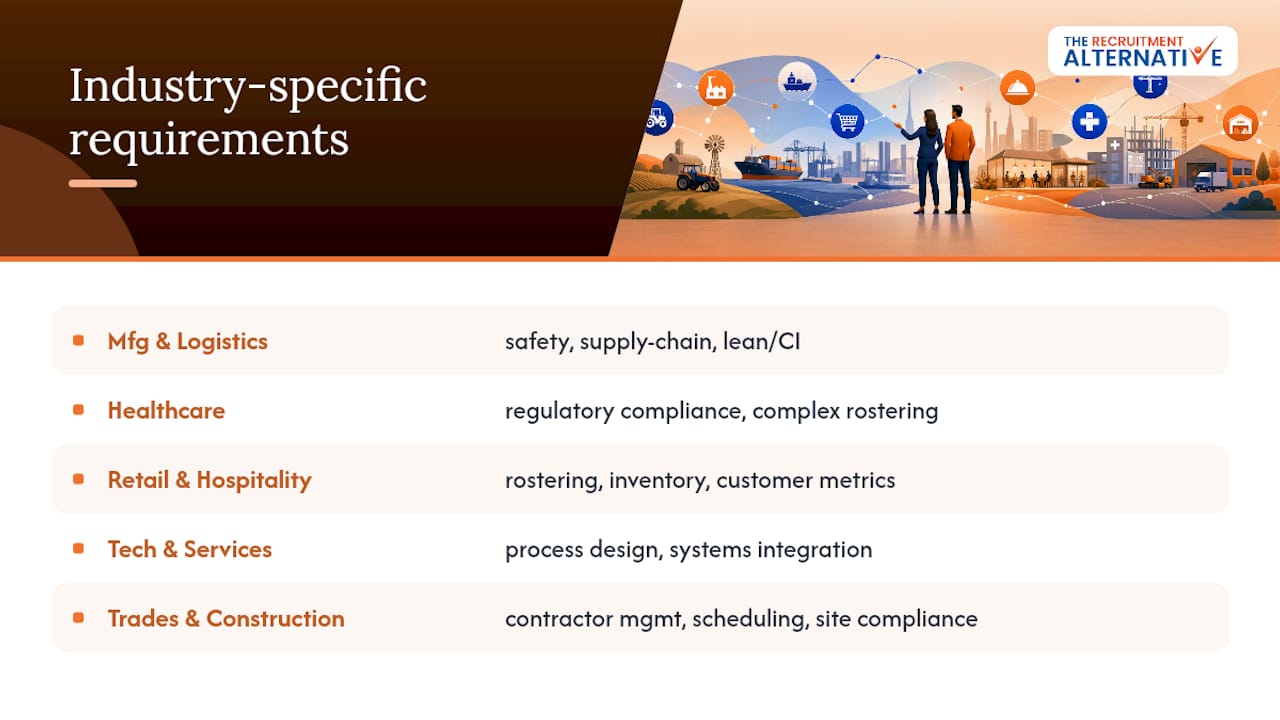
The core of the role, owning processes, people, budgets, and performance, stays consistent, but the specific requirements shift meaningfully by sector. In manufacturing and logistics, expect to weight safety compliance knowledge and supply chain experience heavily, often requiring familiarity with lean or continuous improvement methodologies. In healthcare, regulatory compliance and rostering complexity dominate the brief, and sector-specific experience matters more here than almost anywhere else.
Retail and hospitality operations managers typically need stronger rostering, inventory, and customer-facing service metrics experience, with less emphasis on formal qualifications and more on demonstrated multi-site or multi-team management. Technology and professional services businesses tend to prioritise process design and systems integration skills, since the “operations” being managed are workflows and platforms rather than physical goods.
Trades and construction operations roles often demand a strong understanding of contractor management, project scheduling, and site compliance requirements, which rarely transfers cleanly from an office-based operations background. Before finalising your job description, map your industry’s specific demands against the generic template, and be honest about which requirements are genuinely non-negotiable versus which are simply “what we’ve always asked for.”
When should you bring in a fixed-fee recruiter instead of running the search yourself?
An internal search works when you have time, a strong network, and someone free to run five weeks of structured assessment. Most businesses don’t have all three at once. Fixed-fee recruitment removes the percentage-of-salary risk and replaces it with predictable, upfront pricing, which shifts your selection criteria toward genuine outcome and cultural fit rather than settling for whoever’s available fastest. That’s the practical case for engaging a specialist rather than an internal-only search.
— Josh Townsend
How does The Recruitment Alternative make operations manager hiring simpler?
The Recruitment Alternative is the alternative to a traditional percentage-fee agency for operations manager hiring: you pay a transparent, tiered flat fee instead of a slice of the candidate’s salary, and that fee stays the same whether the search takes three weeks or eight.
Coverage spans sales, administration, finance, engineering, healthcare, technology, trades, and executive roles across Australia and New Zealand, so an operations manager search sits comfortably within our usual scope. Our process follows the same discovery, sourcing, and assessment workflow outlined earlier in this article, backed by a replacement guarantee if a placement doesn’t work out in the first few months. That guarantee matters most in a role like this one, where a bad hire’s cost isn’t just the salary, it’s the operational disruption while the wrong person settles in.
Check the simple flat-fee structure to see exactly what your tier covers, then get in touch to start a search this week.
Sources
Build your job description from the operations manager JD and hiring guide, which includes copy-ready templates and sample interview questions. Cross-check role scope and skills against SEEK’s operations manager overview for a broader picture of typical responsibilities.
For hiring-manager structure and HR search planning, Pluck’s guide to hiring manager intelligence is a useful partner resource. Read how recruitment agencies work before you brief a recruiter for the first time, and see management recruitment strategy guidance for broader context on structuring the search.
- Operations Manager job description template & hiring guide — Rework resources
- How to become an Operations Manager – Skills & Job Description – SEEK

