
The plan is simple: start onboarding the moment your candidate accepts the offer, run three parallel tracks (compliance, operational setup, and cultural integration), and follow a structured 30/60/90 day roadmap until the new hire is performing independently. Treating onboarding as a single first-day event rather than a staged process is where most employers lose the people they’ve just spent months finding.
Before day one, get through these:
- Send the written offer and confirm agreed employment conditions
- Order equipment, set up accounts, and organise system access
- Notify the team and assign an onboarding buddy
- Schedule statutory paperwork and payroll/super setup
On day one and in week one:
- Run a people-first welcome (not a paperwork dump)
- Introduce the buddy and key teammates
- Set week-one goals tied to the 30/60/90 roadmap
Key Takeaways
Effective onboarding runs three parallel tracks, compliance, operational setup, and cultural integration, from offer acceptance through a structured 90-day roadmap.
| Point | Details |
|---|---|
| Start before day one | Pre-boarding between offer and start date prevents Day 1 becoming a paperwork scramble. |
| Separate induction from onboarding | Induction is a short administrative event; onboarding is a multi-month integration process. |
| Compliance has its own timeline | Contracts, tax forms, and super setup must be sequenced before and after start date. |
| Track measurable milestones | Monitor time to productivity, early retention, and new-hire confidence through day 90. |
| Consider outsourcing candidate search | The Recruitment Alternative’s fixed-fee model frees internal time for onboarding while it sources the shortlist. |
Table of Contents
- Pre-boarding: what to do between offer acceptance and day one
- Day one: logistics, welcome pack, and a sample first-day agenda
- Induction versus onboarding: what to cover when
- Employer responsibilities and legal compliance during onboarding
- Provisioning IT, equipment, and access: a practical checklist
- Training plan and the 30/60/90 roadmap
- Cultural integration, buddy systems, and the check-in cadence
- A one-page onboarding checklist and template snippets
- A recruiter’s honest take on where onboarding goes wrong
- When a flat-fee recruitment partner makes onboarding easier
- Frequently asked questions
- Sources
Pre-boarding: what to do between offer acceptance and day one
Pre-boarding is the stretch between a signed offer and a first day that actually feels organised. Business frames this clearly: agree employment conditions in writing, confirm start date, hours, pay and reporting lines, and get the offer signed before you move on to anything else. Skipping this step is how disputes start three months later.
Once the offer is locked in, split the work into three tracks that run at the same time rather than one after another: statutory compliance (contracts, tax file declarations, super forms), operational provisioning (IT accounts, hardware, building access), and social preparation (team notice, buddy assignment, desk setup). Treating compliance as its own timed track, separate from IT and culture tasks, is what stops legal admin from swallowing the whole first week.
A short pre-boarding checklist:
- Send the signed offer, position description, and start-date confirmation
- Request the new hire’s bank details, super fund choice, and tax file number
- Order laptop, phone, and system logins at least five business days out
- Email a welcome note introducing the manager and buddy
Pro Tip: Send a two-line “what to bring and wear” note the week before. It sounds trivial, but it’s the question new starters ask most and rarely feel comfortable raising.
Day one: logistics, welcome pack, and a sample first-day agenda
Confirm three things before the new hire’s car hits the driveway or their laptop boots up: who’s greeting them, how they’ll get building or system access, and what’s on the desk waiting for them. Nothing undermines a first impression faster than a manager who’s “just stepping into a meeting” when the new starter arrives.
A solid welcome pack includes:
- Login credentials and a one-page IT quick-start guide
- An org chart and a short “who’s who” with photos
- A role cheat sheet covering key contacts, tools, and where to find things
- Practical items: parking pass, lanyard, stationery, kitchen access
A sample first-day agenda you can reuse:
- 9:00am, welcome and building/system orientation
- 10:00am, meet the manager, review role expectations and week-one goals
- 11:00am, buddy introduction and team walkthrough
- 1:00pm, systems setup and first small task
- 4:00pm, quick end-of-day check-in with the manager
For remote hires, swap the building tour for a video call with the wider team and courier the welcome pack a week ahead so it arrives before day one, not after it.
Induction versus onboarding: what to cover when
Induction is the short, administrative introduction, typically a day to a week, covering safety, systems, and policy. Onboarding is the longer integration process that runs for months and shapes whether someone becomes a productive, engaged employee. SHRM’s guidance on onboarding draws this distinction plainly: orientation is an event, onboarding is a process. Confusing the two is why so many “onboarding programs” are actually just a single busy first day followed by silence.
Conflating orientation with onboarding creates a “sink or swim” experience: the paperwork gets done, but the actual work of integrating someone into a team and a role never gets scheduled at all.
Split topics by timing so nothing falls through the gap:
- Day one: safety, systems, policy, and team introductions (induction)
- Week one: role expectations, tools, and first small wins
- 30/60/90 days: skill development, feedback loops, and performance benchmarks
A quick validation tool worth running at each milestone is the 5 C’s: Compliance, Clarification, Culture, Connection, and Check-back. If any of the five is missing at the 30-day mark, the program has a gap, not just a slow start.
Employer responsibilities and legal compliance during onboarding
Get the employment contract right before day one, not after it. Fair Work’s guidance on employment contracts sets out what must be agreed, including pay, hours, leave entitlements, and the Fair Work Information Statement, which every new employee must receive. Building your own employment contract in Australia around these requirements avoids the vague verbal arrangements that cause disputes later.
Sequence the compliance tasks like this:
- Before day one: signed contract, Fair Work Information Statement, tax file declaration, super fund selection, right to work verification
- On or after start: payroll setup, superannuation contributions, workplace policy acknowledgements
- Ongoing: probation review dates recorded, performance notes kept from week one
Keep every document on file. If a probation issue arises at week ten, your own records are the first thing you’ll need.
Provisioning IT, equipment, and access: a practical checklist
Nothing kills first-week momentum faster than a new hire staring at a locked screen while someone hunts for a password. Assign ownership early: IT handles hardware and system accounts, facilities handles building access, and the hiring manager owns the role-specific tools and shared drive permissions.
The core checklist:
- Laptop or desktop, configured and tested before start date
- Email account, calendar, and collaboration tool logins
- Access to shared drives, project management software, and phone/telephony setup
- Building access card or code, and any required safety equipment
Pro Tip: Set access permissions at the level the role actually needs, not “admin for now, we’ll tidy it up later.” Over-provisioned accounts are one of the most common and preventable security gaps in small businesses.
Confirm every item is live 48 hours before start date, not on the morning itself.

Training plan and the 30/60/90 roadmap
Structure learning around three clear phases rather than a vague “settling in” period:
- Days 1 to 30, learn the role: shadow key tasks, complete core system training, meet stakeholders
- Days 31 to 60, build independence: own smaller tasks solo, receive structured feedback weekly
- Days 61 to 90, deliver results: hit agreed performance benchmarks and contribute without close supervision
Business Queensland’s induction guidance supports building this into a documented program rather than leaving it to informal mentoring.
The first week matters more than most employers realise. BambooHR’s research found that 29% of new hires know within their first week whether the job feels like the right fit, which is exactly why the 90-day roadmap needs strong early milestones, not just a distant final review.
Track these three metrics throughout:
- Time to productivity (when they’re contributing without supervision)
- Early retention through the 90-day mark
- New-hire confidence, gathered via a short 30-day survey
Cultural integration, buddy systems, and the check-in cadence
Assign a buddy on day one, someone outside the direct reporting line who can answer the small, informal questions a new hire won’t take to their manager. Brief the buddy properly: their job is to check in daily for the first fortnight, introduce the new hire to the wider team, and flag concerns before they become problems.

Harvard Business Review’s research on team involvement found that scheduled introductions, shared lunches, and short shadowing sessions speed up both practical learning and social belonging, far more than a single group welcome email ever does.
A workable check-in cadence:
- Daily, brief check-ins during week one
- Weekly, structured conversations through weeks two to eight
- Monthly, from week nine onward, tied to the 90-day review
For remote teams, replace corridor chats with scheduled video check-ins and a written, searchable knowledge base so nothing depends on someone remembering to explain it out loud.
A one-page onboarding checklist and template snippets
Copy this into your task manager or HRIS as a phase-by-phase working checklist:
- Pre-boarding: signed offer, contract, super and tax forms, IT and access requests lodged
- Day one: welcome pack, agenda run, buddy introduced, systems tested
- Week one: role expectations set, first small task assigned, daily buddy check-ins
- Day 30: confidence survey, first formal feedback conversation
- Day 60: independence review, adjust support as needed
- Day 90: performance review, transition to standard management cadence
Quick template prompts: a welcome email covering start time, dress, parking, and who to ask for; a Day-1 agenda blocked in 60 to 90 minute segments; and 30-day check-in questions asking what’s working, what’s unclear, and what support is missing.
Watch for red flags in the first 90 days, disengagement in meetings, missed informal check-ins, or a buddy relationship that never got off the ground, and address them immediately rather than waiting for the formal review.
A recruiter’s honest take on where onboarding goes wrong
Most onboarding failures aren’t about missing paperwork. They’re about managers who nail the first day and then vanish for six weeks, leaving the new hire to work out the unwritten rules alone. The fix is unglamorous: put the check-in cadence in the calendar before day one, not after week three when things already feel off. If you’d rather hand candidate search to someone else while you focus on getting this right internally, The Recruitment Alternative’s tip sheet is worth a look.
When a flat-fee recruitment partner makes onboarding easier
A strong onboarding plan only pays off if you’re hiring the right person in the first place, and that’s where a lot of internal teams lose weeks they don’t have. The Recruitment Alternative works as a fixed-fee alternative to commission-based agencies, so instead of losing internal hours to sourcing, screening, and chasing candidates, you get a shortlist delivered while your team focuses on the onboarding plan above.
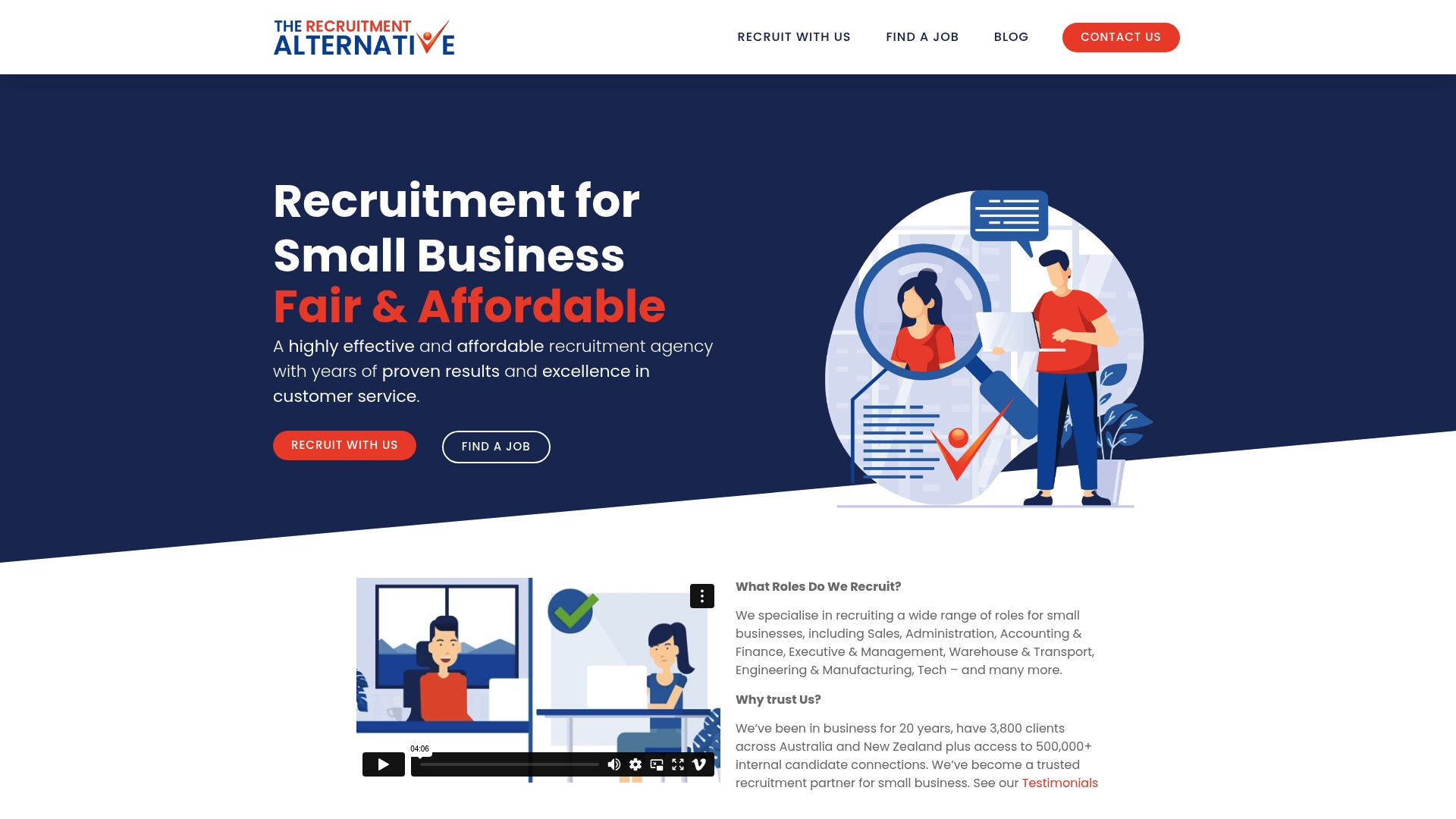
Outsourcing candidate search makes the most sense when you’re filling high-volume roles, hiring for a specialist skill set outside your team’s usual networks, or simply don’t have spare HR capacity this quarter. Because pricing is tiered by salary rather than charged as a percentage, you know the cost upfront, and replacement insurance covers you if a placement doesn’t work out in the first two to three months. If you’re weighing up internal hiring against outsourcing, check the flat-fee recruitment page and get a quote for your next role before your next vacancy stretches your team any thinner.
Frequently asked questions
How long should a new staff onboarding process take?
Most effective programs run for a full 90 days, not just the first week, with structured check-ins at 30, 60, and 90 days to track progress against agreed goals.
What’s the difference between induction and onboarding?
Induction is the short, administrative introduction covering safety, systems, and policy, usually completed within a week. Onboarding is the longer integration process that continues until the new hire is performing independently.
What should be in a new hire welcome pack?
Login credentials, an org chart, a role cheat sheet, and practical items like a parking pass or building access code, ideally ready before the new hire arrives.
Do I need a buddy system for onboarding to work?
It’s not mandatory, but assigning a buddy who checks in daily during the first fortnight significantly speeds up social integration and gives new hires a low-pressure person to ask small questions.
Is outsourcing onboarding to a recruitment agency an option?
Recruitment agencies typically handle candidate sourcing and placement rather than onboarding itself. A fixed-fee recruiter like The Recruitment Alternative can free up the internal time you need to run the onboarding plan properly once the right candidate is hired.
Sources
- 44% of new hires regret their decision within a week, BambooHR study finds
- Onboard new employees
- Employment contracts
- Onboarding — SHRM
Recommended
- Onboarding Success: Tips for Welcoming Your New Employee – The Recruitment Alternative
- Hiring new staff is a critical part of a company’s growth and doing it right is paramount to success. – The Recruitment Alternative
- 10 things to look for when hiring new staff – The Recruitment Alternative
- Tips to having happy staff – The Recruitment Alternative