

Workforce scalability hiring is the practice of aligning headcount, skills, and contract types so staffing levels can expand or contract with demand, without a full rebuild of your hiring process each time. The best high-level approach combines a permanent core team with flexible, on-demand workers, all supported by consistent, repeatable hiring processes.
Research on small business growth links this directly to alignment (having the right people, in the right place, at the right time) and fluidity (how quickly you can reallocate people when conditions change), as Lee Dyer and Jeff Ericksen’s workforce alignment research sets out. Get those two things right and scaling up or down stops being a crisis.
- A stable core of permanent staff for consistent, essential functions
- A bench of contractors, part-timers, or agency staff for peaks and projects
- Standardised job briefs, scorecards, and onboarding so quality doesn’t slip as you grow
The Recruitment Alternative works with businesses building exactly this mix, using a flat-fee model that removes much of the cost risk from testing a scalable hiring approach for the first time.
Key Takeaways
Scalable hiring works when a permanent core, a flexible staffing bench, and standardised processes operate together, not as separate initiatives.
| Point | Details |
|---|---|
| Definition first | Workforce scalability hiring means aligning headcount, skills, and contract types so staffing adjusts to demand. |
| Fix alignment and fluidity | Improving interview signal capture and role clarity typically pays back faster than buying new tools. |
| Mix your staffing models | Combine permanent core roles with contractors, part-timers, and agency staff for peaks. |
| Audit before you scale | A 30-day review of recent interviews usually reveals the real bottleneck: missing, inconsistent candidate data. |
| Pilot with a flat-fee partner | The Recruitment Alternative’s flat-fee model lets businesses trial scalable hiring with a defined, upfront cost. |
Table of Contents
- Core principles: alignment, fluidity, and elasticity
- Why workforce scalability matters for growing businesses
- Which staffing models actually support scalable hiring?
- How do you actually build scalable hiring, step by step?
- What are the common risks, and how do you manage them?
- How The Recruitment Alternative supports scalable hiring
- What the conventional advice on scalable hiring gets wrong
- Get started with flat-fee recruitment built for growth
- Frequently asked questions
- Sources
Core principles: alignment, fluidity, and elasticity
Two ideas do most of the heavy lifting in workforce scalability: alignment and fluidity. Alignment means your staffing matches actual demand, not last year’s org chart. Fluidity is how fast and cheaply you can move people, roles, or hours when demand shifts. Dyer and Ericksen’s research on small business sales growth treats these two factors as the real competitive advantage, not headcount size itself.
There’s a useful parallel with cloud computing here. IT teams talk about elasticity (scaling capacity up or down automatically) and the difference between horizontal scaling (adding more units, like servers or staff) and vertical scaling (upgrading the capability of existing units, like cross-training current employees). Research applying these concepts to workforce management shows the same logic works for staffing: elasticity and resource optimisation map directly onto workforce flexibility.
In HR terms, that gives you four dimensions to configure:
- Competence mix — what skills sit in-house versus on-call
- Headcount — how many people, at what commitment level
- Employee contribution — hours, output, or project scope per person
- Deployment pattern — where and when people are actually rostered
Statistic snapshot: Academic modelling of workforce scalability has even been used to test whether businesses can shift to a four-day work week by reallocating tasks and optimising deployment patterns, rather than simply adding headcount.
Why workforce scalability matters for growing businesses
Over-hiring during a good quarter is one of the most expensive mistakes a small business makes, because permanent salaries, superannuation, and leave entitlements don’t disappear when demand cools. A scalable approach controls that cost by keeping the permanent core lean and covering peaks with flexible labour instead.
The benefits compound from there:
- Lower long-term overheads compared with hiring permanent staff for temporary spikes
- Faster response to seasonality, since flexible arrangements like temporary staff, job sharing, and outsourcing are built for exactly this, as Encyclopedia confirms
- Reduced hiring risk, because a pre-built talent pool means you’re not starting from zero when demand hits
- Fewer panic hires, which are the ones most likely to turn into costly mismatches
None of this is free. Managing a mixed workforce adds complexity to onboarding, payroll, and compliance, and it demands more disciplined process than a straightforward permanent-only model. That trade-off is worth naming early, because it shapes every decision in the next section.
Which staffing models actually support scalable hiring?
A scalable workforce isn’t one model. It’s a deliberate mix, chosen role by role.
- Permanent core plus contingent bench. Keep your critical, ongoing functions as permanent hires, then build a vetted bench of contractors or agency staff who can be activated quickly. This is the backbone model for most growing small businesses.
- Part-time and job-share arrangements. These suit predictable but reduced-hours demand, such as a role that genuinely needs coverage five days a week but not full-time hours on any single day.
- Short-term agency staff for seasonal peaks. Retail, hospitality, and logistics businesses use this constantly to handle demand spikes without adding permanent headcount, a pattern well documented in Employment Enterprises’ guidance on planning for growth.
- Freelancers and project specialists. Best for defined, time-boxed work such as a website rebuild or a compliance audit, where you need deep skill for a finite period, not an ongoing role.
Maintaining a pre-vetted list of contractors and agency contacts before you need them is what separates businesses that scale smoothly from those that scramble. Temporary recruitment support can help build that bench without adding permanent payroll commitments.
Pro Tip: Review your contingent bench every quarter, even when you’re not actively hiring. A contractor who was available in March may not be in November, and a stale list is nearly as useless as no list at all.
How do you actually build scalable hiring, step by step?
Most businesses know they should be more scalable. Few have a concrete plan to get there. Here’s one that works without a large HR team behind it.
- Run a 30-day audit of your recent hiring. Pull your last ten to fifteen interviews and check for consistency. Practitioner experience across small HR teams consistently shows the biggest scaling bottleneck is “signal loss”: missing competency notes, inconsistent scoring, and no single source of truth for candidate data. Fixing this usually frees up more recruiter capacity than any new tool.
- Forecast demand against your business cycle. Map your sales and marketing calendar against past hiring triggers. If Q4 always brings a spike, that’s not a surprise anymore. It’s a scheduled hiring event.
- Build talent pools before you need them. Maintain warm relationships with past applicants, referred candidates, and contractor networks so you’re not starting sourcing from scratch when demand hits, a point scalable hiring strategy guides emphasise repeatedly.
- Standardise the process. Write consistent job briefs, build interview scorecards, and document onboarding steps once, then reuse them. Even a simple applicant tracking system (ATS) or shared spreadsheet dashboard beats ad hoc email threads.
- Pilot before you scale fully. Trial the new process on one role or one department first.
- Measure and iterate. Track time-to-fill, cost-per-hire, and three-month retention, then adjust before rolling the model out further.
- Missing a single source of truth for interview data is the most common (and most fixable) scaling bottleneck
- ATS adoption plus employer branding materially improves scale-up hiring outcomes
- A hiring plan aligned to your growth strategy beats one built reactively
Pro Tip: Standardising your interview scorecard alone often does more for time-to-hire than any software purchase. Small teams that fix this first typically see faster shortlists within one or two hiring cycles.
What are the common risks, and how do you manage them?
Scaling your hiring model changes how your business operates, and change always meets resistance somewhere. Managers who are used to owning every hire may resist a shared talent pool. Staff may be wary of contractors working alongside them. None of this is a reason to avoid scalable hiring, but it is a reason to manage the rollout deliberately.
- Communicate early with hiring managers about why the model is changing, not just what’s changing
- Train managers on the new process before launch, not after the first hiccup
- Pilot first in one team before a business-wide rollout
- Get contracts right. Worker classification (contractor versus employee) carries real legal weight in Australia, and getting it wrong is expensive. A clear employment contract framework protects both sides
- Build in quality controls, including structured interview rubrics, short trial periods, and replacement clauses for permanent hires that don’t work out
- Track contingent labour spend transparently so flexible staffing doesn’t quietly become more expensive than the permanent hires it was meant to replace
How The Recruitment Alternative supports scalable hiring
Building a scalable workforce usually starts with one honest question: can you afford to test a new hiring model without committing to a large upfront agency fee? The Recruitment Alternative was built around exactly that problem.
Its flat-fee recruitment model covers sales, administration, finance, engineering, healthcare, technology, trades, and executive roles, with pricing tiered by salary rather than charged as a percentage. That structure removes much of the financial risk small businesses face when piloting a new staffing mix for the first time, because you know the cost before you start, not after a candidate is placed.
Scalable hiring isn’t about having the biggest team. It’s about having the right mix of permanent and flexible people, with a process consistent enough that adding one more hire doesn’t mean reinventing the wheel.
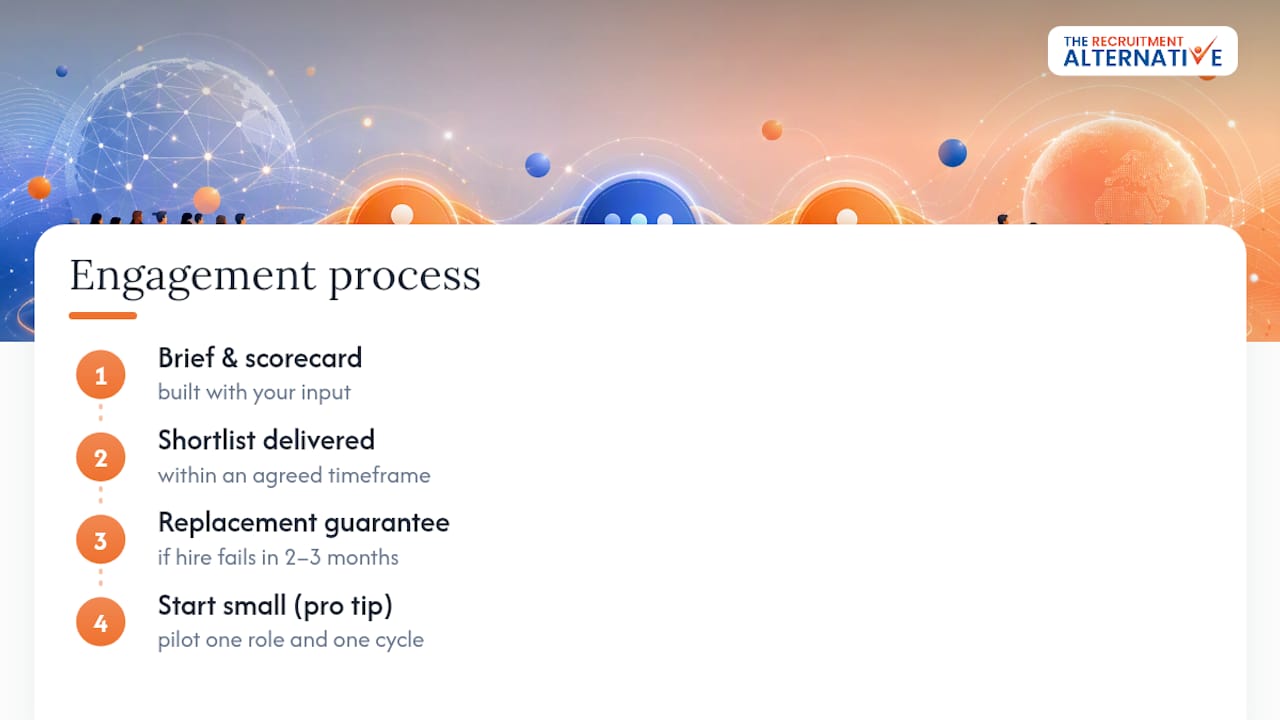
A typical engagement follows a defined path: a brief and scorecard built with your input, a shortlist delivered within an agreed timeframe, and a replacement guarantee if a permanent hire doesn’t work out within the first two to three months. That last point matters more than it looks. It’s the quality control layer that lets you scale confidently instead of cautiously.
Pro Tip: If you’re piloting a scalable hiring model for the first time, start with one role and one hiring cycle. A single successful placement builds the internal case for expanding the approach.
Readers can review what to look for in a recruitment agency before committing to any partner, flat-fee or otherwise.
What the conventional advice on scalable hiring gets wrong
Most guides on this topic treat scalability as a technology problem: buy the right ATS, automate the right workflow, and the rest follows. That’s backwards. The research on alignment and fluidity is clear that the biggest gains come from fixing how you capture and use interview information, not from the software stack sitting underneath it.
Small businesses often assume scalability means “hire more contractors.” It doesn’t. It means having a repeatable process that works whether you’re hiring your third employee or your thirtieth, and knowing in advance which roles belong in your permanent core versus your flexible bench. Skip that decision and you end up with contractors doing work that needed institutional knowledge, or permanent staff hired for a demand spike that never repeats.
If you take one thing from this guide, prioritise the audit before the tooling. Fix your interview scorecards and your single source of truth for candidate data first. Everything else, including whether to pilot a flat-fee recruitment model, becomes a much easier decision once that foundation is solid.
Get started with flat-fee recruitment built for growth
The Recruitment Alternative gives you a fixed, upfront cost for permanent placements instead of the percentage-of-salary model most agencies charge, which makes it a lower-risk way to pilot the scalable hiring approach outlined above. You know the cost before a candidate is even shortlisted, and every placement carries a replacement guarantee if the hire doesn’t work out in the first two to three months.
This suits businesses that need to fill a permanent role now, whether that’s one hire to test the model or several as you build out your core team, without committing to the higher fees that come with traditional commission-based agencies. The service spans sales, admin, finance, engineering, healthcare, technology, trades, and executive roles across Australia and New Zealand.
If you’re ready to see what a flat-fee approach costs for your next hire, check the simple flat-fee structure or head straight to flat-fee recruitment to start a conversation about your role.
Frequently asked questions
What is workforce scalability hiring, in simple terms?
It’s a hiring approach where headcount, skills, and contract types can expand or contract with business demand, typically through a mix of permanent staff and flexible workers, rather than relying on one fixed staffing model.
How is workforce scalability different from just hiring more staff?
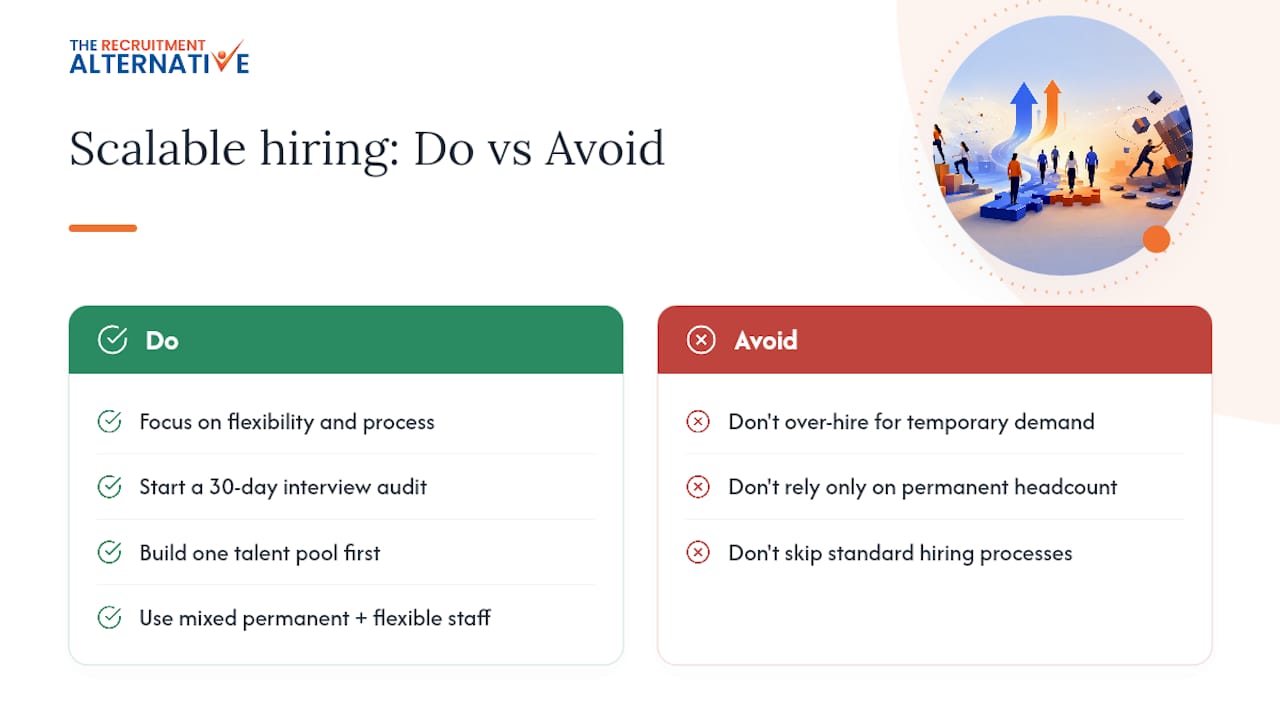
Scalability focuses on flexibility and process, not just numbers. It’s about being able to adjust your workforce quickly and cheaply, which requires prepared talent pools and standard processes, not just adding permanent headcount.
What’s the fastest way to start scaling hiring in a small business?
Start with a 30-day audit of your recent interviews to find where information is being lost, then build one talent pool for your most frequently hired role before expanding the approach further.
Does workforce scalability hiring cost more than traditional hiring?
Not usually. Over-hiring for temporary demand tends to cost more long-term than a mixed model of permanent and flexible staff, especially once ongoing salary and entitlement costs are factored in.
Is a flat-fee recruitment model suited to scalable hiring?
Yes. A fixed, upfront cost per placement makes it easier to budget for growth-stage hiring, which is why it’s a practical starting point for businesses piloting scalable staffing for the first time.
Sources
- Workforce alignment, human resource scalability and small business sales growth — Lee Dyer & Jeff Ericksen (ResearchGate)
- Scalability in workforce management: applying scalability principles to foster a four-day work week (arXiv)
- Encyclopedia
- Why and how to build a scalable workforce — Employment Enterprises
Recommended
- How to create a hiring strategy for a growing business – The Recruitment Alternative
- How recruitment supports business growth in 2026
- Why Recruitment Support for SMEs Drives Growth and Stability – The Recruitment Alternative
- High volume hiring best practices for Australian employers – The Recruitment Alternative

