

Hiring budget planning is the process of forecasting and controlling every dollar spent to fill a role, from the first job ad to the new hire’s first pay cheque. It ties planned headcount to business outcomes, so leadership can see exactly what growth costs before it happens.
Three things to do right now:
- Pull last year’s recruitment spend from finance or your own records as a baseline.
- Multiply planned hires by average cost-per-hire for each role type to build a forecast.
- Add a contingency buffer for urgent replacements or salary surprises.
Open that spreadsheet today. Even a rough baseline beats guessing.
Table of Contents
- What is a recruitment budget, exactly?
- What cost categories belong in a hiring budget?
- How do you calculate a recruitment budget?
- Which metrics prove your recruitment budget is working?
- How can you stretch a fixed recruitment budget further?
- What roadblocks derail hiring budget planning?
- How do you build a simple recruitment budget template?
- Frequently asked questions
- Sources
What is a recruitment budget, exactly?
A recruitment budget is a structured financial plan covering sourcing, selection, tooling, onboarding, and the internal time staff spend on hiring. It’s not just an advertising line item. It’s the full cost of getting someone into a seat and productive.
The plan serves three purposes: it controls costs before they spiral, aligns each hire to a business outcome (revenue target, project deadline, service level), and gives you a lever to trade speed against cost when leadership asks “can we go faster?”
Ownership matters here. HR typically owns the plan itself, finance approves the numbers and sits across cash flow, and hiring managers feed in role-level detail, like whether a role needs specialist screening or relocation support.
- HR: builds and maintains the plan
- Finance: approves and monitors against forecast
- Hiring managers: supply role specifics and urgency
What cost categories belong in a hiring budget?
Most budgets miss categories because they only think about job ads. A complete recruitment budget spreads across nine buckets:
- Sourcing and advertising — job boards, LinkedIn campaigns, employer brand content
- Agency or RPO fees — either percentage-of-salary or fixed-fee models
- Internal time — recruiter hours and hiring manager hours spent screening and interviewing
- Assessment and screening — psychometric tools, skills tests, background checks
- Tools and ATS — applicant tracking systems, sourcing platforms
- Onboarding and equipment — laptops, software licences, induction time
- Relocation support — for interstate or international hires
- Referral bonuses — payouts for employee-sourced candidates
- Contingency — buffer for urgent or unplanned hires
Agency fees deserve a closer look. Traditional contingency agencies typically charge a percentage of the candidate’s salary, which means your cost per hire can vary with pay negotiations. Fixed-fee recruitment locks that cost in advance, which is exactly why it appears again later in this guide as a budgeting lever rather than just a service option. Hidden costs like internal screening time and slow-fill delays often dwarf the advertised agency fee.
Pro Tip: Track internal time in hours, not vibes. A hiring manager who spends six hours screening resumes for a role has a real cost, even if no invoice shows up.
How do you calculate a recruitment budget?
Three steps turn a vague hiring wish list into a number finance will approve.
- Baseline. Pull last year’s actuals by category: advertising spend, agency invoices, tooling subscriptions, referral payouts. This is your starting point, not your forecast.
- Forecast. Multiply planned hires by average cost-per-hire for each role type, then add fixed annual costs like your ATS subscription or recruiter salaries. 4Corner Resources frames this as Total Recruiting Budget = (estimated hires × average cost per hire) + fixed annual costs, which is a formula worth pinning above your desk.
- Sensitivity. Model a best case (hires go smoothly, low churn) and a worst case (two roles need urgent replacement, salaries jump 10% due to market pressure). Add a contingency line for both.
Profitual recommends separating committed hires from projected ones in this forecast step, since a role you’ve already approved carries a different budget certainty than one you’re merely planning for next quarter. Practitioners commonly build in a non-negotiable contingency buffer for unplanned replacements and mid-year salary inflation. Treat that buffer as a standing line, not an afterthought you add when something breaks.
Which metrics prove your recruitment budget is working?
Numbers justify spend and tell you where to shift budget mid-year. Six metrics matter most:
- Cost-per-hire (CPH) — total spend divided by number of hires
- Time-to-fill — days from role approval to offer acceptance
- Time-to-productivity — days from start date to full performance
- Cost-per-qualified-candidate (CPQC) — spend divided by candidates who actually meet the brief
- Source yield — which channels produce hires, not just applicants
- 90-day retention — whether the hire sticks past probation
Breezy HR argues time-to-productivity matters more than time-to-fill, because a fast, sloppy fill that takes months to become productive costs more than a slower, better one. If you lack internal history to benchmark against, Jobs and Skills Australia’s employment projections offer a useful external reference point for forecasting demand and expected hiring volumes in your sector.
How can you stretch a fixed recruitment budget further?
Getting more value from the same budget usually comes down to four moves.
- Fix process bottlenecks first. Slow interview scheduling and indecisive hiring committees cost more than any ad spend line. Speeding up decisions shortens time-to-fill without spending a cent more.
- Shift toward higher-yield channels. Employee referrals and your own candidate database typically produce better quality-of-hire at a lower CPQC than paid job ads.
- Reallocate ruthlessly. Track CPQC by source monthly and cut channels that aren’t producing qualified candidates, even if they’re cheap upfront.
- Consider fixed-fee recruitment for predictability. When hiring volume is steady, a flat-fee model removes the variability of percentage-based agency billing, which makes forecasting genuinely easier.
Pro Tip: Run a quarterly source audit. If a job board delivered zero qualified candidates last quarter, stop paying for it before renewing, not after.
Sourcing strategy matters as much as spend allocation. Structured sourcing steps for technical roles can lift yield meaningfully in tight skill markets, where the wrong channel wastes budget fast.
What roadblocks derail hiring budget planning?
Three problems show up again and again.
- No data to justify requests. Fix this by running a baseline exercise before you ask finance for anything. A number beats an opinion every time.
- Treating recruitment as one lump sum. Budget by category instead, and assign an owner to each one, so no single line item quietly blows out unnoticed.
- Reactive cuts during a downturn. Protect committed hires (roles already approved and underway) and trim discretionary spend, like employer brand campaigns, before cutting anything mid-process.
A quiet fourth problem: internal time rarely gets counted. If a hiring manager spends four hours a week for six weeks screening candidates for one role, that’s roughly 24 hours of loaded salary cost that never appears on an invoice but absolutely appears in your budget reality.
How do you build a simple recruitment budget template?
Three tabs, one spreadsheet. This structure works whether you’re hiring for one role or fifty.
Tab 1: Baseline. Last year’s actuals by cost category. Nothing fancy, just what you actually spent.
Tab 2: Forecast. Planned hires × average cost-per-hire by role type, plus fixed annual costs (ATS, recruiter salaries, employer brand retainer).
Tab 3: Sensitivity. Best case, worst case, and contingency scenarios for urgent replacements or salary shifts.
Essential columns across the sheet: role, start date, hire type (permanent, contract, executive), estimated CPH, fixed costs, budget owner, actual spend, and variance. A simple CPH formula: total category spend ÷ number of hires in that category. Report monthly against budget, and keep a leadership dashboard down to three things: total spend versus budget, top three sources by CPQC, and roles still open past target fill date. Workable’s spreadsheet-style breakdown is a useful reference if you’re starting from scratch.
Publisher perspective: why we favour fixed-fee recruitment
We favour transparent, fixed-fee recruitment when cost visibility and stability matter more than anything else, particularly for high-volume or budget-constrained hiring. It won’t suit every scenario. A niche executive search often benefits more from a contingency model built around exclusivity and speed. But if finance wants a predictable cost-per-hire figure they can plan against, fixed-fee removes the guesswork entirely.
Getting your recruitment budget right protects both the outcome and the process behind it: a well-structured plan turns hiring from a reactive expense into a forecastable business investment.
| Point | Details |
|---|---|
| Start with a baseline | Pull last year’s actual recruitment spend by category before forecasting anything new. |
| Use the standard formula | Total budget = (planned hires × average cost-per-hire) + fixed annual costs. |
| Track time-to-productivity | Measure how long a hire takes to perform, not just how long they took to find. |
| Build in contingency | Reserve budget for urgent replacements and mid-year salary movement as standard practice. |
| Consider fixed-fee models | Flat-fee recruitment reduces cost variability compared with percentage-of-salary agency billing. |
Where to go for deeper reading and templates
- Jobs and Skills Australia: recruitment activity trends for labour-market signals feeding hiring forecasts
- Breezy HR’s recruitment budget guide for template tabs and productivity metrics
- Profitual’s hiring plan framework for committed versus projected hire forecasting
- 4Corner Resources’ budget formula guide for the fixed-versus-variable cost breakdown
- Workable’s spend tracking tutorial for a spreadsheet-style example
Frequently asked questions
What is hiring budget planning in simple terms?
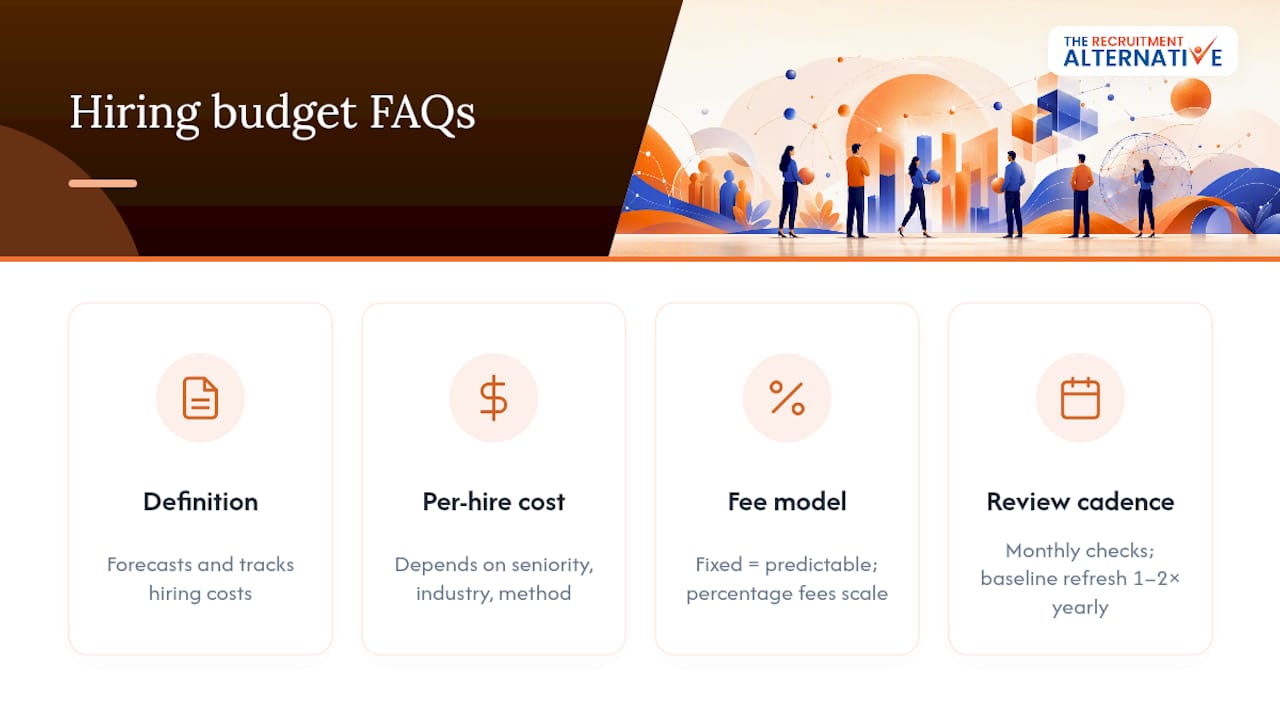
It’s the process of forecasting and tracking every cost involved in filling a role, from sourcing through onboarding, so spend stays tied to actual business needs rather than guesswork.
How much should a business budget per hire?
There’s no single figure that applies universally, since it depends on role seniority, industry, and hiring method. Building your own baseline from past spend gives a far more reliable number than any generic average.
What’s the difference between a hiring budget and a recruitment budget?
They’re generally used interchangeably. Both refer to the planned spend and cost categories tied to filling open roles, whether that’s one hire or fifty.
Is fixed-fee recruitment cheaper than a traditional agency?
It’s typically more predictable rather than always cheaper outright, since fixed-fee models charge a set price regardless of salary, while percentage-based agencies scale their fee with the offer, which can cost more for senior hires.
How often should a recruitment budget be reviewed?
Monthly reviews against forecast catch variance early, while a full sensitivity and baseline refresh once or twice a year, often around EOFY or quarter boundaries, keeps the plan aligned with actual business cycles.
Sources
- Recruitment activity rise — Jobs and Skills Australia
- Employment projections — Jobs and Skills Australia
- 11 Ways to Get More Out of Your Recruitment Budget in 2026 — Breezy HR
- Building a hiring plan into your financial forecast — Profitual
- Recruiting budget: How to build & manage one in 2026 — 4Corner Resources
Recommended
- What is hiring manager partnership and why it matters
- How to create a hiring strategy for a growing business – The Recruitment Alternative
- How to build a recruitment budget in australia 2026
- Hiring new staff is a critical part of a company’s growth and doing it right is paramount to success. – The Recruitment Alternative

