

The most reliable way to hire across multiple industries is to build your process around three to five core competencies, not job titles. A skills-first playbook, anchored by structured scorecards and short work samples, lets you evaluate a logistics coordinator and a healthcare administrator against the same standard and pick the better performer every time. Start right now: pull up your most urgent vacancy and write down three non-negotiable competencies the person must demonstrate on day one.
Why does this beat industry-only hiring? Because the Business confirms that the most common hiring mistakes come from poorly defined roles, not from candidates who lack industry badges. When you define what “good” looks like in behavioural terms, a candidate from an adjacent sector can demonstrate it just as clearly as a same-industry veteran. Transferable skills hiring also expands your candidate pool and speeds time-to-hire when role design focuses on capability rather than pedigree.
Key takeaways
A skills-first, standardised hiring playbook is the most reliable way to hire across multiple industries without rebuilding your process for every new sector.
| Point | Details |
|---|---|
| Start with competencies | Define three to five non-negotiable competencies before writing the job ad or choosing a sourcing channel. |
| Confirm engagement type early | Check employee vs contractor classification against Fair Work criteria before posting any role. |
| Use structured scorecards | Rate every candidate against the same competencies using anchored evidence notes to reduce bias. |
| Plan the 30–90 day onboarding | Document milestones, assign a buddy, and schedule formal check-ins before the new hire’s first day. |
| The Recruitment Alternative | Covers permanent placements across all major industries under a flat-fee model with a replacement guarantee. |
Table of Contents
- How to hire across multiple industries: choosing the right employee type first
- Estimating hiring costs and realistic timelines by seniority
- How to write a skills-first job description that attracts cross-industry candidates
- Where to find candidates and how to adapt sourcing by industry
- Screening, structured interviews and scorecards: a repeatable selection system
- A 30–90 day onboarding plan that reduces early churn
- Compliance checks and contracts: what to confirm before you make an offer
- Flat-fee recruitment that works across every industry
- Sources
How to hire across multiple industries: choosing the right employee type first
Before you write a single line of a job ad, confirm what kind of engagement you actually need. Getting this wrong creates payroll errors, super shortfalls, and potential Fair Work liability.
The quick rule of thumb: if you control how the work is done, set the hours, and supply the tools, you almost certainly have an employee, not a contractor. Fair Work’s types of employees guidance sets out the classification factors in plain language and is the first document to read before you post any role.
Common engagement categories:
- Full-time employee: 38 ordinary hours per week, full entitlements (annual leave, personal leave, super). Suits ongoing roles with predictable workloads.
- Part-time employee: Fewer than 38 hours per week, pro-rata entitlements. Good for roles where a full-time load is not justified.
- Casual employee: No guaranteed hours, no paid leave, but a casual loading applies (currently 25% on top of the base rate). Suits variable or seasonal demand.
- Fixed-term employee: Employed for a defined period or project. Full entitlements apply; note that repeated fixed-term contracts can create ongoing employment obligations under Fair Work rules.
- Contractor/consultant: Engaged for a specific outcome, uses their own tools, sets their own hours, and typically invoices via ABN. Super may still apply depending on the arrangement.
Classification checklist before you commit:
- Does the worker set their own hours, or do you?
- Who supplies the tools and equipment?
- Can the worker subcontract the work?
- Is the worker integrated into your business operations?
- Does an applicable modern award cover this role?
Pro Tip: Run this decision before you draft the job ad. Misclassifying a worker as a contractor when they are legally an employee can trigger back-pay of entitlements, super, and penalties. A five-minute classification check now prevents months of remediation later.
Estimating hiring costs and realistic timelines by seniority
Hiring costs catch many employers off guard because they extend well beyond the recruiter’s fee. The total cost of a hire typically includes advertising, recruiter or agency fees, payroll setup, induction time, and the productivity gap while the seat is empty.
Use the Fair Work award finder to confirm the applicable modern award and minimum pay rate before you build any cost estimate. Award coverage affects base salary, penalty rates, allowances, and leave loading, all of which flow directly into your payroll cost.
Typical time-to-hire by seniority:
- Entry-level roles: 2–4 weeks from ad to offer
- Mid-level professional roles: 4–6 weeks
- Senior specialist or management roles: 6–10 weeks
- Executive roles: 10–16 weeks (see executive recruitment guidance for senior-specific considerations)
Worked example for an SME hiring a mid-level role:
Say you are hiring an operations coordinator at $75,000 per annum. A rough first-year cost estimate might look like this: job board advertising at $400–$600, a flat-fee recruiter engagement at $4,000–$6,000, payroll setup and STP enrolment at minimal cost if you use accounting software, super at roughly $8,625 for the year, and an estimated four weeks of reduced productivity during handover. Total first-year cost of hire: approximately $13,000–$16,000 before salary. That figure is why getting the hire right the first time matters more than saving a few hundred dollars on the ad spend.
How to write a skills-first job description that attracts cross-industry candidates
Write the job description around outcomes and competencies, not around the last person who held the role. A JD that opens with “must have five years in [specific industry]” filters out capable candidates before they read the second line.
Template elements for a skills-first job description:
- Role outcome: One sentence describing what success looks like in 12 months (e.g. “The operations coordinator will have reduced order processing time by 20% and built a reliable supplier communication rhythm”).
- Three to five non-negotiable competencies: Behavioural capabilities the role genuinely requires (see examples below).
- Nice-to-haves: Industry-specific knowledge or credentials that are helpful but not deal-breakers.
- Day-to-day accountabilities: Four to six concrete tasks the person will own.
- Measurable success indicators: Specific, observable outputs tied to the first 30, 60, and 90 days.
Examples of transferable competencies that work across industries:
- Stakeholder management (healthcare, project management, sales, government)
- Data literacy and reporting (finance, logistics, technology, administration)
- Client-facing communication (retail, professional services, trades, consulting)
- Safety-critical attention to detail (manufacturing, construction, healthcare, aviation)
- Process improvement and documentation (operations, IT, aged care, education)
A skills-based matching approach helps both employers and candidates identify where capability overlaps with role requirements, regardless of industry background.
Pro Tip: To convert a technical requirement into a work sample, ask: “What would a competent person produce in the first two weeks?” Then design a short task around that output. A 45-minute data reconciliation exercise reveals more about analytical accuracy than any certificate, and it is equally fair to candidates from banking, healthcare, or logistics.

Where to find candidates and how to adapt sourcing by industry
Diversify your sourcing channels. Relying on a single job board for every role is the fastest way to get a shallow, same-industry shortlist. The most effective multi-industry sourcing strategies combine job boards with specialist networks, employee referrals, industry communities, campus pipelines, and contingent talent pools.
Channel options and the roles they suit best:
- Seek and Indeed: Broad reach for most professional, administration, and trades roles; strong for entry-to-mid level.
- LinkedIn: Mid-to-senior professional roles, management, technology, finance, and executive search.
- Trade-specific forums and associations: Electricians, plumbers, engineers, and safety professionals; often faster than generalist boards for licensed trades.
- University and TAFE networks: Graduate and early-career roles across engineering, healthcare, business, and technology.
- Employee referrals: Consistently one of the highest-quality sourcing channels across all industries; incentivise formally.
- Industry associations and communities: Niche but high-signal for specialist roles (e.g. nursing peak bodies, engineering institutes, accounting associations).
- Contingent and temp-to-perm pools: Useful when you want to assess a cross-industry candidate before committing to a permanent hire.
When to use a specialist recruiter vs. run it in-house:
Use a specialist recruiter when the role is senior, the talent pool is narrow, or you need a shortlist within two to three weeks. Run the hire in-house when the role is entry-to-mid level, the competencies are clearly defined, and you have time to manage the process. Combine both approaches for high-volume hiring across multiple roles simultaneously, which is where a generalist recruitment agency that covers many sectors adds the most value.
Employer branding for cross-industry appeal: Write job ads that describe the work and the team, not the industry. Phrases like “you will have worked in a fast-paced environment managing competing priorities” attract candidates from retail, healthcare, and logistics equally. Avoid industry jargon in the ad headline; save it for the role brief shared with shortlisted candidates. Attracting talent through your brand is a practical starting point for employers refining their messaging.
When hiring people with disability, JobAccess guidance on interviewing covers reasonable adjustments you should offer at the interview stage, from accessible venues to alternative assessment formats.
Screening, structured interviews and scorecards: a repeatable selection system
Use structured interviews and short, job-relevant work samples as the backbone of selection. Unstructured interviews are the single biggest source of bias in cross-industry hiring because they reward familiarity with industry jargon rather than actual capability.
Components to include in a hiring scorecard:
- Each of the three to five core competencies listed in the JD
- A 1–5 rating scale with anchored descriptors (1 = no evidence, 3 = clear evidence, 5 = exceptional evidence)
- An “evidence notes” field for each competency where the interviewer records specific examples
- A “red flags” field for concerns to probe in reference checks
- An overall recommendation: progress, hold, or decline
Selection process in order:
- CV screen against the competency checklist: Does the candidate’s history show evidence of the three to five core competencies? Ignore job titles; read for outcomes.
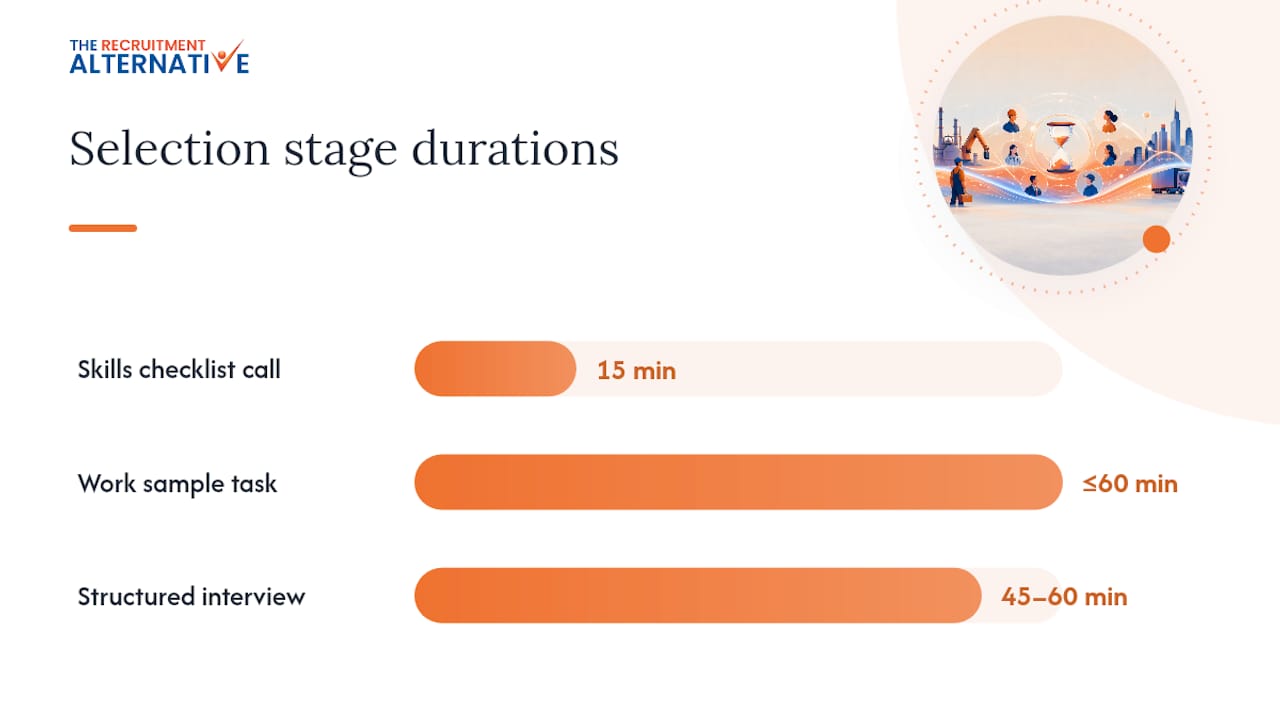
- Skills checklist call (15 minutes): Confirm availability, salary expectations, and ask one competency question to gauge communication.
- Work sample task: A short, practical exercise mirroring the role’s real early challenges. Keep it under 60 minutes; longer tasks disadvantage candidates from other industries who are unfamiliar with your terminology.
- Structured interview (45–60 minutes): Behavioural questions mapped to each competency, asked in the same order for every candidate.
- Reference checks: Two referees, at least one direct manager.
Sample behavioural interview questions by competency:
- Stakeholder management: “Tell me about a time you had to align two groups with conflicting priorities. What did you do and what was the outcome?”
- Data literacy: “Describe a situation where you used data to change a decision. What data did you use and how did you present it?”
- Safety-critical attention to detail: “Give me an example of when you caught an error before it became a problem. How did you find it?”
Reference check checklist:
- Confirm dates of employment and role title
- Ask: “How did [candidate] handle situations where they had to learn something new quickly?”
- Ask: “Would you rehire them? Why or why not?”
- Note any hesitation or qualification in the referee’s answers
A recruitment process tip sheet covers additional screening steps and scorecard templates you can adapt for your own hiring panels.
A 30–90 day onboarding plan that reduces early churn
A structured 30–90 day plan reduces early turnover and speeds competency transfer for cross-industry hires. Without it, new starters spend their first month figuring out who to ask rather than doing the work they were hired for.
Milestone framework:
- Days 1–30 (orient and connect): Complete all paperwork, meet key stakeholders, shadow core processes, attend any mandatory inductions (WHS, systems, compliance). Manager check-in at end of week one and week four.
- Days 31–60 (contribute and build): Take ownership of one defined workstream, complete any role-specific training, establish working rhythms with the team. Manager check-in fortnightly.
- Days 61–90 (deliver and evaluate): Achieve the first measurable success indicator from the JD, complete probation review, set 90-day-to-six-month goals. Formal probation check-in at day 85–90.
Onboarding checklist:
- Signed employment contract and Fair Work Information Statement provided
- TFN declaration and super choice form completed
- IT access, tools, and equipment provisioned before day one
- Buddy or mentor assigned from within the team
- Role-specific training schedule confirmed for weeks one to four
- WHS induction completed and recorded
- 30/60/90-day goals documented and shared with the new hire
Cultural induction for cross-industry hires: Assign a buddy who can translate internal language and explain unwritten norms. Cross-industry hires often have strong capability but need a decoder for the organisation’s specific way of working. A two-week check-in question as simple as “What’s still confusing?” surfaces friction before it becomes a resignation.
Fair Work’s probation guidance explains what reasonable probation terms look like and what obligations apply during that period.
Compliance checks and contracts: what to confirm before you make an offer
Confirm award coverage, correct classification, super and tax obligations, right-to-work status, and WHS obligations before you make any offer. These are not optional steps; they are the legal floor for every hire in Australia.
The Fair Work awards page explains modern award coverage and how to confirm which award applies to a role. If you are unsure, use the Find My Award tool to identify the correct instrument before setting a salary.
Documents to collect at offer or on day one:
- Signed employment contract (use Fair Work contract templates as a starting point)
- Fair Work Information Statement (mandatory for all new employees)
- Small Business Fair Dismissal Code (if you employ fewer than 15 people)
- TFN declaration form completed and lodged via Single Touch Payroll
- Superannuation choice form (or stapled fund details from the ATO)
- Proof of identity (passport or driver’s licence)
- Visa evidence and right-to-work confirmation for non-citizens (check via the Department of Home Affairs visa conditions tool)
- Qualifications or licences where the role legally requires them (e.g. nursing registration, electrical licence, security licence)
Probation reminders:
- Probation periods are not set by law; they are agreed in the contract. Six months is common for most roles.
- Unfair dismissal protections under Fair Work apply after the minimum employment period (six months for employers with 15 or more employees; one year for small businesses).
- Document performance concerns in writing during probation; verbal-only feedback creates risk if the employment ends.
WHS obligations: Every employer must provide a safe workplace, conduct a risk assessment for the role, and induct new starters into relevant safety procedures before they begin work.
Why standardising your hiring playbook makes cross-industry hiring scalable
Standardisation reduces time-to-hire, improves quality, and makes it possible to run the same hiring process for a sales role, a trades role, and a technology role without rebuilding from scratch each time. When your scorecards, screening questions, and onboarding plans are documented, any manager in your business can run a hire to the same standard.
The evidence supports this. Multi-industry recruitment strategy research consistently highlights that employers who build broader sourcing channels and standardised evaluation frameworks attract better cross-industry candidates and make faster decisions. Treating your talent pipeline like a portfolio, with defined approaches for core, emerging, and peripheral roles, is how engineering and multi-industry talent strategies scale without losing rigour.
Three steps to implement a standardised playbook:
- Step 1: Build a master scorecard template with your five most common competencies and a rating scale. Adapt it per role by swapping in role-specific competencies; keep the structure identical.
- Step 2: Train every interview panel member on behavioural questioning technique before they sit in an interview. A 30-minute briefing before the first panel session is enough to align scoring.
- Step 3: Run a pilot for one role using the full playbook, then debrief the hiring manager on what worked and what to adjust. One pilot cycle is usually enough to validate the process.
Pro Tip: Capture the new hire’s 90-day performance data and compare it against their scorecard ratings. If high scorers consistently perform well and low scorers struggle, your scorecard is working. If the correlation is weak, revisit your competency definitions before the next hire.
What cross-industry hiring actually teaches you about your own business
There is a version of this conversation that most hiring guides skip entirely: what cross-industry hiring reveals about the assumptions baked into your existing roles.
When you force yourself to write a job description around competencies rather than industry history, you often discover that half the “requirements” in your old JDs were proxies for familiarity, not predictors of performance. A “must have five years in financial services” requirement frequently means “we want someone who already knows our jargon,” which is a training problem, not a hiring criterion.
The most instructive hires are the ones where a candidate from an adjacent sector outperforms same-industry candidates in the first 90 days. It happens more often than most hiring managers expect, particularly in roles where analytical thinking, stakeholder communication, or process discipline matter more than product knowledge. Product knowledge transfers in weeks; judgment and work ethic do not.
There is also a structural argument for cross-industry hiring that rarely gets made plainly: insular hiring compounds over time. Teams that only hire from within the same sector develop shared blind spots. Leaders from adjacent industries bring complementary mental models and challenge assumptions that have calcified into “the way we do things here.”
The practical lesson is not to abandon industry experience as a criterion. It is to treat it as a nice-to-have unless the role genuinely requires a licence, a regulated qualification, or deep technical knowledge that cannot be transferred quickly. For most roles, it can.
Flat-fee recruitment that works across every industry
Hiring across sales, administration, engineering, healthcare, technology, and trades does not have to mean rebuilding your recruitment process from scratch for each sector. The Recruitment Alternative delivers permanent staff placements across all of these industries under a transparent flat-fee model, so you pay a fixed price per successful hire rather than a percentage of salary.
For Australian SMEs, that distinction is significant. The Recruitment Alternative’s flat-fee pricing tiers are structured by candidate salary band and come with a candidate replacement guarantee if the hire does not work out within the first two to three months. The service covers sourcing, screening, structured interviews, and shortlist delivery, so your team focuses on the final decision, not the process overhead.
If you are ready to fill a role now, get in touch with The Recruitment Alternative to discuss your vacancy and receive a shortlist built around the competencies that matter for your business.
Sources
These official resources support the steps covered throughout this guide:
- Guide to hiring employees
- Types of employees — Fair Work
- Find my award — Fair Work services
- Interviewing people with disability — JobAccess
- Tax file number declaration — ATO

