

Values-based recruiting is a structured hiring approach that assesses whether a candidate’s personal values, behaviours and attitudes align with the lived operating values of your organisation, not just their technical qualifications. Done well, it predicts long-term retention, team cohesion and cultural health better than skills screening alone. The industry term you’ll encounter in toolkits and academic literature is “values-based recruitment” (VBR), and it sits alongside skills assessment rather than replacing it.
A values-based hiring process typically includes:
- Defined lived values — the 3–5 operating values your team actually demonstrates day to day, not aspirational statements on a wall
- Behavioural criteria — each value translated into observable, measurable behaviours
- Structured assessment — behavioural interview questions, independent scoring and documented evidence
- Role briefings that communicate values expectations to candidates and external recruiters
- KPI tracking to measure retention and quality of hire post-placement
Organisations such as Skills for Care have developed full VBR toolkits, and NHS England has embedded values-based selection into clinical hiring at scale. The Recruitment Alternative applies the same principles across Australian SMEs and larger employers.
Pro Tip: Start with 3 core operating values, not a long aspirational list. Assessing more than 5 values in a single hiring process dilutes rigour and overwhelms interviewers.

Key takeaways
Values-based recruiting delivers measurably better retention and team cohesion when built on defined lived values, structured behavioural assessment and consistent KPI tracking.
| Point | Details |
|---|---|
| Start with lived values | Audit what your best performers actually do, then select 3–5 values your organisation currently demonstrates. |
| Translate to behaviours | Write a one-sentence behavioural definition for each value before building any interview questions. |
| Use structured assessment | One STAR-format question per value, independently scored on a 1–4 rubric, prevents gut-feel bias. |
| Track retention at 12 months | Compare retention for values-assessed hires against your historical baseline to validate the process. |
| The Recruitment Alternative | Provides flat-fee, values-led permanent recruitment across Australia with candidate replacement insurance included. |
Table of Contents
- Why does values-based recruiting matter for Australian employers?
- Culture-fit, culture-add and keeping values assessment fair
- How to implement values-based recruiting: a step-by-step framework
- How do you assess values fairly in interviews?
- How do you measure the success of values-based hiring?
- What are the common pitfalls and legal considerations for Australian employers?
- Useful templates and resources to get started
- What does recent research and market evidence show?
- How The Recruitment Alternative applies values-based recruiting in practice
- The Recruitment Alternative: flat-fee values-led hiring for Australian employers
- Sources
Why does values-based recruiting matter for Australian employers?
Skills get a candidate through the door. Values determine whether they stay and contribute.
A Tiger Recruitment survey cited by Forbes found that nine in ten people would not work for an organisation that did not share their personal values. For Australian employers competing for talent in a tight labour market, that figure has a direct bearing on attraction and offer acceptance rates.
The business case goes beyond attraction. Skills are table stakes: most shortlisted candidates can do the job. Values alignment is what separates the hire who thrives at 12 months from the one who exits at six. Skills for Care’s VBR toolkit reports employer feedback of reduced recruitment costs and lower turnover where values-based recruitment is applied consistently, though the underlying research dates to 2016 and local pilots are worth running to establish your own baseline.
Measurable benefits employers typically report include:
- Lower voluntary turnover at the 6–12 month mark, reducing vacancy and rehiring costs
- Faster onboarding because values-aligned hires adapt to team norms more quickly
- Stronger team cohesion, particularly in customer-facing and care-sector roles
- Clearer hiring decisions — structured behavioural evidence replaces gut-feel assessments
- Stronger employer brand, especially with candidates who research culture before applying
For SMEs, the ROI is particularly tangible. Replacing a mid-level employee can cost the equivalent of several months’ salary when you account for lost productivity, advertising, and onboarding time. A single well-structured values interview that prevents one poor hire pays for the process many times over.
Culture-fit, culture-add and keeping values assessment fair
Not all values-based hiring is equal. The most common mistake is conflating values alignment with cultural fit, which often becomes a proxy for “people like us.” That narrows your talent pool and introduces bias.
Stated values versus lived values is the first distinction to get right. Stated values are what appears in your annual report. Lived values are what your team actually rewards, tolerates and models on a Tuesday afternoon. Hiring against stated values that leadership does not demonstrate creates a disconnect new hires notice within weeks, a problem practitioners call value-washing.
Culture-add is the more defensible frame. Rather than asking “will this person fit in?”, you ask “does this person share our core operating values, and do they bring perspectives or experiences that strengthen the team?” Structured values assessment widens rather than narrows the talent pool when values are defined as observable behaviours rather than vague aspirational statements.
Fairness principles to embed from the start:
- Write a behavioural definition for each value so every interviewer assesses the same thing
- Use structured questions — the same questions, in the same order, for every candidate
- Score independently before panel discussion to prevent anchoring
- Document evidence from each interview, not just a score
- Run demographic outcome audits at least annually to detect whether any group is being screened out disproportionately
Pro Tip: Before changing your hiring criteria, run an internal values audit. Ask your best performers what behaviours they see rewarded and what they see tolerated. The gap between those two answers tells you where your lived values actually sit.
How to implement values-based recruiting: a step-by-step framework
This framework draws on practical implementation guidance for building end-to-end values-based processes. Adapt the time estimates to your organisation’s size and hiring volume.
-
Audit your current values — survey high performers and long-tenured staff. Identify 3–5 behaviours that consistently appear. Discard aspirational values that are not yet demonstrated at leadership level.
-
Select 3–5 core operating values — choose values that are genuinely differentiating for your organisation, not generic (“integrity”, “teamwork”). Name them specifically: “customer accountability” is more assessable than “customer focus.”
-
Translate each value to behaviours — write a one-sentence behavioural definition and two or three observable indicators. Example: Customer accountability = “Takes ownership of a customer issue through to resolution without being prompted, even when the cause sits outside their direct responsibility.”
-
Write the role brief and job description — include a values section in every role brief. Describe the behaviours you expect, not just the skills. Values-based job advertising uses language like “you take ownership of problems” rather than “strong communication skills required.” This self-selects for aligned candidates before the first screen.
-
Source and attract — share your values content through your careers page, LinkedIn and any job boards you use. Brief any external recruiter with your behavioural definitions, not just the job title and salary band. Hiring for culture starts at the attraction stage.
-
Stage your assessment process:
- CV screen: look for evidence of the behaviours in how candidates describe past roles
- Values interview: one structured behavioural question per value (STAR format), independently scored
- Skills assessment: technical test, work sample or case study
- Reference check: ask referees specifically about the behaviours you assessed
-
Make the decision — combine values scores and skills scores using a pre-agreed weighting. Document the rationale. A candidate who scores highly on skills but poorly on values is a retention risk; a candidate who scores highly on values but needs skills development is often the better long-term hire.
-
Embed in onboarding — introduce new hires to the behavioural definitions in week one. Connect values to performance conversations from the first review cycle.
Role brief template essentials: job title, reporting line, key accountabilities, required skills, 3–5 values with behavioural definitions, and the assessment method for each value. Send this to every external recruiter before they begin sourcing.
How do you assess values fairly in interviews?
Structured behavioural interviews are the most reliable instrument for values assessment. Situational judgement tests, work samples and targeted reference checks each add signal, but the behavioural interview is the foundation.
Practitioners recommend one behavioural question per value, using past-behaviour (STAR) format, scored independently before panel discussion, with demographic audits to detect drift over time.
Sample behavioural questions mapped to common values:
- Ownership: “Tell me about a time you identified a problem that wasn’t technically your responsibility. What did you do, and what was the outcome?”
- Integrity: “Describe a situation where you had to deliver news a client or colleague didn’t want to hear. How did you handle it?”
- Collaboration: “Give me an example of a project where you had to work with someone whose approach was very different from yours. What did you do to make it work?”
- Customer focus: “Tell me about a time a customer was dissatisfied despite your best efforts. What steps did you take?”
- Adaptability: “Describe a time when priorities shifted significantly mid-project. How did you respond?”
- Accountability: “Tell me about a mistake you made at work. How did you address it and what did you change afterwards?”
Simple scoring rubric:
| Rating | Evidence standard |
|---|---|
| 4 — Strong | Specific, recent example with clear behavioural indicators; outcome described |
| 3 — Adequate | Relevant example present; some indicators evident; outcome partially described |
| 2 — Weak | Vague or hypothetical response; limited behavioural evidence |
| 1 — Absent | No relevant example; deflects or describes what they “would” do |
Set a minimum threshold (typically 3 or above on all values) before progressing to the skills stage. Panel members score independently, then compare. Where scores diverge by more than one point, discuss the specific evidence before averaging.
How do you measure the success of values-based hiring?
Tracking outcomes closes the loop and lets you refine your process. Gauging recruitment effectiveness requires a small set of KPIs you can realistically collect without a dedicated HR analytics team.
| KPI | How to measure | Why it matters |
|---|---|---|
| Retention at 6 and 12 months | Track headcount of each cohort at 6 and 12 months post-start | Direct indicator of values-hire quality |
| Time to full productivity | Manager assessment at predefined intervals against role milestones | Values-aligned hires typically reach productivity faster |
| Values interview score vs. retention | Compare average values score for leavers vs. stayers | Validates your scoring rubric over time |
| Candidate NPS | Post-offer survey asking “would you recommend our hiring process?” | Measures whether values communication attracts the right people |
| Quality of hire | Composite of performance rating, manager satisfaction and retention at 12 months | Holistic measure of hiring decision quality |
For SMEs, a practical starting point is retention at 12 months segmented by whether the hire went through a structured values interview. That single comparison, run after 12 months of consistent practice, gives you the evidence to justify the process internally.
Two patterns employers commonly report after adopting structured values assessment: fewer “surprise” resignations in the first year, and faster team integration for new hires. Both reduce the hidden costs of turnover that rarely appear on a recruitment budget line.
What are the common pitfalls and legal considerations for Australian employers?
The most frequent failure mode is vague values. “Passion” and “positivity” cannot be assessed with behavioural evidence. If you cannot write a one-sentence behavioural definition for a value, it is not ready to be assessed.
Other pitfalls to avoid:
- Over-reliance on “vibe” — gut feel in an unstructured interview is not values assessment; it is bias with a values label
- Assessing too many values — more than five values per hire dilutes rigour and fatigues interviewers
- Hiring against aspirational values — assess only values your organisation currently demonstrates, not ones you aspire to
- Inconsistent questions — varying questions across candidates makes scores incomparable and increases legal exposure
Australian legal considerations (general guidance only — confirm current obligations with a qualified HR or legal professional):
Under the Fair Work Act 2009 and state/territory anti-discrimination legislation, selection criteria must be applied consistently and must not directly or indirectly discriminate on protected attributes including age, gender, race, disability, religion or pregnancy. Values questions that probe personal beliefs, family intentions or cultural background can constitute indirect discrimination. Stick to work-relevant behavioural evidence. Keep interview notes and scoring records for a minimum of 12 months after a hiring decision.
Pro Tip: Governance matters. Assign one person to own your values-based recruitment process, conduct an annual audit of demographic outcomes, and require leadership to demonstrate the values in performance reviews — not just hiring. Without that accountability, the process drifts back to gut feel within two hiring cycles.
Useful templates and resources to get started
Building your own toolkit does not require starting from scratch. The core documents you need are:
- Values audit worksheet — a structured survey for current employees to identify lived behaviours
- Behavioural translation table — maps each value to its definition, positive indicators and red-flag indicators
- Values interview scorecard — one page per candidate, one row per value, with evidence notes and a 1–4 rating
- Role brief template — includes values section alongside skills and accountabilities, ready to send to hiring managers and external recruiters
For external tool options, structured behavioural interview platforms and situational judgement test providers are available in Australia. When evaluating any assessment tool, check that it has been validated for the role type and that the vendor can provide demographic bias data for Australian populations.
The Skills for Care VBR toolkit and Indeed’s values-based recruitment guide are both practical starting points, though they are UK-focused and will need adaptation for Australian employment law and local labour market conditions. The behavioural frameworks translate directly; the legal and regulatory references do not.
For SME-specific hiring guidance, recruitment tips for smaller Australian businesses offer a practical complement to the values framework above.
What does recent research and market evidence show?
The candidate preference data is clear. Nine in ten people surveyed said they would not work for an organisation that did not share their values. In the Australian context, where employer branding increasingly influences candidate decisions at the shortlist stage, that preference has a direct effect on offer acceptance rates and early-tenure engagement.
Practitioner evidence from healthcare and social care sectors, where VBR has been applied most systematically, shows consistent patterns: employers who implement structured values assessment report fewer early-tenure exits and stronger team cohesion scores. The mechanism is straightforward. When candidates self-select based on clearly communicated values, and interviewers assess against defined behavioural criteria rather than impression, the match between hire and role is more durable.
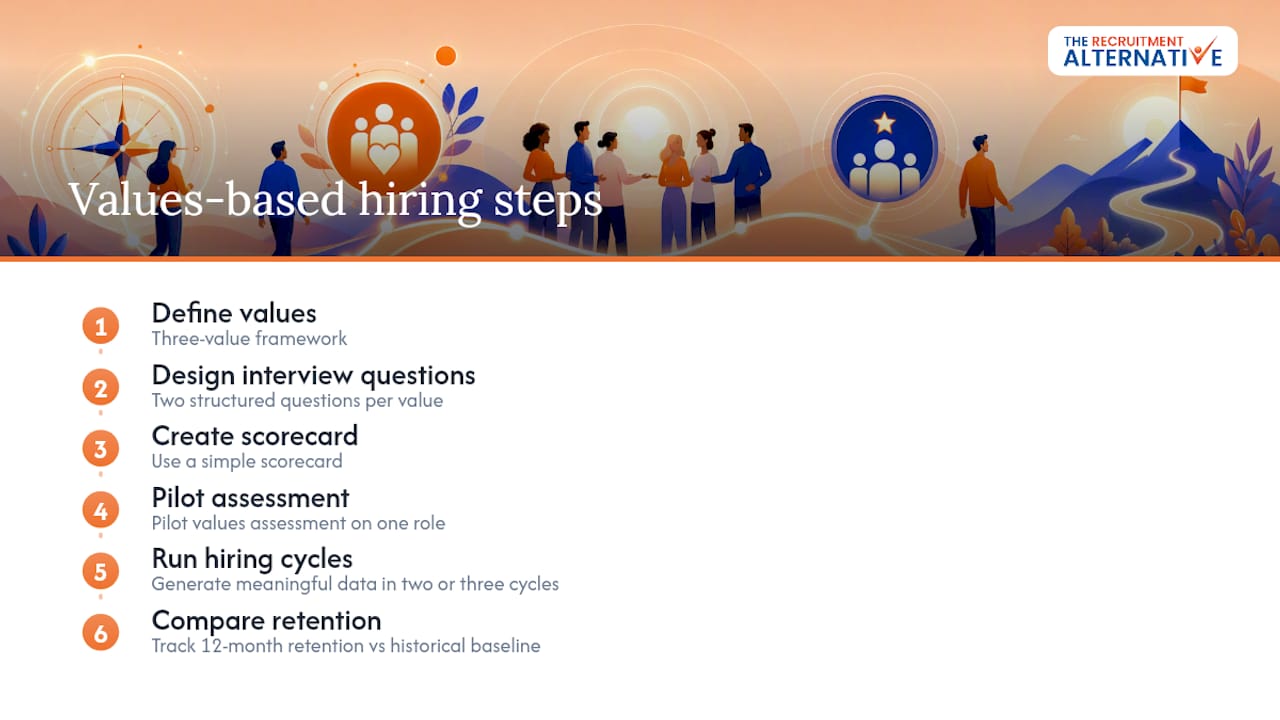
For Australian SMEs, the practical implication is that you do not need a large HR team to benefit. A three-value framework, two structured interview questions per value, and a simple scorecard is enough to generate meaningful data within two or three hiring cycles.
Pro Tip: Pilot values assessment on one role type before rolling it out across the business. Track retention at 12 months for the pilot cohort versus your historical baseline. That comparison gives you the internal evidence to expand the programme with confidence.
Employee benefits and employer value proposition also play a supporting role in attracting values-aligned candidates. Research on how benefits affect recruitment outcomes shows that candidates who are drawn by genuine organisational values, rather than compensation alone, tend to stay longer and perform more consistently.
How The Recruitment Alternative applies values-based recruiting in practice
Values-based recruitment works best when the external recruiter understands your operating values as clearly as your hiring manager does. At The Recruitment Alternative, every client brief includes a values section alongside the skills and experience requirements. Before sourcing begins, the team works with the hiring manager to confirm which 3–5 values are genuinely lived in the organisation, translate them into behavioural definitions, and build those definitions into the candidate screening process.
In practice, that means candidates are assessed against behavioural criteria at the sourcing stage, not just at the final interview. Shortlists include notes on values evidence alongside skills evidence, so hiring managers can make a more complete decision with less time spent in first-round interviews.
The result is fewer “surprise” exits in the first year and a faster path to full productivity for new hires — outcomes that show up in the KPIs outlined earlier in this article.
The Recruitment Alternative: flat-fee values-led hiring for Australian employers
Implementing a values-based hiring process takes structure, time and the right briefing. The Recruitment Alternative gives Australian employers a fixed-fee recruitment service that builds values assessment into every placement, without the percentage-of-salary cost that makes traditional agencies prohibitive for SMEs.
For a flat fee, The Recruitment Alternative handles candidate sourcing, behavioural screening against your defined values, shortlisting with evidence notes, and placement across roles in sales, administration, finance, engineering, healthcare, technology and executive leadership. Every engagement includes candidate replacement insurance if a hire does not work out in the first two to three months.
The agency works with businesses of all sizes across Australia. Whether you are building a values framework from scratch or briefing an external recruiter for the first time, the team can help you get the process right from the start.
Get started with flat-fee recruitment or view the simple fee structure to see what values-led hiring costs with The Recruitment Alternative.
Sources
- Values-Based Hiring: Look Beyond Skills To Find The Best Employees For Your Business
- Values-Based Hiring: Framework for Alignment Without Bias
- Values-Based Hiring: Complete Guide to Hiring for Fit
- Values-based recruitment
- A guide to values-based recruitment
When using these sources locally, treat the behavioural and process guidance as directly applicable and the legal or regulatory references as a starting point only. Confirm current obligations under the Fair Work Act 2009 and relevant state anti-discrimination legislation with a qualified HR professional or employment lawyer.
Recommended
- Quick Guide to an Effective Recruitment Process – The Recruitment Alternative
- How candidate databases work: a practical guide for recruiters – The Recruitment Alternative
- Why recruitment transparency matters for Australian employers – The Recruitment Alternative
- 5 Reasons to Treat Your Candidates Like Your Customers

