

Licensing is both a quality filter and a hiring constraint in Australian trades recruitment. Before progressing any offer to a tradesperson, verify that their licence is current, issued in the relevant jurisdiction, and covers the specific work you need done. For employers using labour-hire providers in Victoria, Queensland, or the ACT, confirm the provider holds a valid labour-hire licence before signing any contract.
Here are the four checks to run before making an offer:
- Trade-specific licence: confirm the licence type, issuing state, expiry date, and that the holder’s name matches the candidate’s identity documents.
- Labour-hire provider licence: if you are engaging a staffing provider, check the relevant state register (Victoria, Queensland, or ACT) to confirm their licence is active and free of recorded objections.
- ASQA registration: for roles requiring a Registered Training Organisation-delivered qualification, verify the RTO’s registration through the Australian Skills Quality Authority national register.
- National Police Certificate (NPC): required by several state regulators and strongly advisable for any role involving site access, supervision, or public safety.
Pro Tip: Treat licence verification as a pre-offer requirement, not a post-offer formality. Discovering a licence issue after a verbal offer has been made creates legal exposure and delays that could have been avoided.
Table of Contents
- Which licences and regulators do you need to check?
- How does licensing affect hiring timelines, costs, and candidate availability?
- How to embed licence checks into your recruitment workflow
- How can you widen the trades talent pool without breaking the rules?
- What are the legal risks of getting licensing wrong?
- How do you build licensing into your recruitment KPIs?
- Seven actions to reduce licence risk and speed up your next hire
- Key takeaways
- Licensing, recruitment, and what most employers miss
- Trades recruitment without the fee percentage
- Regulators and sources to bookmark
Which licences and regulators do you need to check?
Always check two layers: the labour-hire provider’s licence (where applicable) and the trade-specific licence or registration required for the role itself.
Labour-hire licensing by jurisdiction
- Victoria: providers must hold a licence under the Labour Hire Licensing Act and meet fit-and-proper and financial solvency standards. Applications require accountant-certified solvency evidence dated within six months; most decisions are made within 60 days.
- Queensland: the Labour Hire Licensing Act 2017 makes it an offence to provide or use unlicensed labour-hire services. Fit-and-proper assessments apply to all applicants.
- Other states: no broad labour-hire licence scheme exists, but employment, WHS, and other obligations still apply. Jurisdictional differences mean you must check state rules early in workforce planning regardless of whether a formal licence is required.
Trade-specific registrations to verify
Check state plumbing, electrical, and gas registries directly. For roles requiring RTO-delivered qualifications, use the ASQA national register. Trade contractor licences (building, demolition, specialist work) are issued by state building authorities and must be verified against the relevant state register.
Employer verification checklist
- Licence number and type
- Issuing state and jurisdictional validity for the work location
- Expiry date and current status (active, suspended, or cancelled)
- Holder name matching identity documents
- National Police Certificate (no more than 12 months old where required)
- Evidence of relevant insurances
- Any recorded objections or disciplinary findings on the state register
South Australia’s regime, for example, publishes applications on an objections register and requires both an NPC and accountant-certified solvency evidence, giving employers a transparent view of provider standing.
How does licensing affect hiring timelines, costs, and candidate availability?
Licences typically lengthen hiring timelines, increase direct and indirect costs, and reduce the available candidate pool in the short term. Credential verification alone extends timelines for trades roles, and employers who treat this as a last-minute step consistently face delays.
Typical verification and onboarding sequence:
- Credential verification against state registers and identity documents
- State-specific checks (labour-hire provider licence, trade contractor licence)
- Assessment of any bridging or upskilling requirements for overseas-trained candidates
- Licence issuance or commencement of supervised employment pending full licence
Typical cost categories to budget for:
- Administrative time for verification and documentation
- Exam and skills assessment fees for candidates requiring bridging
- Licence application fees (varies by state and licence type)
- Training or course sponsorship costs
- Wage premium for fully licensed staff versus those working under supervision
The IZA research cited above makes clear that skill wastage among overseas-trained migrants compounds these costs. A qualified tradesperson who cannot immediately meet local licensing requirements may spend months in lower-skilled work before gaining full entitlement, reducing the return on your recruitment investment.
How to embed licence checks into your recruitment workflow
Embed licence verification at the screening stage and make documentary confirmation a formal step before any offer is made. This protects you legally and prevents wasted time on candidates who cannot legally perform the role.
- Job advertisement: state the required licence type, issuing jurisdiction, and any NPC requirement clearly in the ad.
- Application screening: use a mandatory application question asking candidates to provide their licence number, issuing state, and expiry date.
- Shortlisting: cross-reference provided details against the relevant state register before scheduling interviews.
- Pre-offer verification: request the physical licence card, a current online register printout, NPC, and any overseas credential recognition documentation.
- Conditional offer: include a clause making the offer conditional on satisfactory licence verification and, where relevant, a clear NPC outcome.
- Onboarding: record licence details in your HR system with an automated renewal reminder set 60 days before expiry.
Documents to request from candidates:
- Licence card (front and back)
- Online register printout dated within 5 business days
- National Police Certificate (where required)
- Evidence of overseas credential recognition (Skills Assessment outcome letter, if applicable)
For trades-specific hiring guidance and contract clause templates, The Recruitment Alternative’s employer resources cover conditional offer language and licence monitoring obligations in detail. You can also review how to create an employment contract in Australia for practical clause guidance.
How can you widen the trades talent pool without breaking the rules?
You can increase candidate supply by offering supervised roles, sponsoring bridging qualifications, taking on apprentices, and partnering with niche trade staffing networks. None of these approaches require you to compromise on licensing standards.

Pro Tip: Partner with a Registered Training Organisation to co-fund exam preparation or bridging courses for experienced candidates who hold overseas qualifications. The cost is typically far lower than the wage premium you would pay to attract a fully licensed candidate from a tight market.
A practical approach used by a number of construction employers involves phased supervision: an experienced but unlicensed worker begins in a clearly defined supervised role, with documented milestones tied to pay progression and increased responsibility as they advance through the licensing process. The key is documentation. Record every supervised work period, the supervising licence holder’s details, and the specific tasks performed. This record supports the candidate’s licence application and demonstrates your due diligence if the arrangement is ever audited.
Employers who invest in licence attainment support for experienced contractors consistently report faster time-to-full-productivity than those who wait for fully licensed candidates to appear on the open market. The construction workforce gap makes this approach a practical necessity, not just a goodwill gesture.
For overseas-trained professionals navigating credential recognition, the pathway to licensed work in Australia can take considerable time. Resources covering career strategy and credential recognition offer useful context on how skilled migrants approach this process, which helps employers set realistic timelines and support structures.
What are the legal risks of getting licensing wrong?
Contracting with an unlicensed labour-hire provider or employing unlicensed staff for licensed activities creates significant penalties and operational risk. This is not a grey area.
Red flags to act on immediately:
- Candidate cannot produce a current licence or licence number
- Licence jurisdiction does not cover the state where work will be performed
- Licence is expired, suspended, or cancelled on the state register
- Labour-hire provider appears on an objections register or cannot produce their licence
- NPC is absent where required, or is more than 12 months old
Under Queensland’s Labour Hire Licensing Act 2017, it is an offence to provide or use labour-hire services without a licence. Penalties apply to both the provider and the host employer. Victoria’s regime carries equivalent obligations, with fit-and-proper and financial solvency requirements that providers must maintain throughout the licence period.
Immediate mitigations when a red flag appears:
- Pause onboarding and do not allow the candidate to commence licensed work
- Assign alternative duties under direct supervision while the issue is resolved
- Contact the relevant state regulator for guidance on your obligations
- Seek legal advice for high-risk situations before proceeding
This article provides general information, not legal advice. Confirm current licensing obligations with the relevant state regulator or a qualified legal professional.
How do you build licensing into your recruitment KPIs?
Include licence verification turnaround time and licence attainment rates as formal KPIs in your trades workforce planning. Without these metrics, licence-related delays become invisible costs that distort your true cost-per-hire.
Metrics worth tracking:
- Time-to-verify (days from candidate submission to confirmed licence status)
- Proportion of hires requiring bridging or sponsorship
- Cost per hire attributable to licence-related activities
- Licence renewal monitoring coverage (percentage of current staff with active renewal reminders)
Budget line items to include:
- Training subsidies and exam fees for sponsored candidates
- Temporary supervision cost buffer for candidates working under licence
- Travel and accommodation for regional staff accessing face-to-face assessments
Regional roles deserve specific attention. Rural and remote locations often have limited access to testing centres and face-to-face assessment requirements, which can add weeks to a candidate’s licensing timeline. Factor this into your vacancy planning and consider whether remote assessment options are available through the relevant authority.
The 2026 integration of state licensing into federal trade skills assessment workflows is designed to create a single front door for skills recognition and state licensing, which should reduce the administrative gap between assessment and licensed work. Build this into your forward workforce planning now. For a structured approach to hiring strategy and KPIs, The Recruitment Alternative’s employer resources offer practical frameworks.
Seven actions to reduce licence risk and speed up your next hire
These seven steps will reduce licensing risk and accelerate your next trades hire.
- Confirm the exact licence type and issuing jurisdiction required for the role before advertising.
- Request the candidate’s licence number and expiry date on the application form as a mandatory field.
- Verify the licence against the relevant state register before shortlisting.
- Request an NPC dated within 12 months for any role involving site access, supervision, or public safety.
- Check your labour-hire provider’s licence on the state register before signing any engagement contract.
- Include a conditional offer clause that makes employment contingent on satisfactory licence verification.
- Set a licence renewal monitoring schedule in your HR system for all licensed staff, with alerts 60 days before expiry.
Key takeaways
Licensing is the single most consequential compliance variable in Australian trades recruitment, and treating verification as a pre-offer step is the most effective way to protect your business and speed up hiring.
| Point | Details |
|---|---|
| Verify before offering | Check licence type, jurisdiction, expiry, and NPC before making any verbal or written offer. |
| Know your jurisdiction | Labour-hire licensing applies in Victoria, Queensland, and the ACT; other states still impose WHS and employment obligations. |
| Budget for licence costs | Include exam fees, training subsidies, and supervision buffers in your cost-per-hire calculation. |
| Widen the pool proactively | Sponsoring bridging qualifications and supervised roles expands candidate supply without compromising standards. |
| The Recruitment Alternative | Offers flat-fee trades recruitment with built-in credential verification support, reducing licence-related delays and cost uncertainty. |
Licensing, recruitment, and what most employers miss
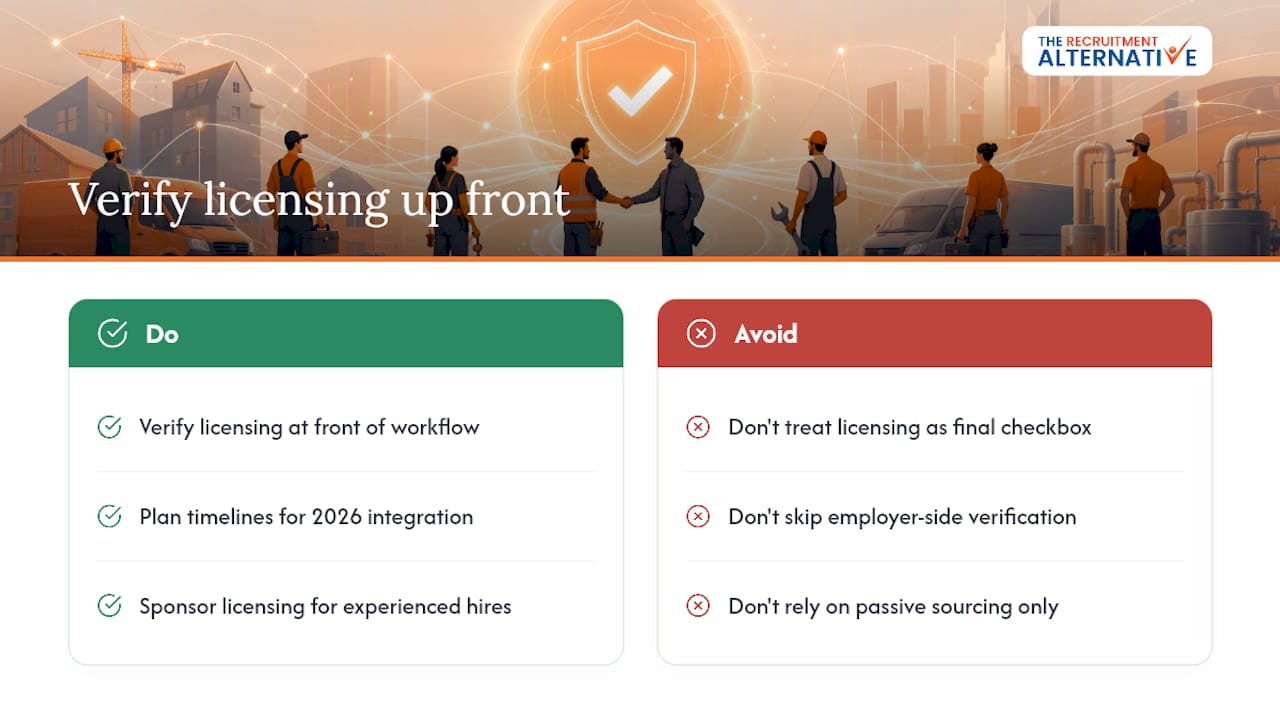
The conventional view treats licensing as a compliance checkbox, something to confirm at the end of the hiring process. That framing gets it backwards. Licensing determines who is available, how long hiring takes, and what it costs. Employers who build licence verification into the front end of their recruitment workflow, not the back end, consistently experience fewer delays, fewer conditional offer complications, and lower overall cost per hire.
The 2026 integration of state licensing into federal trade skills assessment is a meaningful shift, but it will not eliminate the need for employer-side diligence. The single front door makes the process faster for candidates; it does not remove your obligation to verify. What it does change is the planning horizon: employers who understand the new workflow can set more accurate timelines and reduce the supervision buffer they currently need to build in.
The other thing most employers underestimate is the value of sponsoring licence attainment for experienced but unlicensed workers. The construction industry’s need for roughly 650,000 additional workers in 2026 means the fully licensed candidate pool will not grow fast enough to meet demand through passive sourcing alone. Employers who invest in structured pathways from supervised work to full licensure are building a competitive advantage, not just filling a gap.
Trades recruitment without the fee percentage
For employers navigating licence complexity in trades hiring, The Recruitment Alternative offers a concrete alternative to traditional commission-based agencies. The flat-fee model means you know the cost of each placement upfront, regardless of the salary level, which is particularly valuable when licence-related delays extend your hiring timeline and push up the total cost of a vacancy.
The Recruitment Alternative recruits across trades, engineering, construction, and related industries throughout Australia, with candidate verification support built into the process. If a hire does not work out within the first two to three months, the candidate replacement guarantee means you are not starting from scratch at full cost. For employers managing multiple trades vacancies with varying licence requirements, the flat-fee recruitment model removes the cost uncertainty that makes licence-heavy hiring feel prohibitive.
To discuss a licence-aware hiring plan for your next trades vacancy, contact The Recruitment Alternative directly.
Regulators and sources to bookmark
These links are curated for employers and contain regulator verification portals, primary legislation, and key research cited in this article.
- Apply for a labour hire licence
- How to start a labour hire company | Sprintlaw Australia
- Selective immigration, occupational licensing and labour market outcomes of foreign‑trained migrants
- Examining the macroeconomic costs of occupational entry regulations
- Why skilled trades roles are becoming the hardest positions for recruiters to fill
- The key to closing construction workforce gaps
Recommended
- Trade staff recruitment best practices: a 2026 guide – The Recruitment Alternative
- Recruitment for trades industries: a practical employer guide – The Recruitment Alternative
- Approaching Inefficient Talent Acquisition – The Recruitment Alternative
- 4 things to get across in an interview – The Recruitment Alternative

