

Candidate matching is the process of ranking and shortlisting candidates by comparing structured profiles to a role’s requirements, using AI to match meaning rather than just keywords. At its core, the candidate matching process converts job briefs and candidate data into comparable signals, then scores and ranks candidates by fit. Three components drive every modern matching system:
- Data ingestion and parsing: extracting structured information from CVs, notes, call transcripts, and enrichment sources into a usable format.
- Representation and embeddings: converting parsed data into numerical vectors that capture conceptual meaning, so a candidate with “fintech experience” can match a role requiring “payments scale-up background” even without identical wording.
- Scoring and ranking: applying weighted algorithms to produce a ranked shortlist, with the best systems explaining why each candidate ranked where they did.
AI-powered matching has shifted recruiter workflows from manual keyword scanning to semantic candidate ranking, reducing time-to-shortlist and surfacing candidates who would otherwise be missed. The Recruitment Alternative applies these principles across permanent placements in Australia, combining structured intake, data hygiene, and human-led final selection to produce shortlists that hold up under scrutiny.
Table of Contents
- Where does candidate matching fit in your hiring workflow?
- How candidate matching works technically, end to end
- What signals do matching systems use, and how should you weight them?
- AI versus rule-based matching: how do you tell the difference?
- Which metrics tell you whether your matching system is actually working?
- A practical implementation checklist for Australian recruiters
- Common pitfalls that cause matching to underperform
- Key takeaways
- The gap between what AI matching promises and what actually matters
- Smarter hiring with The Recruitment Alternative’s flat-fee model
- Useful sources for recruiters in Australia
Where does candidate matching fit in your hiring workflow?
Matching is not a single event. It runs at multiple points across the hiring lifecycle, and knowing when to trigger it determines how much value you extract.
The standard workflow:
- Intake: The recruiter and hiring manager align on must-haves, nice-to-haves, salary band, first-90-day priorities, and success metrics. This is where matchable signals are created. Skipping or rushing intake is the single most common reason shortlists miss the mark.
- Sourcing: Matching runs against the existing candidate database and external sourcing channels simultaneously. The system surfaces ranked candidates from the talent pool while outreach targets net-new prospects.
- Screening: Matching scores inform which candidates receive priority screening calls. Recruiters use scores as a triage guide, not a final verdict.
- Shortlisting: Human recruiters review ranked candidates, apply contextual judgement, and assemble the shortlist. This is where strong candidate-recruiter relationships matter most.
- Interview and selection: Matching plays no direct role here. Final selection must remain a human decision, informed by structured interviews, references, and assessments.
- Post-placement feedback: Outcome data (did the hire succeed at 3, 6, and 12 months?) feeds back into the matching model, improving future rankings.
When to trigger matching:
- At job creation, as soon as the intake brief is locked.
- After any intake update (revised salary band, changed must-haves).
- Continuously as new candidates enter the database or existing profiles are enriched.
Most applicant tracking systems (ATS) in Australia, including platforms like Bullhorn, JobAdder, and Vincere, support API-based matching integrations that push ranked results directly into the recruiter’s workflow. The practical implication: matching should feed into your ATS pipeline view, not sit in a separate tool that requires manual cross-referencing.
Pro Tip: Set a calendar trigger to re-run matching on active roles every five business days. Candidate databases change constantly, and a profile enriched with a new certification this week may rank far higher than it did last week.
How candidate matching works technically, end to end
Understanding the mechanics helps you evaluate vendors honestly and diagnose why a system is underperforming.

The five-stage pipeline
A reliable matching pipeline runs through five sequential stages:
- Data extraction and parsing: The system reads CVs, LinkedIn profiles, notes, call transcripts, and enrichment data, then extracts structured fields: job titles, dates, skills, qualifications, company names, and quantified outcomes. Parsing quality sets the ceiling for everything downstream. A parser that misreads dates or drops role scope produces noisy signals that no algorithm can recover.
- Skills standardisation: Raw skill strings (“MS Excel”, “Microsoft Excel Advanced”, “Excel pivot tables”) are mapped to a canonical taxonomy. Without this step, the same skill appears as three different signals.
- Semantic embeddings: Job requirements and candidate profiles are each converted into high-dimensional numerical vectors. These vectors capture meaning, not just text. This is why semantic embeddings allow a “payments scale-up” role to match a candidate whose CV says “fintech experience” — the vectors sit close together in meaning-space even though the words differ.
- Scoring and ranking: The system calculates similarity between the role vector and each candidate vector, applies configured weights (skills, seniority, recency, domain), and produces a ranked list with a score per candidate.
- Continuous learning via RLHF: Recruiters accept, reject, or modify shortlist suggestions. Those decisions feed back into the model as labelled training data, gradually tuning it toward “what good looks like” for your firm and your clients.
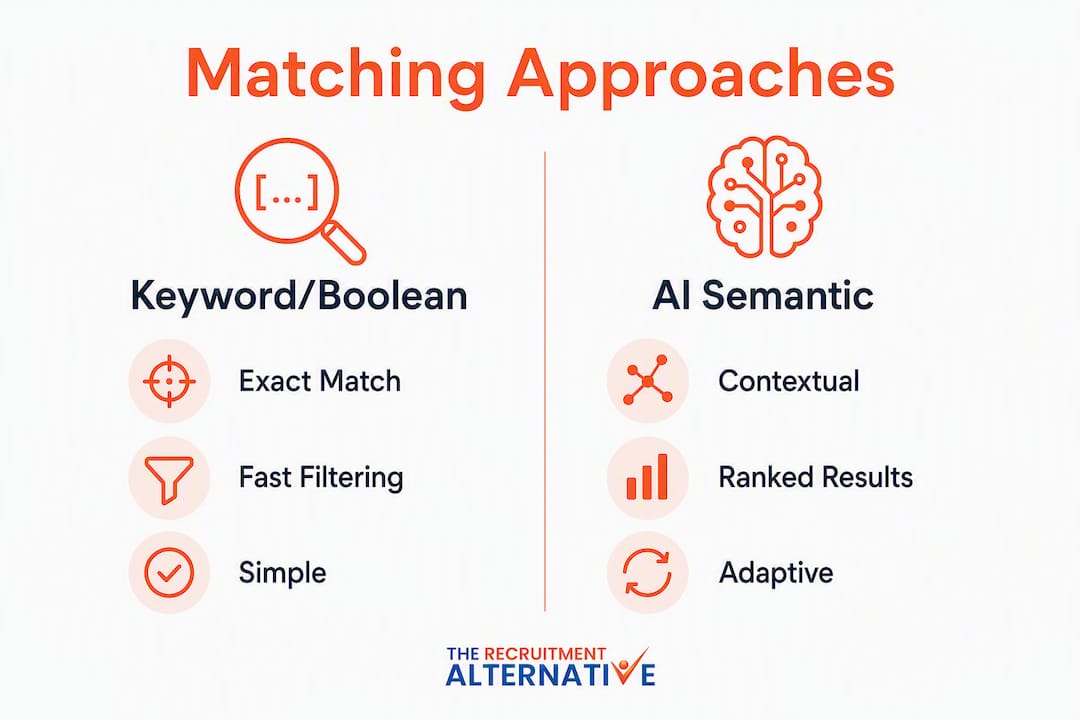
Matching approach comparison
| Approach | How it works | Typical failure mode | Best use case |
|---|---|---|---|
| Keyword / Boolean | Exact string matching against defined terms | Misses synonyms, abbreviations, and conceptual equivalents | High-volume screening where terms are standardised |
| Semantic (embedding-based) | Vector similarity across meaning-space | Can over-match on surface context; needs clean parsing | Most permanent roles; strong from day one |
| Predictive (ML ranking) | Learns from historical placement outcomes | Requires 60–90 placements before outperforming semantic; risks encoding historical bias | High-volume agencies with labelled outcome data |
Pro Tip: To test a vendor’s matching quality, run a role you filled successfully six months ago through their system. Check where the actual hire ranks. If they land outside the top five, ask the vendor to explain why — and treat a vague answer as a red flag.
What signals do matching systems use, and how should you weight them?
Matching systems draw on a mix of explicit and inferred signals. Knowing which signals matter for which role type lets you configure weights deliberately rather than accepting vendor defaults.
Core signals most systems use:
- Explicit skills: Named skills directly stated in the CV or profile.
- Inferred skills: Skills implied by job title, employer, or project context (a “Head of FP&A at a Series B startup” implies advanced financial modelling and board reporting).
- Seniority and career trajectory: Years of experience, progression speed, and whether the candidate has moved up, sideways, or stalled.
- Company size and domain adjacency: Experience at a comparable-scale organisation in an adjacent sector often predicts success better than exact-industry experience.
- Tenure and recency: How long the candidate stayed in relevant roles, and how recently they used key skills.
- Certifications and qualifications: Particularly important for regulated roles in healthcare, engineering, and finance in Australia.
- Availability and notice period: Practical signal that affects time-to-start.
- Assessment results: Where psychometric or skills assessments have been completed, these can be weighted alongside CV signals. The value of psychology tests in matching depends on role type and how well the assessment maps to job requirements.
How weighting differs by role level:
For entry-level roles, weight explicit skills, qualifications, and availability heavily. Career trajectory matters less; potential and learning agility matter more. Keep thresholds moderate to avoid false negatives on candidates who are strong but have thin CVs.

For mid-level roles, balance explicit skills with domain adjacency and tenure. A candidate who has done the job at a smaller company in an adjacent sector is often a better match than someone with the exact title but at a company with a very different operating context.
For senior and executive roles, inferred signals and career trajectory outweigh keyword matches. Executive recruitment depends heavily on contextual judgement that no algorithm fully replicates. Use matching to surface candidates for human review, not to shortlist autonomously.
Setting thresholds: Define must-have signals as hard filters (a registered nurse role requires AHPRA registration — no score compensates for its absence). Nice-to-haves should influence ranking, not eliminate candidates. Setting must-have thresholds too broadly produces false positives; setting them too narrowly produces false negatives and a thin shortlist.
AI versus rule-based matching: how do you tell the difference?
The term “AI matching” covers technically distinct approaches, and vendors use it inconsistently. A recruiter who cannot distinguish genuine semantic or predictive matching from a relabelled Boolean filter will overpay for underperformance.
| Feature | Rule-based (Boolean/keyword) | AI (semantic/predictive) |
|---|---|---|
| Match basis | Exact term overlap | Conceptual similarity via embeddings |
| Synonym handling | Fails without manual synonym lists | Handles naturally |
| Transparency | Easy to audit; logic is explicit | Requires explainability features to audit |
| Bias risk | Encodes explicit bias in rules | Can encode historical bias in training data |
| Setup effort | High (manual rule maintenance) | Lower ongoing maintenance; higher initial data need |
| Improvement over time | Static unless rules are updated | Improves with feedback (RLHF) |
Common vendor mistakes to watch for:
- Labelling a keyword filter as “AI-powered” with no embedding or learning component.
- Systems that read only the CV and ignore notes, call transcripts, and enrichment data. A context-rich database consistently outperforms a CV-only system.
- No explainability: if a vendor cannot show you why a candidate scored 87%, the system is a black box and you cannot govern it responsibly.
- No feedback loop: a system with no mechanism for recruiters to signal good and bad matches will not improve.
When to use a hybrid approach: Boolean filters work well as hard pre-filters (must hold a current Australian driver’s licence; must have right-to-work in Australia). Semantic matching then ranks the filtered pool by conceptual fit. Predictive layers add value only once you have sufficient placement history with outcome labels.
Demanding explainability: Mature matching platforms show match reasons at the candidate level: “matched on Python and data engineering; stretch on Spark; no signal on Kubernetes.” Require this in vendor demos and write it into procurement contracts. Without it, you cannot identify bias, explain decisions to candidates, or comply with Australian privacy and anti-discrimination obligations.
The disadvantages of AI in recruitment are real and worth understanding before committing to any platform. Transparency and human oversight are not optional extras.
Which metrics tell you whether your matching system is actually working?
Tracking the right metrics separates a matching system that genuinely improves outcomes from one that merely looks impressive in a demo.
Key metrics to define and track:
- Precision: Of the candidates on your shortlist, what proportion were genuinely suitable? Low precision means wasted interview time.
- Recall: Of all genuinely suitable candidates in your database, what proportion did the system surface? Low recall means good candidates are being missed.
- Shortlist acceptance rate: The percentage of shortlisted candidates the hiring manager agrees to interview. Structured intake produces shortlists accepted 2.4 times more often than unstructured intake, making this metric sensitive to both matching quality and intake quality.
- Interview-to-offer rate: How many interviews convert to offers? A low rate often signals a matching or intake problem upstream.
- Time-to-shortlist: Days from role activation to shortlist delivery. Matching should reduce this; if it does not, investigate parsing or data hygiene issues.
- Diversity impact: Are certain demographic groups systematically under-represented in shortlists? Run this check quarterly.
- False negative rate: Candidates who were not shortlisted but who, in hindsight, would have been strong hires. Periodic spot-checks of B-tier candidates reveal this.
Baseline and post-implementation tracking template
Evaluation checklist:
- Run three to five historical filled roles through the system and check where actual hires rank.
- Conduct A/B tests: use matching for half your active roles and manual screening for the other half over a 60-day period.
- Track candidate outcomes at 3, 6, and 12 months post-placement to build outcome-labelled data for predictive model training.
- Perform manual spot-checks on B-tier candidates monthly to estimate false negative rates.
- Review diversity metrics quarterly and investigate any shortlist that deviates significantly from the available candidate pool.
Realistic ramp expectations: Semantic matching produces gains from the first week. Predictive matching typically requires 60–90 placements with outcome labels before it measurably outperforms semantic matching alone. Set expectations with stakeholders accordingly.
A practical implementation checklist for Australian recruiters
Getting matching right is as much about process discipline as it is about software. The following checklist covers the five areas that determine whether a matching system delivers or disappoints.
1. Structured intake
- Define must-haves and nice-to-haves explicitly before activating a role in the ATS.
- Capture first-90-day priorities and success metrics, not just a job description.
- Record the hiring manager’s stated preferences as structured notes, not free text buried in an email thread.
- Revisit and update the intake brief whenever requirements change. Matching against a stale brief produces stale results.
Recruiters who run thorough intakes produce shortlists accepted 2.4 times more often than those who skip the process. The software amplifies the quality of your intake; it does not compensate for a poor one.
2. Data hygiene
- Validate your parser on a sample of messy, non-standard CVs before committing to a platform. Parsing errors are the dominant source of poor match quality.
- Capture call notes and interview transcripts in the ATS, not in personal notebooks or email. A matching engine that reads only CVs will consistently underperform one that ingests the full candidate record.
- Map skills to a canonical taxonomy and update it as new skills emerge (particularly relevant in technology and healthcare roles in Australia).
- Timestamp all profile updates so recency signals remain accurate.
3. Governance and compliance
Australia’s Privacy Act 1988, the Fair Work Act 2009, and state-level anti-discrimination legislation all have implications for automated candidate screening. Key obligations:
- Obtain candidate consent for automated processing of their data.
- Maintain audit logs of matching decisions, including which version of the model was active.
- Run periodic fairness audits to check for demographic bias in shortlists.
- Ensure candidates can request an explanation of why they were or were not shortlisted.
- AI in recruitment is evolving quickly in Australia; stay current with guidance from the Office of the Australian Information Commissioner (OAIC).
4. Human-in-the-loop rules
AI matching should be decision support, not a decision-maker. Set clear rules:
- No candidate is rejected solely on a matching score without human review.
- Shortlists require sign-off from a recruiter before being sent to a hiring manager.
- Recruiters document their reasons for overriding a high-score candidate.
5. Continuous improvement via RLHF
- Record recruiter accept/reject decisions on shortlisted candidates as labelled training data.
- Track placement outcomes at 3, 6, and 12 months and feed results back into the model.
- Schedule a quarterly review of matching weights against actual placement outcomes.
- Retrain or retune the model when you detect drift (e.g., shortlist acceptance rates declining over two consecutive months).
Pro Tip: Ask your vendor whether the platform reads call notes and enrichment data in addition to CV text. Request a live demonstration using a candidate record that has substantial notes but a thin CV. If the notes-rich candidate does not rank materially higher than their CV alone would suggest, the system is CV-only regardless of what the sales deck says.
Common pitfalls that cause matching to underperform
Even well-configured systems produce poor results when the underlying conditions are wrong. These are the failure modes that appear most often in practice.
Common pitfalls:
- Stale candidate profiles: A CV last updated three years ago carries outdated skills signals. Matching against it produces false negatives on candidates who have grown significantly.
- Vague job descriptions used as the matching brief: If the role brief says “strong communication skills and relevant experience,” the system has almost nothing to match against. Garbage in, garbage out.
- Over-weighted proxies: Weighting employer brand or university name as a proxy for quality encodes socioeconomic bias and degrades match accuracy for roles where those proxies do not predict performance.
- False confidence in AI labels: Assuming a vendor’s “AI matching” is semantic or predictive without verifying the technical architecture. Many tools are Boolean filters with a modern interface.
- CV-only ingestion: Ignoring notes, transcripts, and enrichment data leaves the majority of candidate context out of the matching calculation.
- No feedback loop: A static matching system that does not learn from recruiter decisions will not improve and will gradually drift out of alignment with your clients’ actual preferences.
Red flags in vendor demos:
- The vendor cannot explain what signals produced a specific match score.
- The demo uses only clean, well-formatted CVs rather than the messy real-world documents your team handles.
- There is no ATS integration or the integration requires manual data exports.
- No audit trail for matching decisions.
- No mechanism for recruiters to signal that a high-scoring candidate was rejected and why.
Remediation steps when results disappoint:
- Tighten the intake brief and re-run matching before assuming the system is at fault.
- Pull a sample of B-tier candidates (those ranked 10–25) and manually review them. If strong candidates appear there, your thresholds or weights need adjustment.
- Enforce human sign-off on all shortlists and document override reasons to build better training data.
- Run a fairness audit on the last 90 days of shortlists before making any model changes.
Key takeaways
Candidate matching works best when structured intake, clean data, and human oversight operate together — no matching system outperforms the quality of the brief and data it receives.
| Point | Details |
|---|---|
| Intake drives match quality | Structured intake produces shortlists accepted 2.4 times more often; the software amplifies your brief, it does not fix a poor one. |
| Semantic beats keyword from day one | Embedding-based matching handles synonyms and conceptual equivalents that Boolean filters miss, with no ramp-up period required. |
| Predictive needs placement history | Predictive matching requires a substantial placement history with outcome labels before it outperforms semantic matching alone. |
| Human oversight is non-negotiable | No candidate should be rejected solely on a matching score; recruiters must retain final judgement and document overrides. |
| The Recruitment Alternative’s approach | The agency combines structured intake, data hygiene, and human-led shortlisting with flat-fee permanent recruitment across Australia and New Zealand. |
The gap between what AI matching promises and what actually matters
There is a version of the candidate matching conversation that focuses almost entirely on the technology: embeddings, vector similarity, RLHF, transformer architectures. It is technically interesting, but it misses the point for most recruiters working in the Australian market.
The single biggest predictor of shortlist quality is not the sophistication of the matching algorithm. It is the quality of the intake conversation that happened before any software was involved. A recruiter who spends 45 minutes with a hiring manager, documents must-haves with precision, captures what the first 90 days need to look like, and records that context in the ATS will outperform a recruiter using a more advanced matching tool but a vague brief, every time.
This matters because the industry conversation tends to position AI matching as the solution to poor shortlists. It is not. It is a multiplier. If the input is weak, the multiplier makes weak results faster. If the input is strong, the multiplier genuinely accelerates good outcomes.
The second thing that gets underweighted is the feedback loop. Most agencies that adopt matching tools do not systematically feed placement outcomes back into the model. They use the tool as a ranking engine and leave it there. The result is a system that never learns what “a successful hire at this client” actually looks like. RLHF is not a technical nicety; it is the mechanism that separates a matching tool that gets better over time from one that stays static.
The governance dimension also deserves more attention than it typically receives. Australia’s privacy and anti-discrimination frameworks place real obligations on agencies that use automated screening. Candidate consent, audit logs, explainability, and fairness audits are not compliance theatre. They are the conditions under which automated matching can be used responsibly and defended if challenged.
The practical upshot: invest in your intake process before you invest in matching software. Get your data hygiene right before you worry about which algorithm to use. And when you do adopt a matching tool, build the feedback loop from day one rather than retrofitting it later.
Smarter hiring with The Recruitment Alternative’s flat-fee model
Sophisticated matching technology is only as useful as the recruiter applying it. The Recruitment Alternative gives Australian businesses a concrete cost advantage over traditional commission-based agencies, with flat-fee permanent recruitment priced by role salary band rather than as a percentage of the hire’s package.
The agency covers a broad range of permanent roles across sales, administration, finance, engineering, healthcare, technology, trades, and executive leadership, throughout Australia and New Zealand. Every placement includes candidate replacement insurance if a hire does not work out within the first two to three months, so the risk of a poor match does not sit entirely with the employer. Before making contact, prepare a clear job brief with defined must-haves, a salary band, a target start date, and your success metrics for the first 90 days. The more specific your brief, the faster the shortlist.
To see the pricing tiers or start a brief, visit The Recruitment Alternative’s website and engage the team directly.
Useful sources for recruiters in Australia
The following sources underpin the claims in this article and are worth bookmarking for deeper reading or internal training.
- AI Candidate Matching: A Complete Guide — Recruiterflow: Covers semantic embeddings and how modern matching differs from keyword filtering. Use this as a technical primer for team training.
- AI candidate matching — Pin: Explains the five-stage pipeline model. Useful for evaluating whether a vendor’s architecture covers all stages.
- AI candidate matching process explained — CVViz: Focuses on parsing quality and its downstream effects. Run vendor parsers against the messy CVs described here before purchasing.
- AI candidate matching how it works — Yena.ai: Distinguishes keyword, semantic, and predictive matching clearly. Use this to benchmark vendor claims against actual technical capability.
- How AI finds best candidates — Spott: Covers explainability requirements and the value of context-rich databases. Use the explainability checklist here in vendor procurement conversations.
- How AI job matching works — Noon.ai: Addresses human-in-the-loop governance and the risks of automated rejection. Relevant for compliance and governance policy drafting.
- What is sourcing in recruitment — Klearskill: Contains the structured intake data showing 2.4 times higher shortlist acceptance. Use this to make the business case for intake investment internally.
- OECD: Empowering the Workforce — Skills-First Approach: Primary research on skills-first hiring trends across OECD countries, including Australia. Useful context for understanding why skills signals are increasingly prioritised over credential proxies in matching systems.
- The Recruitment Alternative: The agency’s website covers flat-fee pricing, industry verticals, and the engagement process for Australian and New Zealand employers.

