

The fastest, safest, and most cost-effective route to permanent healthcare staffing in Australia is to engage a specialist permanent recruiter or a reputable flat-fee recruitment partner. That single decision determines whether your hire takes four weeks or four months, and whether your compliance obligations are met before or after an offer goes out.
To get started immediately:
- Confirm your role specification — title, clinical scope, AHPRA registration requirements, roster pattern, and salary band.
- Set a realistic budget and timeline — factor in credential verification, notice periods, and any visa processing if you are open to international candidates.
- Select one recruitment partner and brief them thoroughly — a detailed intake conversation cuts sourcing time considerably.
Australian employers looking for a transparent, fixed-price option can consider The Recruitment Alternative, which places permanent healthcare staff across nursing, allied health, aged care, and more, under a tiered flat-fee model with a replacement warranty.
Table of Contents
- Why permanent healthcare staff outperform temporary arrangements
- What compliance checks are required for permanent healthcare hires in Australia?
- What does the permanent healthcare recruitment process look like, step by step?
- How much does permanent healthcare recruitment cost in Australia?
- How do you choose the right recruitment partner for permanent healthcare hires?
- Why proactive recruitment partnerships reduce your reliance on temporary staff
- Key takeaways
- A recruiter’s perspective on what makes permanent healthcare placements work
- The Recruitment Alternative: flat-fee permanent healthcare recruitment
- Useful sources and next steps
Why permanent healthcare staff outperform temporary arrangements
The financial case for permanent hires is stronger than most hiring managers realise. Temporary and agency labour carries a visible hourly premium, but the hidden costs — overtime loading, repeated orientation, reduced admission capacity, and lower team morale — frequently exceed what a single permanent placement fee would have cost.

Permanent hiring supports continuity, reduces overtime, and protects patient flow. When a ward or aged care facility relies on rotating agency staff, clinical handovers become fragmented, medication management risk increases, and residents or patients lose the consistency that underpins quality care.
The benefits compound across role types:
- Nursing — permanent RNs and ENs build unit-specific knowledge that reduces clinical errors and supports graduate mentoring.
- Allied health — physiotherapists, occupational therapists, and speech pathologists in permanent roles carry caseloads more efficiently and build therapeutic relationships.
- Doctors and senior clinicians — permanent medical officers and VMOs stabilise rosters and reduce locum dependency.
- Aged care — reliability and fit predict retention more reliably than acute care experience alone; a nurse who excels in a hospital setting may not suit a residential aged care environment.
- Mental health and community — permanent staff build trust with vulnerable clients over time, which is clinically significant and difficult to replicate with short-term cover.
Statistic callout: Prolink’s integrated recruiting programme reported significant operational cost savings for one health system by reducing contingent labour spend through permanent placement.
Pro Tip: Before comparing placement fees, calculate your total cost of vacancy: add overtime hours paid in the last quarter, agency margin on any temporary cover, and the time your managers spent on repeated inductions. That figure is your true baseline, and it almost always makes a permanent hire look cheaper.
What compliance checks are required for permanent healthcare hires in Australia?
Australian healthcare employers carry significant regulatory obligations before a permanent hire can start. Missing a step does not just delay the start date — it can expose the organisation to liability.
Core checks for all clinical roles
- AHPRA registration verification — confirm the candidate holds current, unconditional registration with the Australian Health Practitioner Regulation Agency. Check the public register directly; do not rely solely on a copy of a certificate.
- National Police Check — required by most health services and mandated under state-based legislation for many clinical roles.
- Working With Children Check (WWCC) — mandatory where the role involves contact with minors, including paediatric wards, community health, and school-based services.
- NDIS Worker Screening Check — required for roles delivering NDIS-funded supports; the check is portable across registered providers.
- Immunisation and health clearances — influenza vaccination is policy in most Australian health services; COVID-19 vaccination requirements vary by state and employer policy; blood-borne virus clearances apply to exposure-prone procedures.
- Credential and qualification verification — primary source verification of degrees, specialist college endorsements, and any postgraduate certifications.
- Clinical reference checks — at least two referees who can speak to direct clinical competence, not just character.
- Right-to-work and visa verification — confirm the candidate’s visa subclass permits the role type and hours; international candidates may require skills assessment through AHPRA or a relevant college before registration is granted.
Why continuous credentialing matters
Effective long-term recruitment includes ongoing credentialing so candidates are ready to start when selected, rather than triggering a compliance queue at offer stage. Recruiters who maintain live credential files for active candidates can cut weeks off the time between offer and start date.
Statistic callout: Visa and primary source verification delays commonly add weeks to time-to-hire for permanent clinical roles when not handled proactively.
Employer intake checklist for your recruiter:
- Role title, AHPRA registration type required, and any specialist endorsement
- Roster pattern and any on-call requirements
- Mandatory checks your organisation requires (police, WWCC, NDIS, immunisations)
- Salary band and any enterprise agreement classification
- Preferred start date and notice period flexibility
- Whether you are open to candidates requiring visa sponsorship
What does the permanent healthcare recruitment process look like, step by step?
The process from initial brief to a new hire’s first day typically runs through five stages. Understanding who owns each step prevents the delays that most commonly extend timelines.

| Stage | Key activities | Who leads | Typical duration | Common blockers |
|---|---|---|---|---|
| 1. Intake and role definition | Role spec, compliance requirements, salary band, culture brief | Employer + recruiter | 1–3 days | Incomplete brief; internal sign-off delays |
| 2. Candidate sourcing and screening | Job advertising, database search, AI-assisted matching, phone screens | Recruiter | 1–3 weeks | Thin candidate market for specialist roles |
| 3. Interviews and clinical assessment | Shortlist presentation, employer interviews, clinical competency review | Employer (final decision) + recruiter (clinical screen) | 1–2 weeks | Scheduling; multiple decision-makers |
| 4. Offer and conditional checks | Reference checks, AHPRA verification, police check, WWCC, immunisations, visa confirmation | Recruiter + employer HR | 1–4 weeks | Visa processing; slow referee response |
| 5. Start and onboarding | Employment contract, orientation, system access, buddy allocation | Employer | 1–2 weeks | Notice periods; credentialing queue |
Typical total time-to-hire by role type:
- Entry-level aged care worker or AIN: 3–5 weeks
- Registered nurse (general): 4–7 weeks
- Allied health clinician (OT, physio, speech): 5–8 weeks
- Senior clinician or specialist nurse: 6–12 weeks
- Medical officer or GP: 8–16 weeks (longer where AHPRA overseas assessment applies)
Some recruitment providers combine AI matching with clinical recruitment expertise and rapid workforce matching platforms to surface suitable candidates faster, particularly for niche allied health and senior clinical roles (pricing details). That technology advantage is most valuable at the sourcing stage; the compliance and clinical assessment steps still require human judgement.
To accelerate without cutting corners:
- Complete the intake brief in one sitting with your recruiter — incomplete briefs are the single biggest source of rework.
- Pre-approve a salary range rather than negotiating after offer — candidates withdraw when offers stall.
- Assign one internal decision-maker for interview scheduling to avoid coordination delays.
- Ask your recruiter whether candidates have live credential files ready, which shortens the conditional check phase.
How much does permanent healthcare recruitment cost in Australia?
Two pricing models dominate the Australian market: percentage-of-salary commission and flat-fee fixed pricing.
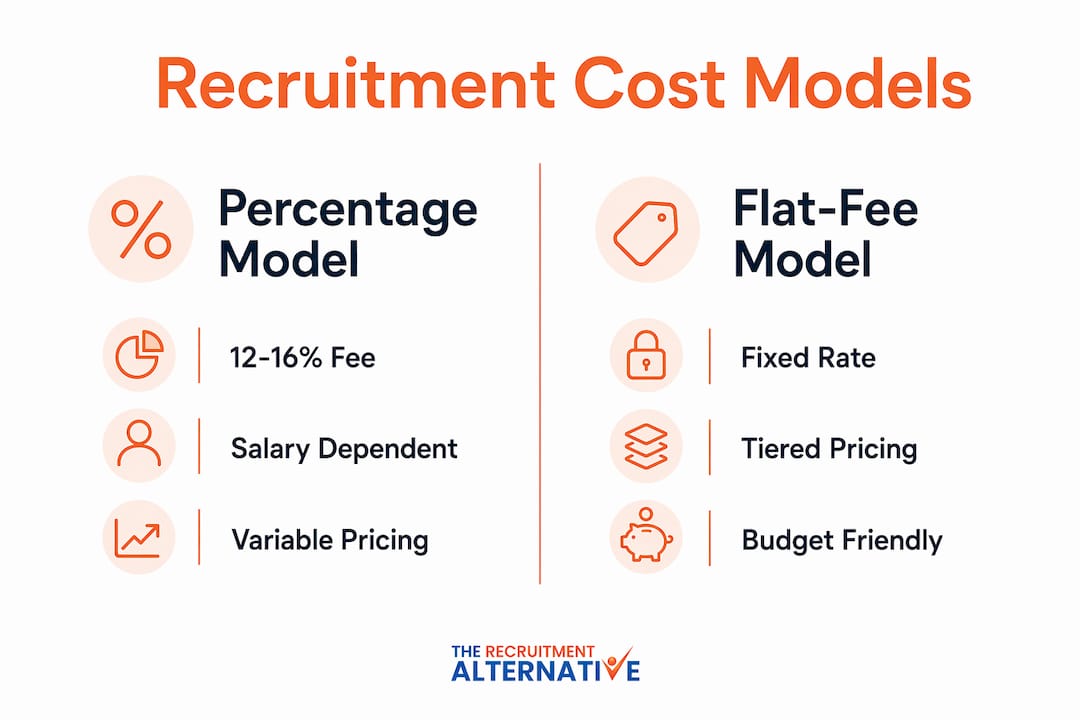
Percentage commission is calculated as a proportion of the successful candidate’s first-year annual salary. Industry practice for healthcare roles typically uses percentage commission based on first-year salary, with placement fees varying accordingly. For example, registered nurse and senior clinician placement fees will differ based on their salary levels.
Flat-fee models charge a fixed amount per placement, tiered by salary band rather than calculated as a percentage. The Recruitment Alternative uses this approach, with tiered pricing that makes the cost predictable regardless of where within a salary band the final offer lands.
| Dimension | Percentage commission model | Flat-fee tiered model |
|---|---|---|
| Cost model | 12–16% of first-year salary; rises with seniority | Fixed price per tier; predictable regardless of final salary |
| Time-to-hire | Varies; incentive to fill quickly | Comparable; process-driven rather than fee-driven |
| Compliance and credentialing | Varies by agency specialisation | Depends on partner; ask specifically about healthcare vetting |
| Candidate quality and clinical fit | Stronger with specialist healthcare agencies | Comparable when partner has healthcare coverage |
| Replacement guarantee | Common; terms vary (30–90 days typical) | The Recruitment Alternative offers replacement warranty within 2–3 months |
| Role and geography coverage | Broad with national agencies | The Recruitment Alternative covers roles nationally across Australia |
Conversion from a temporary or locum arrangement to a permanent role usually attracts a fee from the original agency, sometimes called a temp-to-perm or conversion fee. Clarify this in writing before placing any temporary staff you may later want to retain permanently.
The replacement warranty is a material risk-reduction tool. If a candidate placed through a reputable agency leaves or is terminated within the warranty period, the agency provides a replacement at no additional cost. Always request this in writing, and confirm the exact trigger conditions.
How do you choose the right recruitment partner for permanent healthcare hires?
The wrong recruitment partner costs more than their fee. A generalist agency without healthcare specialisation will source candidates who look right on paper but lack the clinical vetting that regulated roles demand.
Evaluation criteria
- Healthcare specialisation — does the agency recruit healthcare roles regularly, or is it one of many verticals they cover occasionally?
- Credential and compliance process — can they describe exactly how they verify AHPRA registration, conduct reference checks, and manage police and NDIS screening?
- Candidate sourcing reach — do they maintain an active database of healthcare candidates, or rely solely on job board advertising?
- Replacement guarantee — is it documented, what is the warranty period, and what triggers it?
- Pricing transparency — is the fee structure clear before you engage, with no hidden charges?
- Client references — can they provide references from healthcare employers in a similar setting to yours?
Questions to ask on the first call
- How do you verify AHPRA registration, and do you check the public register directly?
- What is your average time-to-hire for this specific role type?
- Do you provide a replacement warranty, and what are the exact terms?
- How do you assess clinical fit, not just clinical qualifications?
- What happens if a candidate’s visa or credential check delays the start date?
- How do you handle conversion fees if we later want to retain a temporary candidate permanently?
Red flags to watch for
- Vague sourcing claims (“we have access to thousands of candidates”) with no explanation of how candidates are screened.
- No documented replacement policy, or one that requires you to re-engage at full fee.
- Inability to describe their AHPRA or NDIS verification process.
- Fees quoted verbally only, with no written engagement terms.
Specialist healthcare recruiters provide deeper clinical vetting than generalist providers, which reduces mis-hires in regulated settings. Running a pilot role — one placement before committing to a broader arrangement — is a practical way to evaluate a new partner’s process and communication before scaling.
Pro Tip: Treat your recruiter as an extension of your HR team from day one. Share your workforce plan, not just the immediate vacancy. A recruiter who understands your census patterns and upcoming retirements can pipeline candidates proactively, which cuts reactive hiring pressure significantly.
Why proactive recruitment partnerships reduce your reliance on temporary staff
The long-term purpose of permanent recruitment is to build a stable team that reduces reliance on expensive temporary staff and improves care continuity. That outcome does not happen from a single placement; it comes from an ongoing partnership where the recruiter understands your organisation’s workforce patterns.
Recruitment partners that act as an extension of the HR team can anticipate talent needs and reduce time-to-hire through proactive pipelining. In practice, this means quarterly workforce reviews with your recruiter, shared visibility of upcoming retirements or contract endings, and a standing brief for hard-to-fill roles so sourcing begins before a vacancy becomes urgent.
The hidden costs of turnover — manager time, repeated onboarding, reduced admissions, lower staff morale — often exceed the upfront cost of a professional recruiter offering a replacement warranty. One health system working with a permanent placement partner reported savings of $1.3 million per year in contingent labour spend after committing to a structured permanent recruitment programme.
Personality fit and alignment with the facility’s patient population and care values predict long-term retention more reliably than clinical skills alone. A recruiter who only screens for qualifications and misses the cultural and care-model fit is setting both parties up for a failed placement within the first year.
Pro Tip: Schedule a quarterly workforce review with your recruitment partner. Bring your roster data, upcoming leave patterns, and any known departures. That 30-minute conversation is worth more than three reactive job briefs placed under pressure.
Key takeaways
Recruiting healthcare workers permanently in Australia is most effective when you engage a specialist or flat-fee partner, complete compliance checks proactively, and treat the recruiter relationship as an ongoing workforce partnership rather than a transactional hire.
| Point | Details |
|---|---|
| Use a specialist or flat-fee partner | Specialist permanent recruiters and flat-fee partners reduce mis-hires and compliance delays in regulated healthcare roles. |
| Complete compliance checks early | AHPRA, police, NDIS Worker Screening, and visa checks should begin at offer stage, not after acceptance. |
| Budget for total cost of vacancy | Overtime, agency margins, and repeated inductions typically exceed a single permanent placement fee. |
| Demand a replacement warranty in writing | A documented 2–3 month replacement guarantee materially reduces your hiring risk. |
| The Recruitment Alternative | Offers tiered flat-fee permanent placement with a replacement warranty, covering healthcare roles nationally across Australia. |
A recruiter’s perspective on what makes permanent healthcare placements work
The intake conversation is where most permanent healthcare placements are won or lost. When a hiring manager can describe not just the clinical requirements but the team culture, the patient population, and the qualities that have made previous hires stay, the recruiter has something to work with. When the brief is “we need an RN, ASAP,” the result is usually a shortlist that looks right and fits poorly.
Common employer missteps, and how good recruiters compensate:
- Salary bands set below market — a recruiter who knows the current market will flag this before advertising, not after three rounds of rejections.
- Too many interview rounds — strong candidates in healthcare are typically fielding multiple offers; a three-stage process for a ward nurse will cost you the shortlist.
- Delayed reference checks — waiting until after verbal acceptance to start references adds 1–2 weeks unnecessarily; run them in parallel with final interviews.
- No onboarding plan at offer stage — candidates who accept and then wait weeks for a start date or system access sometimes withdraw; have the onboarding timeline ready before the offer goes out.
For better collaboration with your recruitment partner, consider these practical steps. Set shared KPIs at the start of each engagement: time-to-shortlist, time-to-offer, and 90-day retention rate. Agree on a decision turnaround SLA for interview feedback — 48 hours is reasonable and keeps candidates engaged. Check in weekly during an active search, not just when the shortlist arrives.
Working effectively with recruiters is a two-way process. The more your recruiter understands your organisation, the better the match quality and the shorter the search.
The Recruitment Alternative: flat-fee permanent healthcare recruitment
Permanent healthcare recruitment does not have to carry a percentage fee that scales with every salary negotiation. The Recruitment Alternative offers a flat-fee recruitment model with tiered pricing based on candidate salary, so you know the cost before the search begins, not after the offer is accepted.
The model covers permanent healthcare roles across nursing, allied health, aged care, medical, and community sectors, with national reach across Australia. Each placement includes a replacement warranty of 2–3 months, documented in writing, which means your hiring risk is covered if a placement does not work out in the early months. There are no percentage commissions, no fee surprises tied to salary negotiations, and no lock-in beyond the engagement terms.
For healthcare employers who want to compare the cost of a flat-fee engagement against their current agency spend, the pricing structure is publicly listed by tier. The practical next step is to brief The Recruitment Alternative on one pilot role, review the shortlist quality and process, and use that experience to decide whether to extend the partnership.
Useful sources and next steps
The Recruitment Alternative internal pages
- Flat-fee recruitment model and pricing tiers — tiered pricing and replacement warranty details.
- Engage The Recruitment Alternative — service overview and healthcare role coverage.
- Partnering with a trusted recruitment agency — how the employer-recruiter partnership works in practice.
- Why partnering with a recruitment agency saves time and money — cost comparison context for permanent vs temporary hiring.
External authoritative references
- AHPRA (Australian Health Practitioner Regulation Agency) — ahpra.gov.au — public register for verifying practitioner registration across all regulated health professions.
- NDIS Worker Screening — ndisworkercheck.gov.au — national database and application portal for NDIS Worker Screening Checks.
- Australian Criminal Intelligence Commission — acic.gov.au — national police check accreditation and processing information.
Consult AHPRA directly for registration verification and any overseas-trained practitioner assessment requirements. For NDIS Worker Screening, check the relevant state or territory portal as processing is administered at the state level. This article provides general guidance for Australian healthcare employers; confirm current regulatory requirements with the relevant authority or a qualified HR professional for your specific situation.
Recommended
- Hiring Challenges in Australia Employers Must Overcome – The Recruitment Alternative
- How recruitment protects against bad hires in Australia – The Recruitment Alternative
- How to Hold on to Good Staff – The Recruitment Alternative
- How to create an employment contract in Australia – The Recruitment Alternative

