

For Australian employers who need skilled trades staff quickly, the fastest and most reliable route is a specialist trades recruitment or labour-hire partner. Labour hire suits project-based or flexible site cover; specialist permanent recruitment is the right model for hard-to-fill or long-term roles. Either way, the immediate next step is to brief your role profile, including required tickets and licences, to a specialist and request a flat-fee quote. The Recruitment Alternative operates Australia-wide on a transparent fixed-fee model, removing the unpredictable commission costs that make traditional agency fees difficult to budget. The 2026 federal budget also included a significant funding package to fast-track trades skills assessment and occupational licensing integration, which may shorten the time skilled migrants take to enter the workforce, though employers still need specialist sourcing to convert that pipeline into workers on site.
Table of Contents
- What do trades and labour recruitment agencies actually do?
- Which trades and blue-collar roles do agencies cover?
- Labour hire, temp-to-perm, or permanent: which model fits your situation?
- How does hiring apprentices through an agency work?
- How do agencies find and verify trades candidates?
- What compliance and safety obligations apply to trades hiring in Australia?
- How do you choose the right trades recruitment or labour-hire partner?
- The Recruitment Alternative’s flat-fee approach to trades hiring
- Key takeaways
- The part of trades hiring most employers get wrong
- Ready to fill your next trades role with a flat fee?
- Useful resources for trades employers
What do trades and labour recruitment agencies actually do?
Agencies operating in this space offer several distinct service types, and choosing the right one shapes your cost, speed, and compliance exposure.
- Labour hire: The agency employs the worker and supplies them to your site. You direct the work; the agency handles payroll, superannuation, workers’ compensation, and statutory entitlements. Best for project peaks, short-term cover, or when you need workers mobilised within days.
- Temporary placement: Similar to labour hire but typically for a defined, shorter engagement. Useful for seasonal demand or filling a gap while a permanent hire is processed.
- Permanent recruitment: The agency sources, screens, and presents candidates for a direct-employment offer. You take on the worker as your own employee. Best for long-term headcount and roles where retention and culture fit matter.
- Temp-to-perm: A structured trial period where the worker starts on labour hire or temp terms, then converts to permanent employment once both parties are satisfied. Reduces hiring risk considerably.
- Contractor management: The agency manages the administrative and compliance wrapper around independent contractors, including invoicing, insurance verification, and award classification.
- Group training and outsourced apprentice management: The agency or a group training organisation (GTO) employs the apprentice, manages their training contract, coordinates TAFE attendance, and rotates them across host employers. Removes the administrative burden of apprenticeship management from your business.
A specialist trades provider adds value beyond administration. Sector specialists maintain pre-verified, ticketed candidate pools and regularly check licence currency, which means placements happen faster and retention tends to be stronger than with a generalist agency.
Which trades and blue-collar roles do agencies cover?
The breadth is wider than most hiring managers expect. A well-resourced trades specialist will supply across:
Construction and civil: Carpenters, concreters, steel fixers, formwork carpenters, scaffolders, riggers, crane operators, plant operators, civil labourers, traffic controllers, and glaziers.

Mechanical and electrical: Electricians, plumbers, boilermakers, fitters and turners, diesel mechanics, and shopfitters.
Mining and resources: Mining trades assistants, underground operators, machine operators, and site labourers.
Apprentices and trainees: First-year through to final-year apprentices across all of the above disciplines.
Many of these roles are “ticketed,” meaning workers must hold current, state-issued licences or high-risk work licences before they can legally perform certain tasks. Employers should expect a specialist agency to verify a white card (general construction induction), state electrical or plumbing licences, high-risk work licences (scaffolding, rigging, crane operation, forklift), and any site-specific safety inductions before placement. Geographic coverage matters too. Regional and remote sites face tighter supply, and agencies with national reach and migration sourcing pipelines are better placed to fill roles in areas where local candidate pools are thin.
Labour hire, temp-to-perm, or permanent: which model fits your situation?
The right model depends on your timeline, budget shape, and how long you need the worker.
-
Labour hire for project peaks or urgent cover. When a project phase demands extra hands within days, labour hire is the only model that delivers at that speed. The agency mobilises pre-vetted workers, manages all payroll and on-costs, and you scale down when the phase ends. The trade-off is a higher hourly rate that includes the agency’s markup to cover those on-costs.
-
Temp-to-perm for risk-managed permanent hiring. If you want to trial a tradesperson before committing to permanent employment, a temp-to-perm arrangement gives you an evidence-based trial period. Well-structured agreements set a clear trial length, performance metrics, and conversion terms upfront to avoid disputes later.
-
Permanent recruitment for long-term headcount. When you need someone for 12 months or more and retention is the priority, permanent recruitment delivers a better outcome. The agency fee is a one-off cost, and the worker joins your payroll directly. With a flat-fee model, that one-off cost is predictable regardless of salary level.
-
Contractor management for specialist or self-employed trades. Where the role suits an ABN contractor arrangement, a managed contractor model keeps your compliance exposure low while giving you access to specialist skills.
On budgeting: When comparing models, include an uplift over base hourly rates to cover superannuation, annual leave, workers’ compensation, and payroll tax, annual leave, personal and carer’s leave, workers’ compensation premiums, and payroll tax where applicable. This on-cost calculation is often the figure that surprises employers who compare only the headline rate. Labour hire shifts most of those on-costs to the provider, which is why the markup exists.
How does hiring apprentices through an agency work?
Engaging apprentices through a group training organisation or specialist agency removes most of the administrative complexity that puts small-to-medium employers off taking on trainees.

The process typically works like this. You identify a trade discipline and intake timing, then brief the GTO or agency on your site requirements and supervision capacity. The GTO employs the apprentice, registers the training contract with the relevant state training authority, and coordinates TAFE or RTO attendance. You host the apprentice on site and direct their day-to-day work. If your project ends before the apprenticeship does, the GTO rotates the apprentice to another host employer, so the training pathway continues uninterrupted.
Outsourced apprentice management also covers payroll, leave entitlements, and progress reporting. For employers who want to build a pipeline without the administrative overhead, it is a practical arrangement. Practical onboarding and early-career rotation schemes significantly improve apprentice retention, which matters when you are investing in someone’s four-year trade qualification. State and federal wage subsidies and incentive payments are available for eligible employers, and the amounts and eligibility criteria change regularly. Check the current offerings through your state training authority or the Australian Apprenticeships Incentives Programme before budgeting.
How do agencies find and verify trades candidates?
Specialist agencies combine multiple sourcing channels to reach both active job seekers and passive tradespeople who are not browsing job boards.
- Industry job boards: Seek, Indeed, and trades-specific boards are the starting point for active candidates. Job board integration across multiple platforms simultaneously widens reach without duplicating effort.
- Ticketed candidate pools: Agencies that specialise in trades maintain databases of pre-verified workers, including licence expiry dates, so they can match a role brief to a ready candidate within hours.
- Referrals and industry networks: Word-of-mouth within trade communities surfaces candidates who never post a CV online. This channel is particularly effective for experienced tradespeople with in-demand specialisations.
- Social and site-based sourcing: LinkedIn, Facebook trade groups, and direct outreach to workers on active sites reach passive candidates.
- Migration pipelines: With the 2026 federal fast-track package in place, skilled migrants completing assessments are entering the workforce faster, and agencies with migration sourcing relationships can tap this pipeline.
Screening checklist employers should expect:
- Licence and ticket verification (white card, state trade licences, high-risk work licences)
- Identity and right-to-work checks
- National police check
- Drug and alcohol testing
- Reference checks (minimum two, ideally from direct supervisors)
- Practical skills assessment or trade test where the role warrants it
- Confirmation of current workers’ compensation and public liability insurance for contractors
Replacement guarantees vary by agency and service type. For permanent placements, a 30–90 day replacement period is standard. For labour hire, the agency typically replaces a worker who does not meet site requirements within 24–48 hours.
Pro Tip: Ask any agency you are evaluating to show you a sample candidate profile for a recent trades placement. The depth of licence verification and reference detail in that profile tells you more about their screening rigour than any sales conversation will.
What compliance and safety obligations apply to trades hiring in Australia?
The responsibility split between employer and agency depends on the engagement model, but both parties carry obligations.
For labour-hire arrangements, the provider employs the worker and is responsible for correct award classification, payroll, superannuation, and workers’ compensation coverage. The host employer, however, remains responsible for site WHS under the Work Health and Safety Act 2011 (and state equivalents). That means safe systems of work, site inductions, PPE provision, and ensuring the worker is only assigned tasks their licences and tickets authorise them to perform.
For permanent placements, the employer takes on full employment responsibility from the start date. The agency’s obligation is to have completed thorough pre-placement screening.
Compliance items every employer should verify before a worker starts:
- Current state trade licence (check via the relevant state licensing authority, e.g. NSW Fair Trading, Consumer Affairs Victoria, QBCC in Queensland)
- High-risk work licence currency (verified through SafeWork Australia or the relevant state regulator)
- White card (general construction induction)
- Workers’ compensation coverage (the agency’s policy for labour hire; your own policy for permanent staff)
- Right-to-work documentation (visa subclass and work entitlement for non-citizens)
- Modern Award classification and applicable pay rates
The 2026 federal budget’s $85.2 million fast-track initiative is designed to integrate occupational licensing across jurisdictions, which should reduce the friction of verifying interstate and overseas qualifications over time. Until that integration is complete, verify each licence against the issuing state’s register.
This article is general information, not legal or compliance advice. Confirm current obligations with the relevant state regulator or a qualified workplace relations professional for your specific situation.
How do you choose the right trades recruitment or labour-hire partner?
Prioritise specialist trades experience, transparent pricing, and verifiable compliance credentials. A generalist agency that occasionally fills a trades role is not the same as a provider whose entire candidate pool is built around ticketed workers.
- Confirm trades specialisation. Ask what percentage of their placements are in trades and blue-collar roles, and request two or three recent case studies from your industry.
- Check compliance credentials. The agency should hold current public liability and professional indemnity insurance, and for labour hire, a labour-hire licence where required by state law (currently mandatory in Queensland, Victoria, South Australia, and the ACT).
- Understand the pricing model. Percentage-of-salary commission fees are unpredictable. A flat-fee or fixed-price model lets you budget with certainty. Ask for the full fee schedule in writing before signing anything.
- Assess their screening process. Walk through their licence verification and reference-checking steps. Weak referencing and no practical skills assessment are red flags for trades roles where competency is a safety issue.
- Ask about replacement terms. What is the guarantee period? What triggers a replacement? Is there a cost?
- Evaluate their onboarding support. Do they assist with site inductions, or does the worker arrive with no briefing? Good agencies prepare candidates before day one.
Use a structured agency evaluation checklist to compare providers side by side. Red flags include no publicly listed insurances, vague or verbal-only pricing, and an inability to provide verifiable client references in your sector.
The Recruitment Alternative’s flat-fee approach to trades hiring
The Recruitment Alternative offers a fixed-fee recruitment model for permanent trades roles across Australia, replacing the unpredictable commission structure of traditional agencies with a single, transparent price regardless of the candidate’s salary. For mid-to-senior trades hires, the cost saving over a percentage-based fee can be substantial.
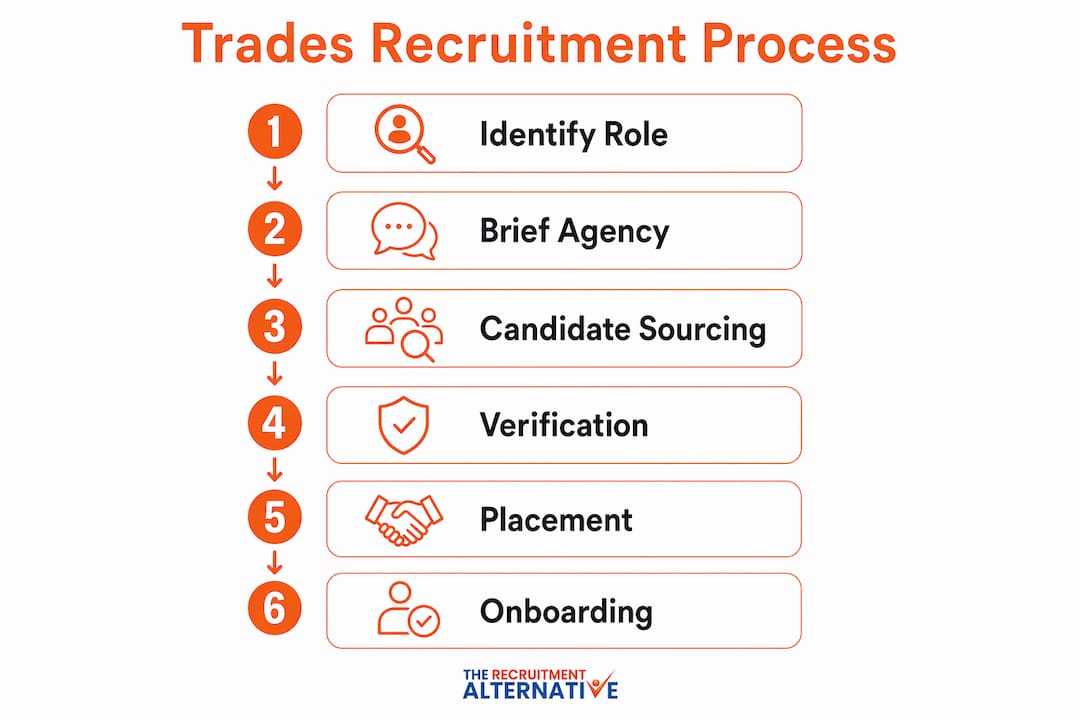
The process follows a clear sequence: you brief the role, including required tickets, site conditions, and availability windows; The Recruitment Alternative sources and shortlists candidates using specialist trades channels; each candidate is verified for licences, right-to-work, and references before presentation; you select and make an offer; the agency supports the onboarding handover. Typical timelines for trades roles depend on the specialisation and location, but the structured process shortens time-to-hire by removing the back-and-forth that slows unstructured searches.
Key benefits for employers:
- Predictable cost: One fixed fee, no commission surprises
- Australia-wide reach: National sourcing across metro and regional markets
- Specialist trades sourcing: Ticketed candidate pools and multi-channel outreach
- Compliance focus: Licence and right-to-work verification built into the process
- Replacement guarantee: Candidates who do not work out are replaced within the guarantee period
For construction-focused employers, The Recruitment Alternative also offers budget recruitment solutions tailored to the specific demands of the building and civil sectors.
Key takeaways
Specialist trades recruitment delivers faster placements and better retention because providers maintain pre-verified, ticketed candidate pools and verify licence currency before every placement.
| Point | Details |
|---|---|
| Choose the right model | Use labour hire for urgent or project-based cover; permanent recruitment for long-term headcount. |
| Budget for on-costs | Apply an uplift over base rates to cover superannuation, leave entitlements, workers’ compensation, and payroll tax. |
| Verify licences before day one | Check white card, state trade licences, and high-risk work licences against the issuing state’s register. |
| Brief your agency clearly | Provide required tickets, site conditions, and availability windows upfront to shorten time-to-hire. |
| The Recruitment Alternative | Offers flat-fee permanent recruitment for trades roles Australia-wide, with licence verification and a replacement guarantee. |
The part of trades hiring most employers get wrong
There is a persistent assumption in trades hiring that speed and quality are in tension: that moving fast means accepting a weaker candidate. In practice, the opposite is often true. The employers who fill roles fastest are the ones who brief agencies with the most precision, not the ones who cast the widest net.
A vague brief, “we need an electrician, ASAP,” produces a slow, frustrating search. A precise brief, including the specific licence class, the site’s WHS induction requirements, the project phase, and the supervision structure, gives a specialist recruiter everything needed to match from a pre-verified pool within hours rather than days. The HIA’s guidance on residential building recruitment reinforces this: competency-based screening and structured onboarding are what separate placements that stick from ones that turn over within 90 days.
The other common pitfall is treating the agency relationship as transactional. Employers who share site conditions, team dynamics, and genuine performance expectations get candidates who are prepared for the reality of the role. Those who treat the brief as a job ad get candidates who were sold a different picture. Onboarding is not the agency’s job alone. A structured first-week induction, clear task assignments, and early feedback loops are what convert a good placement into a long-term hire.
Ready to fill your next trades role with a flat fee?
Traditional recruitment agencies charge a percentage of salary, which means a senior electrician or licensed plumber hire can cost thousands more than it should. The Recruitment Alternative offers a genuinely different model: a flat-fee recruitment service for permanent trades roles, with the same specialist sourcing, licence verification, and replacement guarantee you would expect from a premium provider.
After you make contact, The Recruitment Alternative will request your role brief, including required tickets, site location, start date, and any specific WHS or induction requirements. From there, the team sources and shortlists candidates, completes licence and right-to-work verification, and presents a shortlist for your review. Coverage is Australia-wide, including regional and remote locations. Replacement terms and compliance checks are built into every placement.
To get started, visit the flat-fee pricing page or submit a vacancy brief directly through the website.
Useful resources for trades employers
- SafeWork Australia: National WHS policy, model laws, and high-risk work licence information.
- NSW Fair Trading / Consumer Affairs Victoria / QBCC (Queensland): State-based trade licence registers for verifying electricians, plumbers, and builders.
- Australian Apprenticeships: Current incentive payments, wage subsidies, and eligibility criteria for employers taking on apprentices.
- Migration Directory: 2026 Trades Fast-Track: Detail on the $85.2 million federal package and what it means for trades migration timelines.
- Trade staff recruitment best practices: The Recruitment Alternative’s practical guide to sourcing and screening trades candidates.
- Tips for working with a recruitment agency: Step-by-step briefing guidance to shorten time-to-hire and improve placement quality.
- Job costing for trades businesses: Practical guidance on calculating labour on-costs and budgeting for trades projects.
Recommended
- Trade staff recruitment best practices: a 2026 guide – The Recruitment Alternative
- Approaching Inefficient Talent Acquisition – The Recruitment Alternative
- Affordable Recruitment Australia wide – The Recruitment Alternative
- Building a Rewarding Career in Trades and Services – The Recruitment Alternative

