

The most reliable accountant hiring process follows five stages: define the role, screen quickly, verify skills with a short task test, run structured interviews, then check references and make an offer fast. Speed and clear criteria matter more than most employers realise, and verification should lean on the Fair Work Ombudsman, business.gov.au and CPA Australia. Employers who prefer to hand this over can also engage a fixed-fee recruitment agency.
TL;DR:
- Using a capability matrix tailored to each specific accountant role streamlines hiring criteria and prevents scope creep that complicates later stages.
- Structuring clear ads with detailed job duties, precise salary bands, and specific software requirements filters out unqualified applications early.
- Conducting no more than two interview rounds with rapid feedback and including realistic task tests significantly enhances selection accuracy and process speed.
- Verifying overseas qualifications with professional documentation and cross-checking award coverage avoids regulatory compliance risks.
- Employing a fixed-fee recruitment service reduces internal delays, cuts costs, and offers a reliable safety net if the candidate does not stay long-term.
Table of Contents
- Defining the accountant role and capability framework
- Writing a job description that attracts the right candidates
- How do you screen accountant résumés efficiently?
- What interview questions should you ask an accountant?
- Skills tests and qualification verification
- Making the offer and onboarding accountants properly
- Legal and compliance essentials employers can’t skip
- Who owns what in the hiring process?
- Communicating with candidates throughout the process
- How do you score and compare accountant candidates fairly?
- Templates: job description, interview questions, and offer letter
- Common mistakes employers make hiring accountants
- A recruiter’s take on what actually moves the needle
- How The Recruitment Alternative makes accountant hiring simpler
- Key resources for verifying compliance and qualifications
- Sources
- FAQ
Defining the accountant role and capability framework
Not every “accountant” role needs the same person. A junior accounts assistant handling accounts payable is a different hire from a management accountant building board reports, and treating them the same is the fastest way to attract mismatched applicants.
Start by naming the archetype: junior/graduate accountant, financial reporting accountant, management accountant, or FP&A specialist. Each maps to a different mix of technical duties, systems exposure and stakeholder contact. From there, build a simple capability matrix covering five areas:
- Technical accounting skills (reconciliations, journals, month end, statutory reporting)
- Systems and software (Xero, MYOB, SAP, Excel modelling, ERP experience)
- Communication and business partnering with non-finance stakeholders
- Compliance awareness (tax obligations, audit readiness, internal controls)
- Growth potential and adaptability, given CPA Australia’s research on skills employers are prioritising shows critical thinking and digital literacy now outweigh pure transactional bookkeeping.
Separate “must-have” from “preferred” criteria before you write the ad. This single step prevents scope creep in interviews later.
Pro Tip: Write the capability matrix before the job ad, not after. Ads written first tend to describe the last person in the role rather than the one you actually need now.
Writing a job description that attracts the right candidates
A vague advert filters out good candidates just as effectively as it filters in bad ones. Structure the advert in five parts: a two-line role summary, key duties (five to seven bullet points, not fifteen), must-have criteria, nice-to-haves, and a clear reporting line plus tech stack.
Naming the software stack (Xero versus SAP, for instance) does more filtering work than any personality descriptor. Candidates self-select based on tools they already know.
Including a transparent salary band is one of the highest-leverage changes you can make to an accountant hiring process. It reduces applications from candidates whose expectations sit outside your range, and Fair Work Commission guidance notes that vague or ambiguous wording in ads carries genuine discrimination risk, so specificity protects you legally as well as commercially.
Structure to include:
- Role summary and reporting line
- Key duties (concrete, not aspirational)
- Must-have vs preferred qualifications
- Salary band and location/hybrid arrangement
- Systems and software used day to day
Post on a mix of general job boards and finance-specific platforms, and track applicant volume against quality at the screening stage so you can adjust wording for the next round.
How do you screen accountant résumés efficiently?
Screening should take minutes per candidate, not an hour, if your criteria are clear. Run every résumé through a pass/fail gate against your must-haves before you assess anything softer.
- Check qualifications first: CA, CPA, or equivalent, matched against ANZSCO 221111 where the role requires it.
- Confirm systems experience matches your tech stack, not just “accounting software” generically.
- Scan for unexplained employment gaps or roles that can’t be verified. Ask about these directly rather than discarding the application. Context often resolves them in thirty seconds.
- Check tenure patterns. Multiple sub-twelve-month stints warrant a direct question, not an assumption.
- Score each candidate against the same three or four criteria using a simple 1 to 5 scale, so shortlisting decisions are comparable across a stack of forty applications rather than based on gut feel.
Consistent scoring is what removes bias from screening. Two reviewers using the same rubric on the same résumé should land within a point of each other. If they don’t, your criteria are too vague and need tightening before the next intake.
What interview questions should you ask an accountant?
Two rounds usually suffice for most accountant hires: a first-round screen with the hiring manager, and a second-round panel including a future stakeholder such as a department head or the finance director. Adding a third round rarely improves decision quality and often costs you the candidate to a faster-moving employer.
Technical questions should test applied knowledge, not textbook recall. Ask candidates to walk through how they’d process a specific journal entry, explain a bank reconciliation discrepancy, or describe how they’d close a month with incomplete data. CPA Australia’s analysis of employer skill priorities points to automation and analytics fluency as an increasingly common differentiator, so ask how a candidate has used tools to reduce manual reconciliation work rather than just whether they’ve “used Excel”.
Behavioural questions should probe deadline pressure and stakeholder friction, since these are where accountants actually struggle in the first ninety days:
- “Describe a time you had to deliver bad financial news to a manager who didn’t want to hear it.”
- “Tell me about a month-end close that went wrong. What did you do?”
- “How do you handle a request from a stakeholder that conflicts with proper process?”
Score every answer against a shared rubric (technical accuracy, communication clarity, judgement under pressure) rather than relying on interviewer impression alone. Calibrate interviewers beforehand by reviewing one sample answer together, so a “4” means the same thing to every panel member.
Pro Tip: Send interview questions to internal panel members 24 hours ahead, not the morning of. Rushed interviewers default to generic questions that don’t test the capability matrix you built earlier.
Skills tests and qualification verification
A well-designed twenty to thirty minute task reveals more about workplace competence than an hour of interview conversation. Give candidates a short, realistic scenario: a bank reconciliation with a deliberate discrepancy, a simplified month-end pack to review for errors, or a basic thirteen-week cash flow forecast built from partial data.
Research from CPA Australia on practical skills verification confirms that scenario-based tasks predict on-the-job performance better than résumé claims or theoretical questioning alone. The best test design mimics real messiness: incomplete data, ambiguous instructions, and a time limit. Ask candidates to document their assumptions as they work, since that written trail tells you as much about their communication as the final answer does.
Mark tests against a fixed answer key focused on accuracy and reasoning, not presentation. A candidate who flags an assumption clearly but formats the spreadsheet imperfectly has usually shown you more than one who submits something polished but silent on their process.
For overseas qualifications, don’t take résumé wording at face value:
- Request primary documentation (degree certificates, membership letters) directly from the candidate.
- Where doubt remains, use CPA Australia’s migration and qualification assessment service for occupations classified under ANZSCO 221111.
- Cross-check membership status with the relevant professional body rather than relying on a claimed designation alone.
Making the offer and onboarding accountants properly
Speed at the offer stage matters more for accountants than almost any other stage of the process, because strong candidates rarely stay on the market long. A slow, multi-week offer process is one of the most common reasons employers lose a preferred hire to a competitor.
- Draft the offer letter as soon as the panel agrees, covering start date, reporting line, probation period and remuneration clearly.
- Confirm classification and minimum entitlements before you finalise pay. Use the Fair Work Pay and Conditions Tool or check award coverage directly, since many accountants working in non-accounting-firm settings are award-free but still entitled to full National Employment Standards.
- Send the offer within 48-hour of the final interview wherever possible.
- Build a 30/60/90 day onboarding checklist covering system access, a buddy or mentor, and a first month-end review with the hiring manager.
Pro Tip: Schedule the new hire’s first one-on-one feedback session for day 14, not day 90. Early course correction prevents the quiet disengagement that leads to resignations in month three.
Legal and compliance essentials employers can’t skip
Anti-discrimination compliance starts at the job ad, not the interview. Fair Work Commission guidance is explicit that vague preferences around age, cultural background or family status can constitute adverse action, even when unintentional. Keep selection criteria tied strictly to the capability matrix you built earlier.
Award coverage for accountants is genuinely inconsistent and worth checking every time. Fair Work’s guidance on accounts employee coverage notes accountants working within accounting firms are frequently award-free, while those in other industries may fall under a different instrument entirely. Never assume; always verify before you set pay.
Accessorial liability extends beyond the business owner. Fair Work’s accessorial liability guidance confirms that individuals involved in hiring decisions, including HR staff and finance managers, can be personally implicated in contraventions. Keep scoring sheets, interview notes and test answers on file.
- Tie every selection decision to documented, job-related criteria
- Verify award or agreement coverage before confirming a salary
- Retain interview and test records for future defensibility
Who owns what in the hiring process?
A stalled accountant hiring process is usually a stakeholder problem, not a candidate problem. Assign ownership clearly before you open the role, because ambiguity here is what causes the multi-week delays candidates cite most often when they withdraw.
The hiring manager owns the capability matrix, technical interview questions, and final decision authority. They should attend every round and be the single point of accountability for moving the process forward.
HR or a recruitment partner typically owns compliance checks, the job ad, screening logistics and offer administration. This person keeps the process moving between interview rounds and chases feedback so candidates aren’t left waiting.
A future stakeholder, such as a finance director or department head the accountant will report to or work closely with, should attend the second-round interview only. Involving senior leadership too early adds delay without improving decision quality, and involving them too late means they veto a candidate after everyone else has already committed.
Payroll or finance operations should be looped in before the offer stage, not after, so classification and pay queries don’t hold up a signed offer letter. A common failure mode is finance discovering award questions only once a verbal offer has already been made to the candidate, forcing an awkward renegotiation.
Set a single decision maker for each stage and a maximum 48 hour turnaround for feedback between rounds. Processes stall when three people need to independently sign off with no deadline attached to any of them.

Communicating with candidates throughout the process
Every stage of an accountant hiring process is also a stage in your employer brand, whether you treat it that way or not. Candidates talk, and a reputation for silence after interviews follows you into future hiring rounds.
Set a communication cadence at the start and stick to it: acknowledge every application within 48 hours, even with a template response, and update shortlisted candidates within three business days of each interview round regardless of whether a decision has been made. “Still deciding, will update you Friday” beats silence every time.
Background recruiter experience consistently shows that fast, transparent communication reduces candidate withdrawals materially, particularly for in-demand accounting skill sets where candidates are often running parallel processes with other employers. A candidate who hears nothing for two weeks assumes rejection and accepts elsewhere.
Give candidates a realistic timeline upfront, including how many rounds to expect and roughly when a decision will land. This single disclosure eliminates most of the anxious follow-up emails that eat into a hiring manager’s week.
Reject unsuccessful candidates personally where you can, with one specific piece of feedback rather than a generic template. It costs little and protects your reputation in what is often a small, well-connected professional community.
How do you score and compare accountant candidates fairly?
A shared scoring system is what separates a defensible hiring decision from a gut call that’s hard to justify later. Build a single scorecard covering four to six weighted criteria drawn directly from your capability matrix: technical accuracy, systems proficiency, communication, judgement under pressure, and cultural or team fit.
Score each candidate on a consistent 1 to 5 scale at every stage, resume screen, task test, and each interview round, rather than forming an overall impression only at the end. This creates a running record you can compare across candidates who may have been interviewed weeks apart.
Have every interviewer score independently before comparing notes as a panel. Discussing scores before they’re recorded lets the most senior or most vocal panel member anchor everyone else’s judgement, which defeats the purpose of a rubric in the first place.
Templates: job description, interview questions, and offer letter
Having a reusable skeleton for each document saves hours on every subsequent accountant hire, and it keeps your process consistent enough to defend if a decision is ever challenged.
Job description skeleton: role title and reporting line, two-line summary, five to seven key duties, must-have criteria, preferred criteria, salary band, tech stack, and location or hybrid arrangement.
Interview question bank (mix and match by seniority):
- Technical: “Walk me through how you’d investigate a $15,000 discrepancy in a bank reconciliation.”
- Technical: “How would you approach closing a month with two supplier invoices still outstanding?”
- Behavioural: “Tell me about a deadline you nearly missed. What happened?”
- Behavioural: “Describe a time you had to explain a financial variance to someone without a finance background.”
Offer letter essentials: position title, start date, reporting line, probation length, base salary and superannuation, standard hours, and any conditions subject to reference or qualification checks. The business.gov.au Employment Contract Tool generates a compliant starting template covering these fields, and The Recruitment Alternative’s guide to creating an employment contract walks through the clauses Australian employers most often get wrong.
Keep every version of these documents on file. When you refine your job ad or interview questions after a hiring round, you build institutional knowledge that makes the next hire faster.

Common mistakes employers make hiring accountants
The single most common pitfall is writing the job ad before the capability matrix, which produces a role description that doesn’t match what the hiring manager actually needs three months in. Fix the sequencing, not the ad wording.
A close second is running three or four interview rounds because no one wants to make the final call. Every additional round adds days to your timeline and gives a strong candidate more time to accept somewhere else. Two rounds, well-structured, beat four rounds of diminishing returns.
Skipping the task test in favour of “a good feeling from the interview” is a persistent trap, especially for senior hires where employers assume experience alone guarantees competence. Polish in conversation doesn’t always translate to accuracy on a reconciliation.
Other recurring issues:
- Assuming a candidate’s stated qualification is accurate without requesting documentation, particularly for overseas credentials
- Setting pay without checking award coverage, then having to renegotiate after a verbal offer
- Leaving candidates without updates for a week or more, which drives withdrawals from your strongest applicants
- Scoring candidates informally instead of against a shared rubric, which opens decisions to challenge and inconsistency
Most of these pitfalls share a root cause: rushing past structure to save a few days, then losing weeks to a bad hire or a stalled process instead.
A recruiter’s take on what actually moves the needle
The biggest wins I’ve seen in accountant hiring come down to unglamorous mechanics: fewer interview rounds and faster feedback. One finance team lost a strong management accountant candidate purely because round three got scheduled two weeks out. A competitor made an offer in four days.
The tactical fix is simple: cap interviews at two rounds and set a 48 hour feedback SLA between them. If your process can’t hit that internally, a fixed-fee recruiter can run it for you.
— Josh Townsend
How The Recruitment Alternative makes accountant hiring simpler
The Recruitment Alternative solves the exact problem this article has walked through: building and running a compliant, well-structured accountant hiring process without the six-week internal timeline or the commission-based agency fees that come with it.
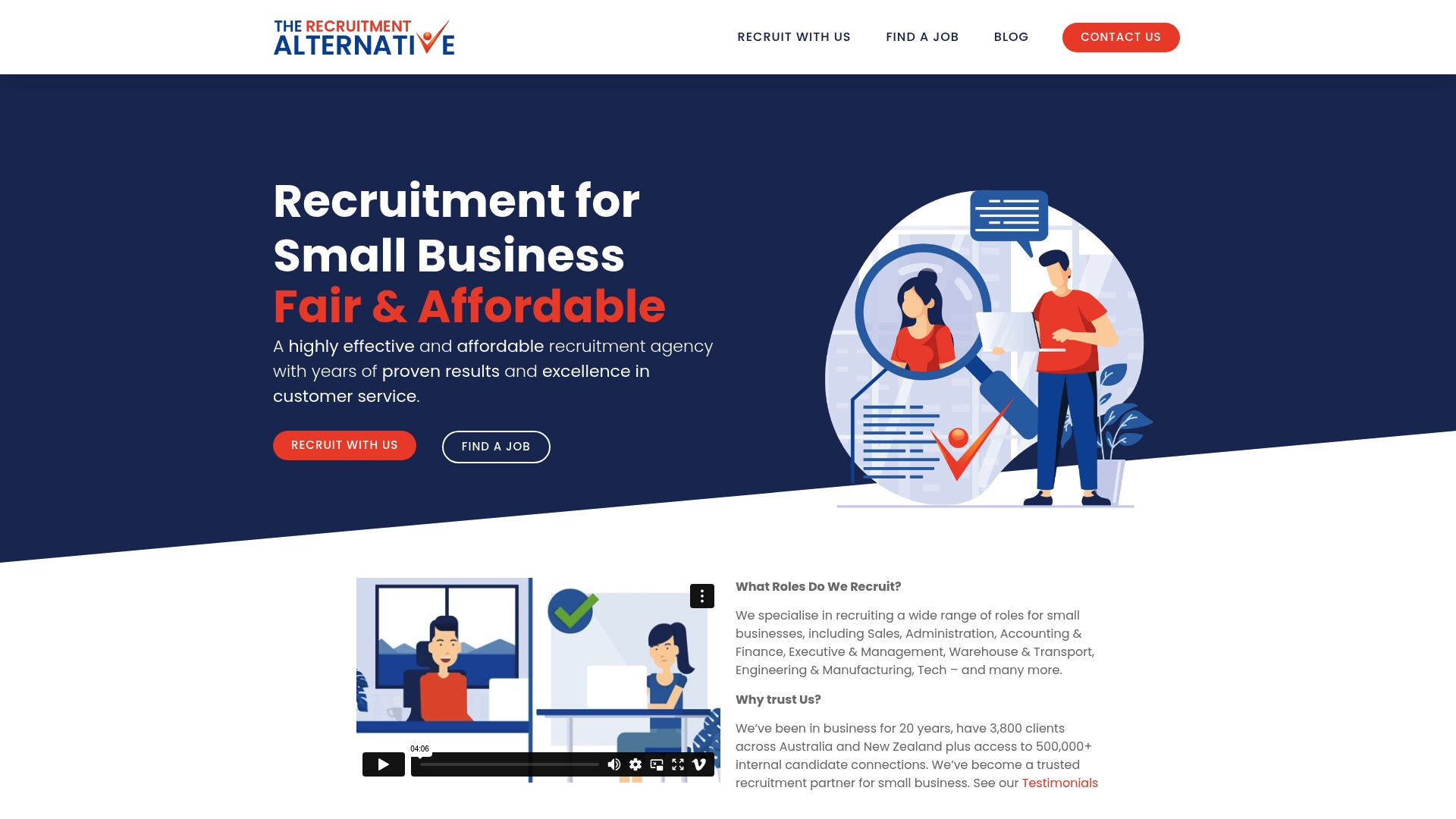
Instead of paying a percentage of salary, you pay a transparent flat fee regardless of how senior the accounting role is, which is a meaningful cost saving compared to traditional commission agencies for finance and accounting positions specifically. The service covers accountants at every level, from graduate through to financial controller. It also covers sales, administration, engineering, healthcare, technology and executive roles across the same fixed-fee model. If a placement doesn’t work out in the first two to three months, the Replacement Campaign option gives you a safety net rather than starting the whole process again from scratch.
If you’re ready to see how the Recruit and Recruit+ flat-fee structures compare against running the process in-house, the pricing page breaks down engagement and placement fees by tier. For a broader look at how fixed-fee hiring works specifically for finance roles, the affordable accounting and finance recruitment guide is worth a read before your next accountant hire.
Key resources for verifying compliance and qualifications
Before you finalise any accountant hire, check obligations against primary sources rather than assumptions. The Fair Work Ombudsman covers discrimination, award coverage and hiring obligations. business.gov.au offers the Employment Contract Tool and Pay and Conditions Tool. CPA Australia verifies overseas qualifications and publishes capability frameworks for accounting roles.
Sources
- Fair Work Commission — discrimination guidance
- Fair Work — award coverage for accounts employees
- Business
FAQ
How hard is it to get hired as an accountant?
Competition varies significantly by specialisation and seniority, with management accounting and FP&A roles typically attracting fewer qualified applicants than entry-level bookkeeping positions. Candidates with strong systems proficiency and demonstrated analytical skills, rather than transactional experience alone, tend to move through structured hiring processes faster, based on CPA Australia’s findings on in-demand skills.
What are the 5 C’s of interviewing?
Definitions of the “5 C’s” vary across recruitment sources and there’s no single agreed framework specific to accounting interviews. Rather than relying on a generic acronym, structure your accountant interviews around the capability matrix and scoring rubric outlined earlier in this guide for a more defensible, role-specific result.
What are the four steps of the hiring process?
Most accountant hiring processes compress into four practical stages: define the role and criteria, screen and shortlist applicants, assess through structured interviews and task tests, then verify and make the offer. Employers who want this managed externally can engage a flat-fee service such as The Recruitment Alternative’s Fixed Fee Recruitment to run these stages on their behalf.
How should I prepare for an accountant interview?
As an employer, preparation means finalising your capability matrix, agreeing on technical and behavioural questions in advance, and briefing every panel member on the scoring rubric before the interview day. Send questions to interviewers 24 hours ahead so the panel arrives calibrated rather than improvising on the day.
How much does it cost to use a fixed-fee recruiter for an accountant role?
The Recruitment Alternative’s Fixed Fee Recruitment service is listed at $4,795 one-off, with tiered Recruit and Recruit+ options available depending on the seniority of the role. Current pricing detail, including engagement and placement fee breakdowns, is available on the flat-fee pricing page.

