

A compliant job offer letter in Australia is a short, conditional summary, not the contract itself. It must name the role, employment type, start date (flagged as conditional if checks are pending), pay including superannuation, ordinary hours, and clear acceptance steps, while pointing the candidate to a full employment contract for the binding detail.
TL;DR:
- The offer letter should be a brief, conditional summary referencing the employment contract, with clear acceptance steps, avoiding any binding promises before checks are complete.
- Including key information such as role, hours, pay with superannuation, award references, and compliance statements ensures clarity and reduces disputes.
- Employers must prioritize sequencing: draft the contract first, issue a conditional offer referencing it, and verify checks before confirming start dates.
- Providing the Fair Work Information Statement and other statutory notices on or before the first day is essential for legal compliance and audit readiness.
- Accurate matching of offer letter details with the signed employment contract prevents common errors that lead to misunderstandings or legal exposure.
Table of Contents
- What an offer letter is (and how it differs from an employment contract)
- What to include in a job offer letter (copyable checklist)
- Legal and compliance checklist for Australian employers
- How to issue a job offer, step by step
- Acceptance, onboarding pack and admin checklist
- Common mistakes in Australian offer letters (and how to fix them)
- How The Recruitment Alternative supports compliant offers
- What happens if a candidate rejects or negotiates a job offer letter
- How long a job offer takes from issuance to first day
- Confidentiality, non-compete and probation clauses to watch for
- Negotiating offer letter terms the right way
- Employee vs contractor: getting the offer right
- Termination and resignation notice in offer letters
- What Australian employers get wrong about offer letters
- Get compliant offer letters out faster with The Recruitment Alternative
- Sources
- FAQ
What an offer letter is (and how it differs from an employment contract)
An offer letter confirms terms and secures acceptance. The employment contract sets out the binding legal obligations both parties are agreeing to. Treating the two as interchangeable is where most employers get into trouble.
A signed offer that spells out every material term can itself become a binding contract, even without a separate agreement attached. That’s rarely what employers intend, and it can lock you into terms before pre-employment checks are finished.
The fix is straightforward:
- Keep the letter to a summary: role, pay, start date, and next steps.
- Use conditional language (“subject to satisfactory reference and background checks”) rather than firm commitments.
- State plainly that the employment contract, once signed, contains the binding terms.
- Draft the employment contract before the offer letter, so figures and clauses match exactly and nobody promises a number the contract later contradicts.
What to include in a job offer letter (copyable checklist)
Every Australian offer letter should cover the same core fields, regardless of industry or role level. Missing one of these is the most common reason offers get queried, delayed, or misread by candidates.
- Employer name, employee name, and the date of the offer.
- Job title, who the person reports to, and the primary work location.
- Employment type: full-time, part-time, casual, or fixed-term.
- Ordinary hours of work per week.
- Start date, marked conditional if checks are outstanding.
- Remuneration, including base pay, pay cycle (weekly, fortnightly), and the superannuation rate payable on top.
- The relevant modern award or enterprise agreement, if one applies to the role.
- Conditions of the offer: right-to-work confirmation, reference checks, police checks, qualification verification.
- Acceptance instructions: deadline, method (signed contract, e-signature, or written confirmation), and who to contact with questions.
- A short line confirming the attached employment contract holds the binding terms.
Pro Tip: List the superannuation rate as a specific percentage, not “as per legislation” — candidates increasingly compare offers on total package, and a vague line here reads as evasive.
Essential elements like these align directly with the Fair Work Act 2009 (Cth) and the National Employment Standards, which set the floor for hours, leave, and notice that every offer ultimately has to respect. Skipping the award reference is a small omission that causes outsized pay disputes later, particularly in retail, hospitality, and trades roles where award coverage is easy to misjudge.
Legal and compliance checklist for Australian employers
Getting the letter right is only part of the job. The surrounding paperwork carries its own statutory deadlines, and missing them is where genuine legal exposure sits.
- Provide the Fair Work Information Statement on or before the employee’s first day, as required under section 125 of the Fair Work Act 2009 (Cth).
- Use the Casual Employment Information Statement (CEIS) for casual hires and the Fixed Term Contract Information Statement (FTCIS) for fixed-term roles, in addition to the standard FWIS.
- Get a signed acknowledgement that the FWIS was received. Failing to provide it, or the right variant for casual and fixed-term staff, is a common compliance error that draws regulatory attention during audits.
- Check the National Employment Standards for minimum leave, notice, and hours entitlements, then confirm whether a modern award or enterprise agreement lifts any of those minimums for the role. Fair Work’s own templates and tools, including Find Your Award, are the fastest way to check.
- Collect a completed TFN declaration and issue the superannuation standard choice form so PAYG withholding and super contributions start correctly from day one.
- Keep a compliance file per hire: signed FWIS acknowledgement, TFN form, super choice form, and the signed contract. It’s the first thing an auditor or the Fair Work Ombudsman will ask for.
How to issue a job offer, step by step
Sequencing matters more than most employers assume. Doing these steps out of order is how conditional offers turn into unconditional promises by accident.
- Draft the employment contract first, so every figure in the offer letter matches it exactly.
- Issue a conditional offer letter that references the attached contract and lists any outstanding checks.
- Set a clear acceptance deadline and specify how the candidate should accept: signed contract, e-signature, or written email confirmation.
- Deliver the Fair Work Information Statement (and CEIS or FTCIS where relevant) on or before the first day, and file the signed acknowledgement.
- Confirm the start date only once all conditions, such as reference or right-to-work checks, are satisfied.
- Put any delay to the start date in writing immediately, rather than leaving it to a phone call. Business.gov.au’s guidance on making an offer recommends giving candidates genuine time to consider terms before locking anything in.
Acceptance, onboarding pack and admin checklist
Once a candidate accepts, the paper trail becomes the evidence that protects both parties if a dispute ever arises.
- File the signed contract or written acceptance alongside the original offer letter.
- Collect the TFN declaration, superannuation choice form, and evidence of right to work.
- Verify licences, tickets, or police checks required for the specific role before the first shift.
- Set up payroll with the correct award classification, PAYG withholding rate, and superannuation percentage.
- Build a compliance folder per employee: signed FWIS acknowledgement, contract, completed checks, and onboarding forms.
Practical onboarding packs that bundle the FWIS acknowledgement with the contract and ATO forms make this a fifteen-minute task rather than a scramble on someone’s first Monday.
Common mistakes in Australian offer letters (and how to fix them)
Most offer letter disputes trace back to the same handful of errors, all of them avoidable with a five-minute review before sending.
- Firm start dates with unfinished checks. If a reference or police check is still pending, say the start date is conditional on it clearing, not a fixed date.
- Duplicating contract clauses. Restating detailed leave, termination, or restraint clauses in the letter creates two versions of the truth. Reference the contract instead of rewriting it.
- One template for every role. A generic letter misses award-specific detail for trades, casual retail staff, or executive hires. Standardised templates with role-specific variants cut errors significantly for employers hiring at volume.
- Numbers that don’t match. If the offer letter says one figure and the contract says another, the candidate reasonably relies on whichever is more generous.
Pro Tip: Run a quick side-by-side check between the letter and contract before either goes out: same pay figure, same super rate, same start date wording. It takes two minutes and catches the error that causes the most disputes.
How The Recruitment Alternative supports compliant offers
Getting an offer letter right is one part of a hiring process that includes sourcing, screening, and onboarding, and most of the delay in that process sits outside the letter itself. The Recruitment Alternative works with employers across sales, administration, finance, engineering, healthcare, technology, trades, and executive roles under a fixed-fee model, which removes the admin load of chasing checks and paperwork on top of finding candidates.
Beyond sourcing, the practical support that matters at offer stage includes standardised templates that reduce the role-specific errors covered above, guidance on sequencing right-to-work and reference checks before a start date is confirmed, and payroll-check advice so award classification and superannuation are correct from day one. A candidate replacement safeguard also covers employers if a placement does not work out in the first few months, reducing the risk of a rushed second hire.
What happens if a candidate rejects or negotiates a job offer letter
Declining an offer carries no legal consequence for the candidate in Australia, provided no signed contract or binding acceptance exists yet. A conditional offer letter that hasn’t been accepted creates no obligation on either side, which is exactly why keeping the letter non-binding until the contract is signed matters so much.
Negotiation is different from rejection and carries no legal risk either, as long as the employer treats a counter-offer as a new proposal rather than an accepted term. If a candidate proposes a different salary or start date, that counter-offer effectively replaces the original one until you both agree on final terms. Employers who confirm a “final” verbal agreement over the phone, then follow up with a letter that quietly changes a term, risk a dispute over which version the candidate reasonably relied on.
The real legal exposure appears once a candidate has accepted in writing and then the employer withdraws the offer, or once an employee has resigned from a previous role in reliance on a confirmed start date that the employer then delays or cancels. Courts have found in favour of candidates in cases where a confirmed, unconditional offer was withdrawn after the candidate had already resigned elsewhere, since the acceptance created a binding obligation. This is precisely why conditional language and a clear acceptance deadline in the letter matter: they protect the employer’s flexibility right up until the point every check has cleared, and they give the candidate certainty about what is and isn’t confirmed at each stage.
How long a job offer takes from issuance to first day
There’s no legislated timeframe for any stage of the offer process in Australia, but a predictable rhythm has emerged across industries. Most employers issue a written offer within one to three business days of a final interview or reference check clearing, and give the candidate three to seven days to consider and respond.
Business.gov.au’s guidance on making an offer recommends giving candidates genuine time to weigh the terms rather than pressuring an immediate answer, particularly where the candidate needs to resign from a current role and serve notice. Once accepted, right-to-work and reference checks typically add another one to two weeks before a start date is confirmed, longer if police checks or licence verification are required for regulated roles like healthcare, education, or financial services.
From first written offer to first day on the job, a few weeks is a realistic average for a permanent hire once notice periods are factored in. Casual and part-time roles often move faster, sometimes within a week, since there’s less contract complexity and frequently no notice period to work through. Fixed-term contract roles sit in between, depending on how quickly the incumbent’s replacement needs to be onboarded. Employers who build these realistic windows into their hiring plan, rather than assuming a candidate can start “next Monday,” avoid the scramble that leads to skipped compliance steps.
Confidentiality, non-compete and probation clauses to watch for
Australian offer letters increasingly reference clauses that belong properly in the employment contract but still need flagging upfront, so the candidate isn’t surprised by them later.
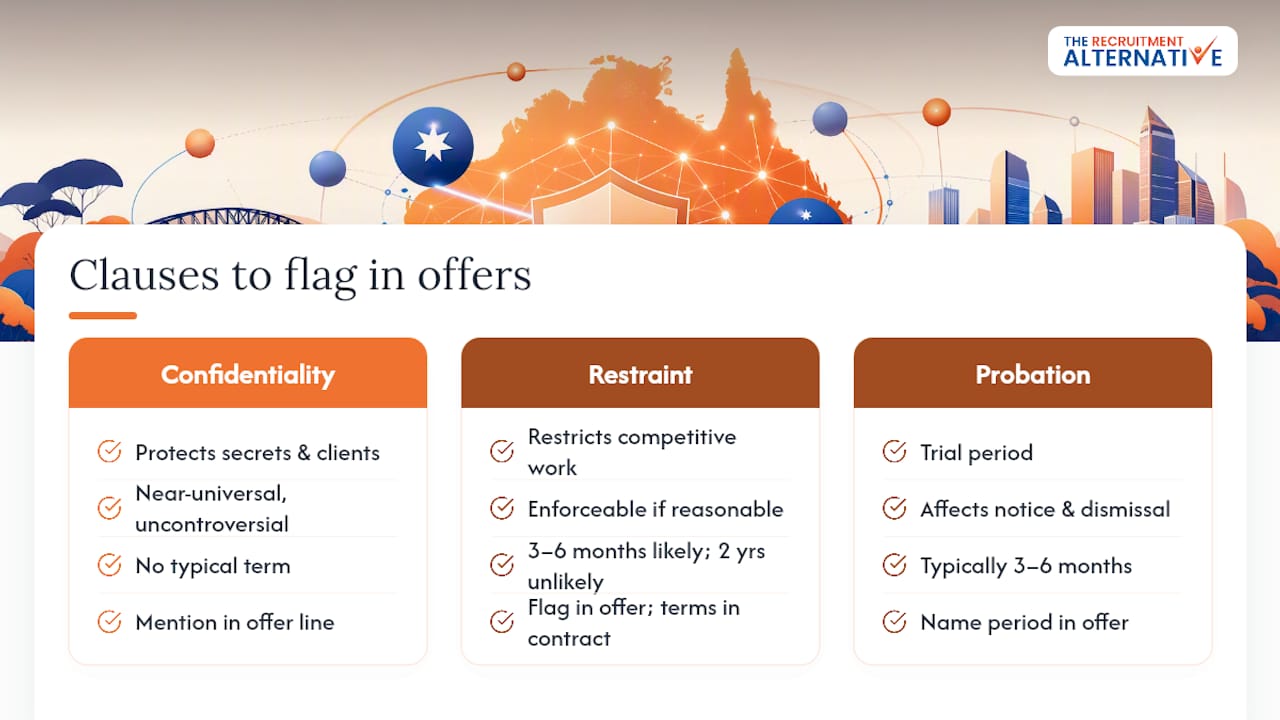
Confidentiality clauses are near-universal and generally uncontroversial. They protect trade secrets, client lists, and commercially sensitive information, and most candidates expect them.
Non-compete and restraint of trade clauses deserve more scrutiny. Australian courts only enforce a restraint to the extent it’s reasonable in scope, geography, and duration, protecting a legitimate business interest rather than simply preventing competition. A restraint stopping a junior sales rep from working anywhere in the same industry nationally for two years is unlikely to hold up; a narrower restraint protecting specific client relationships for three to six months has a much better chance. If a role carries a restraint clause, flag it in the offer letter so the candidate can raise questions before signing, not after.
Probationary periods are standard in most Australian employment contracts, typically three to six months, and should be named in the offer letter even though the detailed terms sit in the contract. A probation period affects notice requirements and, in some cases, unfair dismissal eligibility under the Fair Work Act, so candidates reasonably want to know it exists before they accept.
The safest approach is a one-line mention of each clause in the offer letter, with the substantive terms left to the contract. Naming a restraint or probation period without detailing it avoids duplicating legal language while still giving the candidate fair warning.
Negotiating offer letter terms the right way
Negotiation is a normal, expected part of Australian hiring, not a red flag on either side. Handling it well protects the relationship before the person has even started.
The most commonly negotiated terms are salary, start date, and flexible working arrangements, roughly in that order. Superannuation is rarely negotiated on its own since the minimum rate is set by law, but total package framing (base plus super) is often where the actual back and forth happens.
Employers should treat every counter-offer as a fresh proposal rather than an amendment to lock in immediately. Put the revised terms in writing before either side treats them as final. A verbal “yes, we can do that” over the phone, without a follow-up email or updated letter, is where miscommunication creeps in and where disputes about “what was agreed” start.
Where a candidate asks for something outside standard policy, such as an unusually early start date or a non-standard hours arrangement, check it against the relevant modern award or enterprise agreement before agreeing. An award might set minimum notice or rostering requirements that make a candidate’s request impractical regardless of what both parties would prefer.
Keep the tone collaborative rather than adversarial. Candidates negotiating terms are usually signalling genuine interest in the role, not testing how far they can push, and treating the conversation that way tends to produce a better long-term hire.
Employee vs contractor: getting the offer right
The distinction between an employee and an independent contractor changes almost everything about what an offer document should say, and getting it wrong carries real financial risk. Since the High Court’s 2022 decisions in CFMMEU v Personnel Contracting and ZG Operations v Jamsek, Australian courts have focused primarily on the written terms of the agreement itself, rather than looking behind it to how the relationship plays out day to day.
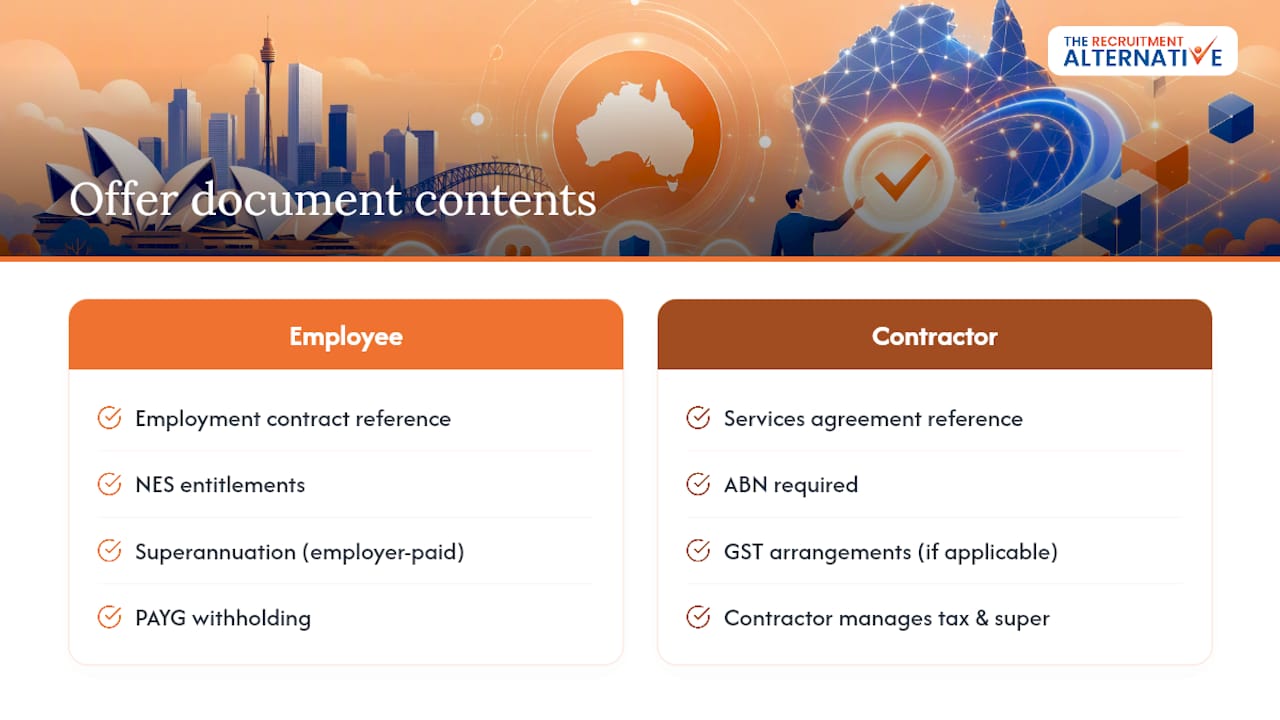
That makes the offer document doing double duty here even more important. An employee offer letter should reference an employment contract, NES entitlements, superannuation, and PAYG withholding. A contractor engagement letter should reference a services agreement, an ABN, GST arrangements where applicable, and make clear the contractor manages their own tax and superannuation.
Mislabelling an employee as a contractor to avoid superannuation, payroll tax, or NES obligations is a costly mistake if the Fair Work Ombudsman or the Australian Taxation Office later determines the relationship was genuinely one of employment. Penalties can include backdated superannuation, PAYG, and potential fines under sham contracting provisions in the Fair Work Act.
If there’s genuine ambiguity about which category a role falls into, get advice before the offer goes out rather than after the person starts. Correcting a misclassified relationship after months of payments is far more expensive than getting the paperwork right at offer stage.
Termination and resignation notice in offer letters
Notice requirements rarely belong in full detail in the offer letter, but ignoring them entirely is a common oversight that causes confusion later. The safest approach names the notice period and points to the contract for the mechanics.
The National Employment Standards set minimum notice periods for employer-initiated termination based on length of service, ranging from one week for under a year of service up to four weeks for over five years, with an extra week added for employees over 45 with at least two years’ service. These are statutory minimums; a contract can specify longer notice but never shorter.
Resignation notice, by contrast, isn’t set by the NES at all. It’s whatever the employment contract specifies, commonly matching the employer’s notice period for consistency, or left silent, in which case reasonable notice based on the role and seniority applies. If the offer letter is silent on resignation notice and the contract is too, both parties are left guessing, which is exactly the kind of ambiguity that turns an amicable exit into a dispute.
Probationary periods often carry shorter notice on both sides, sometimes as little as one to two weeks, and this should be stated clearly since it differs from the standard notice that applies once probation ends. Mentioning the notice framework in the offer letter, even briefly, sets the expectation early rather than leaving it as a surprise buried in contract clause fourteen.
What Australian employers get wrong about offer letters
The conventional advice on offer letters treats them as a formality, a quick email to send once the “real” decision has been made. That’s backwards. The letter is often the first written record either party can point to if things go sideways, and treating it as an afterthought is how well-intentioned employers end up accidentally bound to terms they hadn’t finalised.
What’s consistently underrated is sequencing. Most guidance focuses on what to include in the letter, but the order you do things in matters just as much: contract first, then conditional letter, then checks, then confirmed start date. Get that order wrong, even with a perfectly worded letter, and you’re exposed anyway.
If there’s one thing employers should prioritise above the wording itself, it’s consistency between the letter, the contract, and whatever was said verbally during the interview. Candidates remember what they were told. When the paperwork doesn’t match the conversation, that’s where trust erodes before someone has even started, and it’s almost always preventable with a five minute cross check before hitting send.
— Josh Townsend
Get compliant offer letters out faster with The Recruitment Alternative
The Recruitment Alternative is the alternative to a traditional agency for Australian employers who need compliant, well-sequenced offers without the admin overhead. Instead of a percentage-of-salary fee that scales with every pay rise you negotiate, Fixed Fee Recruitment runs on a transparent flat cost, which the business states deliver over 70% in savings against commission-based agencies.

Beyond sourcing candidates across sales, administration, finance, engineering, healthcare, technology, trades, and executive roles, the Recruit and Recruit+ pricing structure is built around the same sequencing this guide recommends: contract first, conditional offer second, checks third. If a placement doesn’t work out in the first few months, the candidate replacement campaign covers a second search without starting the fee clock from zero. Employers juggling employer branding alongside hiring can also lean on partners like HarbourSide Digital for candidate attraction support.
Check current pricing on the flat-fee structure page and get in touch to discuss your next hire.
Sources
- How to write an employment letter of offer in Australia | Sprintlaw
- Fair Work information statement | Fair Work
- Steps to make an offer of employment | business.gov.au
- TFN declaration | ATO
FAQ
Does getting a job offer letter mean you’ve got the job?
Not necessarily. A conditional offer letter usually means checks such as references or right-to-work verification still need to clear before the role is confirmed. Read the conditions section carefully. If the letter states the offer is “subject to” specific checks, the job isn’t fully secured until those conditions are met.
Is a letter of offer legally binding in Australia?
It can be, if it contains every essential term and the candidate accepts it in writing, even without a separate contract. Most employers avoid this by using conditional language and pointing to the employment contract as the source of binding terms.
How long does an offer letter take in Australia?
There’s no set legal timeframe, but employers typically issue a written offer within one to three business days of a final decision, then allow the candidate three to seven days to respond. Add another one to two weeks for right-to-work and reference checks before the start date is locked in.
How do you check an Australian job offer letter is compliant?
Confirm it names the role, employment type, pay including superannuation, hours, and start date, and that it references an award or enterprise agreement where one applies. Then check the Fair Work Information Statement has been provided and acknowledged, since that’s a statutory requirement under section 125 of the Fair Work Act, separate from the letter itself.

