

Skills-based hiring means selecting candidates on demonstrated ability and potential rather than proxies like degrees, job titles, or years of experience, and it works because it widens the talent pool while making hiring decisions more consistent. Employers who adopt it properly see better-fit hires and stronger retention, but only when they redesign job analysis and assessment rather than simply deleting a degree requirement. The first move is practical: pick one pilot role, map the competencies it actually needs, and build a validated assessment around them.
TL;DR:
- Implementing skills-based hiring requires redesigning job analysis and assessments, not just removing degree requirements, to effectively widen talent pools.
- Validated work samples, situational judgment tests, and structured interviews tailored to specific competencies are essential for reliable candidate evaluation.
- Focusing on observable, testable core tasks makes skills-based assessments practical for roles like sales, administration, and technology, but licensing may still be necessary for regulated professions.
- Measuring success involves tracking quality of hire, retention, time to productivity, diversity, and cost per hire, with continuous feedback improving assessments over time.
- Partnering with experienced recruitment services can streamline sourcing and screening, especially in high-turnover or hard-to-fill roles, while keeping internal decision frameworks intact.
Table of Contents
- What is skills-based hiring, and where does it apply?
- What practical benefits can employers expect?
- How do you actually implement skills-based hiring?
- What goes wrong, and how do you fix it?
- How do you measure whether it’s working?
- Where does a recruitment partner fit in?
- When should HR leaders prioritise this?
- How The Recruitment Alternative helps you put this into practice
- Sources
- FAQ
What is skills-based hiring, and where does it apply?
Skills-based hiring, sometimes called competency-based hiring or a skills-first approach, evaluates candidates against the specific abilities a role requires instead of relying on credentials that only loosely predict performance. A degree, a job title, or a set number of years in a similar role are proxies. They correlate with skill in some cases, but they screen out plenty of capable people who gained the same ability through a different path.
The distinction matters because genuine skills-based recruitment requires more than dropping a qualification line from a job ad. Research from the Burning Glass Institute found that firms announcing they’d removed degree requirements saw little real change in who they hired unless they also rebuilt job analysis and assessment around the actual competencies needed. The policy change without the process change is largely cosmetic.
Skills fall into two broad categories worth separating in any job competency framework:
- Technical or role-specific skills — coding in a particular language, operating a CNC machine, reconciling accounts to Australian Accounting Standards.
- Transferable or durable skills — problem-solving, written communication, and increasingly, AI fluency, which the World Economic Forum’s workforce research now ranks among the fastest-growing hiring priorities.
Not every role suits a skills-first pilot equally well. Sales, administration, trades, technology, and customer-facing operations roles tend to work well because the core tasks are observable and testable in a structured exercise. Roles gated by statutory licensing, such as registered nursing, law, or certain engineering disciplines, still need the credential as a legal floor. Skills-based assessment can sit on top of that floor to differentiate candidates who all meet the licensing bar.
What practical benefits can employers expect?
The case for skills-based hiring rests on four measurable outcomes, and each one shows up differently depending on how seriously an organisation implements the model.
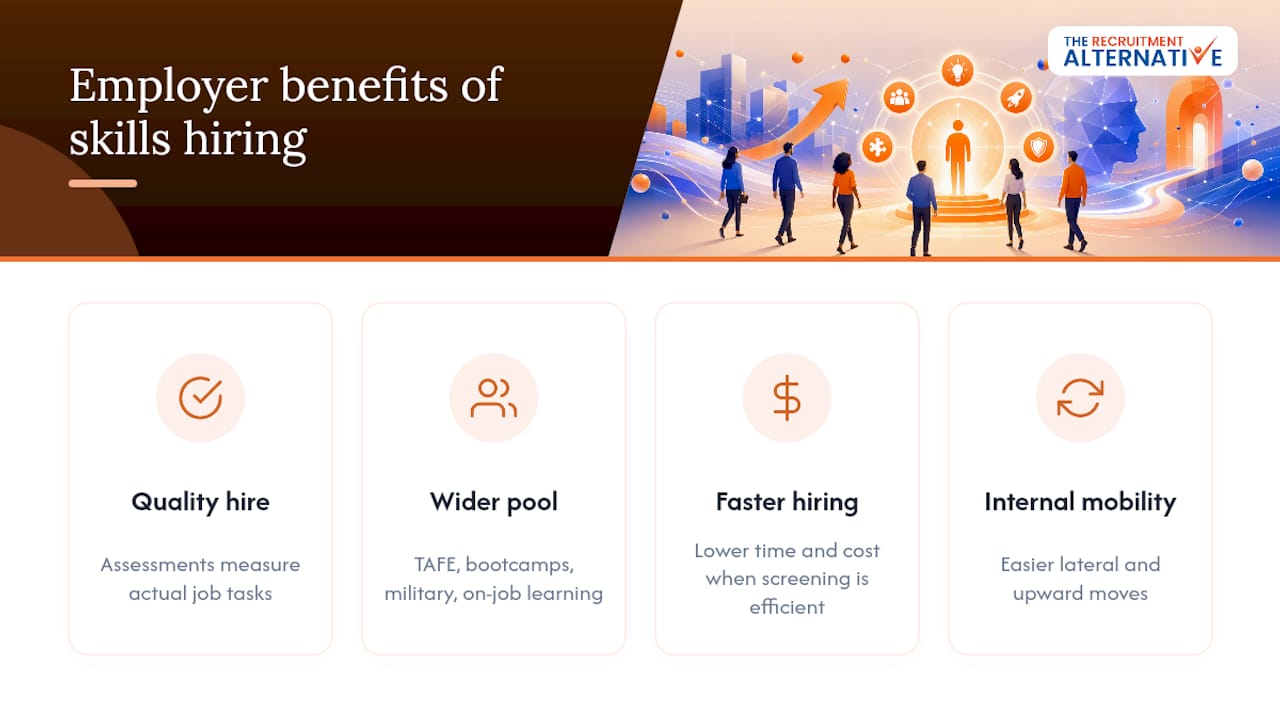
Quality of hire improves because assessments measure the actual task, not a credential correlated with it. Structured interviews and work samples predict on-the-job performance more reliably than a resume screen built around job titles.
The talent pool widens. Candidates who gained skills through TAFE, bootcamps, military service, or informal on-the-job learning become visible instead of filtered out at the application stage. This is also where a job competency framework earns its keep: it forces recruiters to articulate what “good” looks like, rather than defaulting to “five years in a similar role.”
Time-to-hire and cost can fall, but only when the assessment process is efficient. A poorly designed multi-stage skills test can actually slow hiring and frustrate candidates, so the fix is a tiered screening approach rather than adding every possible test.
Internal mobility strengthens. Once a business maps roles to skills rather than titles, it becomes far easier to identify existing staff who could move sideways or upward, which supports retention.
The evidence on durable skills backs this up directly: practitioners and workforce researchers increasingly flag communication, adaptability, and problem-solving as under-assessed but high-value traits, precisely because traditional screening rarely tests for them directly.
How do you actually implement skills-based hiring?
Treat this as a five-step build, not a one-off policy announcement. Skipping steps is exactly how the “degree drop, nothing changes” outcome happens.
-
Choose pilot roles carefully. Pick positions where the core tasks are observable, where you hire often enough to gather data quickly, and where a bad hire is costly enough to justify the setup effort. Sales, technical support, and administration roles are common starting points.
-
Run a proper job analysis. Break the role into its component tasks, then define the competencies behind each one with proficiency levels (novice, competent, expert). This is the step most employers skip, and it’s the one that determines whether the rest of the process is defensible. Competency-based hiring guidance from Headstart treats job analysis as the non-negotiable foundation for any structured assessment that follows.
-
Design validated assessments. Work samples, situational judgement tests (SJTs), and structured interviews with anchored rubrics are the three pillars worth building first. An SJT presents a realistic scenario and asks the candidate how they’d respond, which is particularly useful for roles heavy on judgement and stakeholder management. Structured interviews work best when every interviewer scores against the same anchored rubric rather than a gut-feel rating.
-
Build scorecards and calibrate decisions. A scorecard that weights each competency and forces a written rationale for the final call reduces the influence of unconscious bias and creates a paper trail if a decision is ever questioned. Run a calibration session with hiring managers before the pilot goes live so everyone is scoring against the same standard.
-
Connect the hire to onboarding. Skills-based hiring doesn’t stop at the offer. Whitney Martin’s guidance for SHRM stresses assessing a candidate’s ability and motivation to learn, not just what they can already do, which means onboarding should close whatever skill gaps the assessment flagged rather than assuming a perfect match on day one.
A structured, multi-hurdle screening approach helps manage candidate volume here: a short, low-burden screen filters the initial pool, and only shortlisted candidates go through the heavier work-sample or SJT stage. This keeps the process rigorous without exhausting every applicant.
Sourcing is worth a separate mention. Employers who look only within their own industry for “years of experience” candidates miss people from adjacent sectors whose skills transfer directly. A logistics coordinator and a hospital ward scheduler solve remarkably similar problems.
What goes wrong, and how do you fix it?
Most failed rollouts share the same root cause: the change is treated as a wording tweak on a job ad, not a genuine systems change. Practitioner analysis from Recruiting Future points squarely at mindset as the biggest barrier, ahead of any technology or tooling gap.
- Mindset resistance. Hiring managers who’ve relied on degree filters for twenty years won’t drop them because HR sent a memo. Bring them into the job definition and assessment design from day one, not after the process is built.
- Weak assessment quality. A test that isn’t validated against actual job performance is just a different kind of proxy. Pilot it, track outcomes, and adjust before scaling.
- Excessive candidate burden. Five assessment stages for an entry-level role will cost you good candidates who simply drop out. Match assessment depth to role seniority and risk.
- No calibration. Without a shared rubric, two interviewers scoring the same candidate can land on opposite conclusions. Run calibration sessions and document the reasoning behind every hire decision.
Avoiding common recruitment mistakes at this stage saves far more time than fixing them after a bad hire is already three months in.
How do you measure whether it’s working?
Skills-based hiring needs the same rigour applied to outcomes as it does to the assessment itself. Set a baseline before the pilot starts, using your last several hires made the traditional way, so you have something real to compare against.
| Metric | What it tells you | How to track it |
|---|---|---|
| Quality of hire | Manager rating and performance review scores at 12 months | Standardised manager scorecard, compared to baseline hires |
| Time to competency | How long a new hire takes to reach expected performance | Manager sign-off against role proficiency levels |
| Retention | Whether skills-matched hires stay longer | 12-month retention rate versus prior cohort |
| Diversity of hires | Whether the pool widened as intended | Applicant and hire demographic tracking |
| Cost per hire | Whether efficiency gains offset assessment build cost | Total recruitment spend divided by hires |
Feed post-hire performance data back into the assessment itself. If your work-sample test isn’t correlating with actual 12-month performance, the test needs revision, not the hiring philosophy. That evidence loop, drawn from the SHRM framework of assessing both current skill and learning capacity, is what separates a durable skills-first approach from a one-off experiment that quietly reverts to old habits within a year.
Where does a recruitment partner fit in?
Building validated assessments, calibrated scorecards, and adjacent-sector sourcing pipelines takes real hours that most internal HR teams don’t have spare, which is why many benefit from The Australian-only recruitment pipeline expertise. This is where an experienced recruitment partner earns its place, without HR handing over ownership of the decision.
A fixed-fee recruitment partner can:
- Source candidates from adjacent industries whose transferable skills a job-title-only search would miss
- Run validated shortlists using structured interviews and work-sample style screening, reducing the burden on internal hiring managers
- Offer a replacement guarantee if a placed candidate doesn’t work out in the first two to three months, sharing some of the hiring risk
The key is retaining ownership of the competency framework and decision rubric internally, even when a partner runs the sourcing and initial screening. That way the hiring decision stays defensible and the skills data keeps feeding back into your own process, not just the agency’s.
When should HR leaders prioritise this?
Start with roles that combine high turnover, chronic hard-to-fill status, and a clear productivity link. Those three factors together justify the setup cost of proper job analysis and validated assessment faster than any other role type.
Candidate experience still matters. Push assessment rigour too far on high-volume roles and you’ll lose good applicants to shorter processes elsewhere. Pilot one role, prove the model with real data, then scale it deliberately.
— Josh Townsend
How The Recruitment Alternative helps you put this into practice
Building a skills-first hiring process from scratch takes time most business owners don’t have spare between running the operation and filling the role. The Recruitment Alternative gives you a shortcut to that outcome: instead of a traditional agency charging a percentage of salary, our transparent fixed-fee recruitment model means you know your cost upfront, whatever the candidate’s skill level or salary band.
Candidates can be sourced across sales, administration, finance, engineering, healthcare, trades, and technology, focusing on demonstrated ability rather than a narrow credential checklist. If a placement doesn’t work out in the first two to three months, our replacement campaign reduces the downside risk of trying a skills-first hire for the first time. Engaging an agency makes the most sense when you need a validated shortlist fast, without building assessment infrastructure in-house first.
Check our flat-fee pricing structure to see exactly what a fixed-fee placement costs before you commit, and get in touch to discuss your first skills-based pilot role.
Sources
For deeper detail on the concepts covered here, see the Burning Glass Institute report on the gap between policy and practice, SHRM’s practitioner guidance on assessment design, Recruiting Future’s implementation interviews, and the HeadStart.gov primer on competency-based hiring fundamentals.
- Skills-Based Hiring: The Long Road from Pronouncements to Practice — Burning Glass Institute
- Skills‑Based Hiring: Building Stronger Teams — SHRM
- Skills-Based Hiring: An independent guide — Recruiting Future
- Headstart
FAQ
What is a skills-based job?
A skills-based job is one where hiring decisions rest on demonstrated ability to perform specific tasks, verified through assessment, rather than on a degree, job title, or years of prior experience.
What are the top skills employers look for?
Employer priorities vary by role, but technical competence matched to the job, problem-solving, communication, adaptability, and increasingly AI fluency consistently rank among the most sought-after skills across industries.
How do I find a job based on my skills rather than my resume?
Look for employers explicitly advertising skills-based hiring or competency-based interviews, and prepare to demonstrate your ability through work samples or situational judgement exercises rather than relying on your job history alone.
What are the seven employability skills?
Definitions vary between frameworks, but common versions include communication, teamwork, problem-solving, initiative, planning and organising, self-management, and technology skills.
Does The Recruitment Alternative support skills-based hiring?
Yes. The Recruitment Alternative sources and shortlists candidates across sales, administration, finance, engineering, healthcare, trades, and technology on a fixed-fee basis, with a replacement guarantee if an early placement doesn’t work out.

